Vector DBs & RAG
Vector databases, embedding stores, retrieval-augmented generation (RAG) infrastructure, and AI-native search. The retrieval layer behind LLM apps.
Our editors' top Vector DBs & RAG picks for 2026 are Pinecone (best for Managed vector database for RAG), Weaviate (best for Open-source vector database), and Qdrant (best for High-performance open-source vectors). All 34 tools in this category are hand-reviewed and re-checked each edition — the full ranked directory is below.



Where to start

Pinecone
AI Infrastructure
Paid - Inquire
4.84
380
Weaviate
AI Infrastructure
Freemium
4.91
400

Qdrant
AI Infrastructure
Freemium
4.85
380

Glean
Productivity
Paid - Inquire
4.92
507

Redis
Vector DBs & RAG
Freemium
4.92
490

MongoDB Atlas Vector Search
Vector DBs & RAG
Freemium
4.85
320
Sorted by
Glean
Enterprise search & knowledge discovery solution for modern teams
Paid - Inquire
4.92
507
Redis
Redis is an in-memory data store used as a vector database, semantic cache and memory layer for AI and agent applications.
Freemium
4.92
490
Neo4j
Neo4j is a graph database that powers knowledge graphs and GraphRAG so AI apps can ground answers in connected, verifiable relationships.
Freemium
4.91
470

turbopuffer
Serverless vector and full-text search built on object storage — powers Cursor, Notion AI, Linear, Superhuman. 95% cost reduction vs traditional vector DBs.
Paid - Inquire
4.92
420
LlamaIndex
Document OCR for the agentic stack — LlamaParse turns complex docs into model-ready data.
Freemium
4.86
400
Cohere
Unlock powerful semantic search, content generation, and intent recognition with Cohere's advanced models.
Freemium
4.85
400
Weaviate
Open-source vector database for storing data objects and vector embeddings
Freemium
4.91
400
Qdrant
Open-source vector database and search engine.
Freemium
4.85
380
Pinecone
Pinecone: Transforming Vector Search for Enhanced Data Retrieval
Paid - Inquire
4.84
380

Exa
AI search API and engine that retrieves the best, real-time web data for AI apps.
Freemium
4.83
360

Zilliz
Vector database platform for enterprise-grade AI applications, powered by Milvus
Freemium
4.84
360
Elastic
Search AI platform pairing Elasticsearch retrieval with vector search for RAG, observability, and security.
Freemium
4.87
328
MongoDB Atlas Vector Search
MongoDB Atlas Vector Search adds semantic vector search to your database for RAG and AI agents.
Freemium
4.85
320
 Acquired
Tavily
Real-time web search, extract, and crawl APIs built specifically for AI agents and RAG.
Freemium
4.82
320
LanceDB
AI-native multimodal lakehouse and serverless vector DB — embedded retrieval for production-scale generative AI, open source, YC-backed.
Freemium
4.84
305
App Orchid
App Orchid is an enterprise semantic-layer platform that makes data AI-ready with knowledge graphs, enabling accurate natural-language querying.
Paid - Contact sales
4.85
288
FalkorDB
Low-latency graph database built for GraphRAG, agent memory, and multi-tenant knowledge graphs.
Freemium
4.84
254
Mixedbread
Multimodal search API with open-source embedding and reranking models for RAG and retrieval.
Freemium
4.84
247

Milvus
High-performance, cloud-native open-source vector database for scalable ANN search — built by Zilliz, Apache 2.0, the most-deployed OSS vector DB in production.
Freemium
4.81
243

TopK
AI-native search engine combining vector, keyword, and custom scoring in one API.
Freemium
4.84
241
Vald
Scalable distributed vector search engine
Free
4.76
240

Marqo
Multimodal vector search engine for unstructured data
Paid - Inquire
4.7
190

Onyx
Onyx (formerly Danswer) is the open-source AI chat and enterprise search platform connecting all your company knowledge into a unified AI assistant.
Freemium
4.78
182

Hebbia
AI for enterprise search and document processing.
Paid - Inquire
4.83
178

Firecrawl
Web scraping built for LLMs — turn any website into clean markdown or structured data with one API call.
Freemium
4.76
168

Chroma
AI-native open-source embedding database for efficient data handling.
Free
4.6
164
Vectara
Vectara is the trusted RAG-as-a-service platform with grounded generation and hallucination evaluation. Built by ex-Cloudera leadership; enterprise-ready.
Freemium
4.43
155

Dataworkz
Build, deploy, and optimize GenAI apps with RAG as a service.
Paid - Inquire
4.61
154
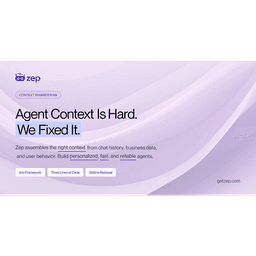
Zep
Zep is a memory platform for AI agents that builds temporal knowledge graphs from chat and business data so agents recall context that changes over time.
Freemium
4.45
145

Sinequa
Sinequa is the enterprise AI search platform with deep document understanding and RAG. Long-running incumbent; serves Fortune 500 and government agencies.
Paid - Paid
4.41
145

Reducto
Reducto is an agentic document-parsing platform that turns messy PDFs and scans into accurate, LLM-ready data for RAG pipelines and extraction.
Free Trial
4.49
140

SciPhi
AI platform for building, deploying, and scaling Retrieval-Augmented Generation (RAG) systems.
Paid - Inquire
4.59
127

Vespa.ai
Open-source vector search engine for large-scale AI applications
Free
4.35
116

Deepset AI
Streamline LLM product lifecycle with deepset Cloud and Haystack.
Paid - Inquire
4.59
114
Vector DBs & RAG AI, answered
What is a vector database?
A vector database stores embeddings, the numerical representations of text, images, or audio, and finds the most similar ones to a query. This semantic search powers retrieval-augmented generation, recommendations, and deduplication. Pinecone, Weaviate, and Qdrant are built for it, while Redis and MongoDB add vector search to existing stores.
What is RAG (retrieval-augmented generation)?
RAG is a pattern where a model retrieves relevant documents before answering, instead of relying only on its training. The application embeds a query, searches a vector database for matching context, and feeds that context to the model. This grounds answers in your data and reduces hallucination.
Which vector database should I use?
Pick a managed service like Pinecone for speed to production with no operations, and open-source options like Weaviate or Qdrant when you want control or self-hosting. If you already run Redis or MongoDB, their built-in vector search avoids adding a system. Decide by scale, latency targets, and how much you want to operate yourself.
Do I need a vector database for RAG?
Not always. For small document sets, in-memory search or a library can be enough, but a vector database becomes important as data grows, latency matters, or you need filtering and updates at scale. Redis suits in-memory use, while Pinecone, Weaviate, and Qdrant handle larger production workloads.
What is the difference between a vector database and a regular database?
A regular database finds exact matches on structured fields, while a vector database finds nearest neighbors by meaning using embeddings. One answers where status equals open, the other answers what is most similar to this. MongoDB and Redis now offer both, but dedicated vector databases optimize specifically for similarity search.
What is enterprise RAG search?
Enterprise RAG search connects a model to a company's internal documents and apps so employees get grounded, permission-aware answers. Glean indexes content across tools and applies access controls, so results respect who can see what. It applies the RAG pattern to organizational knowledge rather than a single dataset.
Collections featuring these tools



Sign up for our newsletter
Receive weekly updates so you can stay up-to-date with the world of AI
Sign up for our newsletter
Receive weekly updates so you can stay up-to-date with the world of AI
The AI tools directory for discovering, exploring, and comparing the most innovative AI tools in the industry