FalkorDB
Low-latency graph database built for GraphRAG, agent memory, and multi-tenant knowledge graphs.
Overview
FalkorDB: a graph database tuned for AI retrieval
Vector-only RAG retrieves fragments that look similar to a query, but it cannot answer questions that depend on how facts connect. FalkorDB is a graph database built for exactly that gap: it stores knowledge as nodes and relationships, queryable with the Cypher language, and serves as the structured-context layer for GraphRAG pipelines and agent memory. Its engine represents graphs as sparse matrices and runs queries as linear-algebra operations, which is where its latency numbers come from.
Created by the team behind RedisGraph, FalkorDB runs as a Redis module, ships as open source, and is also offered as a managed cloud with a free tier. Multi-tenancy is a first-class design goal: a single instance can serve more than 10,000 isolated graphs, which matters when every customer or every agent needs its own knowledge graph.
Key Features
- Property-graph model with Cypher queries, so existing graph skills and tooling carry over
- Sparse-matrix, linear-algebra query engine; published benchmarks show 36ms p50 latency versus 469ms for comparable graph workloads
- Multi-tenant architecture supporting 10,000+ isolated graphs on one deployment
- GraphRAG SDK with ontology auto-detection and integrations for popular LLM frameworks
- Combined graph and vector search in a single engine for hybrid retrieval
- Deploy anywhere: open-source Docker image, on-prem, or FalkorDB Cloud with TLS, VPC peering, and graph-level access control
Ideal Use Case
FalkorDB suits teams building GraphRAG systems that must answer relationship-heavy questions — org charts, supply chains, fraud rings, codebases — and SaaS builders who need a separate knowledge graph per customer or per agent without running a cluster per tenant.
How FalkorDB differentiates
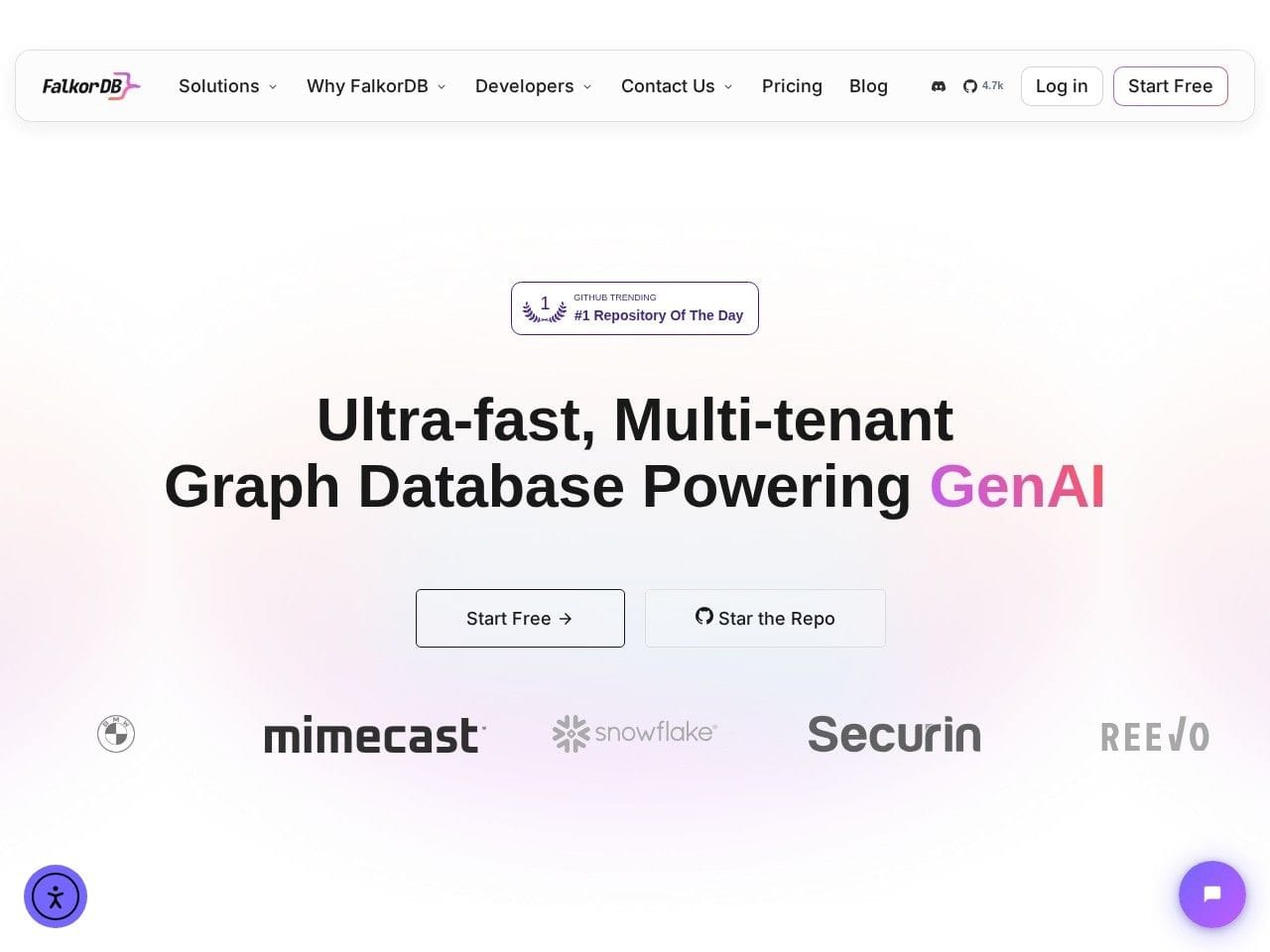
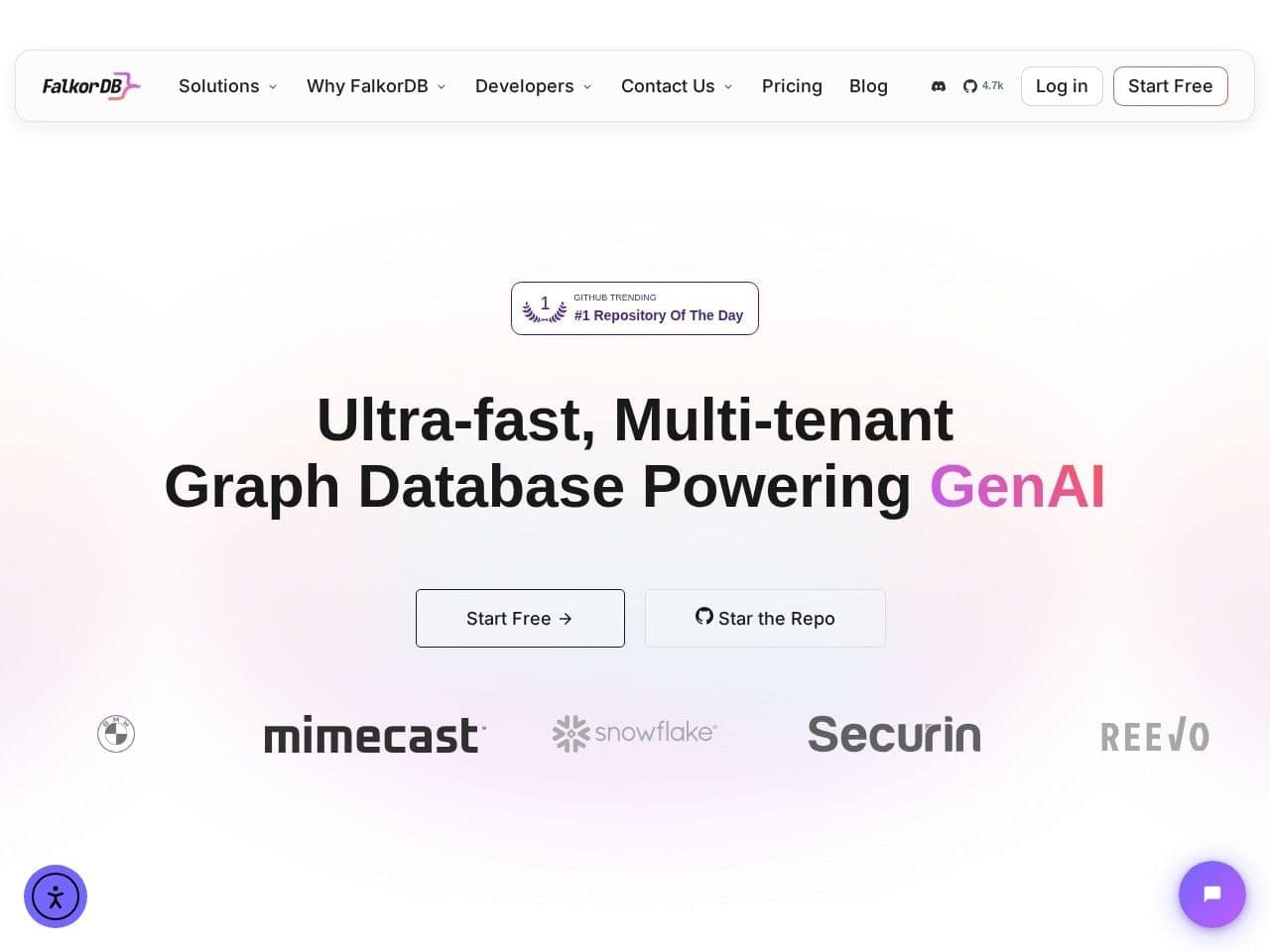
Against Neo4j and other incumbents, FalkorDB competes on latency, memory footprint, and multi-tenant density rather than ecosystem breadth, and publishes head-to-head benchmarks against Neo4j, AWS Neptune, TigerGraph, and ArangoDB. The open-source repository has around 4,700 GitHub stars, and the company lists BMW, Mimecast, Snowflake, and Securin among organizations using it.
FAQ
Is FalkorDB open source? Yes. The database is open source and can be self-hosted; FalkorDB Cloud is the managed option with a free tier and paid plans.
Does FalkorDB support Cypher? Yes. FalkorDB uses the Cypher property-graph query language, which eases migration from Neo4j and other Cypher-compatible databases.
What makes it fast? Graphs are stored as sparse adjacency matrices and queries execute as linear-algebra operations, yielding low tail latency even under multi-tenant load.
Can I use FalkorDB for agent memory? Yes. Its multi-tenant design lets each agent or customer own an isolated graph, and the GraphRAG SDK handles ontology detection and LLM integration.
tl;dr
FalkorDB is a low-latency, multi-tenant graph database from the RedisGraph team, built to ground LLMs with knowledge graphs — open source, Cypher-compatible, with a managed cloud free tier.
Why Use FalkorDB
User Reviews
Similar Tools