Weaviate
Open-source vector database for storing data objects and vector embeddings
Overview
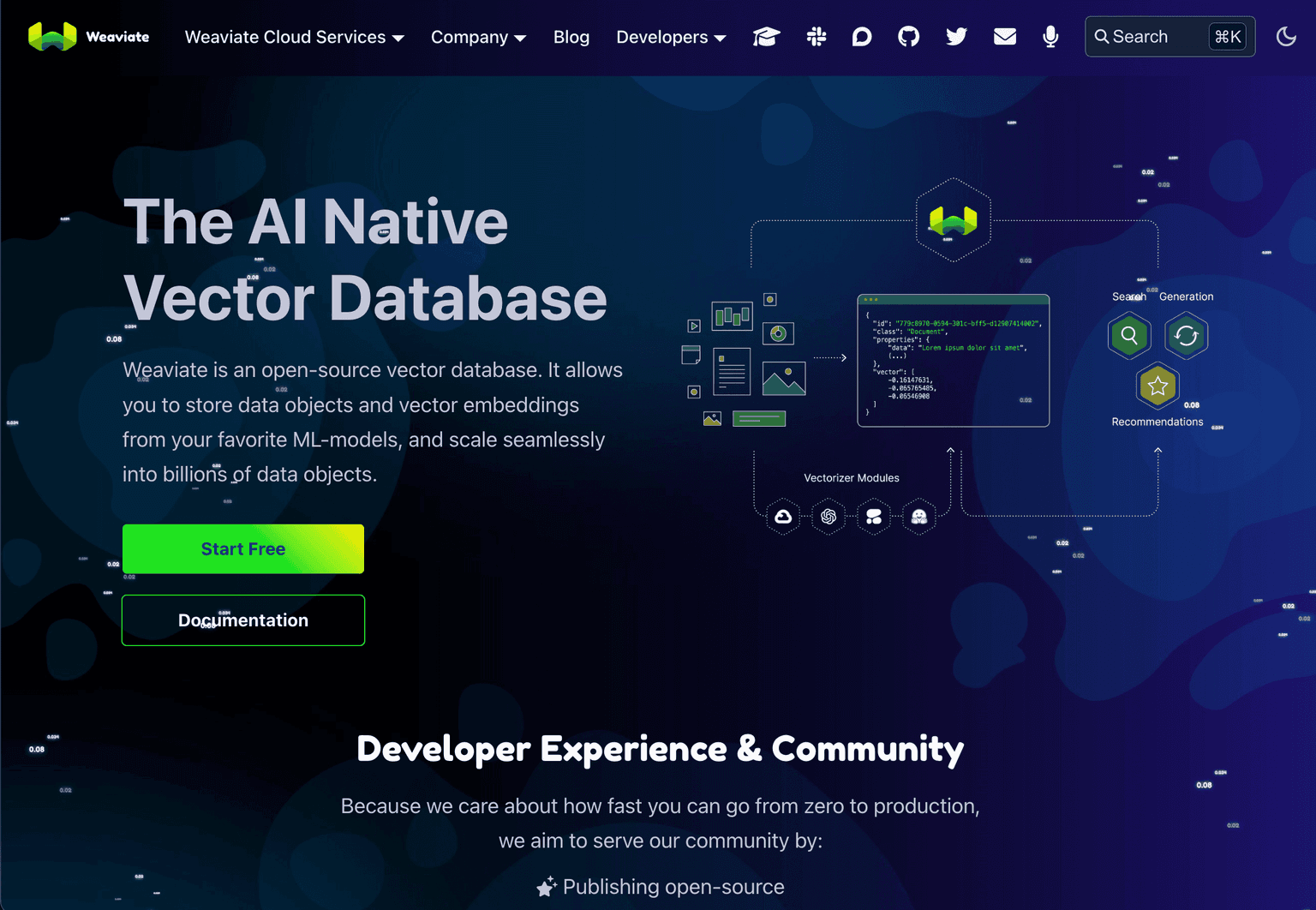
The AI Native Vector Database
Weaviate is an open-source vector database that allows users to store data objects and vector embeddings from their favorite machine learning models. It is designed to scale seamlessly into billions of data objects. Weaviate uses generative AI to effortlessly generate custom apps and websites, unlocking endless possibilities for users and transforming the way we create, connect, and impact our world. The platform offers a wide range of tools and features, including vector search, hybrid search, and generative search, to help users create next-gen search experiences.
Key Features:
- AI-Powered App Generation: Weaviate uses generative AI to effortlessly create custom apps and websites based on user input.
- Vector Search: Perform lightning-fast pure vector similarity search over raw vectors or data objects, even with filters.
- Hybrid Search: Combine keyword-based search with vector search techniques for state-of-the-art results.
- Generative Search: Use any generative model in combination with your data, for example, to do Q&A over your dataset.
Ideal Use Case:
Weaviate is ideal for developers, data scientists, and businesses looking to store and manage large volumes of data objects and vector embeddings from machine learning models. It is also suitable for users who want to create custom apps and websites using generative AI.
Why use Weaviate:
- AI-Powered Data: Weaviate uses generative AI to create custom apps and websites, offering a unique and powerful approach to app creation.
- Vector Database: Store and manage data objects and vector embeddings from machine learning models.
- Scalability: Weaviate is designed to scale seamlessly into billions of data objects.
- Next-Gen Search Experiences: Create next-gen search experiences with vector search, hybrid search, and generative search.
FAQ
What is Weaviate and what does it do? Weaviate is an open-source vector database designed to store data objects alongside their vector embeddings, making it useful for AI applications that need to search and retrieve information based on meaning rather than exact matches.
Who should use Weaviate? Weaviate is built for developers and organizations working with AI models who need a specialized database to manage vector embeddings and semantic search capabilities within their applications.
What is Weaviate's pricing model? Weaviate operates on a freemium model, allowing you to start for free and upgrade as your needs grow. Visit the Weaviate pricing page for current plans and details on paid tiers.
How does Weaviate compare to similar vector database tools? Weaviate is an open-source option in the vector database space, offering an alternative to other AI infrastructure solutions like those in the RAG and vector database category, with the flexibility of self-hosting or managed deployment options.
tl;dr:
Weaviate is an open-source vector database that allows users to store data objects and vector embeddings from their favorite machine learning models. The platform uses generative AI to create custom apps and websites and offers a wide range of tools and features to help users create next-gen search experiences. Weaviate is ideal for developers, data scientists, and businesses looking to store and manage large volumes of data objects and vector embeddings.
Related
Looking for more options? Browse the AI Infrastructure directory or read our best AI infrastructure tools listicle. Weaviate is also tracked on Crunchbase.
Why Use Weaviate
Editorial Review
Our take on Weaviate.

Weaviate is an open-source vector database designed to store and query data objects alongside their embeddings for retrieval-augmented generation.
What works
- Open-source with self-host and managed options
- Stores objects and embeddings together; simplifies RAG pipelines
- High community satisfaction; active development
What doesn't
- Self-hosting adds operational overhead and maintenance
- Steep learning curve for query syntax and optimization
Weaviate handles the infrastructure problem of scaling vector search: you store both raw data and embeddings in one place, then query them together. This matters because RAG systems need fast, accurate retrieval of context, and keeping vectors separate from source documents creates friction. As a freemium open-source tool, Weaviate lets you self-host on your own infrastructure or use their managed cloud offering—useful if you want to avoid vendor lock-in or need to keep data on-premise.
The trade-off is typical for infrastructure: you're buying operational complexity. Self-hosting means managing your own instance, backups, and scaling; the managed tier removes that burden but requires trust in their platform. It competes directly with Qdrant, Pinecone, and Turbopuffer—all solving the same problem with different deployment models and feature sets.
Weaviate works well if you're building a RAG pipeline that needs both semantic search and metadata filtering, or if you want to avoid per-query pricing. The rough edges are learning the query language and debugging vector quality issues, which aren't unique to Weaviate but matter in practice.
User Reviews
Similar Tools