Neo4j
Neo4j is a graph database that powers knowledge graphs and GraphRAG so AI apps can ground answers in connected, verifiable relationships.
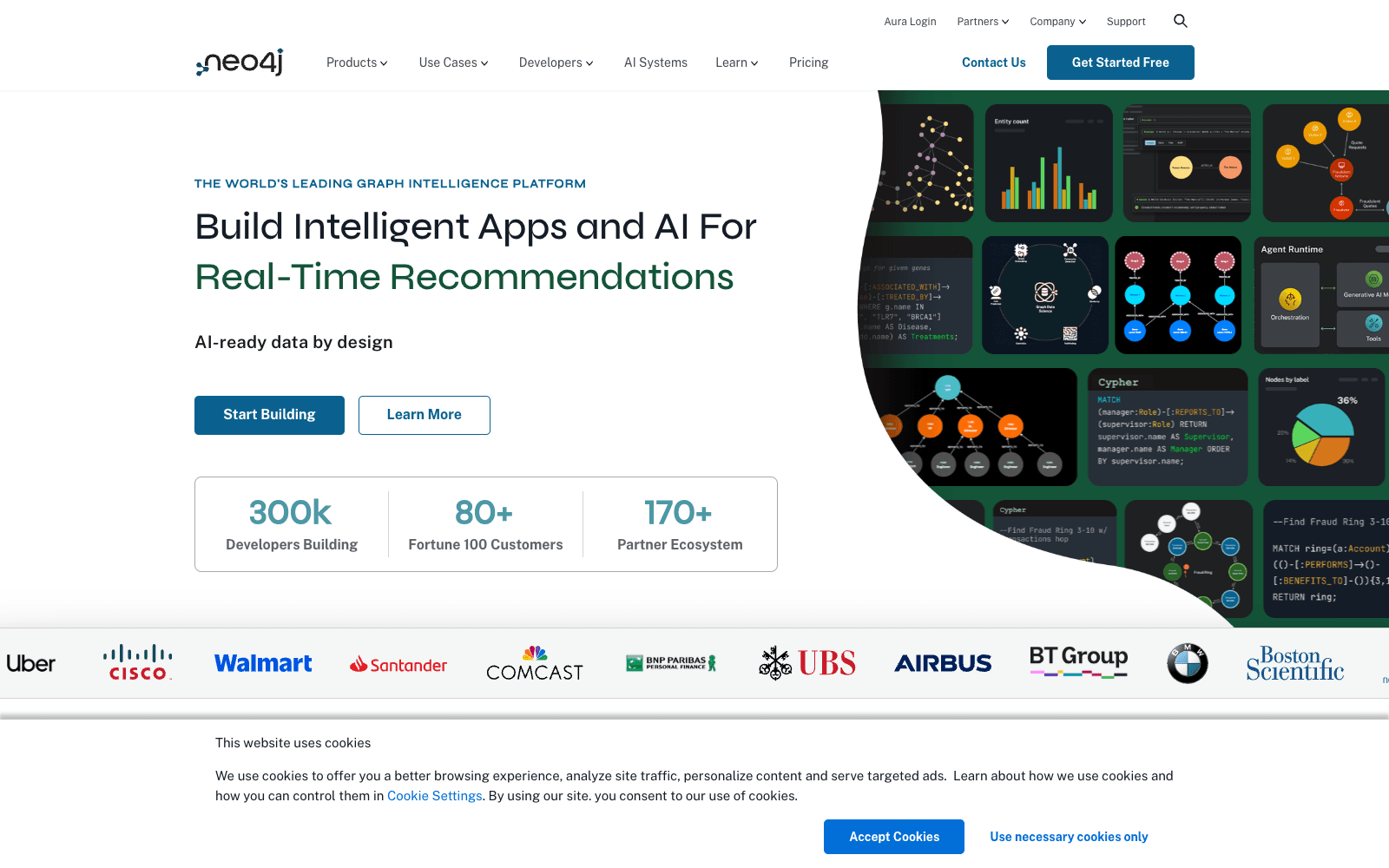
Overview
Neo4j
Neo4j is an open-source graph database that stores data as nodes and relationships instead of rows and tables. Founded in 2007, Neo4j has become central to GraphRAG, where AI applications query a knowledge graph to ground large language model answers in connected, verifiable facts. With native vector search built into the core database, Neo4j lets teams combine semantic similarity with graph traversal in one query. It is infrastructure rather than an AI product, but it underpins retrieval pipelines, agent memory and fraud-detection systems where the relationships between entities carry the meaning that flat vector stores miss.
Production credibility: Founded 2007 in Malmo, Sweden by Emil Eifrem, Johan Svensson and Peter Neubauer; headquartered in San Mateo, CA. Raised approximately $581M total, including a $325M Series F in 2021 (the largest in database history) led by Eurazeo with GV, plus a reported ~$50M follow-on in 2024 from Noteus Partners; valuation reportedly above $2B. Surpassed $200M ARR (Nov 2024), roughly doubling over three years. Used by 84% of the Fortune 100 and named customers including NASA, UBS, Walmart, Klarna, IBM, Merck, EY, Daimler and Dun & Bradstreet. Leads the graph DBMS category.
Key Features
- Native vector indexes for storing and querying embeddings alongside graph data
- Cypher query language for multi-hop traversal of nodes and relationships
- GraphRAG patterns that ground LLM answers in a knowledge graph to cut hallucination
- Graph Data Science library with 65+ algorithms for centrality, similarity and pathfinding
- AuraDB fully managed cloud service across AWS, Azure and Google Cloud
- LLM Knowledge Graph Builder to construct graphs from unstructured documents
- Integrations with LangChain, LlamaIndex and major hyperscaler AI stacks
- ACID transactions and role-based access control for production workloads
Ideal Use Case
Teams use Neo4j to build GraphRAG pipelines and knowledge graphs that give AI agents connected, explainable context, and to power fraud detection, recommendations and network analysis where relationships between entities drive the answer.
How Neo4j differentiates
For RAG, Neo4j competes with vector-only stores like Pinecone and pgvector, but solves a different half of the problem. Pinecone and pgvector return chunks ranked by embedding similarity; Neo4j returns answers grounded in explicit relationships between entities, which is what GraphRAG exploits to reduce hallucination on multi-hop questions. The trade-off is modeling cost: you design a graph schema and write Cypher, where a pure vector store is closer to drop-in. Neo4j now ships native vector indexes, so many teams use it for both similarity and traversal instead of running a separate vector database. It is heavier to operate than pgvector inside an existing Postgres instance.
FAQ
Q: What is Neo4j used for? A: Neo4j is a graph database for storing and querying highly connected data. Common uses include knowledge graphs, GraphRAG for AI apps, fraud detection, recommendations, identity and network analysis.
Q: How is Neo4j used for AI and GraphRAG? A: In GraphRAG, an LLM retrieves facts from a Neo4j knowledge graph rather than only similarity-matched text chunks. Native vector search lets one query combine semantic similarity with graph traversal, grounding answers in explicit relationships and reducing hallucination on multi-hop questions.
Q: Neo4j vs Pinecone: which should I use for RAG? A: Pinecone is a managed vector database optimized for similarity search and easy to drop in. Neo4j adds relationships and traversal, which GraphRAG uses for multi-hop reasoning, and now includes native vector indexes. Many teams use Neo4j when entity relationships matter and Pinecone for pure similarity at large scale.
Q: Who founded Neo4j? A: Neo4j was founded in 2007 by Emil Eifrem, Johan Svensson and Peter Neubauer, originally in Sweden. Emil Eifrem is the long-time CEO.
Q: How much has Neo4j raised? A: Neo4j has raised approximately $581M, including a $325M Series F in 2021 led by Eurazeo with GV, and a reported ~$50M follow-on in 2024. Its valuation is reported to be above $2B.
tl;dr
Neo4j is the leading graph database and a core building block for GraphRAG and AI knowledge graphs. With native vector search plus relationship-based traversal, it grounds LLM answers in connected facts. It is infrastructure, not an AI product, but it is widely used in production AI retrieval stacks.
Why Use Neo4j
Editorial Review
Our take on Neo4j.

Neo4j is a graph database built for knowledge graphs and GraphRAG, letting AI apps ground answers in connected relationships instead of flat embeddings.
What works
- Native graph relationships for AI-grounded reasoning, not vectors alone
- Freemium tier + vector support for hybrid semantic + relational search
- High community rating signals strong product reliability and fit
What doesn't
- Graph modeling and Cypher queries have learning curve vs. flat vector DBs
- Overkill for simple document retrieval or similarity-only workloads
Neo4j handles structured relationships natively—entities, properties, edges all modeled as a graph rather than vectors alone. This matters for RAG because a knowledge graph can express "Company X acquired Company Y in 2020" as a traversable relationship, not just a similarity score. When your LLM needs to verify facts or chain reasoning across connected data, graph traversal often beats vector search alone. Neo4j supports both: you can store vectors on nodes and edges, then combine semantic search with graph constraints.
The freemium model gets you started with a managed instance; paid tiers add enterprise features and scale. That said, graph databases have a learning curve—Cypher queries and graph modeling upfront cost against the payoff of cleaner, more verifiable answers for knowledge-heavy AI workloads.
If your RAG pipeline is mostly "find similar documents and summarize," a vector DB is simpler. If you need to encode company hierarchies, event timelines, or interconnected entities that your LLM should reason about explicitly, Neo4j removes friction. Not a universal swap for Redis or LanceDB—more a tool for a specific class of problem where relationships matter as much as semantics.
User Reviews
Similar Tools