Vespa.ai
Open-source vector search engine for large-scale AI applications
Overview
Vespa: The Open-Source Vector Search Engine Powering AI at Scale
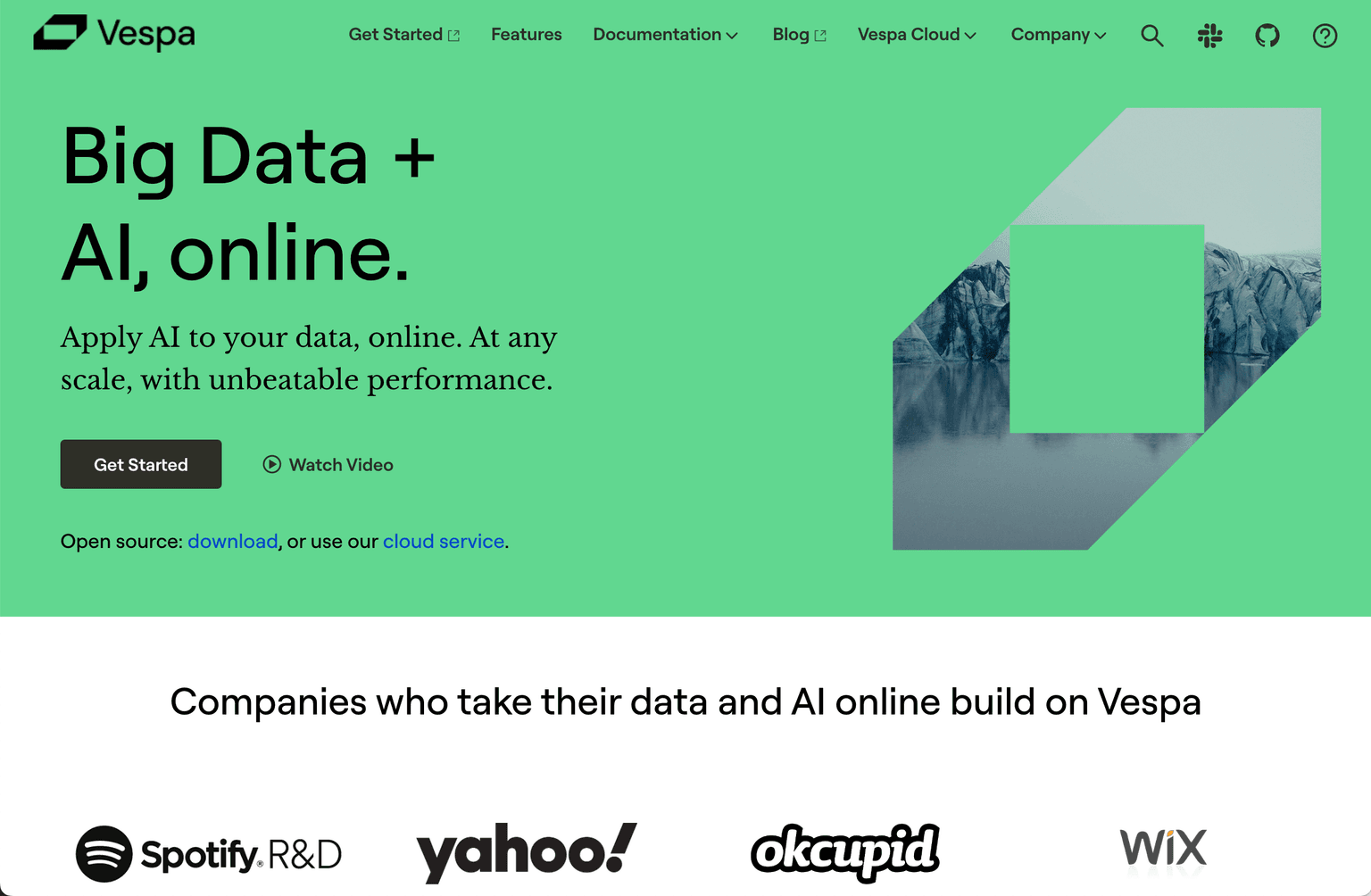
Vespa is an open-source vector search engine designed to apply AI to data at any scale, with unbeatable performance. It's a fully featured search engine and vector database, supporting vector search (ANN), lexical search, and search in structured data, all in one query. Integrated machine-learned model inference allows real-time AI application to make sense of data. Vespa's scalability and high availability empower the creation of production-ready search applications at any scale.
Key Features:
- Multimodal Search Capabilities: Combines vector, text, and structured data search.
- Machine Learning Support: Engineered for scalable machine-learned model inference.
- Auto-Elastic Data Management: Automatic data distribution and redistribution.
- High-Performance Architecture: Scales to any data amount and traffic, optimized for hardware efficiency.
- Diverse Use Cases: Ideal for search, recommendation, conversational AI, and semi-structured navigation.
- Community and Support: Active development community and comprehensive documentation.
Ideal Use Case:
Vespa is perfect for data scientists, AI researchers, and developers needing a robust, scalable solution for managing large volumes of vector data in AI and machine learning projects.
Why use Vespa:
- Versatile Data Analysis: Handles a wide range of data types and formats.
- Scalable and Efficient: Adapts to project sizes and requirements.
- Cutting-Edge AI Integration: Leverages the latest advancements in AI and machine learning.
- Open-Source Flexibility: Offers transparency and community-driven enhancements.
tl;dr:
Vespa is an advanced open-source vector search engine that provides a powerful and scalable solution for AI and machine learning applications, enhancing data management and search capabilities.
FAQ
Q: What is Vespa.ai's purpose? A: Open-source vector search engine for large-scale AI applications.
Q: How much does Vespa.ai cost? A: Vespa.ai is free to use. No credit card required.
Q: Who is Vespa.ai for? A: Typical Vespa.ai users include data analysts and BI teams.
Q: What can replace Vespa.ai? A: Top alternatives to Vespa.ai include Hex, Quantexa IQ, and Triple Whale. Explore alternatives in the same category for more options.
Related
Looking for more options? Browse the BI & Analytics directory or read our best AI analytics tools listicle. Vespa.ai is also tracked on Crunchbase.
Why Use Vespa.ai
Editorial Review
Our take on Vespa.ai.

The serious answer when your retrieval problem outgrows a vector database. Vespa does vector, lexical and structured search plus ranking inference in a single query at genuinely large scale — and it will make you earn it.
What works
- Vector, lexical, structured search and ranking in a single query
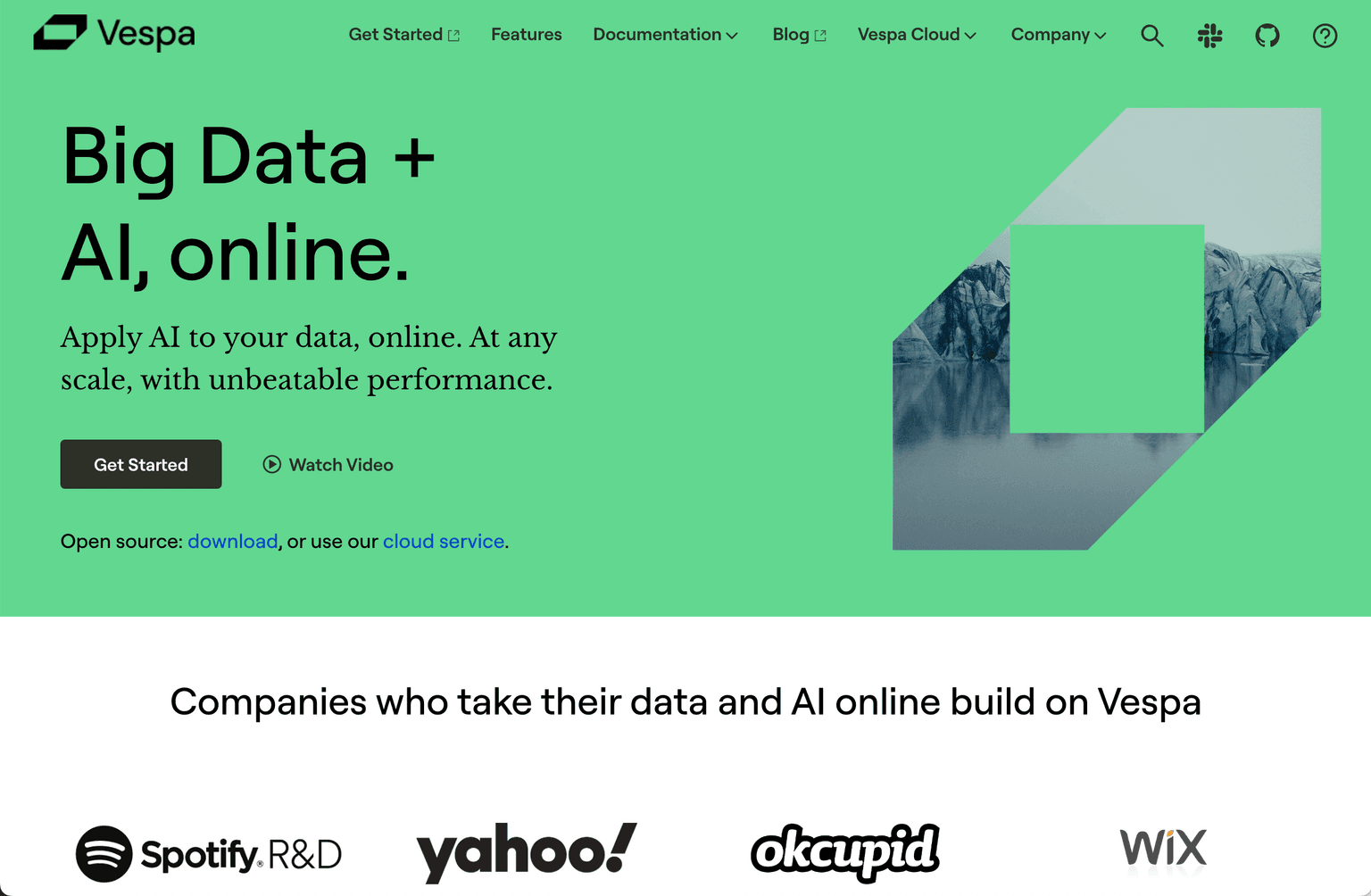
- Named production users include Spotify, Perplexity, Yahoo and Farfetch
- Managed Vespa Cloud available if you would rather not operate it
What doesn't
- Steep operational learning curve versus pgvector or a hosted API
- Overkill for corpora that still fit comfortably inside Postgres
Vespa is the engine that came out of Yahoo and spun into its own company in 2023, and the lineage shows in the design. Where most of this category gives you approximate nearest-neighbour search and leaves ranking to you, Vespa runs vector search, keyword search, structured filters and machine-learned ranking inside one query against one distributed index. For hybrid retrieval that genuinely needs to be hybrid, that architecture is the difference between running one system and gluing together three.
The production evidence is unusually strong for open-source infrastructure. Spotify, Perplexity, Yahoo, Vinted, Farfetch and OkCupid all appear as named users, and those are workloads with real latency budgets and real corpus sizes. Vespa Cloud exists if you would rather not operate it yourself, including a managed option on AWS.
The honest caveat is operational weight. This is a distributed system with its own deployment model, schema language and ranking configuration, and the learning curve is steep next to reaching for pgvector or a hosted vector API. If your corpus still fits comfortably in Postgres, Vespa is the wrong tool and the setup cost will feel absurd. If you are past that point — tens of millions of documents, hybrid ranking, tight latency — it is one of very few options that will hold.
User Reviews
Similar Tools