Best AI Data Visualization Tools (2026)









Best AI Data Visualization Tools in 2026
The AI data visualization tools that matter in 2026 look nothing like the chart-builders they replaced. The shift was less about new vendors and more about generative AI changing how analytics gets done — natural-language queries replaced SQL for most ad-hoc analysis, AI-generated charts replaced manual chart-builders for first-pass exploration, and predictive AI moved from a separate vertical into general-purpose BI platforms.
This guide covers the eight AI data visualization tools and AI analytics platforms that ship in production at real companies in 2026: Hex, Julius AI, ThoughtSpot, Databricks, Qlik, Pecan AI, Streamlit, and Akkio. Each is rated on what it does well, where the honest 2026 limitations sit, and which buyer it's the right fit for.
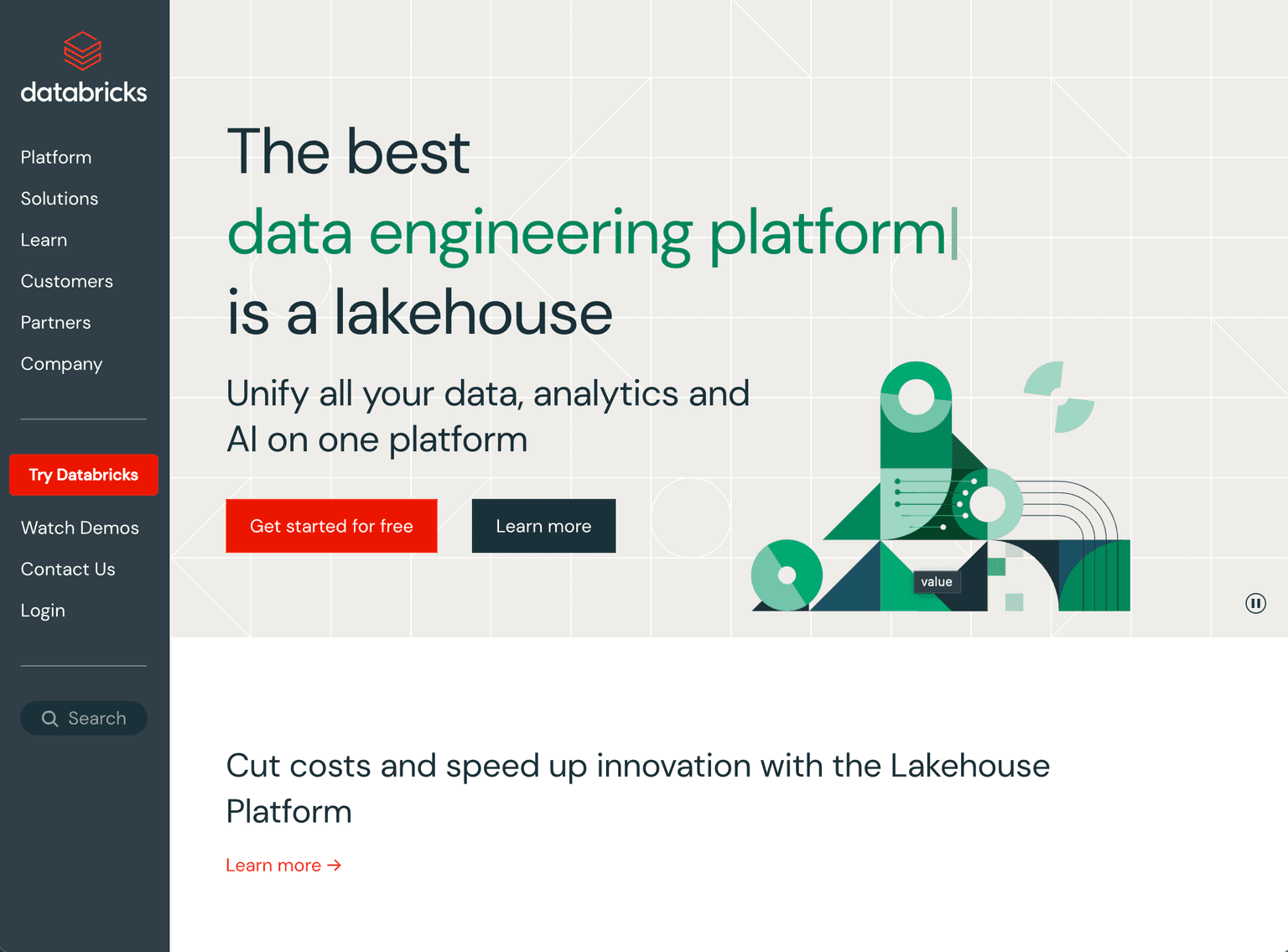
What changed since our last review (August 2026): the money moved decisively toward agentic analytics. Databricks signed a term sheet at a $188 billion valuation in July 2026 — a 40% jump from February — with the proceeds earmarked for Genie, Lakebase, and its Unity AI Gateway. ThoughtSpot replaced its Sage assistant with Spotter, shipped industry-tuned Spotter agents in March 2026, and was named a Leader in the July 2026 Gartner Magic Quadrant for Analytics and BI Platforms. Hex closed a $70M Series C (total raised $172M) with Snowflake Ventures participating, and is building AI agents into the workspace. The practical consequence for buyers: "does it answer questions" is now table stakes, and the live evaluation criterion is whether the tool can take a multi-step analytical task and run it end to end.
How We Evaluated These Tools
The tools below were evaluated on five criteria, in priority order:
- Real production deployments at named companies — not just demos or vendor case studies, but verifiable production usage at scale
- Honest output quality — does the AI produce analyses that pass review by an actual data team, or does it require constant correction
- Integration depth — does the tool connect to the data sources real organizations have (Snowflake, BigQuery, Postgres, Salesforce, etc.) without bespoke engineering
- Pricing transparency — published pricing or clear pricing tiers for buyers to evaluate procurement against
- 2026 currency — has the product shipped meaningful AI capability in the last 12 months, or is it AI-by-marketing-claim only
We did not include tools where AI is a sidebar feature on a non-AI-first product. Tableau, Power BI, and Looker all have AI features but the core platforms predate the AI era — for those, see the dedicated sections in our Best AI Tools for Marketing & SEO and Best AI Tools for Operations collections where they fit better.
The Three Lanes of AI Analytics in 2026
Most teams researching AI analytics are solving one of three problems. Mixing the lanes is the most common procurement mistake — a natural-language analytics tool isn't the same product as a predictive-analytics platform.
- Natural-language analytics: ask a question in English, get a chart. For analysts, executives, and business users who shouldn't have to write SQL. Leaders: ThoughtSpot, Julius AI.
- AI-native data workspaces: notebooks and apps that combine SQL, Python, AI assistance, and visualization in one collaborative environment. For data teams. Leaders: Hex, Databricks, Streamlit.
- Predictive and prescriptive analytics: forecasting, churn prediction, lead scoring, and decision automation. For business leaders making forward-looking decisions. Leaders: Pecan AI, Akkio, Qlik.
Most mid-to-large data teams in 2026 run one tool from each of the first two lanes (NL analytics for business users + AI-native workspace for the data team). Predictive analytics is added when the use case warrants it, not as a default.
Quick Comparison
| Tool | Best for |
|---|---|
| Hex | AI-native data workspace. Best for data teams wanting one environment for SQL, Python, AI, and visualization with strong collaboration features. |
| Julius AI | Accessible AI data analyst. Best for non-technical users who need analysis from a CSV without learning SQL or Python. |
| ThoughtSpot | Natural-language analytics for the enterprise. Best for organizations rolling out self-serve analytics across non-technical teams. |
| Databricks | Lakehouse + AI/BI. Best for enterprises with serious data engineering needs alongside analytics. |
| Qlik | Established BI with AI augmentation. Best for organizations already on Qlik that want to layer AI without platform replacement. |
| Pecan AI | Predictive analytics for go-to-market teams. Best for sales and marketing teams predicting churn, lead scoring, and campaign performance. |
| Streamlit | Python-based data apps. Best for data scientists shipping interactive analytics apps to stakeholders without learning frontend. |
| Akkio | No-code generative BI. Best for SMB and mid-market teams without dedicated data scientists. |
Natural-Language Analytics
The lane that matured fastest in 2024–2026. Pre-LLM "natural language query" tools were brittle and required strict schema training. Modern NL analytics tools (post-LLM) handle conversational ambiguity, follow-up questions, and the kinds of imprecise prompts non-technical users actually write.
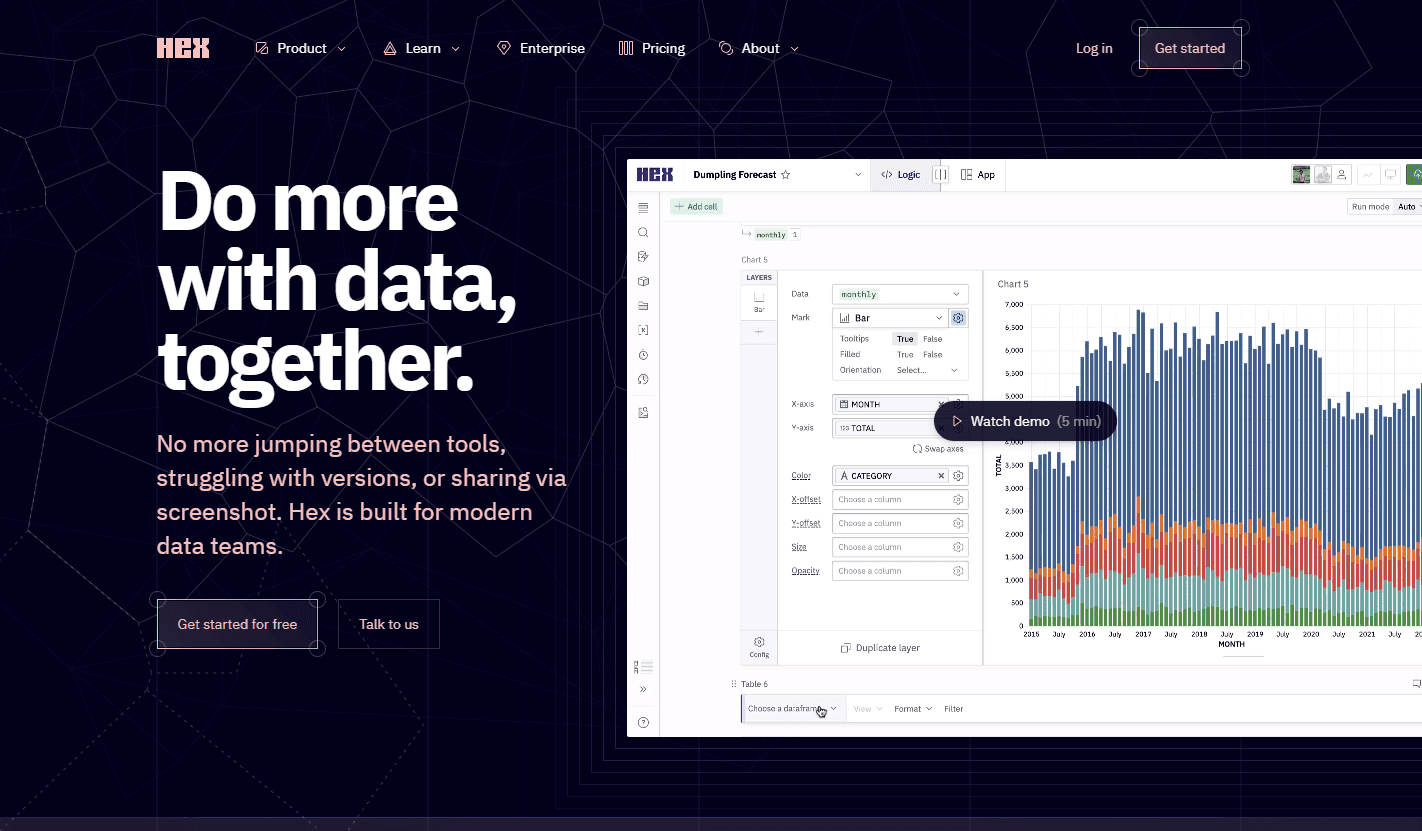
1. Hex — The AI-Native Data Workspace
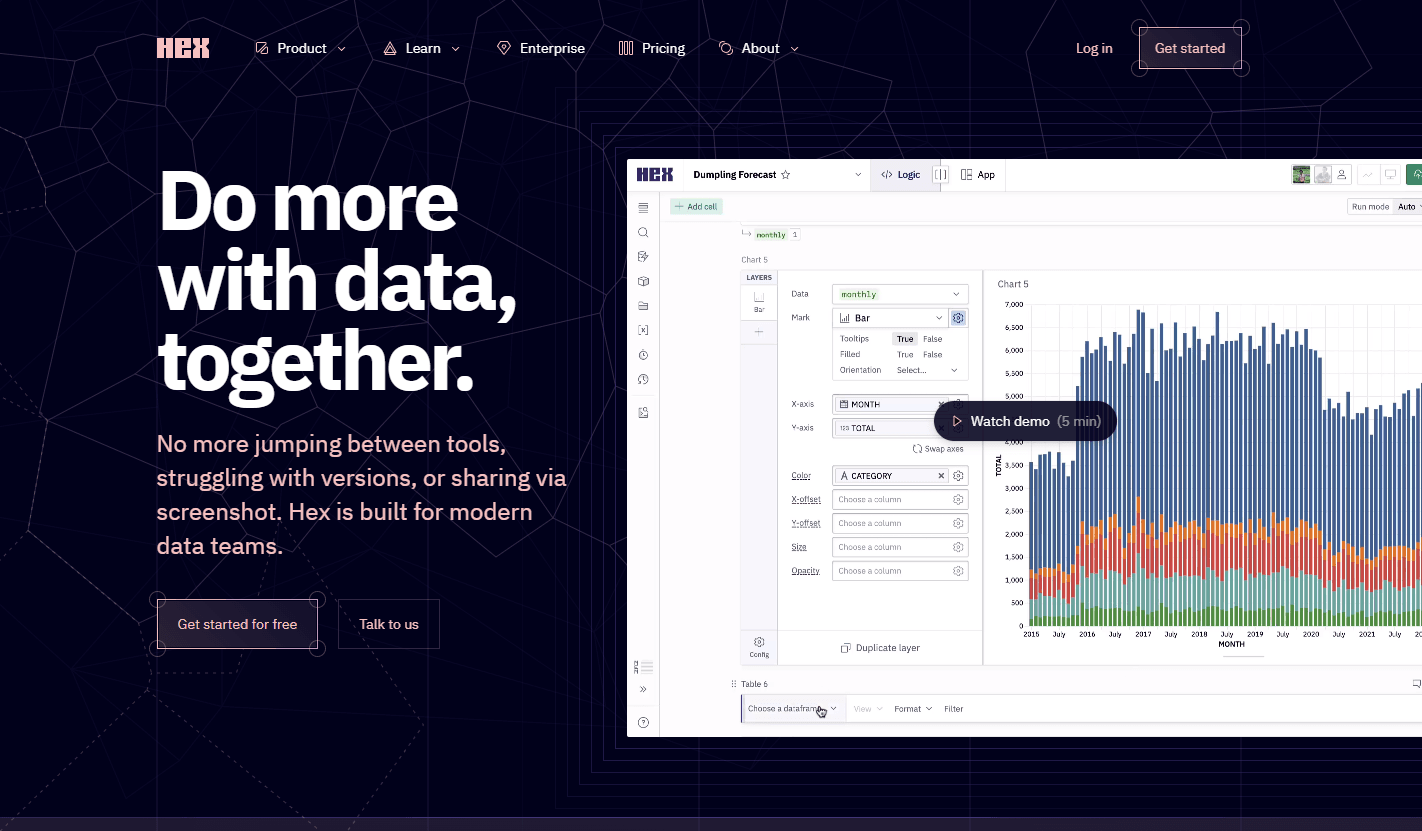
Hex is the data workspace that data teams switched to when Jupyter notebooks and Looker dashboards stopped being enough. The product combines SQL, Python, an AI assistant (Hex Magic), and Reveal-style presentation in one collaborative environment. The 2024–2025 AI capabilities — especially the Magic AI that translates English to SQL or Python with full context of the workspace's data — are the strongest in the category for data-team daily use.
Production credibility: raised a $70M Series C in 2025 led by Avra with Snowflake Ventures, Sequoia, a16z, Amplify and Redpoint participating, taking total funding to $172M. Deployed at Brex, ClickUp, Notion, Reddit, and dozens of other data-mature companies. Hex Magic ships to all paid tiers, and the Series C is explicitly funding AI agents inside the workspace.
What it wins at: data teams that need one environment across SQL, Python, AI, and shareable visualizations; the strongest AI assistance for technical analysts; collaborative workflows where multiple analysts contribute to the same notebook.
Where it falls down: for non-technical business users, Hex requires more data literacy than ThoughtSpot or Julius AI. Best for the data team itself; pair with one of those for the broader organization.
2. Julius AI — AI Data Analyst for Non-Technical Users

Julius AI targets the use case ChatGPT Code Interpreter pioneered: upload a CSV or connect a database, ask questions in plain English, get charts and analysis back. Julius extended that into a full analytical workflow with persistent projects, reusable workflows, multi-step analyses, and export to standard formats. As of 2026 the product has crossed 1M+ users primarily among finance, consulting, and operations professionals.
Production credibility: ranked among the top AI data tools by Product Hunt in 2024 and 2025; used widely in finance, consulting, and ops teams that work in spreadsheets daily.
What it wins at: non-technical users who need real analysis without learning SQL or Python, finance and consulting workflows that previously required junior analyst time, and a free tier that handles meaningful exploration.
Where it falls down: not a team collaboration platform — Julius is a single-user analytical tool. For data team workflows, Hex or Databricks fit better. Output quality on complex multi-step analyses occasionally requires human verification.
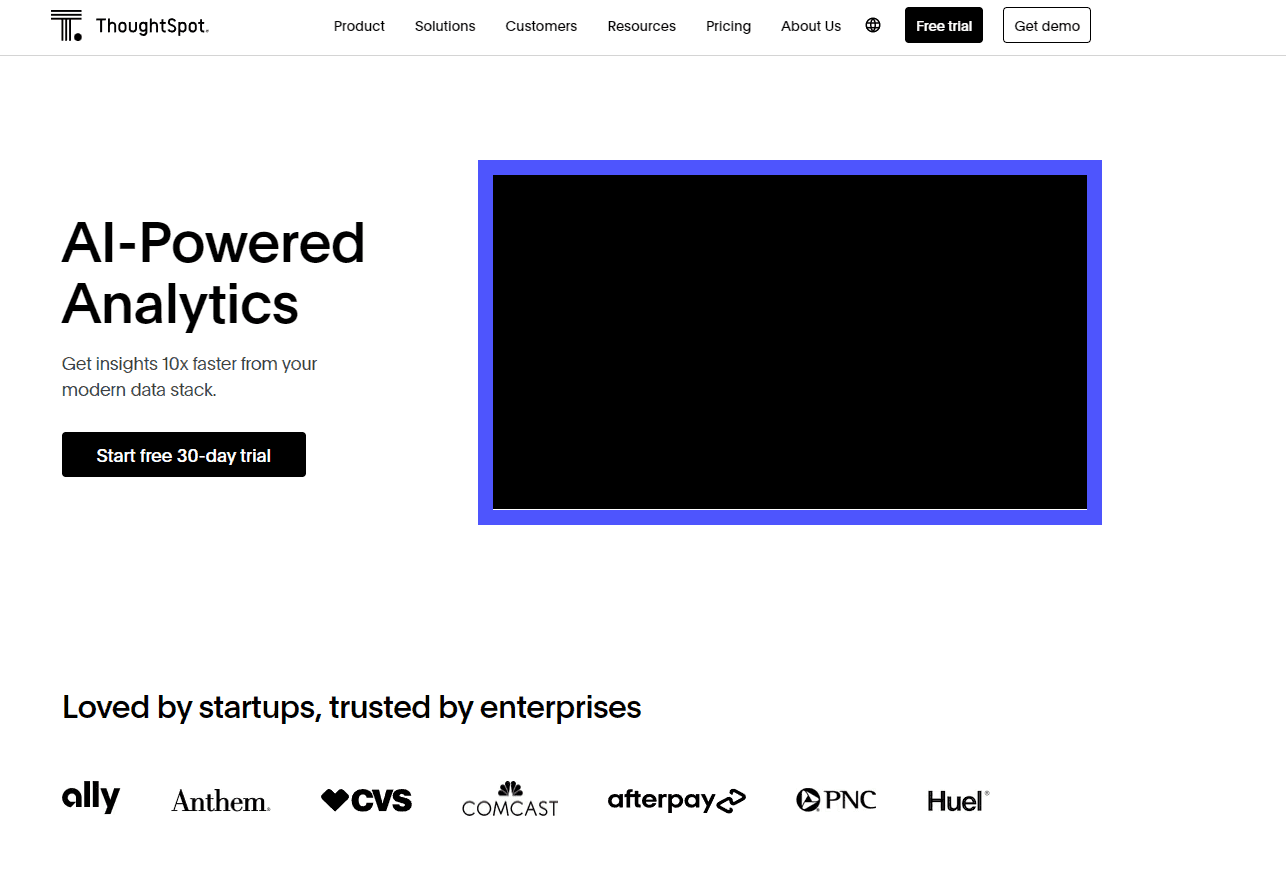
3. ThoughtSpot — Natural-Language Analytics for the Enterprise
ThoughtSpot was building natural-language analytics before the LLM wave and rebuilt the product around generative AI through 2023–2025. Spotter — which replaced the older Sage assistant — handles ambiguous business questions and translates them into SQL against the underlying data warehouse. In March 2026 ThoughtSpot shipped industry-tuned Spotter agents for specialised sectors, moving the product from "answers questions" to "runs the analytical task." Strong at the enterprise tier where the alternative is months of dashboard-building work for every new question.
Production credibility: $4B+ valuation per most-recent fundraise; named a Leader in the 2026 Gartner Magic Quadrant for Analytics and BI Platforms (July 2026), cited for its agentic-analytics vision. Deployed at Walmart, Snowflake, T-Mobile, BT Group, Hulu, and other Fortune 500 enterprises. Native integrations with Snowflake, Databricks, BigQuery, Redshift, and most major data warehouses.
What it wins at: enterprises rolling out self-serve analytics to non-technical users, organizations on modern cloud data warehouses (Snowflake, BigQuery, Databricks), and use cases where the alternative is dashboard-building backlog.
Where it falls down: enterprise pricing — ThoughtSpot is meaningfully more expensive than Julius or Akkio. Setup requires modeling work upfront (the AI needs to understand your business semantics) — typically 4–8 weeks before production rollout.
AI-Native Data Workspaces
For data teams. Combining SQL + Python + AI assistance + visualization + collaboration in one environment, vs the 2018–2022 stack of Jupyter + Looker + Slack.
4. Databricks — Lakehouse + AI/BI Genie
Databricks shipped AI/BI Genie as the generative AI layer on top of the Databricks lakehouse, joining the natural-language analytics conversation from a different starting point: data warehouse + ML platform with NL querying built in. For organizations already running Databricks for data engineering and ML, AI/BI Genie is the obvious analytics upgrade.
Production credibility: signed a term sheet in July 2026 for a ~$3B strategic round at a $188B valuation led by Coatue — a 40% step up from the $134B mark it hit in February — with the money aimed at Genie, the Lakebase agent database, and its Unity AI Gateway. Disclosed a $5.4B revenue run-rate in February 2026, up 65% year over year; deployed at 50% of the Fortune 500 per company disclosures. Databricks has the deepest integration story for organizations whose data, ETL, and ML workflows already run on the platform.
What it wins at: enterprises with serious data engineering needs alongside analytics, organizations standardizing on the lakehouse architecture, and unified ML + analytics workflows on the same data and access controls.
Where it falls down: for organizations not yet on Databricks, the platform commitment is significant — this is not a standalone analytics tool you bolt onto an existing stack lightly. Pricing complexity is real; budget time for procurement.
5. Streamlit — Python Data Apps for Data Scientists
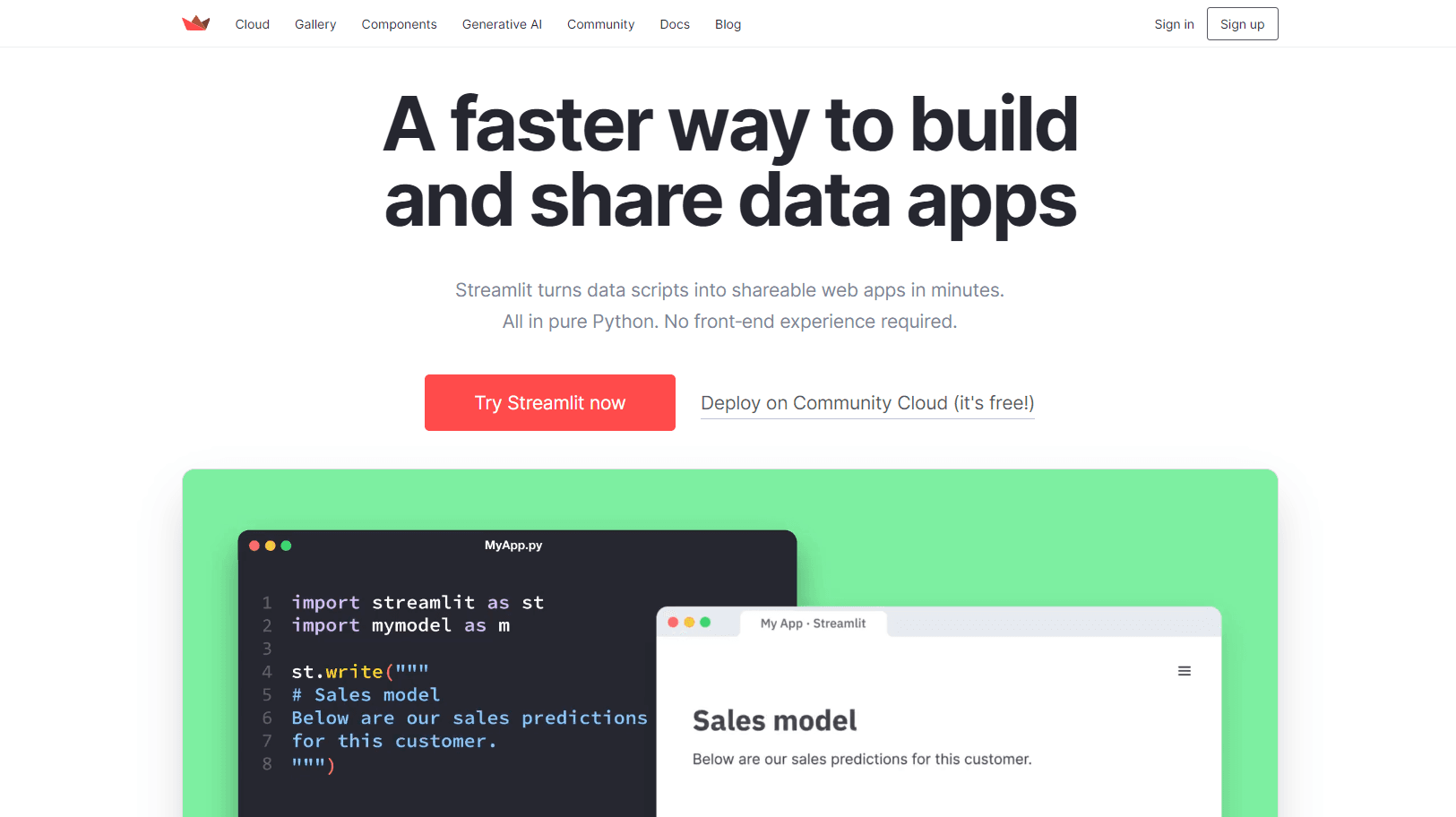
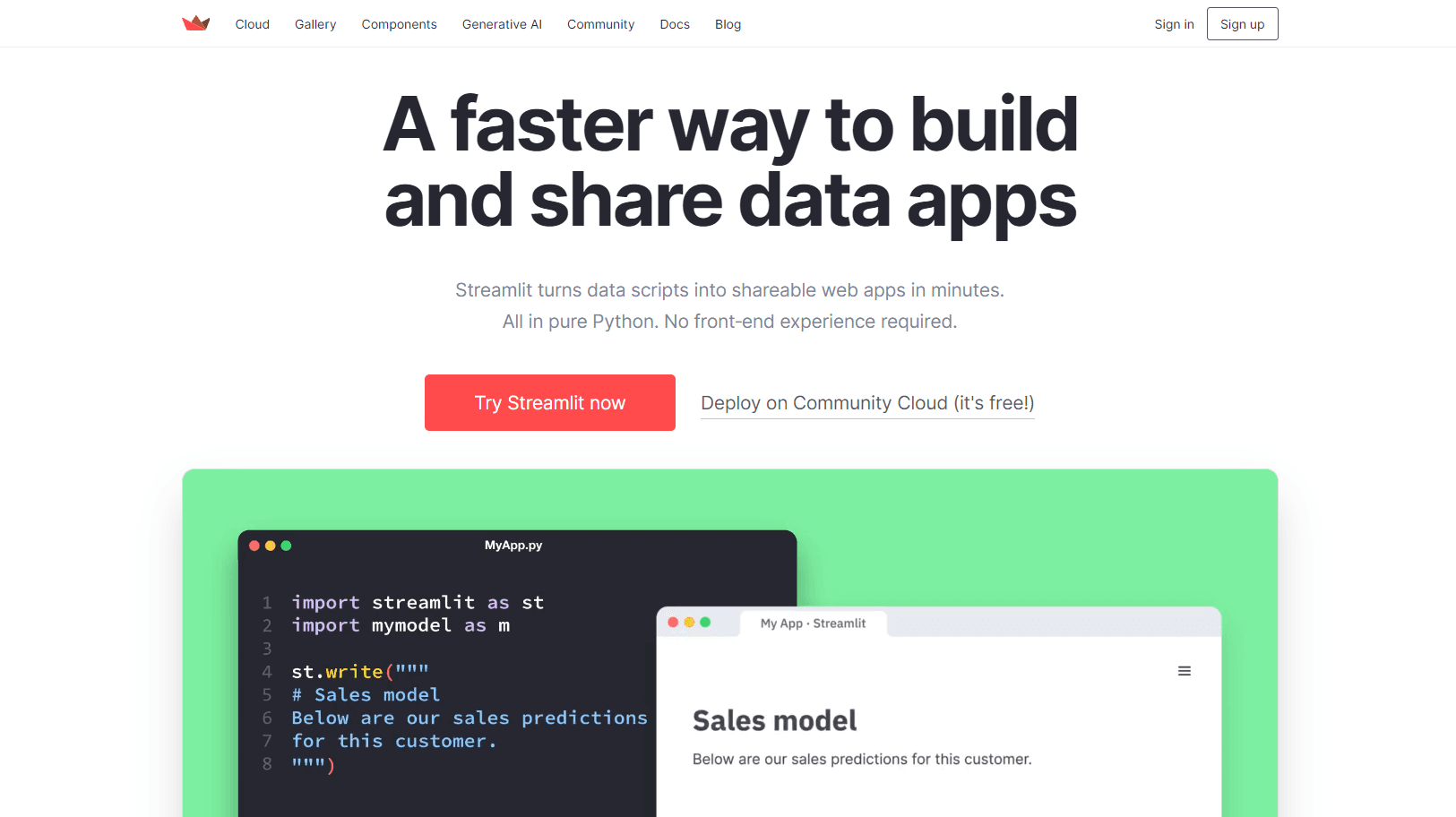
Streamlit (acquired by Snowflake in 2022) lets data scientists ship interactive web apps from pure Python — no JavaScript, no frontend framework. The 2024–2026 AI capabilities (Streamlit Connections for any data source, native LLM integrations, AI-suggested visualizations) make it the go-to for data scientists shipping AI-powered apps to stakeholders without learning React.
Production credibility: open-source with 30K+ GitHub stars; deployed at Uber, Stripe, and most major data-driven companies for internal tools. Snowflake's acquisition gave it deep Snowflake integration on top of the open-source core.
What it wins at: data scientists shipping interactive analytics apps to non-technical stakeholders, internal AI demo apps and proofs of concept, and the Python-to-production path that requires no DevOps.
Where it falls down: for production-grade business intelligence (cohort analysis, complex permissions, mature dashboards), Streamlit apps lack the polish of dedicated BI tools. Best for prototypes and internal tools, not consumer-facing analytics.
Established BI With AI Augmentation
6. Qlik — Mature BI With AI Layered On
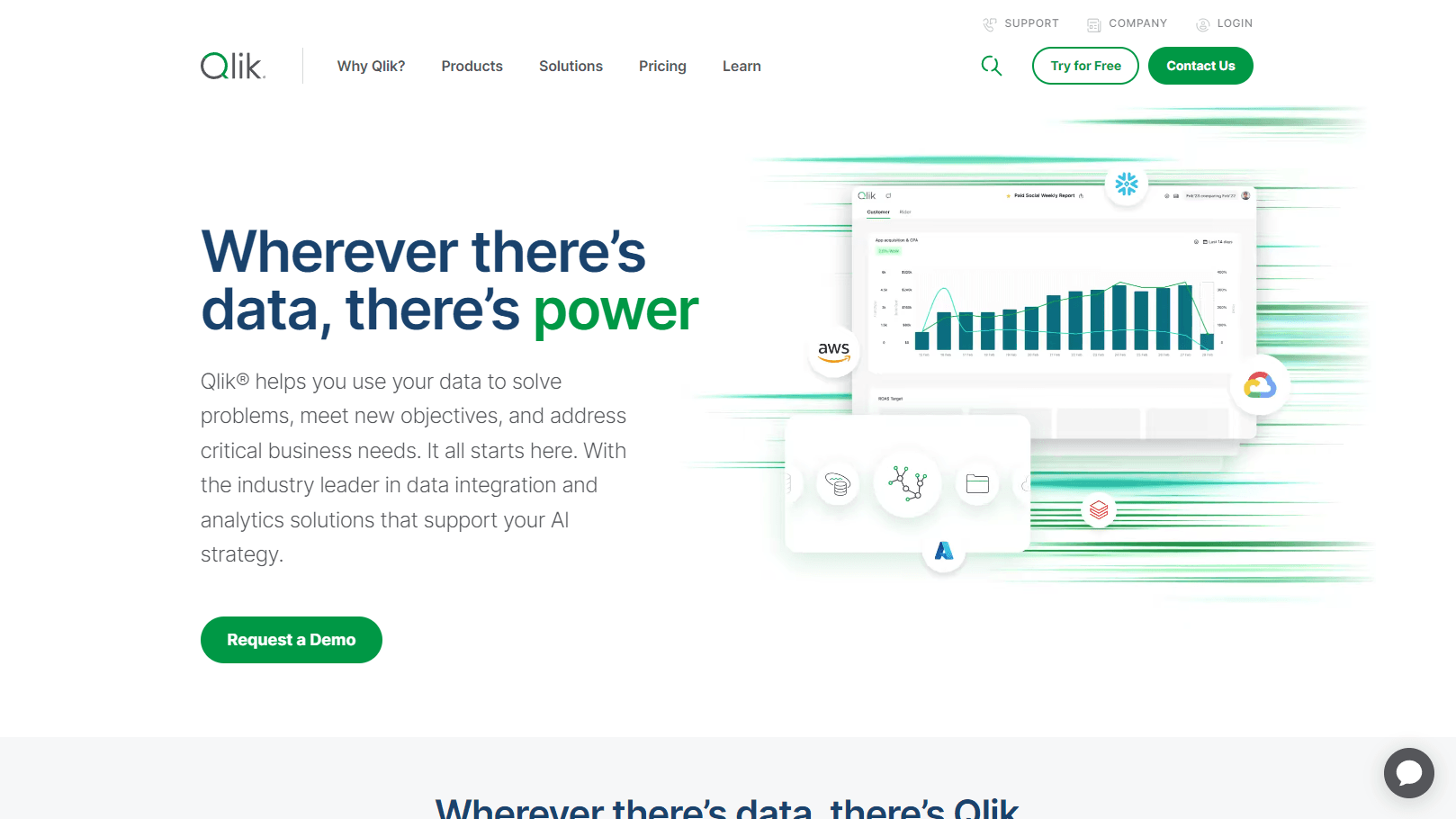
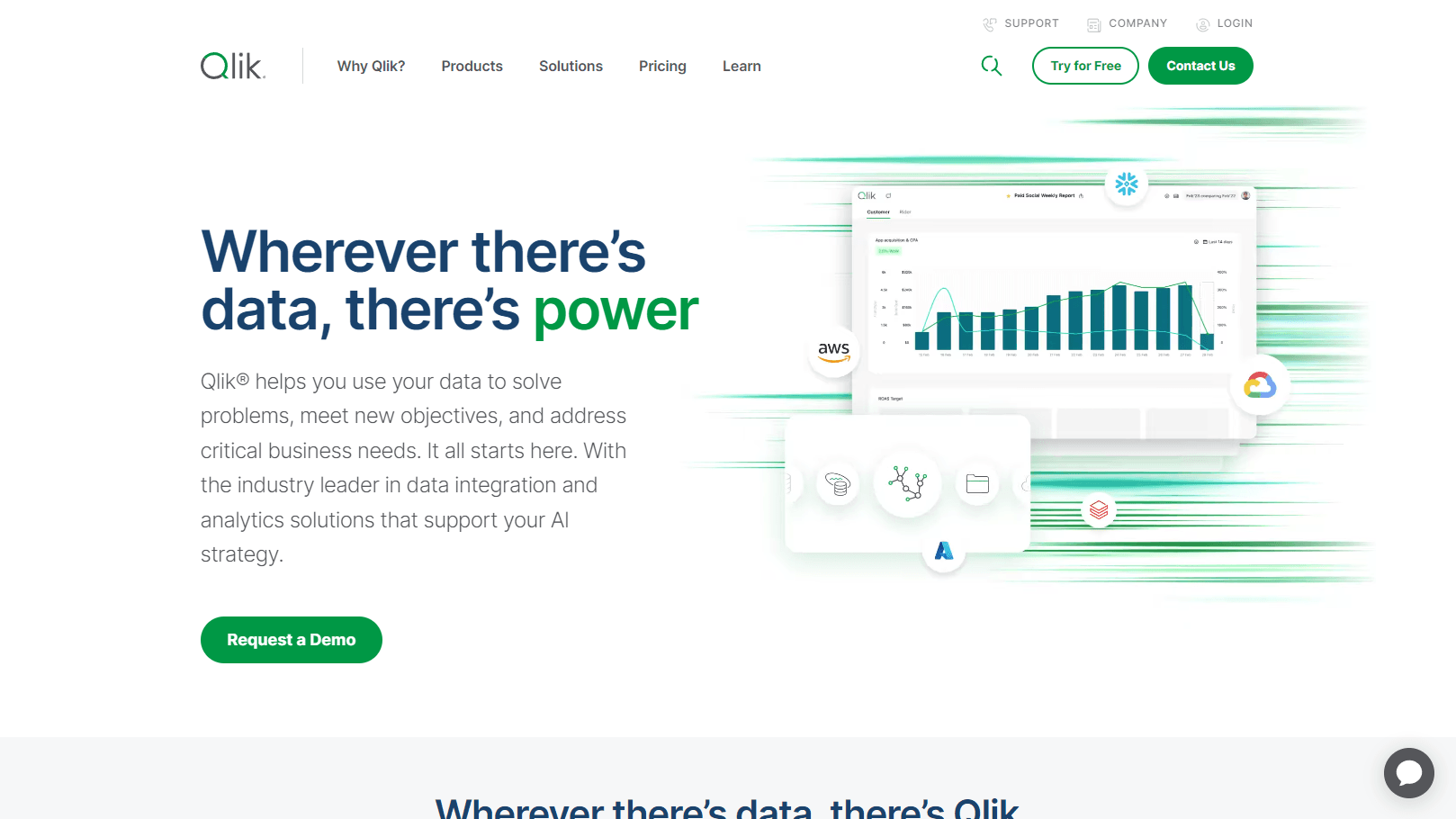
Qlik is the established BI player that layered AI augmentation onto a mature platform. Qlik Sense, Qlik Cloud, and Qlik AutoML cover BI dashboards, embedded analytics, and predictive ML respectively — all unified under the Qlik Insight Advisor that handles natural-language analytics across the platform.
Production credibility: privately held since the Thoma Bravo acquisition in 2016; 38,000+ active customers per company disclosures; deployed across Fortune 500 in industries from healthcare to manufacturing.
What it wins at: organizations already on Qlik that want to add AI without platform replacement, industries with strict data governance (healthcare, financial services, manufacturing), and embedded analytics use cases (analytics inside other applications).
Where it falls down: for greenfield AI-analytics deployments, the AI-first competitors (Hex, ThoughtSpot, Julius) ship faster. Qlik's AI capabilities are competitive but not category-leading — best when there's existing investment to leverage.
Predictive and Prescriptive Analytics
7. Pecan AI — Predictive Analytics for Go-To-Market
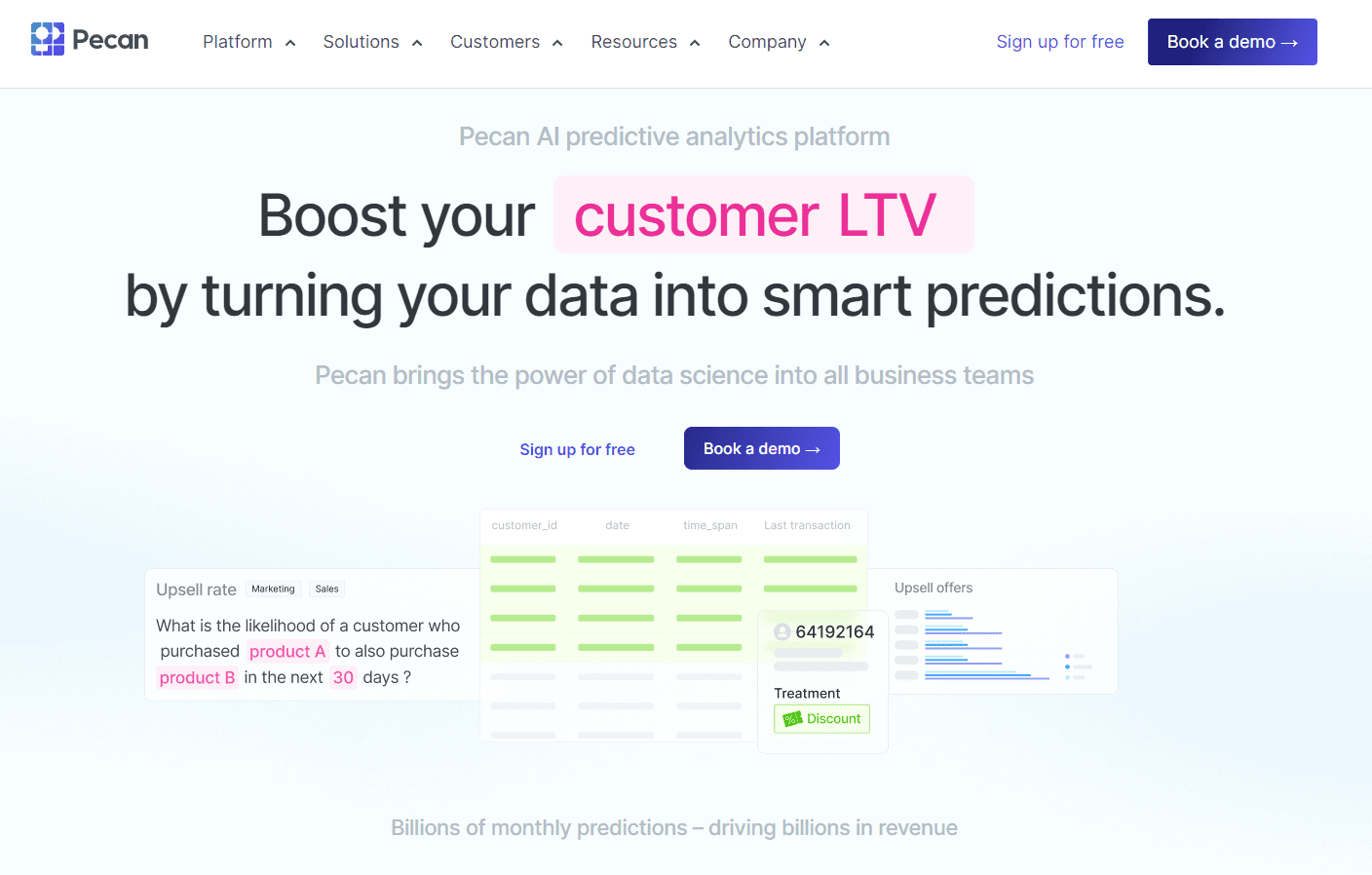
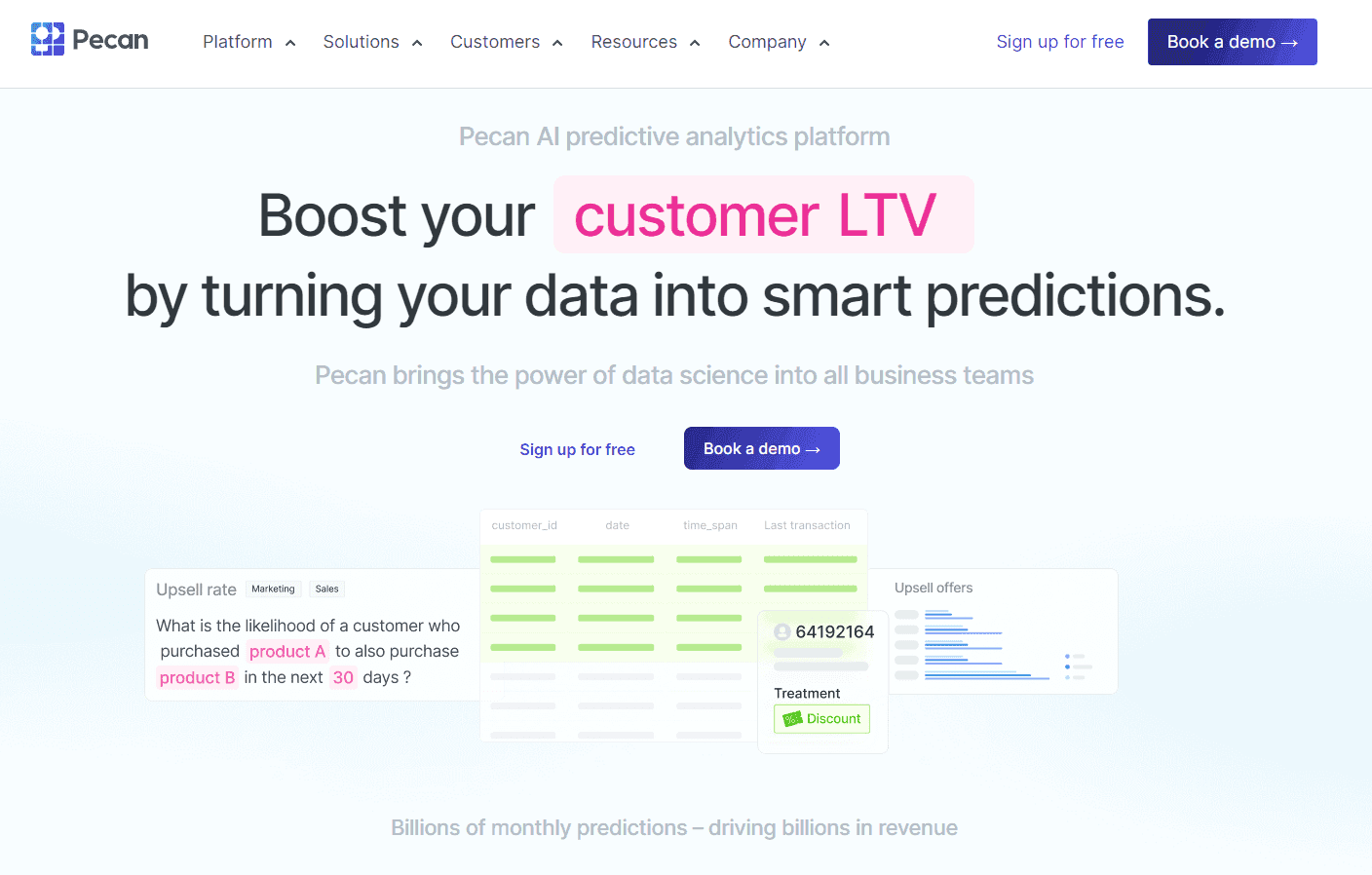
Pecan AI targets the predictive analytics use case specifically — churn prediction, lead scoring, customer lifetime value, marketing campaign performance forecasts. The product is designed for go-to-market teams (sales and marketing) rather than data scientists, with prebuilt templates for common GTM use cases.
Production credibility: raised $66M Series C in 2022; customer base across e-commerce, fintech, gaming, and SaaS. Templates for SaaS churn, e-commerce LTV, lead scoring, and campaign performance are ready-to-use.
What it wins at: GTM teams (sales, marketing, customer success) needing predictive analytics without dedicated data scientists, prebuilt templates for common use cases, and the no-code workflow for non-technical users.
Where it falls down: for custom predictive use cases outside the template library, the no-code constraint becomes limiting. Best for the standard GTM use cases the product was designed around.
8. Akkio — No-Code Generative BI
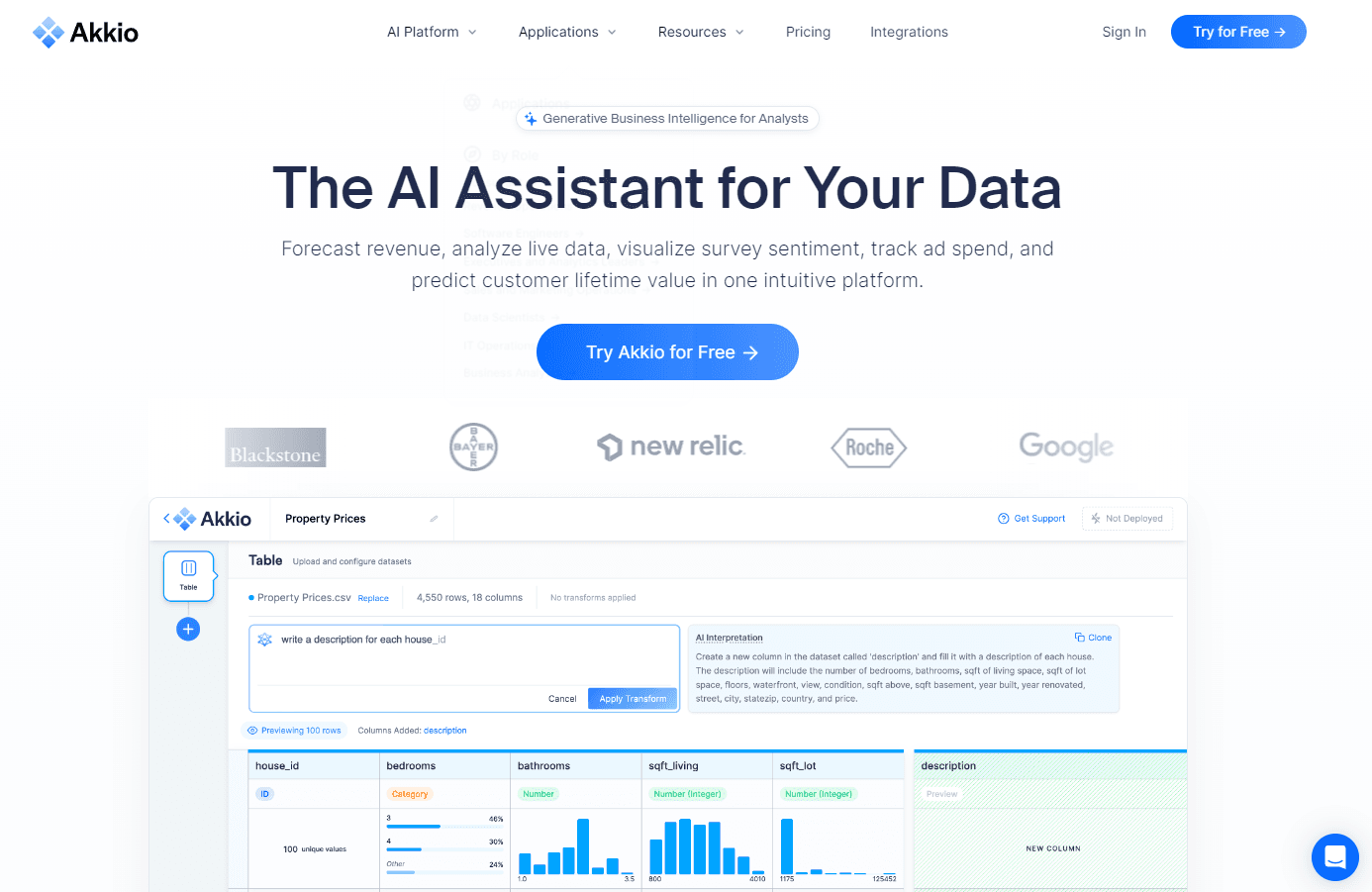
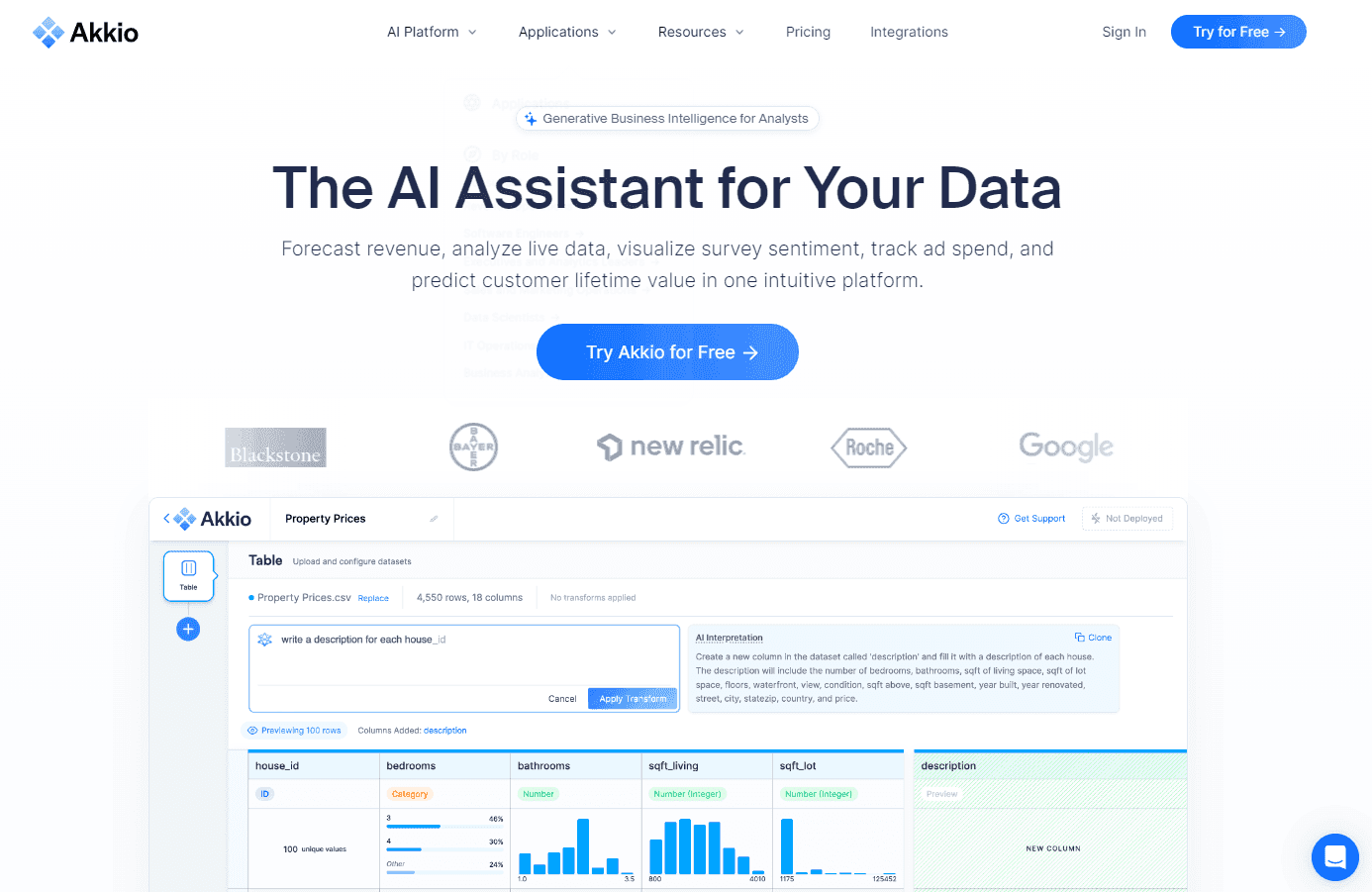
Akkio is the SMB and mid-market option in the no-code AI BI lane. Connect a data source, get AI-generated analyses and predictions without setup time. Less powerful than Pecan for serious predictive use cases, but the lower price point and faster time-to-value make it a fit for teams without dedicated data resources.
Production credibility: raised Series A in 2022; customer base skewed SMB and mid-market across e-commerce, marketing agencies, and operations teams.
What it wins at: SMB and mid-market teams without data scientists, fast time-to-first-result on common BI use cases, and pricing accessible at the small-team budget tier.
Where it falls down: for serious enterprise analytics or complex predictive modeling, Pecan AI or full-platform alternatives (Hex, Databricks) produce better results. Best as the entry-tier no-code option, not the long-term enterprise solution.
How to Choose AI Analytics Tools by Team Shape
Match tools to the actual team shape:
- Solo data analyst or non-technical user: Julius AI for ad-hoc analysis from CSVs and database connections. Free tier covers casual use.
- Mid-market data team (3–10 analysts): Hex as the workspace + ThoughtSpot for self-serve to broader organization. Skip Databricks unless you have data engineering needs warranting the lakehouse.
- Enterprise (50+ analysts): Databricks as the data platform + ThoughtSpot for self-serve + Qlik or existing BI investment for governed reporting + Pecan or Akkio for predictive use cases as needed.
- GTM team needing predictions (sales, marketing, success): Pecan AI for the prebuilt templates. Add Julius AI for ad-hoc analysis.
- Data scientists shipping internal apps: Streamlit for any internal data app needing to ship in days not weeks.
The single highest-leverage 2026 addition for organizations not yet using AI analytics: Julius AI for the data team or finance team. Free tier handles real work; the productivity lift on "I have a CSV, what does it tell me" is substantial.
For adjacent reading, see our Best AI Tools for Finance and Accounting for the FP&A and finance-ops adjacency, Best AI Tools for Operations for the broader business automation context, and Best AI Development Frameworks for the engineering-tools layer underneath.
Frequently Asked Questions
What are AI data visualization tools? AI data visualization tools generate charts, dashboards and written analysis from a plain-English question instead of from a manually configured chart-builder. You connect a data source, ask something like "show me revenue by region for the last four quarters," and the tool writes the query, picks an appropriate chart type, and explains what it found. The category splits into three lanes in 2026: natural-language analytics (ThoughtSpot, Julius AI), AI-native data workspaces (Hex, Databricks, Streamlit) and predictive platforms (Pecan AI, Akkio, Qlik).
Can AI reliably turn natural language into SQL? For well-modelled data, yes — this is the most mature capability in the category. ThoughtSpot Spotter, Hex Magic and Databricks Genie all translate business questions into SQL against a governed semantic layer, and accuracy on straightforward aggregations is high enough to trust in production. Accuracy falls off sharply on poorly documented schemas, ambiguous column names, and questions requiring multi-table business logic nobody has encoded. The determining factor is the quality of your semantic layer, not the model.
What's the best AI tool for data analytics in 2026? Depends on the user. For non-technical users analyzing CSVs and database connections, Julius AI. For data teams needing one collaborative workspace across SQL, Python, AI, and viz, Hex. For enterprises rolling out self-serve analytics across thousands of business users, ThoughtSpot. There isn't one tool that wins all use cases — pick by who's actually doing the analysis.
Can AI tools replace data analysts? Not the analysts, but they meaningfully change what one analyst can ship in a week. The teams getting the most leverage use AI for the high-volume repetitive work ("summarize last week's metrics," "why did revenue drop in Region X") and keep humans for the judgment-heavy work (defining the right questions, interpreting ambiguous results, deciding what to do about it). Most data teams adopting these tools see headcount stable but coverage expanded — analysts handling more business units or more questions per week than they could before.
Are these AI analytics tools safe with sensitive data? The enterprise tiers of Hex, ThoughtSpot, Databricks, and Qlik all carry SOC 2 Type II, encryption at rest and in transit, role-based access control, and signed DPAs. For regulated industries (financial services, healthcare), validate specific compliance certifications during procurement (HIPAA for healthcare, SOC 2 + PCI DSS for financial services). Free and starter tiers usually have weaker guarantees — read the data-handling settings before pasting sensitive material.
How do these tools connect to my existing data sources? Native connectors to the major cloud data warehouses (Snowflake, BigQuery, Databricks, Redshift) are universal across the leading tools. Most also connect to Postgres, MySQL, Salesforce, HubSpot, Stripe, and 50+ other common business data sources. For unusual or legacy sources, check the specific connector list during evaluation — gaps are real but increasingly rare.
What's the difference between AI analytics and traditional BI? Traditional BI (Tableau, Power BI, Looker) is dashboard-centric — you build dashboards, users consume them, new questions require new dashboards. AI analytics is question-centric — users ask questions in natural language, the AI answers, dashboards get built only when something needs to be saved for repeated use. Most enterprises run both: AI analytics for the long tail of ad-hoc questions, traditional BI for the canonical reports everyone sees.
Are AI analytics tools good enough for executive reporting? For monthly board reports and executive dashboards, traditional BI still wins on polish and reliability. AI analytics shines for the ad-hoc questions that arise during board meetings ("why did churn spike in Q3 in the SMB segment?") — the AI answers in real-time during the meeting rather than queuing the question for the data team to answer next week. Best practice in 2026 is canonical reports in traditional BI, ad-hoc questions in AI analytics.
What's the typical pricing? Wide range. Free tiers (Julius AI, Streamlit open-source) cover casual or single-user work. Mid-market tools (Hex, Akkio) start at hundreds per month per user. Enterprise tools (ThoughtSpot, Databricks, Qlik) are six-figure annual contracts at typical Fortune 500 deployment scale. None publish public pricing in the meaningful sense above mid-market — budget for procurement at the enterprise tier.
Will general-purpose LLMs replace AI analytics tools? No. ChatGPT and Claude can analyze data you paste in, but they don't connect to your data warehouse, don't maintain access controls, don't produce dashboards stakeholders can save and share, and don't handle the volume or schema complexity of real organizational data. The AI analytics tools above use LLMs underneath — but the value is in the surrounding platform (connections, governance, persistent workspaces, collaboration), not the LLM call itself.
Final Thoughts
The AI analytics category in 2026 is one of the fastest-moving in enterprise software. The leaders have all crossed the threshold from "AI as a marketing claim" to "AI as the primary value proposition," and the gap between the AI-first platforms and the AI-bolted-on legacy tools widened significantly through 2025–2026.
For organizations not yet using AI analytics tools, Julius AI for individual analysts and Hex for data teams is the highest-ROI 2026 starting pair — both have generous free tiers or accessible pricing, and the productivity lift shows up in week 2. Add ThoughtSpot once organizational rollout is the bottleneck; add Databricks when data engineering needs justify the platform commitment; add Pecan AI when predictive use cases warrant a dedicated tool.
The biggest 2026 mistake: assuming a Tableau or Power BI "AI feature" delivers the same value as an AI-first platform. The user experience and analytical quality are different categories of product.
Categories these tools span
More collections you may also like


Sign up for our newsletter
Receive weekly updates so you can stay up-to-date with the world of AI
Sign up for our newsletter
Receive weekly updates so you can stay up-to-date with the world of AI
The AI tools directory for discovering, exploring, and comparing the most innovative AI tools in the industry