TopK
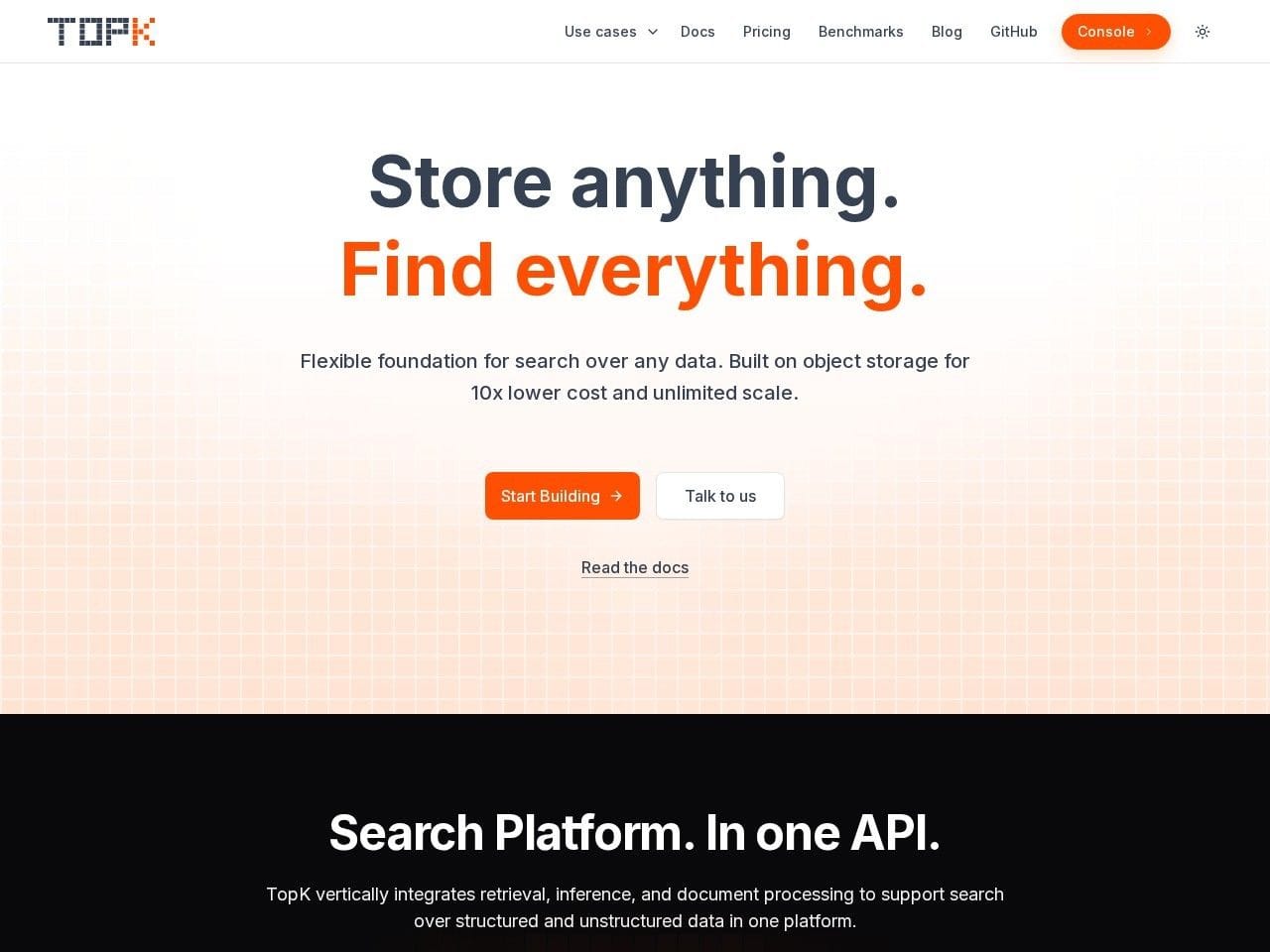
AI-native search engine combining vector, keyword, and custom scoring in one API.
Overview
TopK: one query API instead of a retrieval stack
Most production RAG systems end up bolting together a vector database, a keyword engine, a metadata store, and a separate reranker — then reconciling their results in application code. TopK collapses that stack into a single engine: dense and sparse vectors, BM25 keyword matching, metadata filters, and custom scoring expressions all execute inside one query, so relevance logic lives in the database rather than in glue code.
The engine is built on object storage, which is how TopK gets to billion-document scale without the cost profile of memory-resident indexes. On top of raw retrieval, a File Search capability generates grounded answers with citations from document collections, and SDKs cover Python, JavaScript, and Rust, plus a SQL compatibility layer and CLI.
Key Features
- True hybrid queries: dense/sparse vectors, BM25, filters, and custom scoring composed in a single request
- Multi-vector retrieval with native late-interaction support across multiple embeddings
- File Search that returns grounded answers with citations; published accuracy of 84–91% across finance, legal, medical, and industrial document sets
- Sub-100ms latency at billion scale, with 17ms p99 reported on a 10M-document benchmark
- Object-storage architecture supporting 1B+ documents per partition at a claimed fraction of competitor cost
- Usage-based pricing with a free tier; private VPC deployment for enterprises
Ideal Use Case
TopK fits teams whose retrieval quality has plateaued on vector-only search — legal, finance, healthcare, and e-commerce applications where exact keyword matches, structured filters, and semantic similarity all matter in the same query, and where consolidating three retrieval systems into one reduces both latency and infrastructure spend.
How TopK differentiates
TopK's pitch is accuracy and consolidation: its benchmarks report up to 80% higher recall than competing engines and p99 latencies of 28ms versus 71–407ms for alternatives. The company, founded in 2024 by Marek Galovič and Jerguš Lejko, raised a $5.5M seed round in 2025 backed by Earlybird, KAYA, and Irregular Expressions to build out the platform.
FAQ
How is TopK different from a vector database? Vector databases handle similarity search; TopK also executes BM25 keyword matching, metadata filtering, and custom scoring in the same query, removing the need for a separate reranking pipeline.
Is there a free tier? Yes. TopK is usage-based with a free tier to start, and offers private VPC deployment for enterprise workloads.
What scale can it handle? The object-storage architecture supports more than a billion documents per partition while keeping p99 latency under 100ms.
Which SDKs are available? Python, JavaScript, and Rust SDKs, plus a SQL compatibility layer and a CLI.
tl;dr
TopK is an AI-native search engine that merges vector, keyword, and custom ranking into one API — billion-scale, sub-100ms, with a free tier and $5.5M in seed backing.
Why Use TopK
User Reviews
Similar Tools