Top 7 AI Meeting Note-Takers (2026)




Best AI Meeting Note-Takers in 2026
Meeting note-takers were the first AI tool category most teams adopted, and the first to cross the line from "interesting demo" to "impossible to give back." In 2026, the question isn't whether to use one — it's which one fits the way your team actually meets, decides, and follows up.
The seven below are the tools that actually show up on real teams' bills. Each one is best at a different shape of meeting work: external sales calls, internal standups, founder-and-VC pitches, customer interviews, all-hands recaps. Pick by use case, not by feature checklist — every product in this list will transcribe a Zoom call, but only one will give your AE a coachable scorecard inside 60 seconds of hangup.
How We Evaluated These Tools
The seven AI meeting note-takers below were evaluated on five criteria, in priority order:
- Real production usage at named teams — not vendor case studies, but verified deployments where the tool is in active daily use across hundreds or thousands of meetings
- Transcription accuracy on real meetings — accents, technical jargon, overlapping speakers, and noisy connections are where vendor demos hide weaknesses
- Post-meeting workflow depth — does the tool ship action items into the systems your team already uses (Slack, Notion, CRM, ticketing) or does it become a separate inbox to manage
- Privacy and consent posture — clear announce-on-join behavior, retention controls, regional data residency, and signed DPAs for the enterprise tier
- 2026 currency — has the product shipped meaningful capability in the last 12 months (the 2025 wave of "meeting agents that act on what was decided" reset the leader board)
We did not include the broader revenue intelligence category beyond Gong (Chorus, Outreach Kaia, Salesloft Conversations) — those are sales-team-only tools that overlap with note-taking but solve a different problem. For sales-specific tools, see our Best AI SDR Tools and Top 10 AI Tools for Sales Professionals guides.
Quick Comparison
| Tool | Best for |
|---|---|
| Fireflies.ai | Pragmatic default. Best for mixed internal + external meetings. |
| Otter.ai | Live-transcript leader. Best for accessibility, education, journalism. |
| Granola | Note-augmenter for founders/PMs who already take notes by hand. |
| Fathom | Free tier that's actually free. Best for ICs and small teams. |
| tl;dv | Async-first recorder. Best for distributed teams who re-watch calls. |
| Gong | Sales intelligence platform that includes note-taking. Best for revenue orgs at scale. |
| Zoom AI Companion | Already on your Zoom bill. Best for Zoom-only orgs that don't want to procure. |
1. Fireflies.ai — The Pragmatic Default
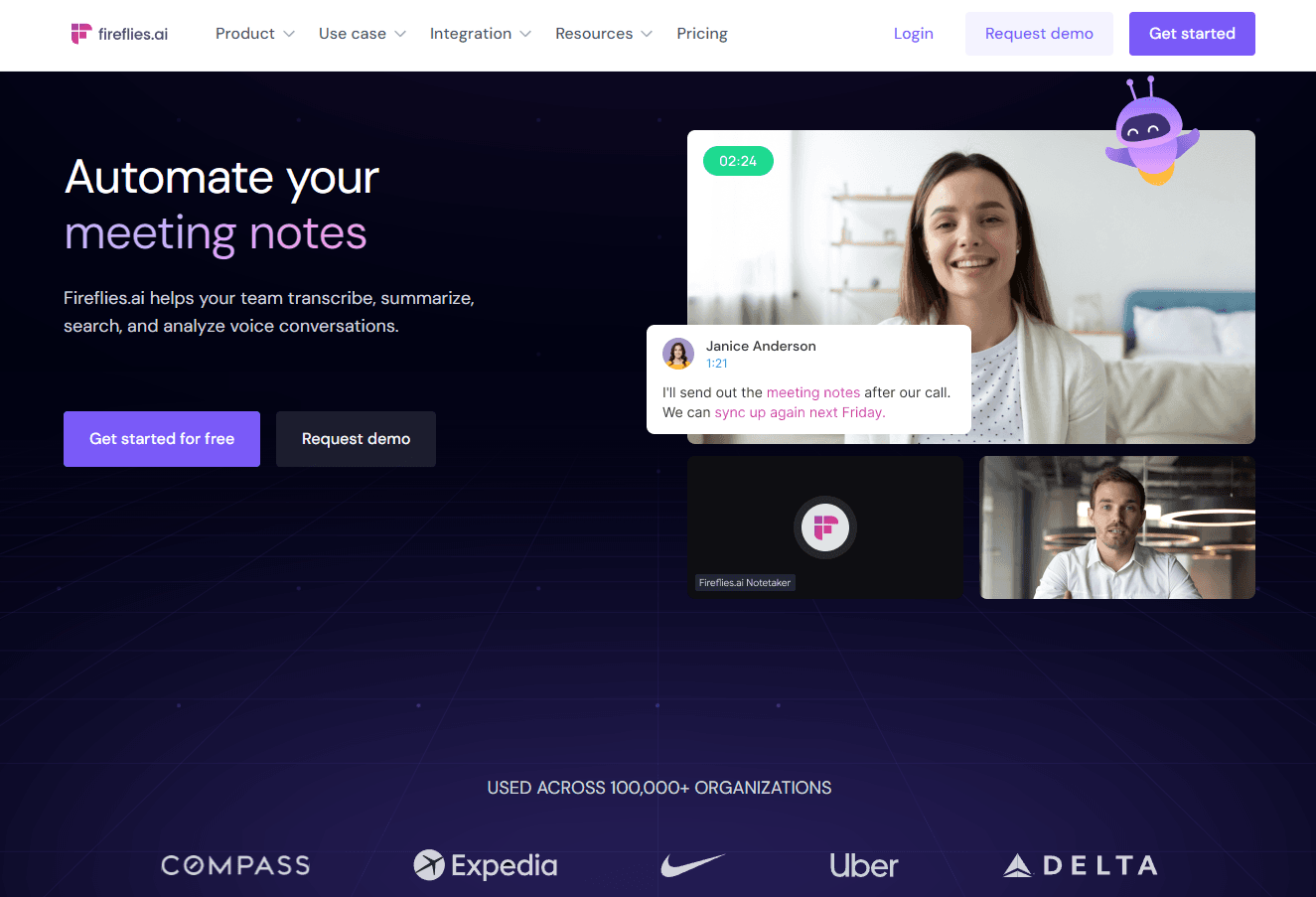
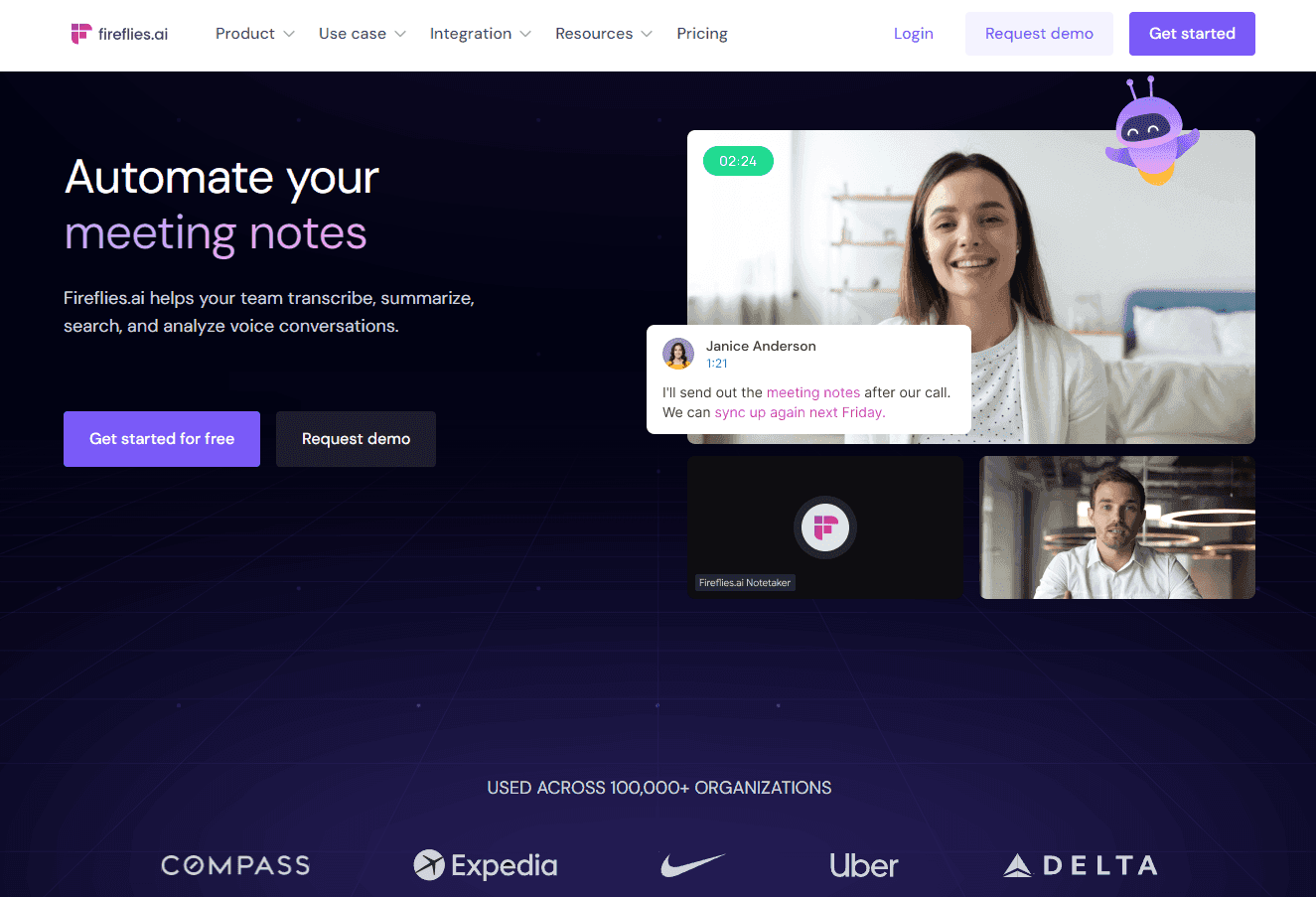
Fireflies.ai is the answer for teams that want "the meeting note-taker" without overthinking it. It joins your calendar invites, transcribes accurately across Zoom, Meet, and Teams, generates summaries with action items, and ships a usable search across every meeting your team has ever recorded. The free tier is generous, the paid tiers don't surprise you, and the integration list (Slack, Notion, HubSpot, Salesforce) covers most teams' downstream needs.
Production credibility: raised $19M Series A from Khosla Ventures and others in 2022; serves 500K+ teams per company disclosures; SOC 2 Type II, GDPR-compliant, with HIPAA and EU-residency options on the enterprise tier. Integrations cover Slack, Notion, HubSpot, Salesforce, Zapier, and 50+ other downstream destinations.
What it wins at: broad coverage at a fair price. Strong for teams where meetings span sales, internal, and customer-facing in one bucket. Conversation analytics (filler words, talk-time ratio, topic tracking) are good enough to be useful without being a full revenue intelligence platform.
Where it falls down: opinionated about being the central knowledge base for meetings, which is great if you buy in and friction if you'd rather it just dumps notes into Notion or Linear and gets out of the way.
2. Otter.ai — The Live-Transcript Workhorse
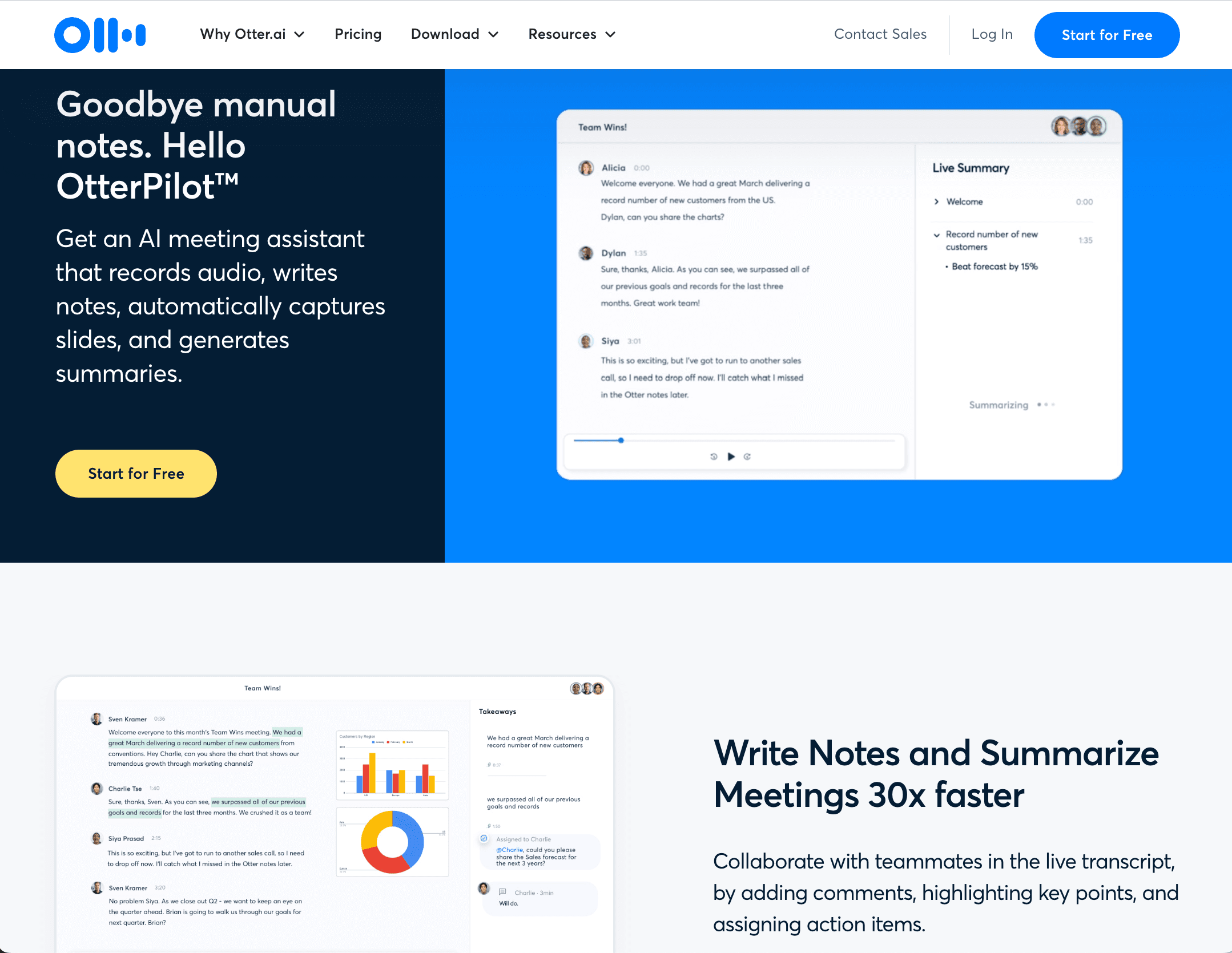
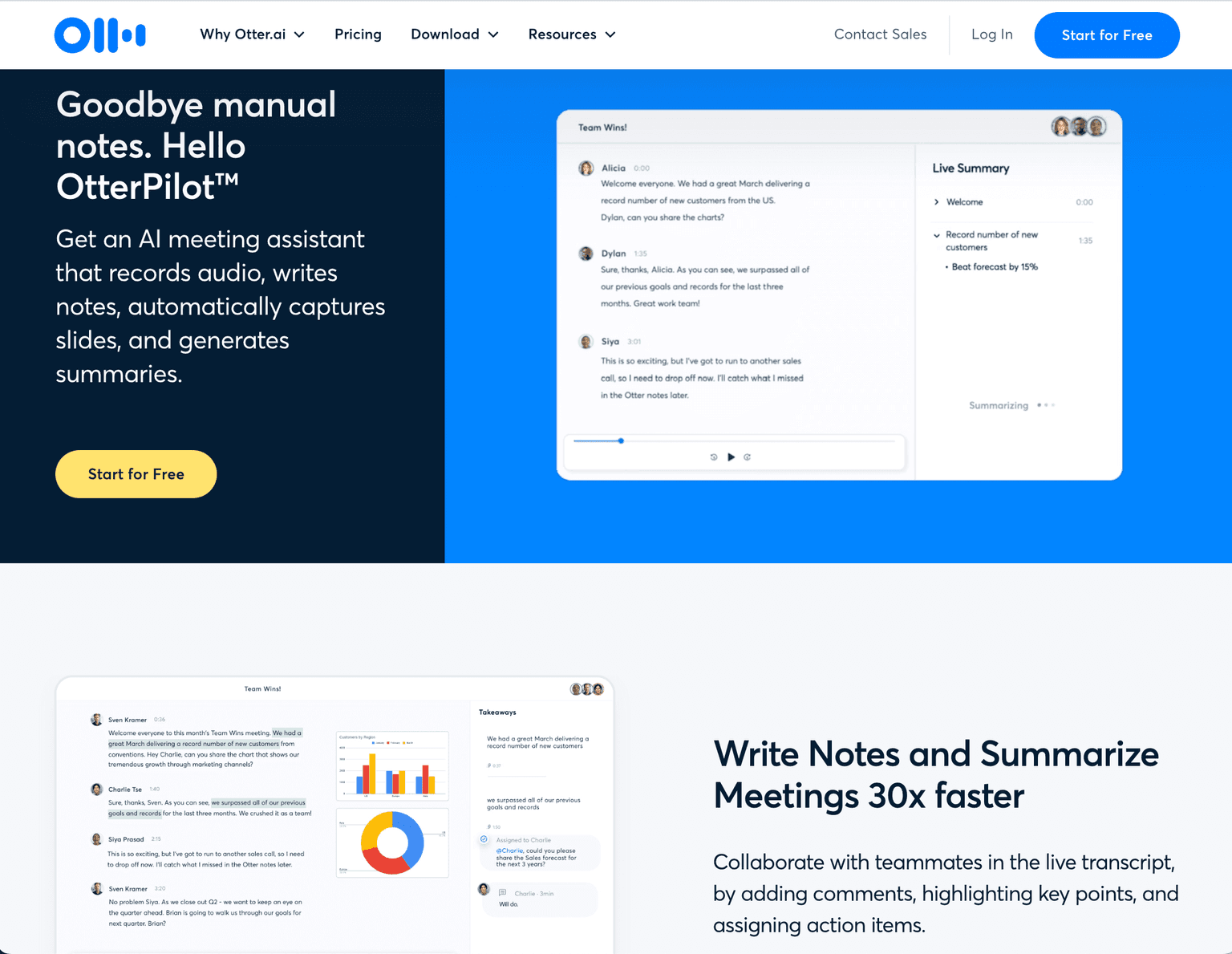
Otter.ai was the first transcription tool that worked, and it's still the most reliable for the use case it was built for: live transcription you can read while a meeting is happening. The OtterPilot summary is fine, but the real value is the running transcript visible during the call — useful for accessibility, for non-native speakers, and for anyone who joins late and needs to catch up without rewinding.
Production credibility: raised $63M Series B at a $500M valuation in 2021 led by Tiger Global and others; reported 25M+ users by late 2024; deployed widely in education (universities offering Otter for accessibility) and journalism. The Chrome extension and mobile app are best-in-category for live use.
What it wins at: live transcription quality, education and journalism workflows, accessibility use cases, and the cleanest in-meeting reading experience. The Chrome extension and mobile app are best-in-category.
Where it falls down: post-meeting workflow tooling (action items, CRM sync, coaching) is behind Fireflies and Gong. A great transcriber, an okay summarizer.
3. Granola — The Note-Taker Built Around How You Already Take Notes
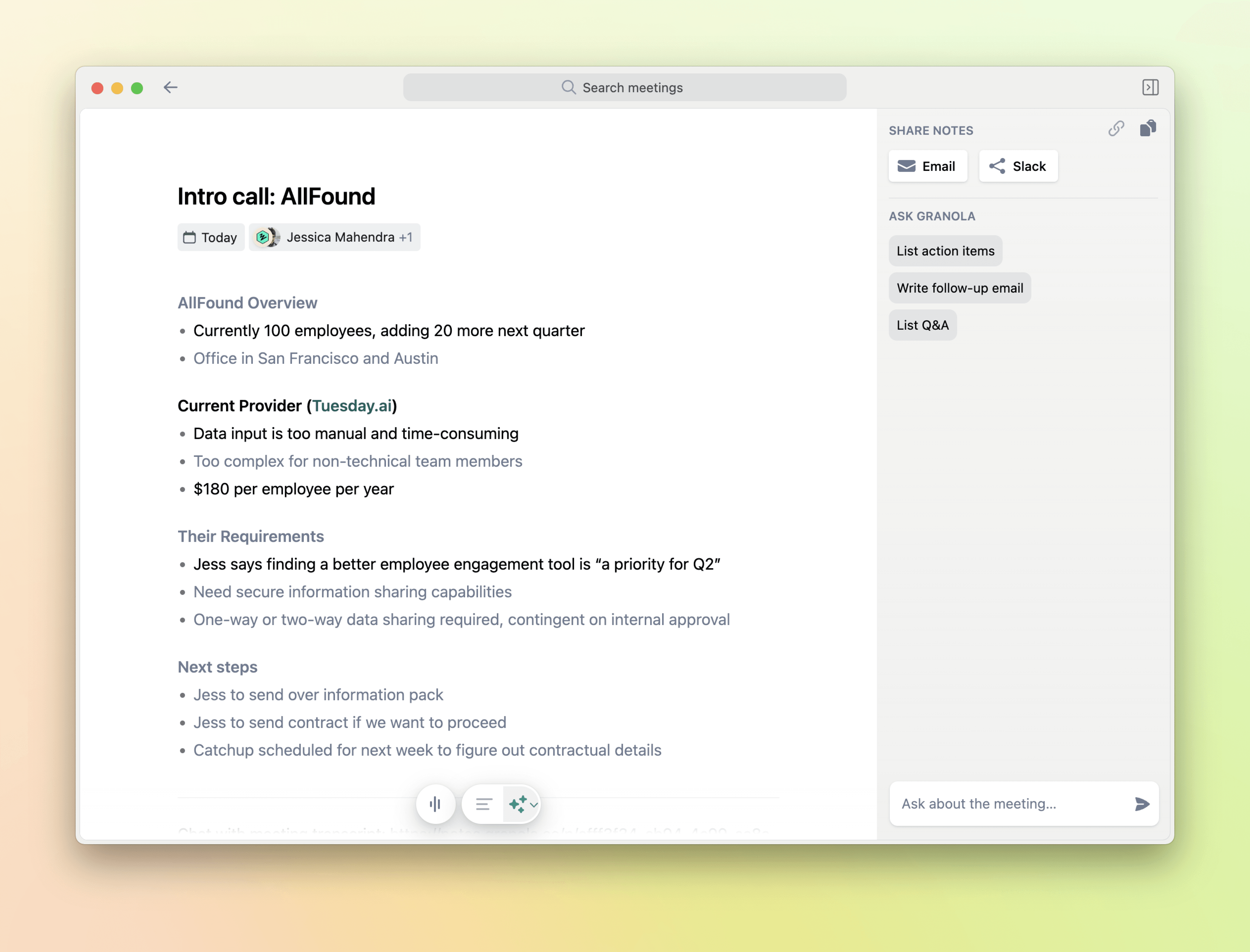
Granola is the only product in this list that doesn't try to replace your note-taking — it augments it. You take rough notes during the meeting; Granola listens in the background and, when you're done, merges your sketch with its transcript-aware summary into a clean shared doc. The result reads like notes you wrote, just faster and with the gaps filled in.
Production credibility: raised $20M Series A from Spark Capital in 2024; previously seed-funded by Lightspeed; has compounded a strong product-design reputation through 2024–2026 with founders, product managers, and venture investors as core personas. The Mac app is consistently cited in product-Twitter recommendation threads.
What it wins at: founders, product managers, and anyone who already takes notes by hand and doesn't want to outsource it. The product has the strongest design taste of anything in this list, and the meeting view is a genuinely new UX, not a reskinned transcript.
Where it falls down: Mac-first, weaker outside Apple ecosystem. Less integration depth than Fireflies. If your team is split across Windows and Linux, this isn't yet the right pick.
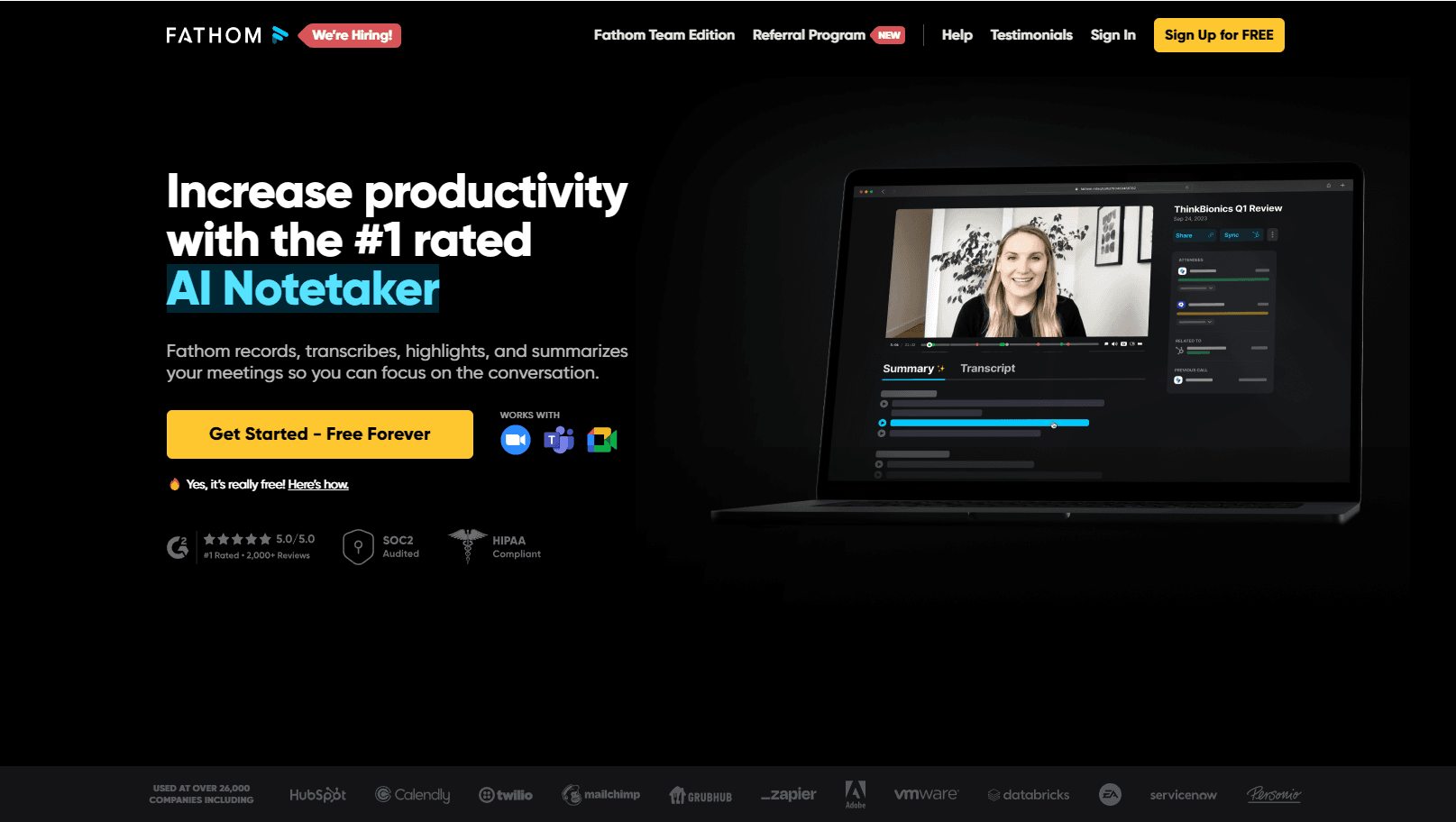
4. Fathom — The Free Tier That's Actually Free
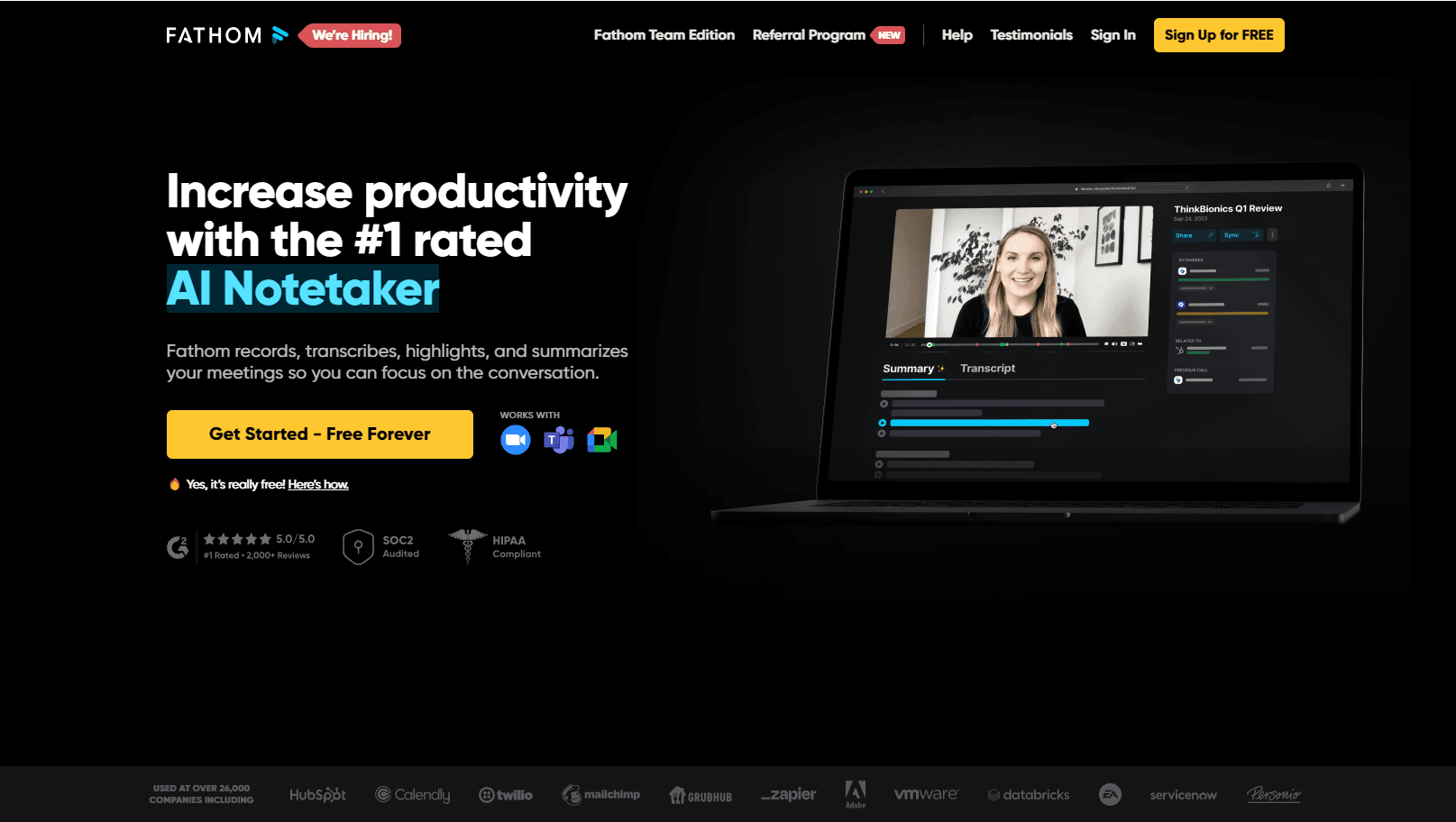
Fathom is the answer for individual contributors and small teams who want a polished note-taker without buying anything. The free tier covers unlimited meetings, real summaries, action item extraction, and CRM sync — categories where most competitors gate hard behind a paywall. The paid tier (Team Edition) layers on shared libraries and admin controls without surprising you.
Production credibility: raised $17M Series A from Sequoia and Y Combinator alumni in 2023; consistently the highest-rated meeting assistant on G2 (4.9/5 with 4,000+ reviews as of early 2026); free tier doesn't artificially limit core capability, which is the rare exception in this category.
What it wins at: solo users, AEs at companies that won't buy them software, and teams running a free pilot before standardizing. Ranks consistently as the highest-rated note-taker on G2, mostly because the free tier doesn't feel crippled.
Where it falls down: less mature for org-wide rollout than Fireflies or Gong, and the analytics depth is light if you want real conversation intelligence.
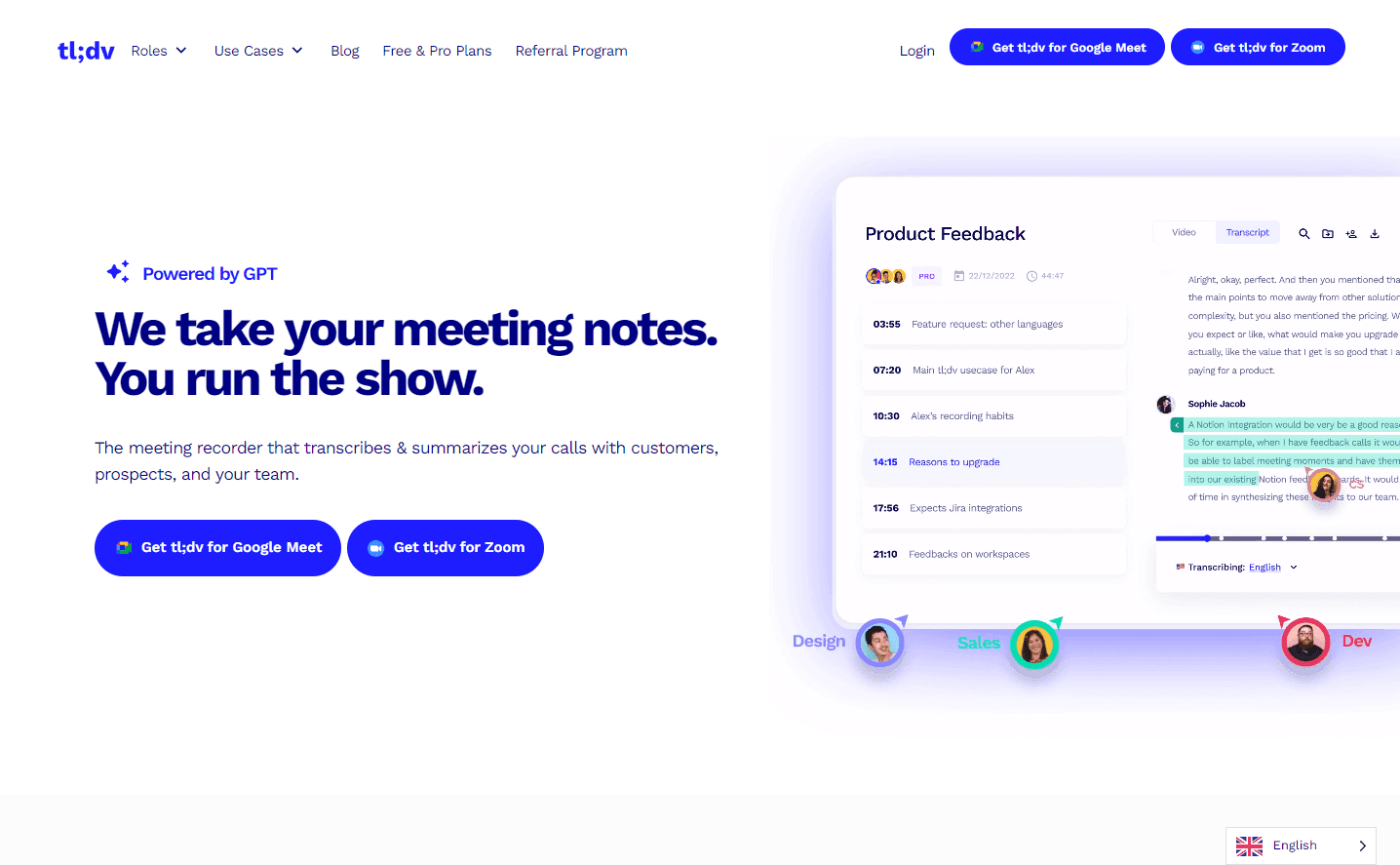
5. tl;dv — The Recorder for Async-First Teams
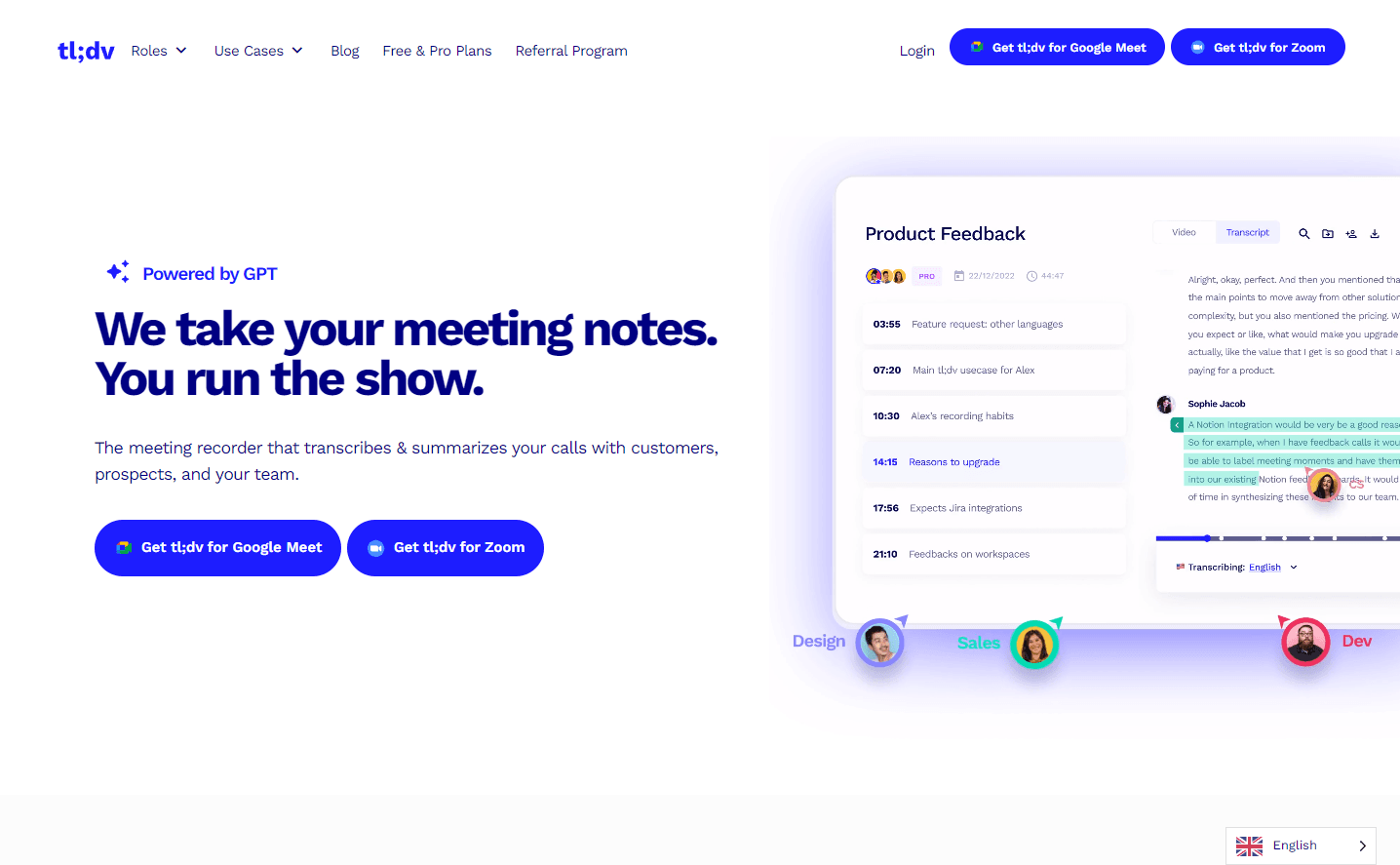
tl;dv treats meetings as artifacts to be reviewed later by people who didn't attend, and the entire product is shaped around that idea. Timestamped highlights, shareable clips, AI-generated chapter markers, and easy embedding into Notion or Slack make it the strongest tool for teams that record once and consume many times — distributed product teams, customer research, internal training.
Production credibility: EU-headquartered (Munich); 1M+ users per company disclosures; 30+ language transcription support which is broader than most US-headquartered competitors. Strong adoption among distributed product, design, and customer research teams.
What it wins at: async-first companies, customer research playback, and any team whose meetings need to be re-watched in pieces by stakeholders who skipped the live call. Multi-language transcription is broader than most competitors.
Where it falls down: live-meeting workflow is thinner than Otter or Fireflies. If your team consumes notes immediately and rarely revisits the recording, you're paying for capability you don't need.
6. Gong — The Sales Intelligence Platform That Happens to Take Notes
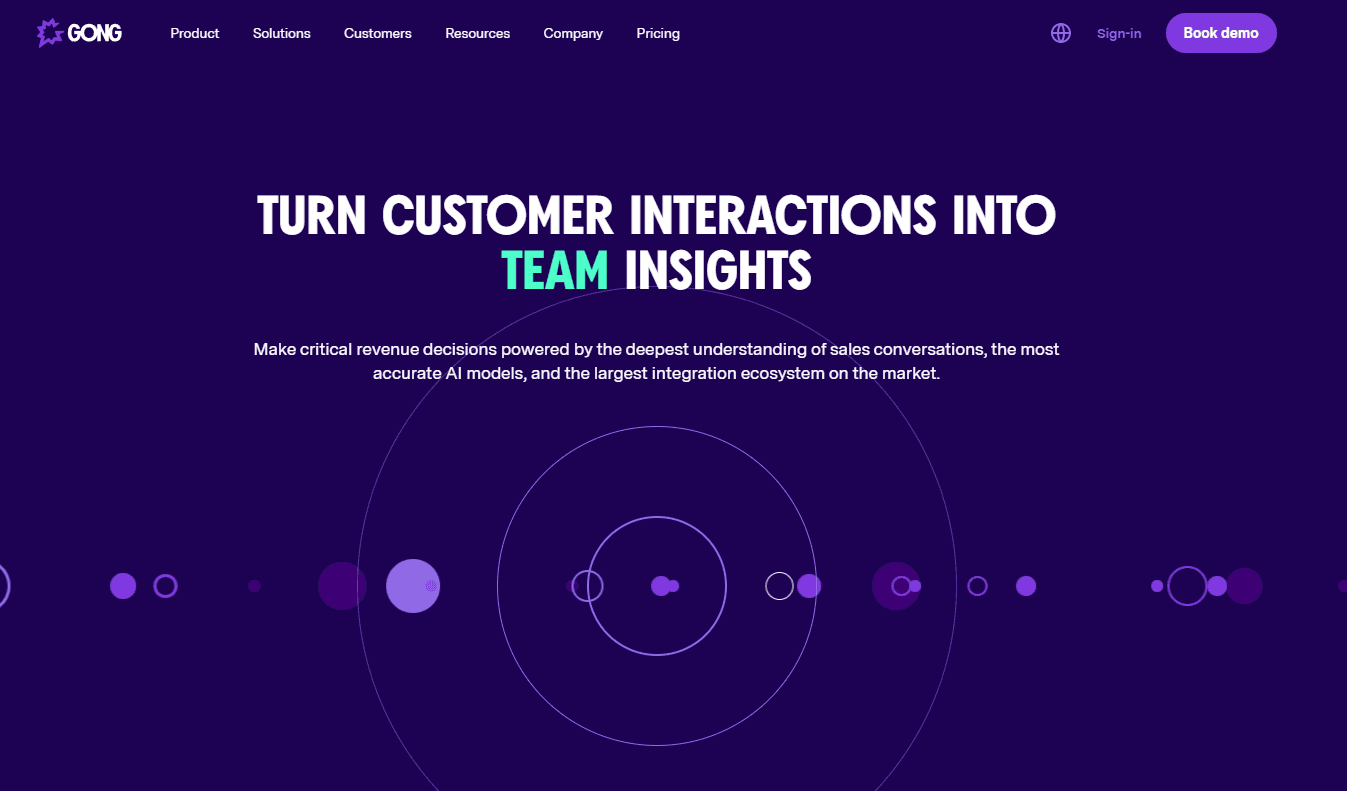
Gong is in a different weight class. It's a revenue intelligence platform with a note-taker bundled in, not the other way around. If you're a sales org with a serious pipeline, Gong is the tool that turns every customer call into a coachable, searchable, deal-graded artifact your CROs and managers actually use. The note-taking is the byproduct of the platform's real job: helping reps win more deals.
Production credibility: $7.25B valuation per its 2021 Series E led by Franklin Templeton; reported $250M+ ARR; deployed at LinkedIn, Hubspot, Zoom, Shopify, Snowflake, Twilio, and most enterprise B2B SaaS sales orgs; SOC 2 Type II + ISO 27001 + GDPR compliance with EU residency available.
What it wins at: sales teams with a mature pipeline, deal coaching, win/loss analysis, and forecasting. Pattern detection across thousands of calls gives managers signals no other tool in this list provides.
Where it falls down: priced and scoped for revenue orgs at scale. Wildly overkill for solo users, internal-only meetings, or teams under ~20 reps. The procurement cycle reflects the price tag.
7. Zoom AI Companion — The Free Note-Taker Already on Your Calls
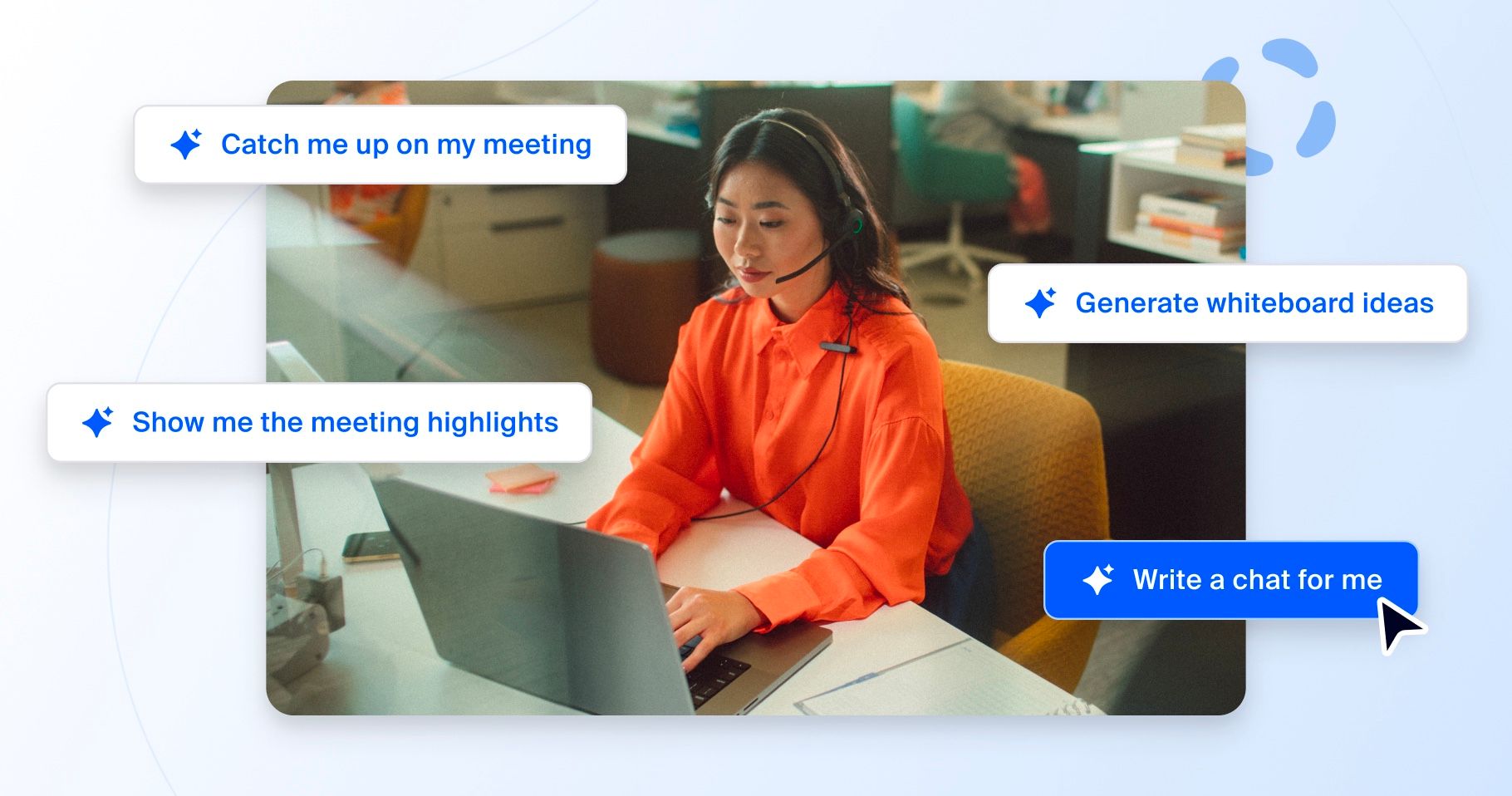
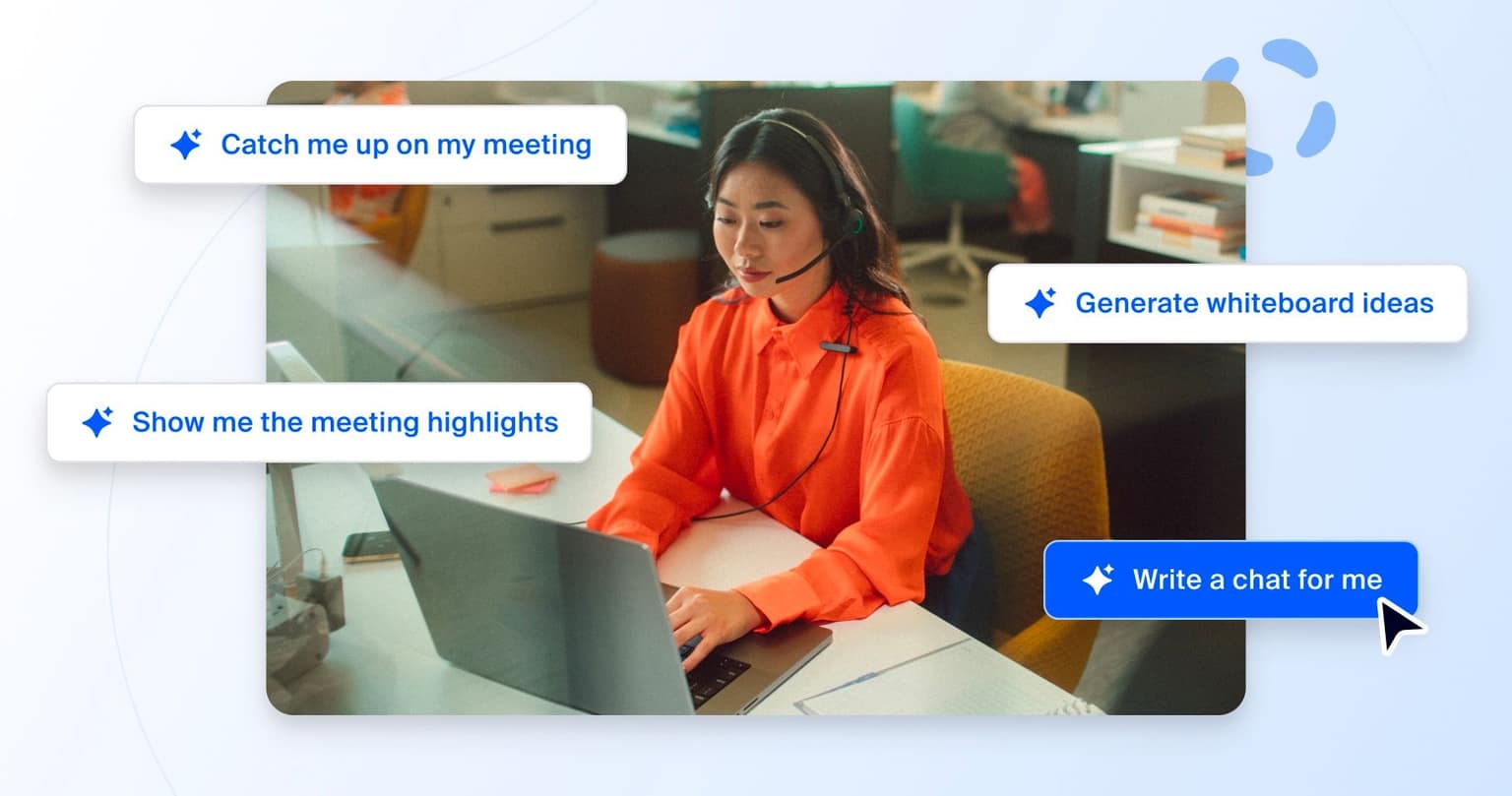
Zoom AI Companion is included in most paid Zoom plans and quietly took the entry-level note-taker market in 2024–2025. It's not the best at any single thing, but it's already there, it's already paid for, and the summaries are good enough that most teams who hadn't standardized on a competitor stopped looking.
Production credibility: ships free with paid Zoom plans (Pro, Business, Business+, Enterprise); deployed across the 220K+ enterprises that already pay Zoom; SOC 2 Type II, HIPAA, FedRAMP-authorized, and EU-residency options inherited from Zoom's enterprise compliance posture.
What it wins at: zero procurement friction, native Zoom integration, and "good enough" summaries that ship straight into the meeting host's inbox. For teams that meet exclusively on Zoom and don't need post-call coaching, it's the boring correct answer.
Where it falls down: locked to Zoom — useless for Meet, Teams, or in-person meetings. Workflow downstream (CRM sync, shared libraries, search across older meetings) is thin. A floor, not a ceiling.
How to Choose Between Them
Most teams over-research this category. Pick by the dominant shape of your meetings:
- Mixed internal + external meetings, want one tool: Fireflies
- Solo or small team, don't want to buy software: Fathom
- Sales org with serious pipeline: Gong (or Fireflies if budget is tight)
- Founder or PM who already takes notes by hand: Granola
- Async-first company that re-watches calls: tl;dv
- Live transcription is the use case: Otter
- Already on Zoom, don't want to buy anything: Zoom AI Companion
Buying two of these is rarely useful — note-takers compete for the same calendar slots. Pick one for the team, and let individuals who need a different shape (e.g., one AE who runs Granola for their own notes) layer it on top.
Adjacent Reading
- Top Conversational AI Platforms (2026) — voice agents and the broader conversational AI category
- Top AI Voice Tools for 2026 — voice cloning, TTS, and the audio-AI ecosystem note-takers depend on
- Best AI SDR Tools for Inbound Conversion — the SDR-specific automation that pairs with Gong-style call intelligence
Frequently Asked Questions
Are AI meeting note-takers accurate enough to rely on? For English-language professional meetings on a decent connection, transcription accuracy is now in the 95%+ range across all the tools above — accurate enough to rely on for action items, decisions, and search. Accents, technical jargon, and overlapping speakers still trip every model. For high-stakes contexts (legal, medical, regulatory), don't substitute the AI summary for a human review.
Is it legal to record and transcribe my meetings? Depends on your jurisdiction. The US is split between one-party consent and all-party consent states; the EU and UK require explicit consent under GDPR. All the tools above announce themselves at meeting start, but "the bot was visible" isn't always sufficient consent. Get your legal team to write a one-paragraph standard you say out loud at the start of external calls, and follow it.
What about privacy and data retention? All the major tools have enterprise tiers with SOC 2 Type II compliance, data residency options, and zero-retention guarantees on the LLM side. Free and consumer tiers don't always. If your meetings touch regulated data (PHI, financial advice, attorney-client), use the enterprise tier with a signed DPA — or don't record those meetings.
Will my customers be annoyed by the bot? Prospects in 2026 are used to seeing a note-taker join. The friction has dropped substantially since 2023. Friction goes back up if (a) the bot is the only attendee from your side at the start of the call, or (b) the bot announces itself awkwardly mid-call. Both are easy to avoid.
Can I use multiple note-takers on the same call? Technically yes, practically don't. Two bots create transcription confusion, license costs double, and the host is making a worse experience for everyone to A/B test a tool. Pilot one at a time.
What's the typical pricing in 2026? Free tiers (Fathom, Otter free, Zoom AI Companion via Zoom) cover individual users and small teams. Mid-tier products (Fireflies, Otter Pro, tl;dv) run $10–25/user/month. Granola is $14/user/month for individuals, $25/user/month for teams. Gong is custom-priced and lands in the mid-five-to-low-six figures annually for typical 50-rep deployments.
Does the AI summary catch action items reliably? For meetings where action items were spoken explicitly ("I'll send the contract Friday"), yes — accuracy is high across all the tools above. For meetings where action items were implied or decided non-verbally (head nods, shared docs in the background), no tool reliably captures them. Pair the AI summary with a 30-second human review at the end of important calls.
Final Thoughts
AI meeting note-takers are a solved category for the easy 80% of meetings and a still-evolving one for the hard 20%. For most teams, the right move is to pick one that matches your meeting shape, standardize on it, and stop deliberating. The hours per week recovered are real — the seat cost is rounded down to zero against a single rep's salary, and the compounding value of a searchable archive of every customer call shows up six months in, not on day one.
The question worth deliberating isn't which note-taker to use. It's whether your team is reviewing the captured calls afterward — because every tool in this list will record the meeting; only the team that builds a habit of reading them gets the actual leverage.
Compare tools in this collection
Categories these tools span
More collections you may also like
Sign up for our newsletter
Receive weekly updates so you can stay up-to-date with the world of AI
Sign up for our newsletter
Receive weekly updates so you can stay up-to-date with the world of AI
The AI tools directory for discovering, exploring, and comparing the most innovative AI tools in the industry