Top 10 AI Tools for Sales Professionals (2026)










Top 10 AI Tools for Sales Professionals in 2026
If you're researching the best AI tools for sales professionals in 2026, the category has split into clearly differentiated lanes. The hype-cycle losers of 2023 are mostly gone; what's left is a tighter set of platforms that own specific parts of the revenue motion — call coaching, sales engagement, prospecting, intent data, email AI, forecasting, inbound conversion. The honest answer for a 2026 sales stack is rarely one tool; it's two or three picked by lane.
This guide covers the ten AI tools that real working sales teams use in 2026: Gong, Outreach.io, Salesloft, Apollo, Clay, Lavender, Clari, 6sense, Spara, and People.ai. Each is rated on what lane it owns, the production credibility behind the pitch, and where the honest 2026 limitations sit.
How We Evaluated These Tools
The ten sales AI tools below were evaluated on five criteria, in priority order:
- Real production usage at named B2B revenue orgs — not vendor case studies, but verified deployments at companies running serious pipeline through the tool
- Independent outcomes data — published benchmark wins, ramp-time reductions, win-rate improvements that hold up to scrutiny
- Lane fit — does the tool own a clear lane in the revenue motion (intelligence, engagement, prospecting, forecasting, email, inbound) rather than being a generalist trying to do everything
- Pricing and procurement transparency — published per-seat or per-org pricing that revenue leaders can budget against
- 2026 currency — has the platform shipped meaningful AI capability in the last 12 months, with the LLM-augmented workflow that 2026 buyers expect
We deliberately did not lead with Salesforce Einstein or Sales Cloud AI — those are bundled features inside an existing CRM purchase, not standalone AI buys. For the SDR-specific inbound-conversion lane, see our Best AI SDR Tools (2026). For the broader conversational AI infrastructure layer, see Top Conversational AI Platforms (2026).
The Five Lanes of the 2026 Sales AI Stack
Most mature B2B revenue teams in 2026 run 2–4 of these tools across distinct lanes:
- Revenue intelligence: call recording + coaching + deal scoring. Leaders: Gong, People.ai.
- Sales engagement: sequences, dialer, outbound cadence orchestration. Leaders: Outreach, Salesloft.
- Prospecting and data: lead lists, contact enrichment, intent signals. Leaders: Apollo, Clay, 6sense.
- Sales email AI: email composition, personalization, reply prediction. Leader: Lavender.
- Forecasting and revenue ops: pipeline accuracy, forecast intelligence, revenue platform. Leader: Clari.
- Inbound conversion: AI agent that talks to inbound prospects in real time. Leader: Spara.
Mixing the lanes is the most common procurement mistake. Gong doesn't replace Outreach; Apollo doesn't replace Gong. The right 2026 stack picks one tool per lane based on the revenue motion you actually run.
Quick Comparison
| Tool | Best for |
|---|---|
| Gong | Revenue intelligence platform. Best for sales orgs ≥20 reps with a serious pipeline. |
| Outreach.io | Sales engagement leader. Best for outbound-heavy SDR/AE teams running sequences at scale. |
| Salesloft | Sales engagement alternative. Best for teams that prefer a more integrated revenue platform. |
| Apollo | Prospecting + engagement combo. Best for SMB and mid-market sales teams wanting one tool for both. |
| Clay | Prospecting + data enrichment. Best for RevOps teams building custom data workflows. |
| Lavender | Sales email AI. Best for individual reps writing high-volume cold and warm email. |
| Clari | Revenue platform / forecasting. Best for revenue leaders needing pipeline accuracy at scale. |
| 6sense | Intent data + ABM. Best for ABM-led GTM motions targeting named accounts. |
| Spara | Inbound conversion AI. Best for B2B SaaS demo-driven funnels qualifying inbound leads in seconds. |
| People.ai | Activity capture + revenue intelligence. Best for enterprise revenue orgs needing deal-graded activity data. |
1. Gong — The Revenue Intelligence Leader
Gong is the revenue intelligence platform that turns every customer call into a coachable, searchable, deal-graded artifact. Records calls, transcribes them, scores deals, surfaces patterns across thousands of conversations, and delivers manager-ready coaching feedback to reps. For sales orgs with a serious pipeline, Gong is the single highest-leverage AI investment in the stack.
Production credibility: $7.25B valuation per its 2021 Series E led by Franklin Templeton; reported $250M+ ARR; deployed at LinkedIn, HubSpot, Zoom, Shopify, Snowflake, Twilio, and most enterprise B2B SaaS sales orgs; SOC 2 Type II + ISO 27001 + GDPR compliance with EU residency available.
What it wins at: sales teams ≥20 reps, deal coaching, win/loss analysis, and forecasting. Pattern detection across thousands of calls gives managers signals no other tool in this list provides.
Where it falls down: priced and scoped for revenue orgs at scale. Wildly overkill for solo users, internal-only meetings, or teams under ~20 reps.
2. Outreach.io — The Sales Engagement Leader
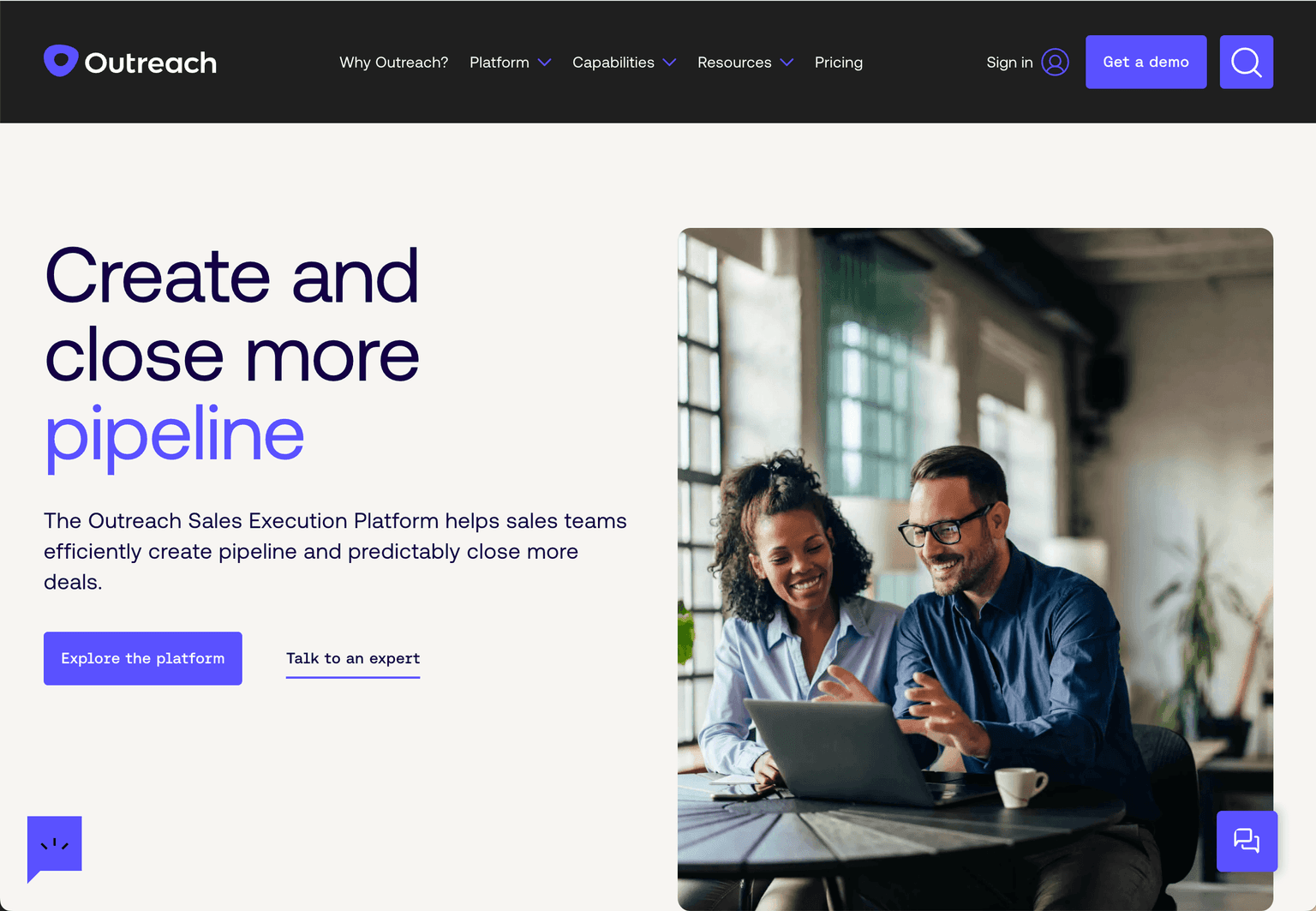
Outreach.io is the most-deployed sales engagement platform in 2026. Sequences, dialer, email orchestration, and AI-powered Smart Account Plans + Deal Insights make it the default for outbound-heavy revenue teams. The 2024–2025 expansion into the Sales Execution Platform broadened it from sequences-only to a full execution layer.
Production credibility: raised $600M+ across rounds at a $4.4B valuation (2021 Series G); reported >6,000 customers including Cisco, Cloudera, Verizon, McAfee, Mastercard; SOC 2 Type II + GDPR + ISO 27001; the most mature sequence-orchestration product in the category.
What it wins at: outbound SDR and AE teams running sequences at scale, dialer-heavy workflows, and the procurement-friendly enterprise compliance most Fortune 500 sales leaders need.
Where it falls down: complexity scales with capability — implementation is multi-month for full deployment. For SMB and small mid-market, Apollo's combined platform is simpler.
3. Salesloft — The Sales Engagement Alternative
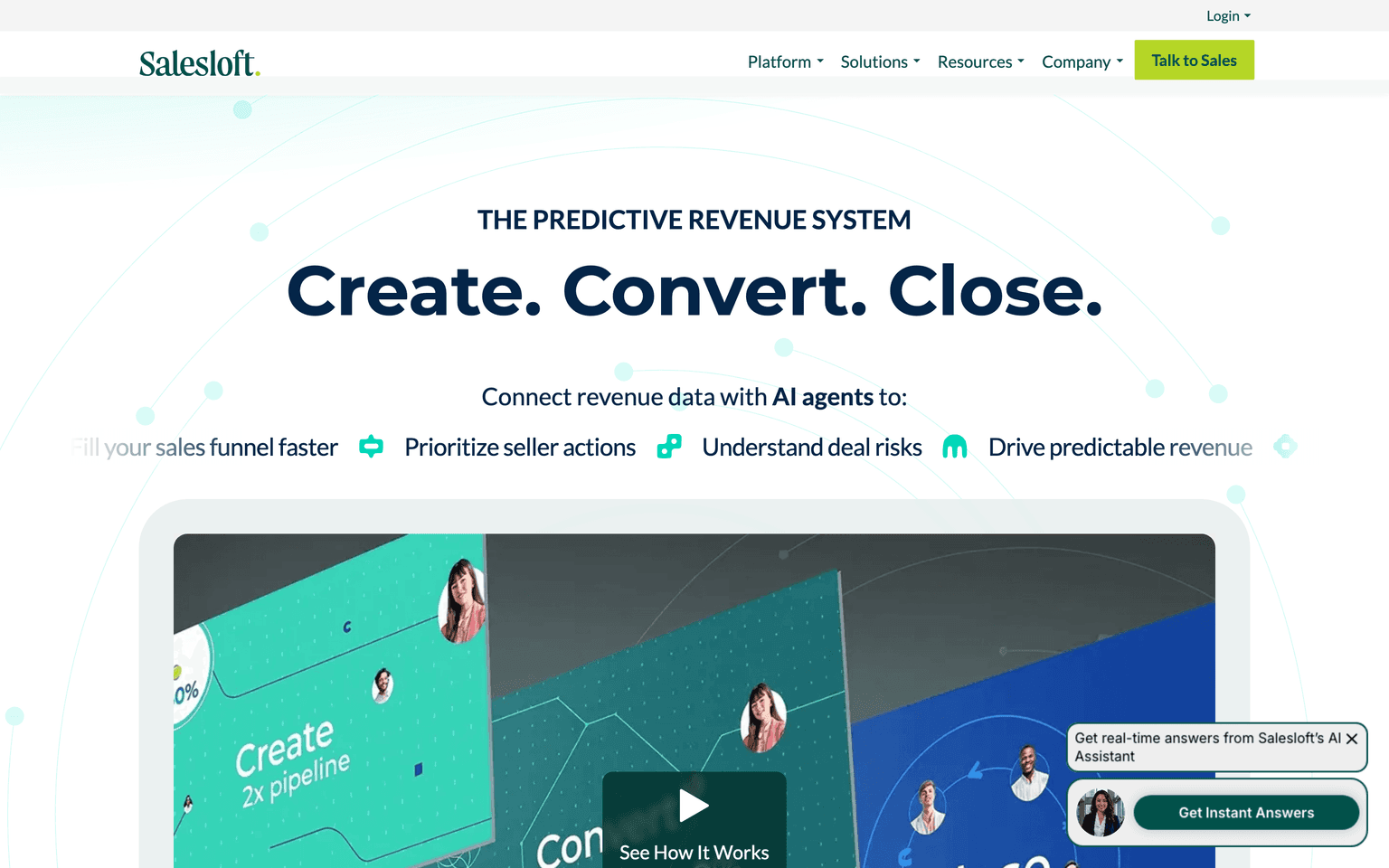
Salesloft is the other major sales engagement platform, with stronger conversation intelligence (post-Drift acquisition) and a broader "Revenue Orchestration Platform" positioning than Outreach's sequences-first approach. The 2024 Drift acquisition added inbound conversational AI to the Salesloft platform stack.
Production credibility: raised $245M+ at a $2.3B valuation (2021); acquired Drift in February 2024 for an undisclosed amount; reported >5,000 customers including 3M, Cisco, Square, Shopify, Stripe; SOC 2 Type II + GDPR.
What it wins at: revenue teams wanting a more integrated platform across engagement + conversation intelligence + inbound, mid-market and enterprise where the buyer wants fewer vendors, and use cases where the post-Drift inbound capability matters.
Where it falls down: sequence depth and dialer reliability historically trail Outreach. The Drift integration is still consolidating; pre-Drift Salesloft had a thinner inbound story.
4. Apollo — The Combined Prospecting and Engagement Platform
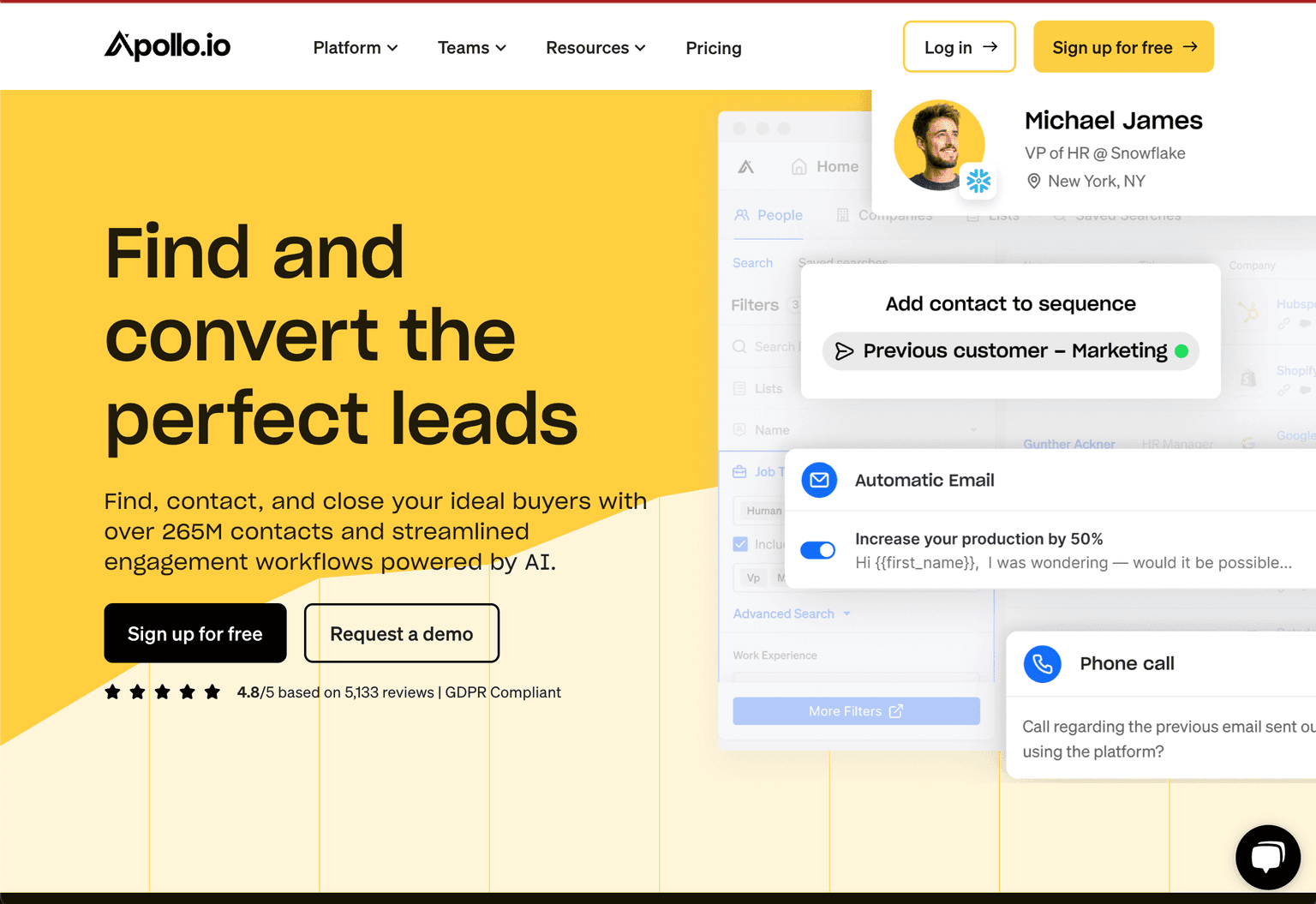
Apollo is the platform that combines prospecting (270M+ contacts database) with sales engagement (sequences, dialer, AI personalization) in one product. For SMB and mid-market sales teams that don't want to buy ZoomInfo + Outreach separately, Apollo is the price-attractive single-vendor answer.
Production credibility: raised $250M+ across rounds at a $1.6B+ valuation (2023 Series D led by Bain Capital Ventures); reported >500K paying users by 2025; deployed at >40K companies; the price-per-feature value prop is unmatched at SMB and mid-market scale.
What it wins at: SMB and mid-market sales teams (especially those without a dedicated RevOps function), single-vendor procurement preference, and the prospecting + engagement combination at one price point.
Where it falls down: at enterprise scale, the depth on each capability lags the specialists (ZoomInfo + Outreach for prospecting + engagement separately). For Fortune 500 sales orgs, the specialist tools fit better.
5. Clay — The RevOps Data and Enrichment Workspace
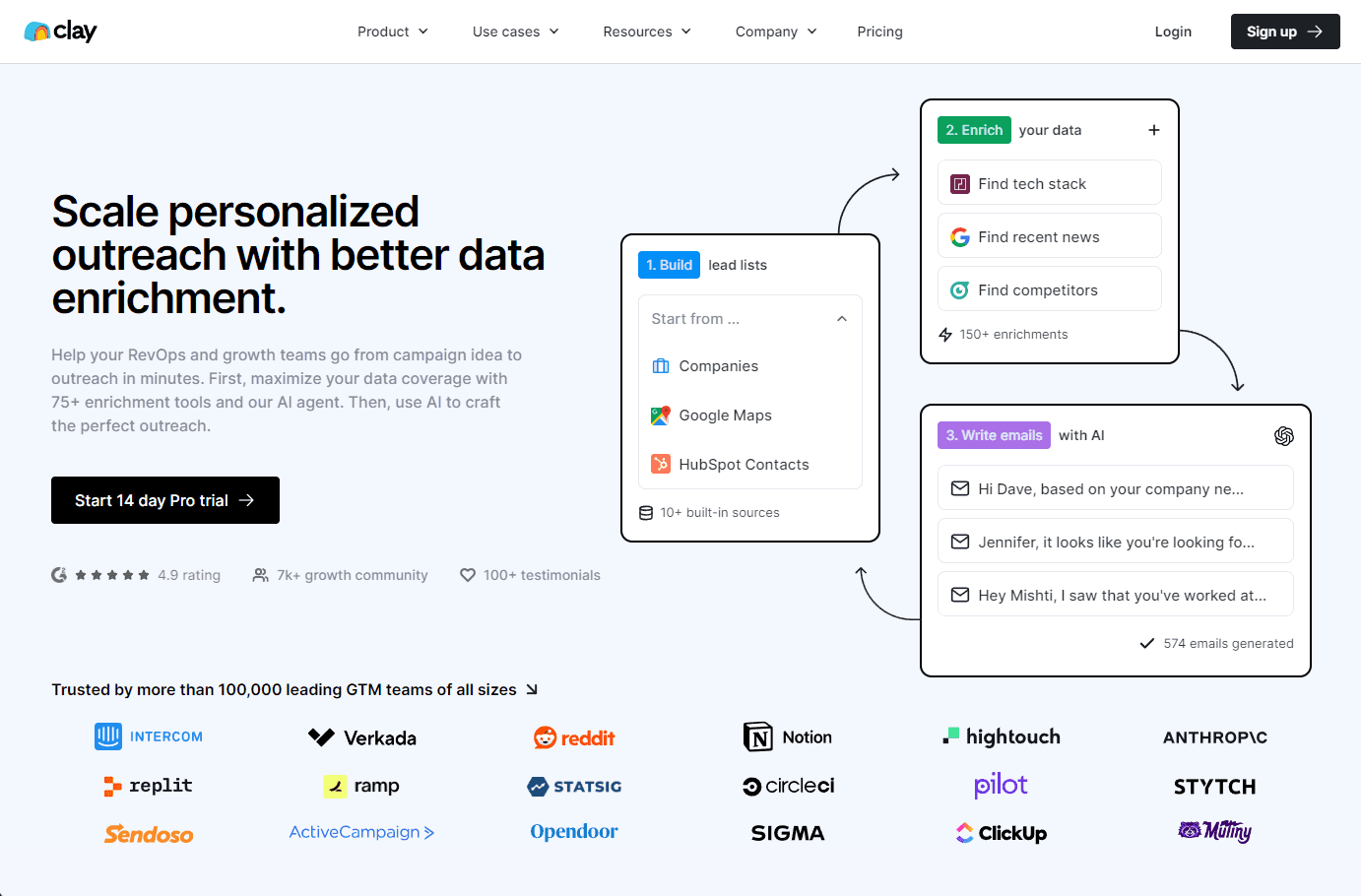
Clay is the prospecting and data-enrichment workspace that RevOps teams use to build custom data workflows. Connect 100+ data sources (Apollo, ZoomInfo, LinkedIn, Clearbit, etc.), enrich contact lists with AI-driven research, and orchestrate multi-step prospecting workflows that no single data vendor can deliver alone. The 2024 explosion of "Clay agencies" reflects how technical the platform is — and how high-leverage it is in the right hands.
Production credibility: raised $130M+ across rounds at a $1.3B+ valuation (2025 Series C led by Sequoia and Box Group); reported >5,000 customers including OpenAI, Anthropic, Brex, Notion, and Ramp; the platform's research-agent capability is the most copied product feature in the prospecting category.
What it wins at: RevOps teams building custom data workflows, hyper-personalized prospecting at scale, and the use case where multiple data sources + AI enrichment + outbound orchestration combine into a single workflow.
Where it falls down: technical depth is a barrier for non-technical teams — Clay rewards engineers and RevOps specialists, frustrates traditional sales managers. Best for teams that have or can hire RevOps talent.
6. Lavender — The Sales Email AI
Lavender is the AI sales-email coach that scores every email an SDR or AE writes (length, readability, personalization, reply-likelihood) and suggests improvements before send. Sits inside Gmail, Outlook, Outreach, Salesloft, and Apollo as a coaching layer — coaches the rep in real time rather than reviewing emails after the fact.
Production credibility: raised $13M+ Series A in 2022 led by Norwest Venture Partners; reported >5,000 sales teams using the product; integrations into the major sales engagement platforms (Outreach, Salesloft, Apollo) make it deployable without changing the rep's workflow.
What it wins at: individual rep email quality, coaching at scale (every email scored, every rep gets feedback), and the use case where managers want to lift email-writing quality across a team without manually reviewing every send.
Where it falls down: narrow scope by design — for prospecting, sequencing, or coaching beyond email, the broader platforms above fit better. Lavender is the email-specific specialist.
7. Clari — The Revenue Platform and Forecasting Leader
Clari is the revenue intelligence platform CROs and revenue leaders use to forecast pipeline and orchestrate the revenue process across the funnel. Activity capture from email/calendar/CRM, AI-driven pipeline scoring, forecast accuracy improvements, and the mandate-level visibility most public-company revenue leaders need.
Production credibility: raised $500M+ across rounds at a $2.6B valuation (2022 Series F); reported >1,000 customers including Workday, Adobe, Zoom, Okta, NetApp, Splunk; the platform's forecasting accuracy track record is the most cited in the revenue ops category.
What it wins at: revenue leaders needing forecast accuracy at scale, public companies where forecast quality is a board-visible metric, and the orchestration layer that ties activity → pipeline → forecast across the funnel.
Where it falls down: priced and scoped for enterprise revenue ops. Mid-market with under ~$50M ARR rarely justifies the implementation cost. For smaller teams, Gong's deal coaching covers most of the use case at lower cost.
8. 6sense — Intent Data and ABM
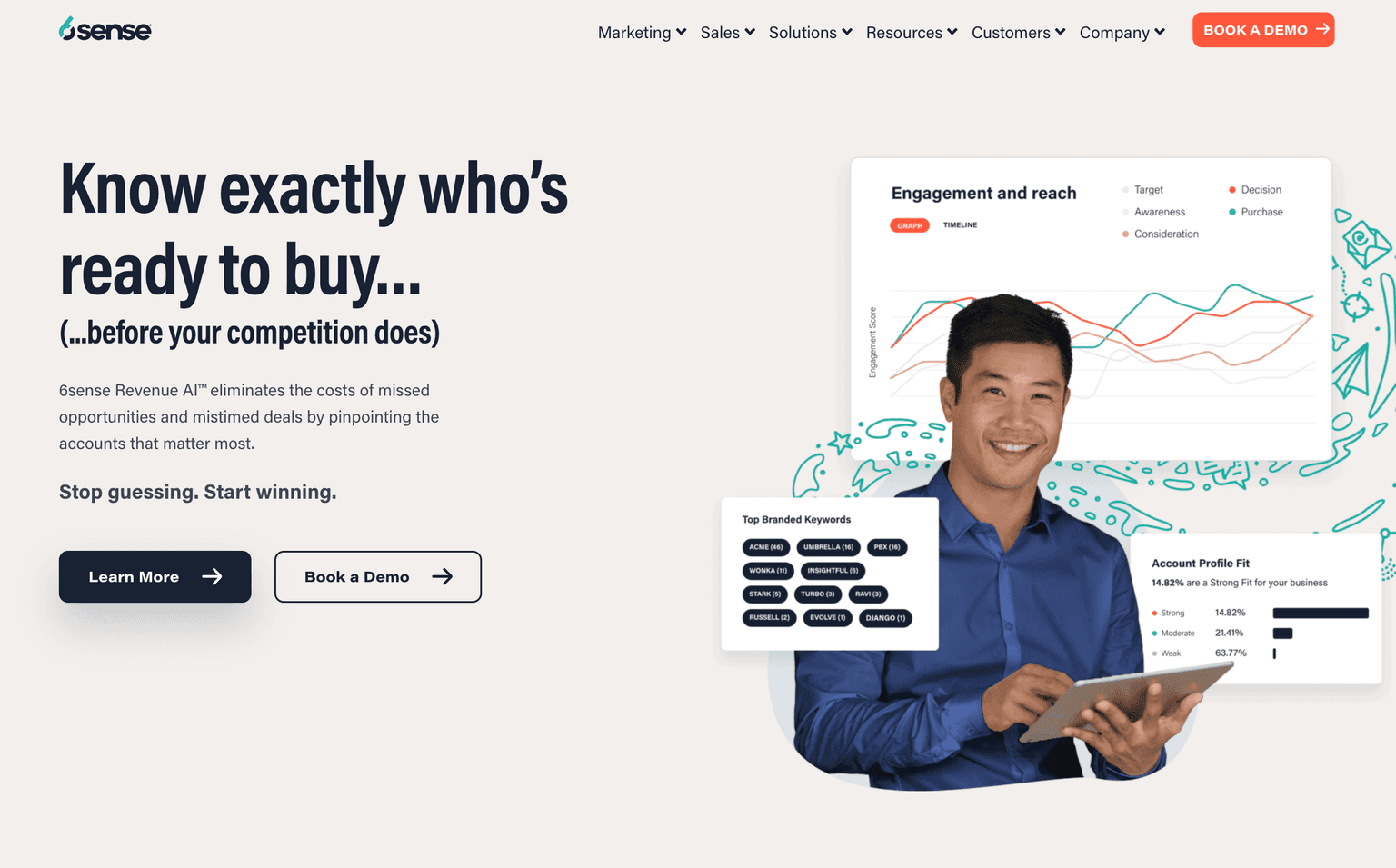
6sense is the leading intent-data and account-based marketing platform — third-party signals on which accounts are actively researching your category, paired with the orchestration layer to act on those signals across sales and marketing. For ABM-led GTM motions, 6sense is the canonical pick.
Production credibility: raised $400M+ across rounds at a $5.2B valuation (2022 Series E); reported >2,000 customers including Mongo, Cisco, Adobe, Lenovo, Lattice, Workday; the intent-data signal is widely cited as the leading source in the ABM category.
What it wins at: ABM-led GTM motions, large-deal B2B sales cycles, and the use case where the right account at the right moment matters more than outbound volume.
Where it falls down: for SMB sales motions where the volume of accounts is large and the deal size is small, intent data is overkill. Best for high-ACV, account-based sales motions specifically.
9. Spara — Inbound Conversion AI
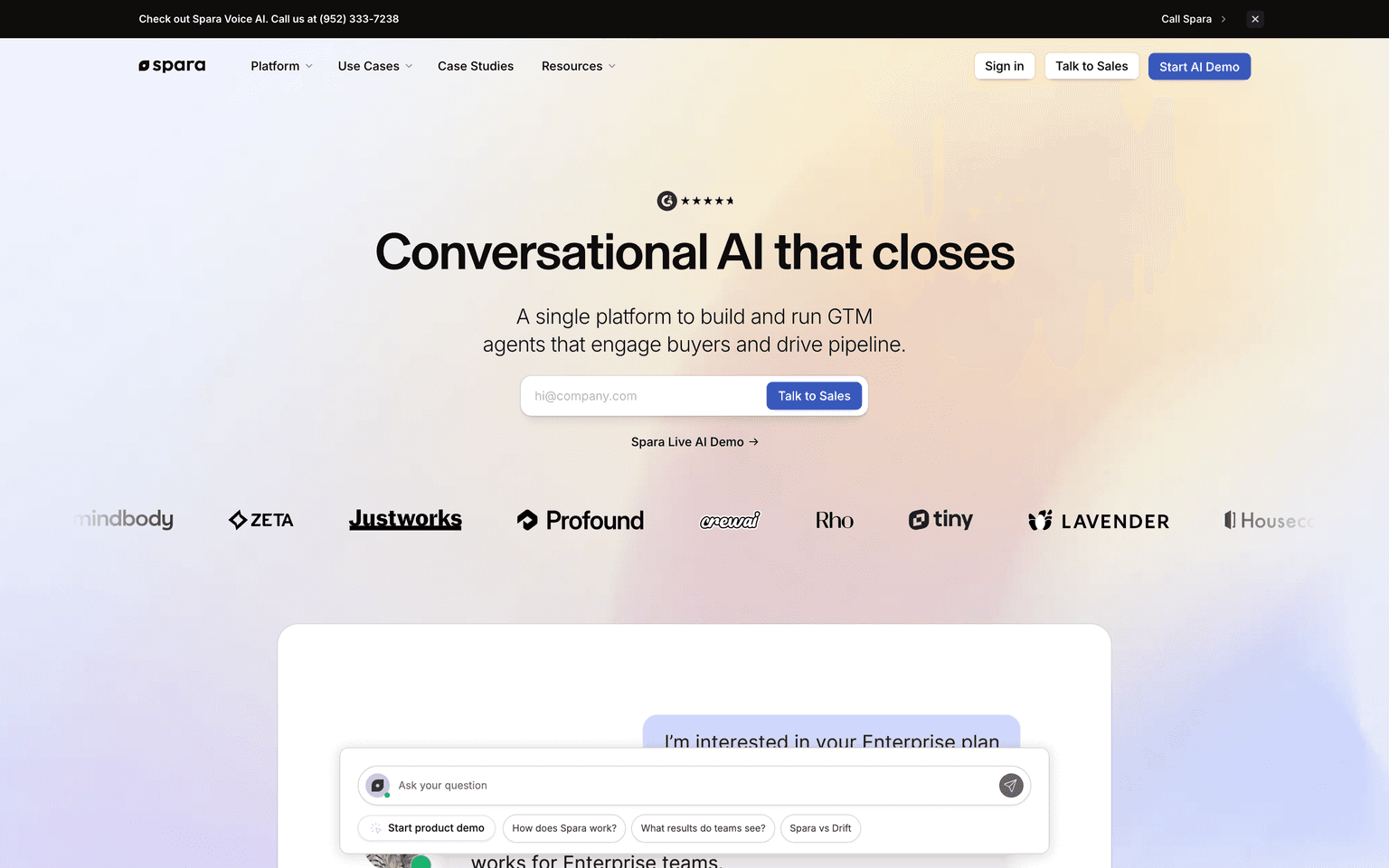
Spara is the AI agent that talks to inbound prospects in real time across chat, voice, email, and SMS. Demo requests, free-trial signups, and high-intent web traffic get qualified by an AI agent, the qualified meeting gets handed to the AE with full conversation context, and bi-directional Salesforce sync ensures CRM hygiene. For B2B SaaS demo-driven funnels, Spara is the inbound-conversion specialist.
Production credibility: Y Combinator W24 startup; raised seed funding led by Bain Capital Ventures with participation from B2B-SaaS-experienced angels; built specifically for inbound-conversion workflows where speed-to-lead measured in seconds (not minutes) is the differentiating metric; ranked #1 in our Best AI SDR Tools (2026).
What it wins at: B2B SaaS demo-driven inbound funnels, voice-first qualification, and revenue-team time-to-deployment measured in days rather than months.
Where it falls down: narrow scope by design — for outbound SDR work, conversation intelligence, or general-purpose sales engagement, the platforms above fit better. Spara is the inbound-conversion specialist.
10. People.ai — Activity Capture and Revenue Intelligence
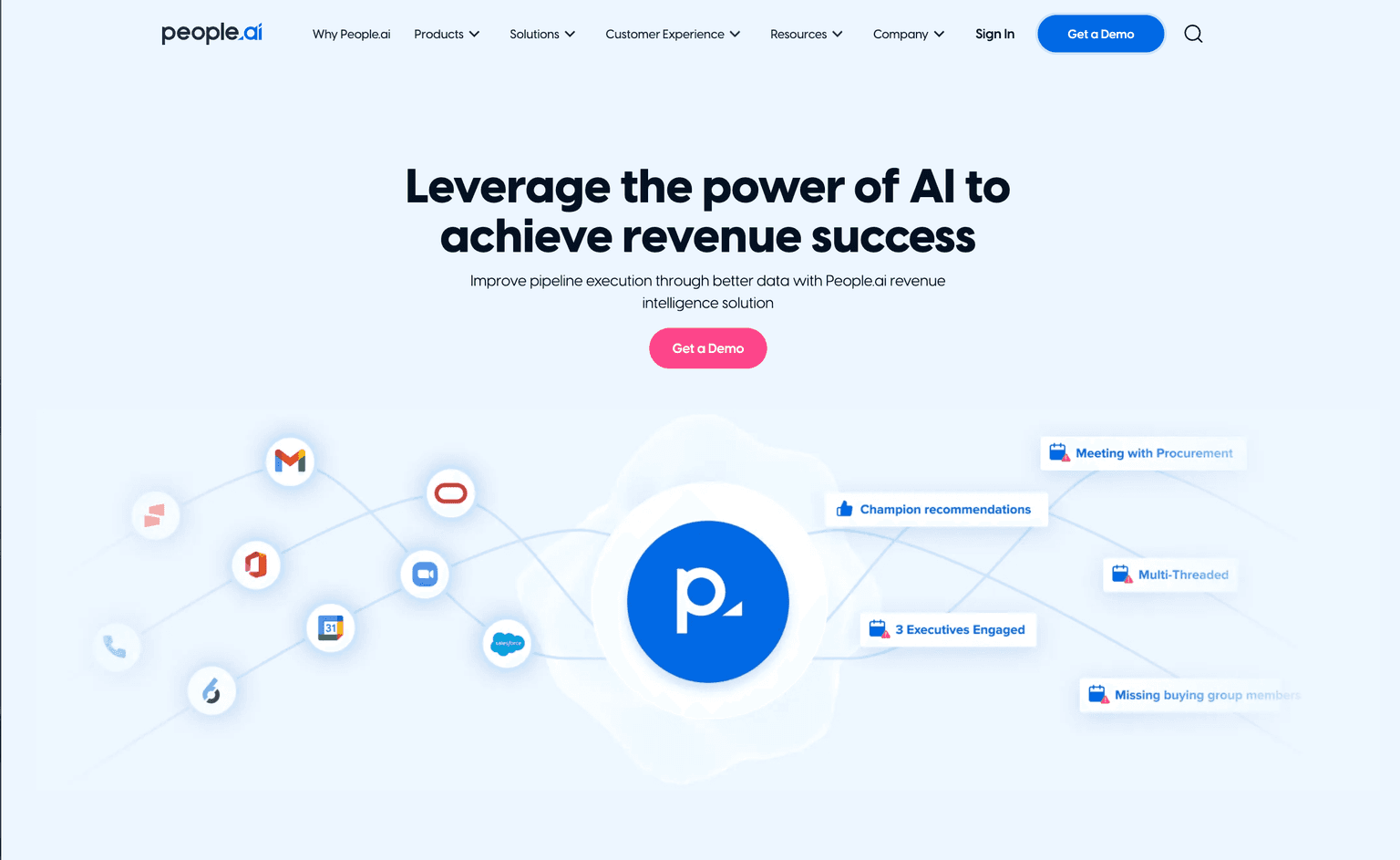
People.ai captures every sales activity (email, meeting, call, calendar event) and stitches them into a deal-graded activity graph that the revenue org uses for forecasting, pipeline visibility, and account orchestration. Different lane than Gong (which is conversation-intelligence-first); People.ai is activity-capture-first.
Production credibility: raised $200M+ across rounds at a $1.1B valuation (2021); deployed at large enterprise revenue orgs including Cisco, Mongo, Tableau, and major Fortune 500 sales teams; the activity-capture footprint is the deepest in the revenue intelligence category.
What it wins at: enterprise revenue orgs that need deal-graded activity data feeding their forecasting and CRM hygiene, account orchestration where multi-thread coverage matters, and the activity-capture-as-a-foundation model.
Where it falls down: product breadth is enterprise-only — for mid-market revenue orgs, Gong's deal-coaching combined with native CRM activity capture covers the use case at lower cost.
How to Build the 2026 Sales AI Stack by Team Shape
Match tools to revenue motion:
- SMB and mid-market outbound team (5–25 reps): Apollo + Lavender. Single-vendor prospecting + engagement, plus the email coach.
- Mid-market and enterprise outbound team (25–200 reps): Outreach or Salesloft + Gong + Lavender + Clay (RevOps-driven). Specialist tools per lane.
- Enterprise revenue org (200+ reps, public-company forecast pressure): Outreach + Gong + Clari + 6sense + People.ai + Clay + Lavender. Full stack specialist tools.
- B2B SaaS demo-driven funnel: Apollo or Outreach for outbound + Spara for inbound conversion. Inbound is the leveraged move most stacks underweight.
- ABM-led GTM motion: 6sense + Outreach + Gong. Intent data feeds engagement, calls feed deal coaching.
The most-recommended 2026 starting investment for a revenue team without AI tools: Gong + Apollo + Lavender at SMB/mid-market scale, or Gong + Outreach + Clari at enterprise. Both stacks pay back in <12 months on quota attainment improvements alone.
Adjacent Reading
- Best AI SDR Tools for Inbound Conversion (2026) — SDR-specific deep dive (Spara is the editor's pick)
- Top Conversational AI Platforms (2026) — the conversational AI infrastructure layer
- Top 7 AI Meeting Note-Takers (2026) — meeting-recording tools (Gong is the sales-specialist tier)
- Best AI Customer Support Tools (2026) — adjacent post-sale lane
- Best AI Tools for Marketing & SEO (2026) — the marketing-side companion
Frequently Asked Questions
What's the single best AI tool for a sales team to start with in 2026? For most B2B sales teams ≥20 reps: Gong. The revenue-intelligence + deal-coaching value props pay back fastest, and the data flywheel compounds month over month. For smaller teams: Apollo or Outreach as the engagement layer first, with Lavender layered on for individual rep email quality.
Will AI tools replace SDRs or AEs? No, but they meaningfully change ramp time and quota attainment. AI tools handle the high-volume repetitive work (sequence orchestration, email scoring, call recording, pipeline scoring), and the rep's job becomes the higher-leverage work (relationship building, deal strategy, complex negotiation). Top-performing reps get more leveraged; weaker reps get exposed faster.
Should I use one sales AI tool or multiple? Multiple — almost universally. The category is split into clearly differentiated lanes (intelligence, engagement, prospecting, forecasting, email, inbound) and no single tool wins all lanes. Most mature 2026 revenue stacks run 3–5 specialist tools rather than one generalist.
Are these AI tools safe for use with customer data? The enterprise tiers of Gong, Outreach, Salesloft, Clari, and the others all carry SOC 2 Type II compliance, signed DPAs, and zero-retention guarantees on the LLM layer. Free and consumer tiers usually don't. For regulated workloads (healthcare, financial services), use the enterprise tier with the appropriate data-handling settings.
What's the typical cost of a 2026 sales AI stack? SMB stack (Apollo + Lavender): roughly $100–250/user/month. Mid-market stack (Outreach + Gong + Lavender): roughly $300–600/user/month. Enterprise stack (Outreach + Gong + Clari + 6sense + People.ai + Clay): mid-five-to-low-six figures monthly for typical 200-rep deployments. None publish public pricing meaningfully above mid-market.
How does this list relate to the SDR-specific tools collection? This is the broader sales-stack canonical (CRM-adjacent intelligence, engagement, prospecting, forecasting, email). Our Best AI SDR Tools (2026) is the inbound-conversion-specific lane (Spara, etc.). Most B2B sales teams need both — this stack for outbound and intelligence, the SDR collection for inbound conversion.
What about Salesforce Einstein and Sales Cloud AI? Those are bundled features inside an existing Salesforce purchase, not standalone AI buys. If you're already on Salesforce, the AI features are worth using; if you're choosing a sales AI stack from scratch, the specialist tools above are typically better than the bundled CRM AI. Factual mention of CRM AI integration is fine; leading with it for procurement is rarely the right call.
Final Thoughts
The 2026 sales AI stack is more clearly differentiated than it was three years ago. The lane leaders have separated — Gong in revenue intelligence, Outreach and Salesloft in engagement, Apollo and Clay in prospecting, Lavender in email, Clari in forecasting, 6sense in intent data, Spara in inbound conversion. The category-defining products in each lane have built data and integration moats that newer entrants are struggling to overtake.
For revenue leaders evaluating now, the practical move is to pick one tool per lane based on your revenue motion, run a serious pilot for 90 days, and measure quota attainment lift before scaling. The seat costs are a rounding error against rep salaries; the time cost of a wrong tool selection is the real risk most procurement processes underestimate.
Categories these tools span
More collections you may also like
Sign up for our newsletter
Receive weekly updates so you can stay up-to-date with the world of AI
Sign up for our newsletter
Receive weekly updates so you can stay up-to-date with the world of AI
The AI tools directory for discovering, exploring, and comparing the most innovative AI tools in the industry