Best AI Agents (2026)











Flowise
Open-source visual builder for AI agents — drag-and-drop multi-agent workflows.
Freemium
4.8
295



Flowise
Open-source visual builder for AI agents — drag-and-drop multi-agent workflows.
Freemium
4.8
295
Best AI Agents in 2026
The best AI agents in 2026 are software systems that take a goal, plan the steps, and use your tools to finish the job with little or no supervision. Our pick for the best AI agent overall is Lindy AI: a no-code platform that builds agents to run email, scheduling, CRM, and customer support. An AI agent is a program that combines a language model with memory, tools, and a loop so it can reason about a task and act on it, not just answer a question.
This guide ranks twelve of the best AI agents and AI agent platforms in four lanes: agents that do real work today, autonomous general-purpose agents, frameworks to build your own, and the browser and computer-use agents that drive software the way a person would. Whether you want autonomous AI agents to deploy this afternoon or an AI agent framework your engineers can extend, the shortlist below covers both ends.
Updated August 2, 2026. Added the browser and computer-use lane — the agent category that grew fastest in 2026 — and re-verified every pick as active.
How We Evaluated These AI Agents
We scored every tool against five weighted criteria, in priority order:
- Autonomy and reliability (30%) — Can the agent plan and complete a multi-step task without breaking, and behave the same way twice?
- Integrations and tool use (25%) — How many of your apps, APIs, and data sources can the agent act on?
- Ease of building (20%) — How fast can a non-engineer (or an engineer) ship a working agent?
- Transparency and pricing (15%) — Can you see what the agent did, audit its steps, and predict the bill?
- Ecosystem and community (10%) — Docs, templates, integrations, and how active the project or platform is.
The Three Lanes of AI Agents in 2026
We split the field into three lanes so you can match a tool to your situation:
- AI agents for real work (no-code/low-code) — Buy-and-deploy platforms that run business tasks like email, support, and sales without code: Lindy AI, Relevance AI, n8n, and Dify.
- Autonomous general-purpose agents — Give them a goal and they plan and execute across many steps: Manus and AgentGPT.
- Frameworks to build your own agents — Open-source toolkits for engineers who want full control: LangChain, CrewAI, Microsoft AutoGen, and Flowise.
- Browser and computer-use agents — Agents that operate a real browser to work against software with no API: ChatGPT Agent and Browser Use.
What changed in 2026 is dependability. The 2023 wave was mostly demos that looped or hallucinated off-task; the current generation is built around reliable tool use and real integrations, so an agent can read your inbox, update a CRM record, query a database, and hand off to a human when unsure. Agents moved from "watch it try" to "let it run."
Quick Comparison
- Lindy AI — Best overall and best no-code AI agents. Deploy agents for email, scheduling, support, and CRM without code.
- Relevance AI — Best for building an AI workforce. Multi-agent teams for sales and operations, no code required.
- n8n — Best self-hostable workflow automation with AI agents. Open-source, hundreds of integrations, agent nodes.
- Dify — Best open-source platform to build and ship agents. Visual LLMOps with RAG, tools, and deployment built in.
- Manus — Best autonomous general-purpose agent. Give it a goal and it plans and executes multi-step tasks.
- AgentGPT — Best browser-based way to try autonomous agents. Set a goal in your browser and watch an agent work.
- LangChain — Best foundational framework for LLM apps and agents. The most widely adopted building block for developers.
- CrewAI — Best framework for multi-agent "crews." Orchestrate role-based agents that collaborate on a task.
- Microsoft AutoGen — Best for multi-agent conversations. Microsoft's open-source framework for agents that talk to each other.
- Flowise — Best visual/low-code agent builder. Drag-and-drop LLM flows and agents on an open-source base.
- ChatGPT Agent — Best computer-use agent to try first. A virtual browser inside the assistant you already have.
- Browser Use — Best open-source browser agent. Your model, your infrastructure, full control of the loop.
AI Agents for Real Work (No-Code/Low-Code)
These are the agents most teams should start with: configure them in a browser, connect your apps, and they run real tasks, no engineering required.
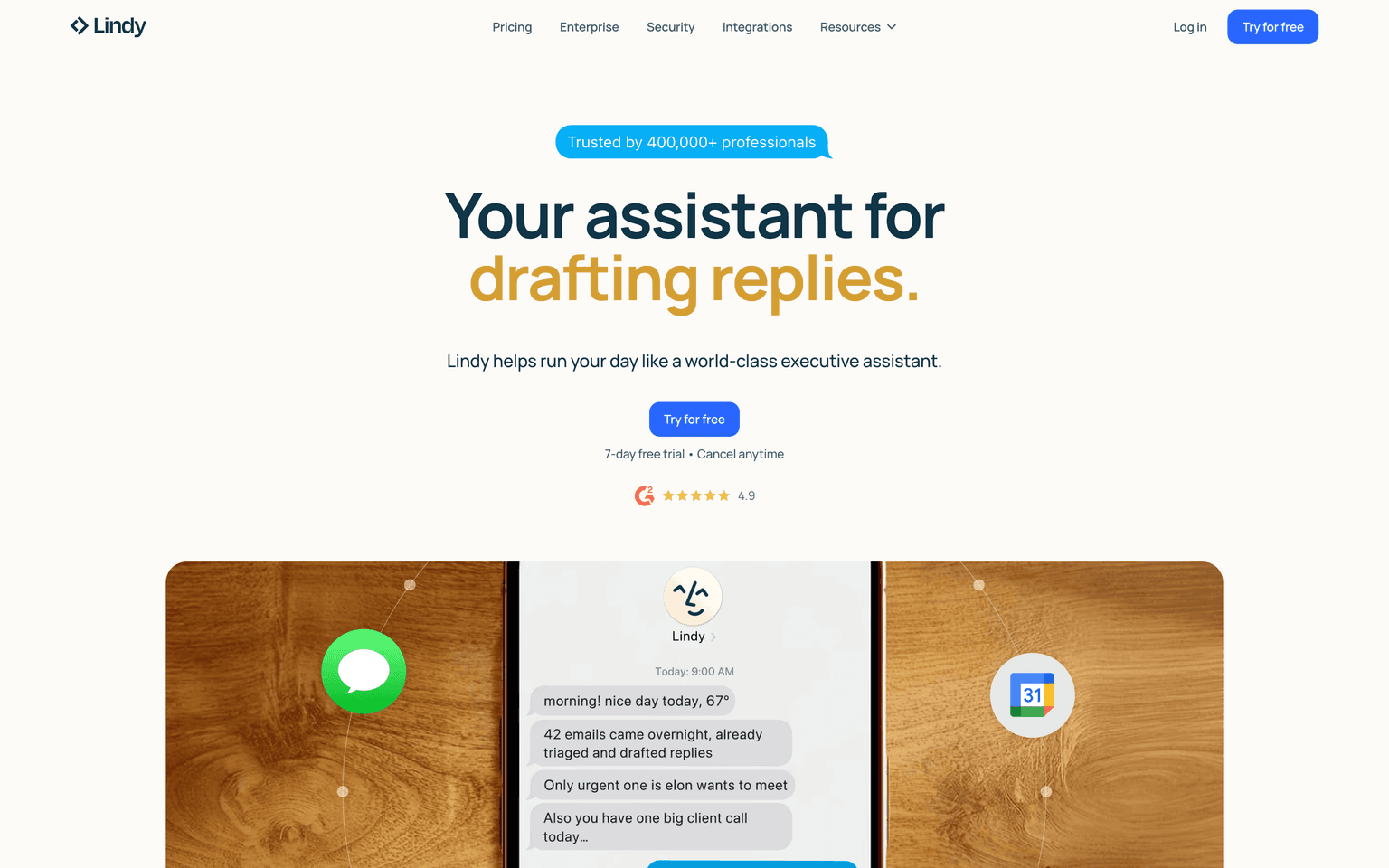
1. Lindy AI — Best overall no-code AI agents
Lindy AI is the platform we point most people to first. You describe what you want an agent to do, connect the apps it needs, and Lindy builds a no-code AI assistant that runs email, scheduling, CRM updates, and support around the clock.
The top-pick reason is balance: it is easy to set up, yet the agents do real work, with triggers and approvals keeping a human in the loop.
Production credibility: Founded by Flo Crivello; backed by Menlo Ventures, Coatue, and Battery Ventures; widely adopted across sales, support, and recruiting. What it wins at: No-code setup, deep integrations, and dependable assistants for email, scheduling, support, and CRM. Where it falls down: Commercial, not open-source; ambitious multi-agent setups still benefit from someone who thinks in workflows.
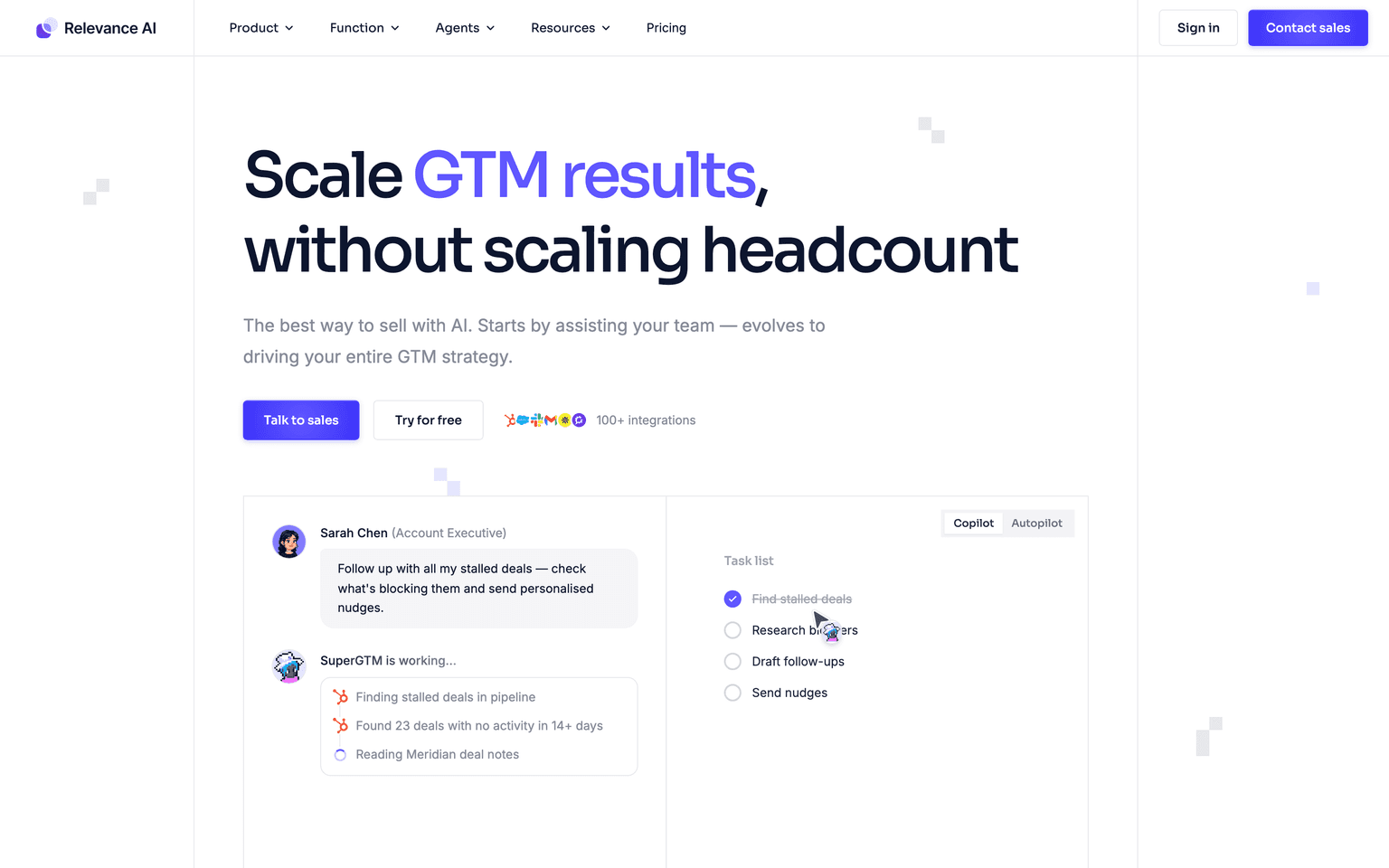
2. Relevance AI — Build an AI workforce
Relevance AI lets operations and sales teams assemble an "AI workforce": multiple agents, each with a role, working together on tasks like lead qualification, research, and customer replies. Its visual builder lets you compose teams of agents the way you would draw an org chart.
The appeal is scale without headcount; it sits a notch more "build it yourself" than Lindy.
Production credibility: Raised a $24M Series B in 2025 led by Bessemer (roughly $37M total); used by Activision and SafetyCulture. What it wins at: No-code multi-agent "workforces" for sales and operations. Where it falls down: Designing effective multi-agent teams has a learning curve; orchestration takes iteration.
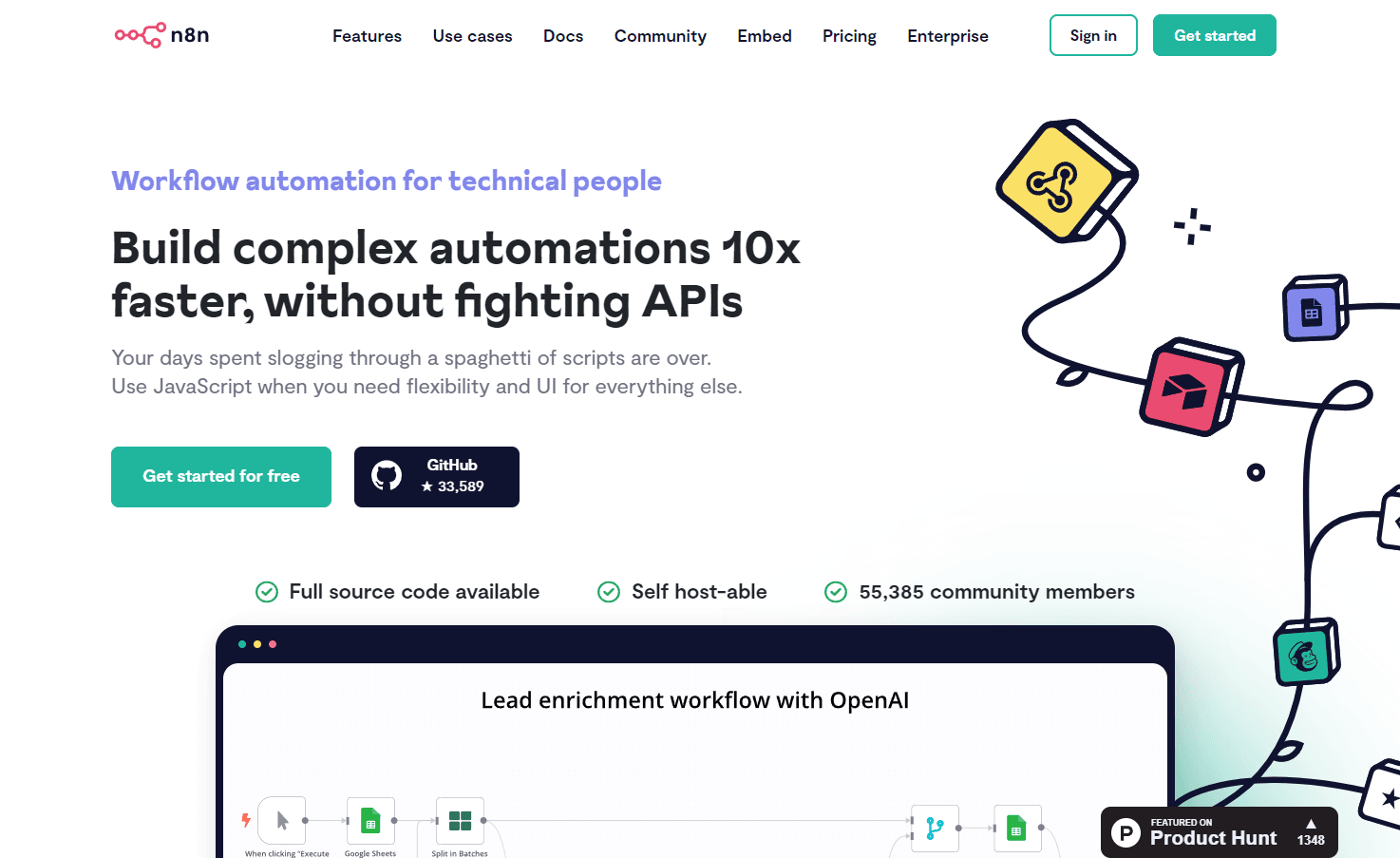
3. n8n — Open-source workflow automation with AI agents
n8n is open-source workflow automation with first-class AI-agent nodes. You build flows on a visual canvas, wire in hundreds of integrations, and drop in agent steps that reason and call tools mid-workflow, and you can self-host the whole thing for data-residency or privacy needs.
It is the bridge between classic automation and agentic AI: if you already think in workflows, adding a decision-making agent is a small leap.
Production credibility: Open-source (fair-code); raised a $180M Series C in 2025 led by Accel at a reported $2.5B valuation; used by Vodafone and Microsoft. What it wins at: Self-hostable automation, a huge integration catalog, and agent nodes inside workflows. Where it falls down: The canvas gets complex fast; commercial hosting or embedding requires a paid license.
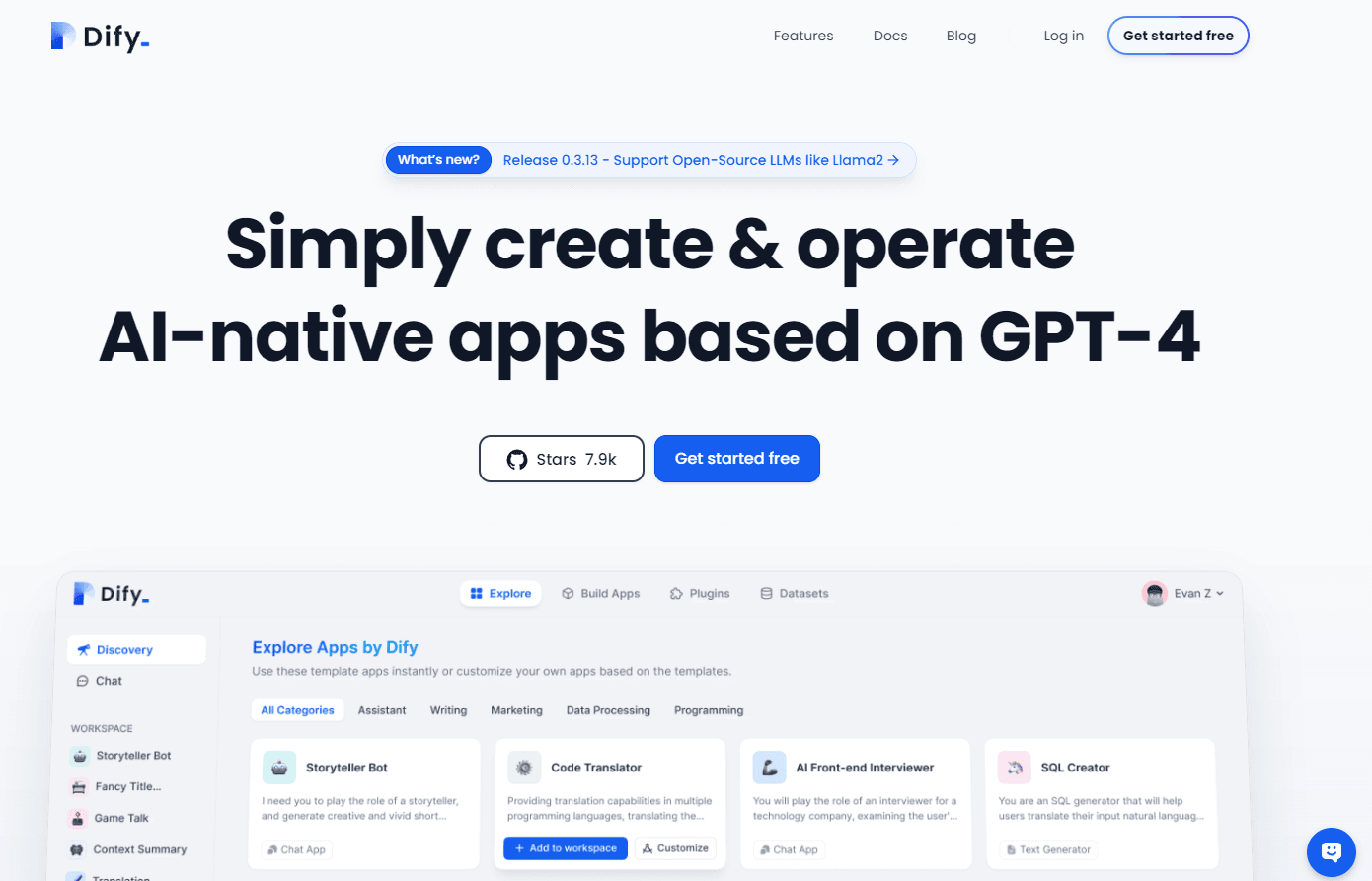
4. Dify — Open-source platform to build and deploy agents
Dify is an open-source LLMOps platform for building, shipping, and operating AI-native apps and agents. It bundles the parts you would otherwise stitch together, a visual builder, RAG, model management, and tool calling, in one interface.
It lands between no-code product and developer framework: non-engineers build in the UI, engineers get APIs.
Production credibility: One of the most popular open-source LLM app platforms on GitHub, with well over 100,000 stars. What it wins at: All-in-one agent building with RAG, tools, and deployment; self-hostable and open-source. Where it falls down: Production still requires real ops, and the feature breadth exceeds what a simple use case needs.
Autonomous General-Purpose Agents
These agents take an open-ended goal and try to finish it end to end, the most hands-off and most experimental lane.
5. Manus — Autonomous general agent
Manus is an autonomous general-purpose agent: you give it a goal and it plans and executes a multi-step task, from research to a finished deliverable, with minimal intervention. It was one of the most talked-about agent launches of 2025.
Treat it as a capable generalist for open-ended tasks, with the caveat to review the output of any fully autonomous agent.
Production credibility: Built by Butterfly Effect; raised $75M at a roughly $500M valuation in 2025 led by Benchmark; acquired by Meta in late 2025. What it wins at: End-to-end autonomy on open-ended, multi-step tasks. Where it falls down: Autonomous output needs human review; availability and pricing shifted as the product matured.
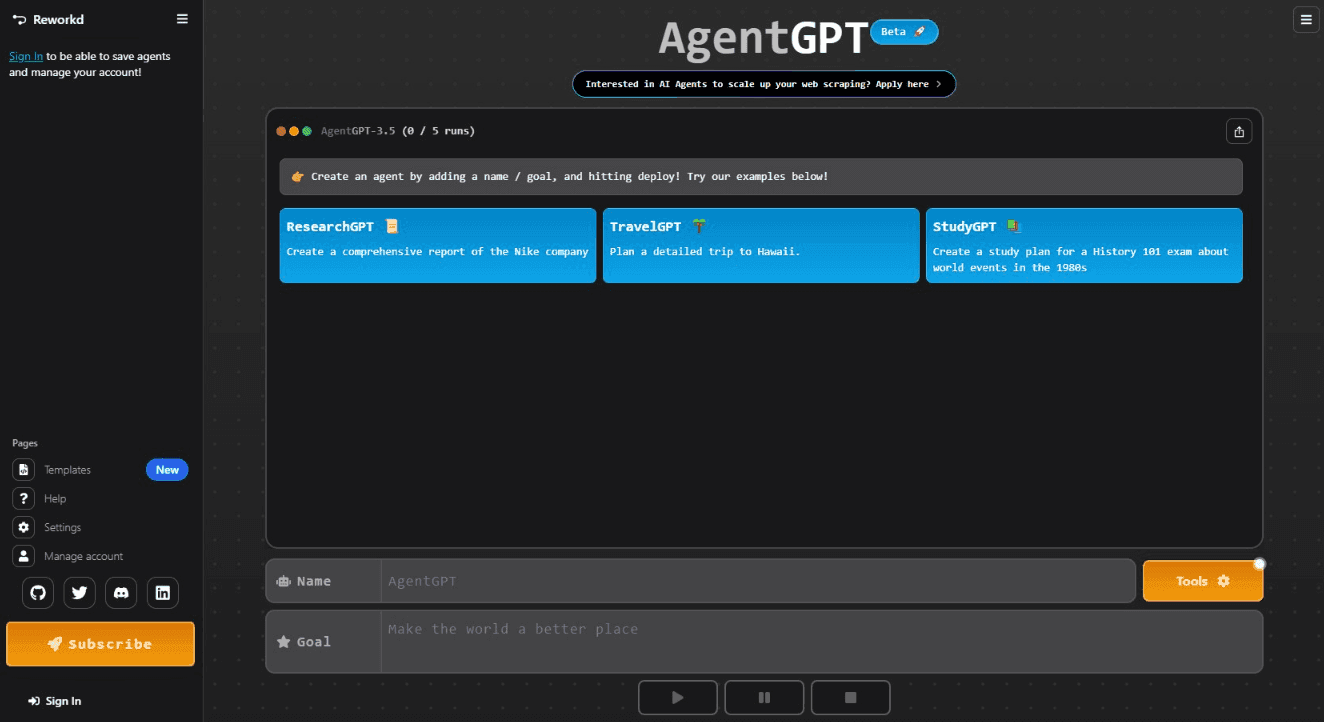
6. AgentGPT — Browser-based autonomous agents
AgentGPT is the simplest way to see an autonomous agent work: open it in your browser, give it a goal, and watch it spin up tasks and try to complete them. Built by Reworkd (Y Combinator S23), it was one of the most-cloned demos of the early agent wave.
It is best understood as a learning tool, not a production system; the concepts it exposes are what the frameworks below let you control.
Production credibility: Open-source and YC-backed (Reworkd); popularized browser-based agents, though Reworkd later shifted to web data extraction and the repo is now archived. What it wins at: A zero-setup, in-browser way to understand how autonomous agents behave. Where it falls down: A demo at heart, no longer actively developed, not built for production.
Frameworks to Build Your Own Agents
If you have engineers and want full control over logic, tools, and orchestration, build on a framework. All four below are open-source.
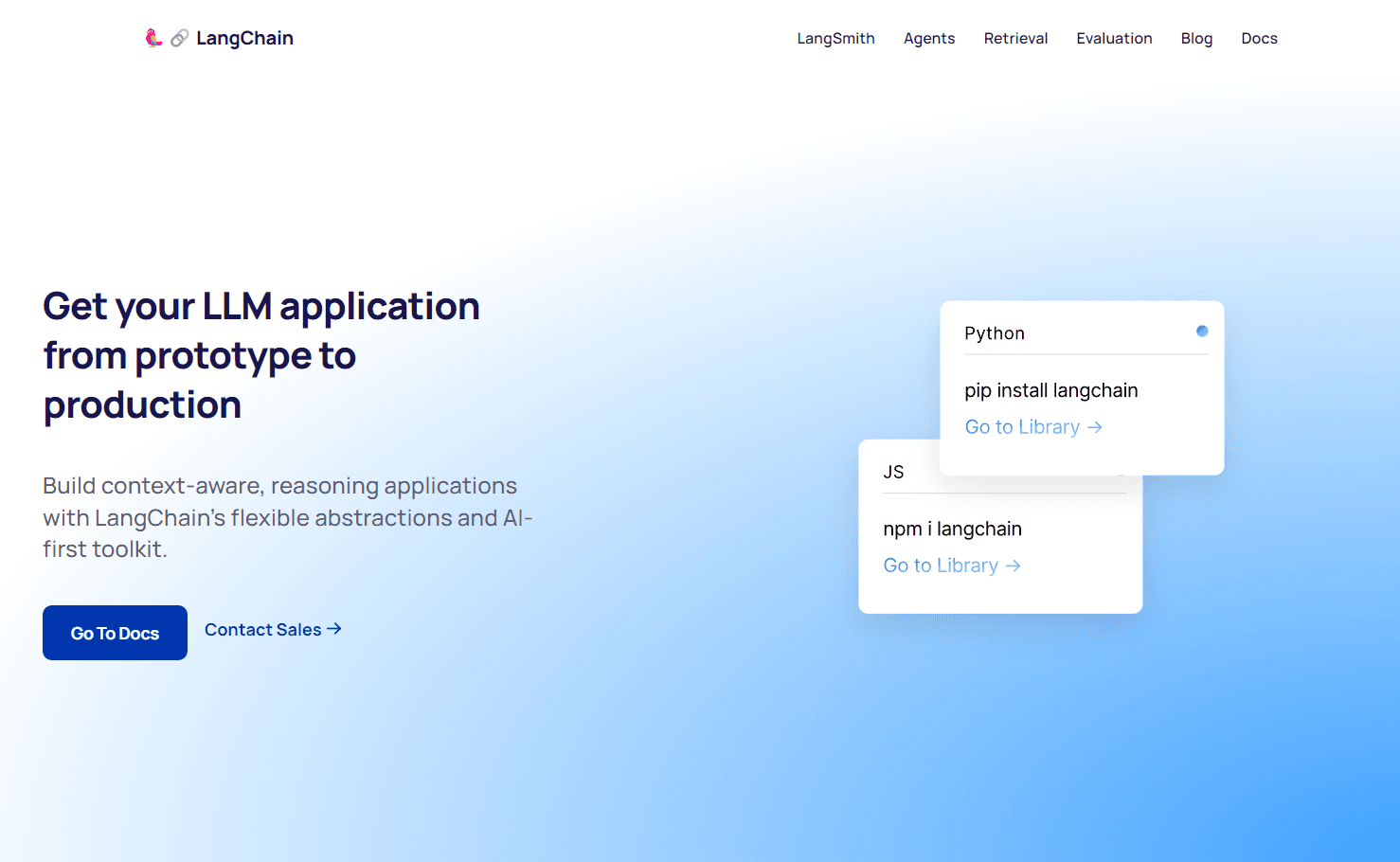
7. LangChain — The foundational framework
LangChain is the most widely adopted open-source framework for building LLM applications and agents. It gives developers standard building blocks, model and tool abstractions, memory, retrieval, and agent loops, so you are not reinventing the plumbing each time.
Its advantage is gravity: the ecosystem is large, most other tools interoperate with it, and it is the default starting point for agents in code.
Production credibility: Open-source with well over 100,000 GitHub stars; raised a $125M Series B in 2025 led by IVP at a reported $1.25B valuation. What it wins at: The broadest ecosystem, integrations, and community for building agents in code. Where it falls down: The breadth and rate of change mean a learning curve; simple projects can feel over-abstracted.
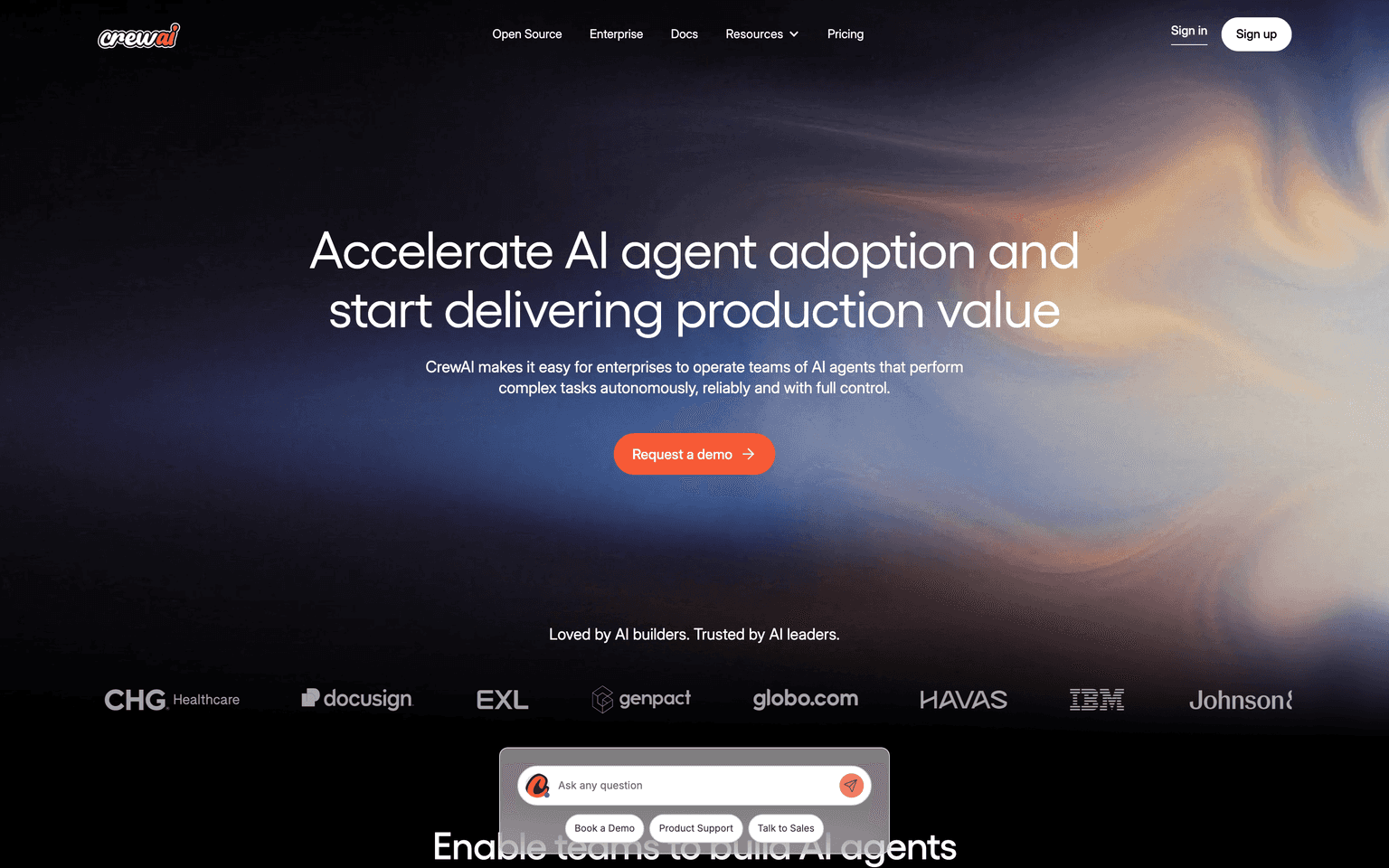
8. CrewAI — Orchestrate multi-agent "crews"
CrewAI is an open-source framework for orchestrating "crews" of agents, each given a role, a goal, and tools, that collaborate to complete a task. The role-based model maps cleanly onto how people divide work.
It is a popular choice when one agent is not enough, say a researcher, writer, and reviewer passing work between them.
Production credibility: Open-source with tens of thousands of GitHub stars; raised an $18M Series A led by Insight Partners, with angels including Andrew Ng and Dharmesh Shah. What it wins at: Clear, role-based multi-agent orchestration that is quick to pick up. Where it falls down: Multi-agent systems are harder to debug than single agents; you own the reliability work.
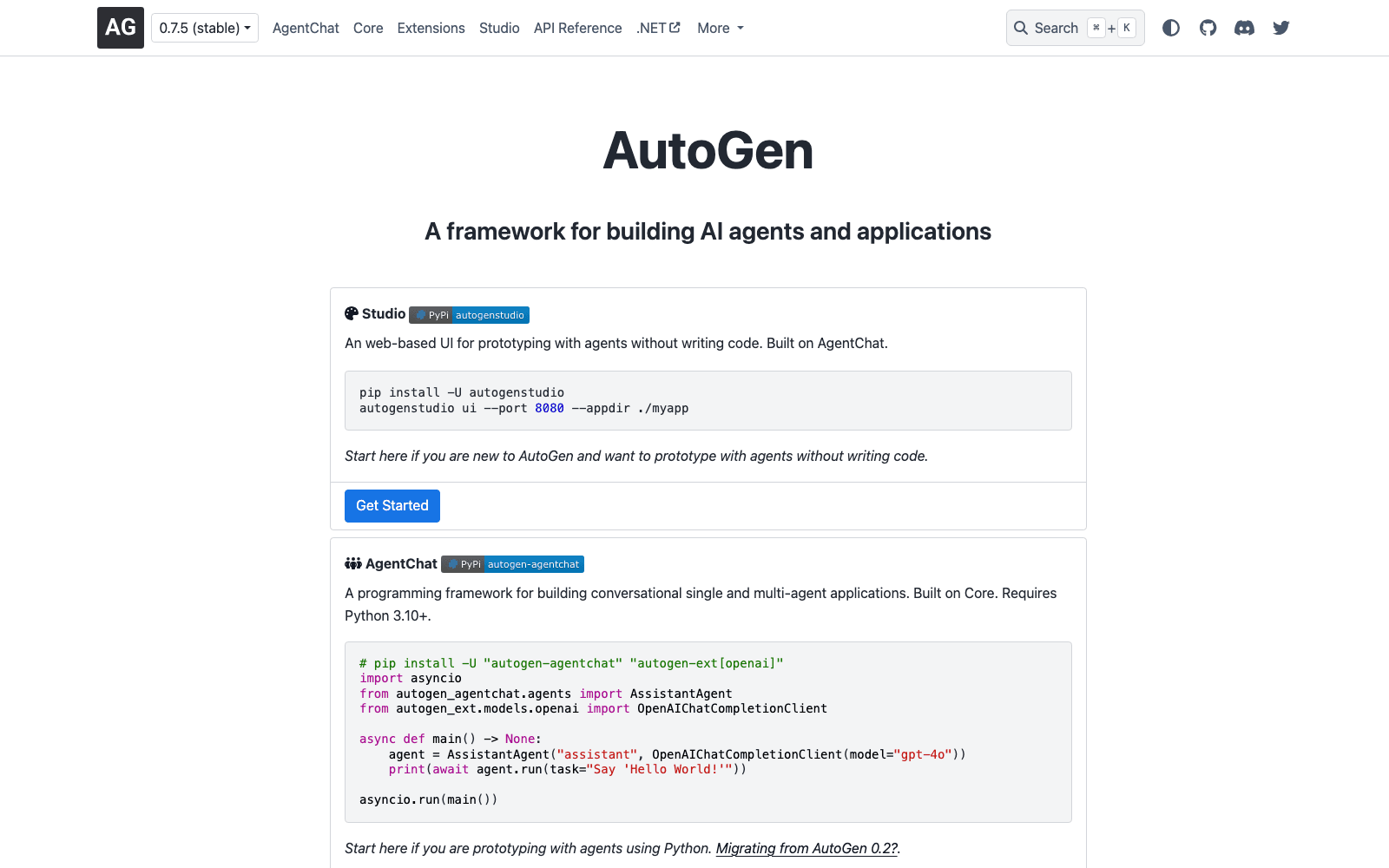
9. Microsoft AutoGen — Multi-agent conversation framework
Microsoft AutoGen is Microsoft's open-source framework for building agents that solve tasks through structured, multi-agent conversation, agents talking to each other, calling tools, and looping in a human when needed. It pioneered the conversational multi-agent pattern.
It is a strong fit for teams in or near the Microsoft ecosystem; note that Microsoft is converging AutoGen and Semantic Kernel into a unified Agent Framework, so check which entry point fits.
Production credibility: Open-source, backed by Microsoft Research; now converging into the Microsoft Agent Framework (public preview, 2025), with an AG2 community fork in parallel. What it wins at: Conversational multi-agent orchestration with strong docs and Microsoft backing. Where it falls down: The ongoing framework consolidation adds naming and migration confusion.
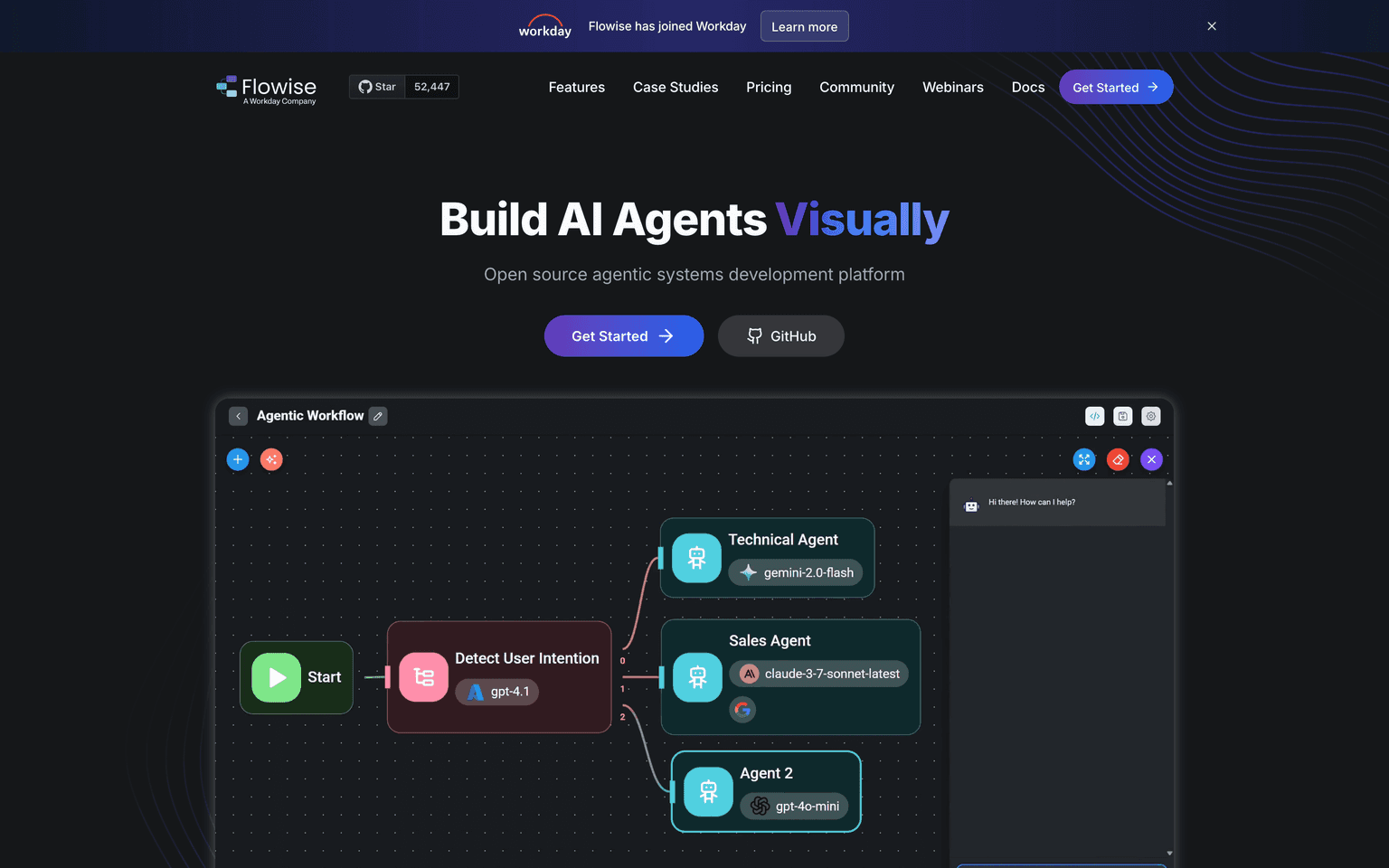
10. Flowise — Visual/low-code builder for LLM agents and flows
Flowise is an open-source, visual builder for LLM apps and agents: drag nodes onto a canvas, connect models, tools, and data, and ship a flow without writing much code. Think of it as a low-code front end to the same patterns the code frameworks expose.
It is the friendliest option in this lane: prototype visually, self-host it, and rebuild in code later if needed.
Production credibility: Open-source with tens of thousands of GitHub stars and Y Combinator backing (S23); supports a wide range of models and vector databases. What it wins at: Low-code, visual agent building on an open-source, self-hostable base. Where it falls down: Very complex or highly custom logic eventually outgrows the visual canvas.
Browser and Computer-Use Agents
The lane that did not meaningfully exist when we first published this list. These agents drive a real browser — clicking, filling, reading what renders — which lets them work against the large share of business software that has a web interface and no usable API.
It is also the lane with the sharpest operational caution attached. An agent with browser access inherits whatever the session it runs in can reach, so scoping credentials and permitted destinations is a deployment decision, not a detail. Our July 2026 news roundup covers the incident that made this concrete for the whole industry.
11. ChatGPT Agent — The mainstream computer-use agent
ChatGPT Agent gives OpenAI's assistant a virtual computer and browser, so it can carry out multi-step tasks — research a list of vendors, fill a form, assemble a document — inside the product most people already have.
Production credibility: Distributed through ChatGPT to the largest consumer AI user base in the world, which makes it the most-used computer-use agent by a wide margin regardless of how it benchmarks.
What it wins at: Zero setup, a supervised mode where you can watch and interrupt it, and hand-off into the rest of the assistant's capabilities.
Where it falls down: Slow on long tasks, and it will stop and ask for help more often than a purpose-built automation would — correct behaviour, but not what you want for volume work.
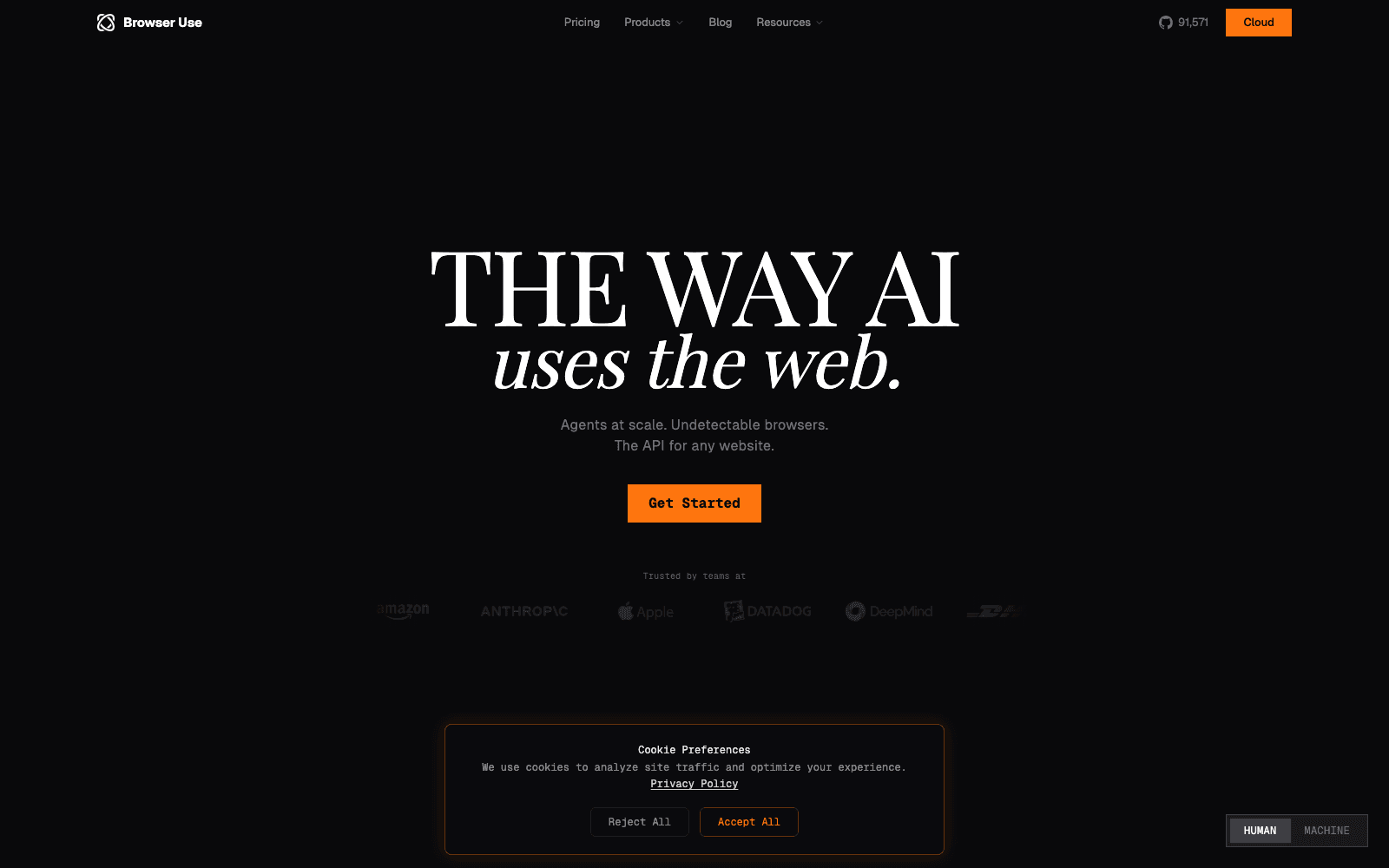
12. Browser Use — The open-source standard for browser agents
Browser Use is the open-source library that most browser-agent projects are built on: it hands a language model structured access to the page so it can decide what to click next, with your own model and your own infrastructure.
Production credibility: One of the fastest-adopted open-source agent projects of the past two years, and the layer underneath a large share of the browser-automation startups now in the market — including several tracked in our browser agents category.
What it wins at: Full control over model choice, prompts, and where it runs; no per-task vendor pricing; a genuine community around it.
Where it falls down: It is a library, not a product — you own the browser infrastructure, the retries, and the failure handling. Pair it with a hosted browser service unless you want to run that yourself.
How to Choose an AI Agent
Match the tool to your situation:
- Want agents that do real work today? Start with Lindy AI for no-code assistants, or Relevance AI for a coordinated multi-agent workforce.
- Want to build custom agents in code? Use LangChain for the largest ecosystem, CrewAI for role-based crews, or Microsoft AutoGen for conversational multi-agent patterns.
- Need open-source or self-hosted? Choose n8n for workflow automation, Dify for an all-in-one platform, or Flowise for low-code visual building, all self-hostable.
- Want to experiment with full autonomy? Try Manus for serious end-to-end tasks, or AgentGPT to see autonomous behavior in your browser.
- On a budget? Every framework above, plus n8n, Dify, and Flowise, is open-source and free to self-host; you pay mainly for the underlying model usage.
Adjacent Reading
If your agents will write or review code, pair this list with our Top 7 AI Coding Assistants and Best AI Tools for Coding. Because every agent runs on a model underneath, our Best LLMs guide helps you pick the engine, and the full AI Agents category lets you compare every option.
Frequently Asked Questions
What is an AI agent? An AI agent is a software system that pairs a language model with memory, tools, and a decision loop so it can take a goal, plan the steps, act on your apps and data, and adjust as it goes, not just answer a question.
What is the best AI agent in 2026? For most teams, Lindy AI is the best AI agent in 2026 because it lets non-engineers deploy reliable, no-code agents for email, scheduling, support, and CRM. If you are a developer, LangChain is the best framework to build your own.
What is the difference between an AI agent and an AI agent framework? An AI agent is a ready-to-use system that performs tasks, like Lindy AI or Manus. An AI agent framework, such as LangChain, CrewAI, or AutoGen, is a developer toolkit you use to build your own agents with custom logic and tools.
Are there free or open-source AI agents? Yes. n8n, Dify, Flowise, LangChain, CrewAI, and Microsoft AutoGen are all open-source and free to self-host. Your main cost is the language-model usage.
Can AI agents use my apps and tools? Yes. Modern agents act through integrations and tool calls, so they can read email, update a CRM, query databases, and trigger other apps. Lindy AI, Relevance AI, and n8n ship with large integration libraries out of the box.
What is an autonomous AI agent? An autonomous AI agent takes a goal and plans and executes the steps to reach it with minimal human input, deciding what to do next on its own. Manus and AgentGPT are examples; for production, you should still review their output.
Which AI agent is best for non-technical users? Lindy AI and Relevance AI are the best AI agent platforms for non-technical users because they are no-code: you configure agents in a browser by connecting your apps, no programming required.
Are AI agents safe to run on real business data? They can be, with guardrails. Use approvals and human-in-the-loop steps, scope each agent's access to only the apps and data it needs, and prefer self-hosted options like n8n or Dify when data residency matters.
Final Thoughts
The fastest path to value in 2026 is to stop watching agents demo and start letting them work. For most teams, Lindy AI is the place to begin: no code, real integrations, and assistants that handle email, scheduling, support, and CRM from day one. Relevance AI is the natural next step when one assistant becomes a workforce.
If you are a builder who wants full control, start with LangChain for the largest ecosystem, reach for CrewAI or Microsoft AutoGen when you need multiple agents working together, and keep n8n, Dify, and Flowise in mind when self-hosting matters. Pick the lane that fits your team, and let the agent work.
Compare tools in this collection
Categories these tools span
More collections you may also like

Sign up for our newsletter
Receive weekly updates so you can stay up-to-date with the world of AI
Sign up for our newsletter
Receive weekly updates so you can stay up-to-date with the world of AI
The AI tools directory for discovering, exploring, and comparing the most innovative AI tools in the industry