Unsloth
Unsloth is an open-source fine-tuning framework that trains LLMs faster with far less GPU memory.
Overview
Unsloth: Fine-Tune LLMs Faster on Ordinary GPUs
Unsloth is an open-source framework for fine-tuning and running large language models with substantially lower memory use and training time than standard Hugging Face pipelines. It rewrites the heavy math of training in hand-optimized kernels, which is how it fits fine-tuning jobs onto single consumer GPUs that would normally require rented cluster time. The project supports 500+ models across text, vision, audio, and embeddings, including Llama, Gemma, Qwen, and Mistral families.
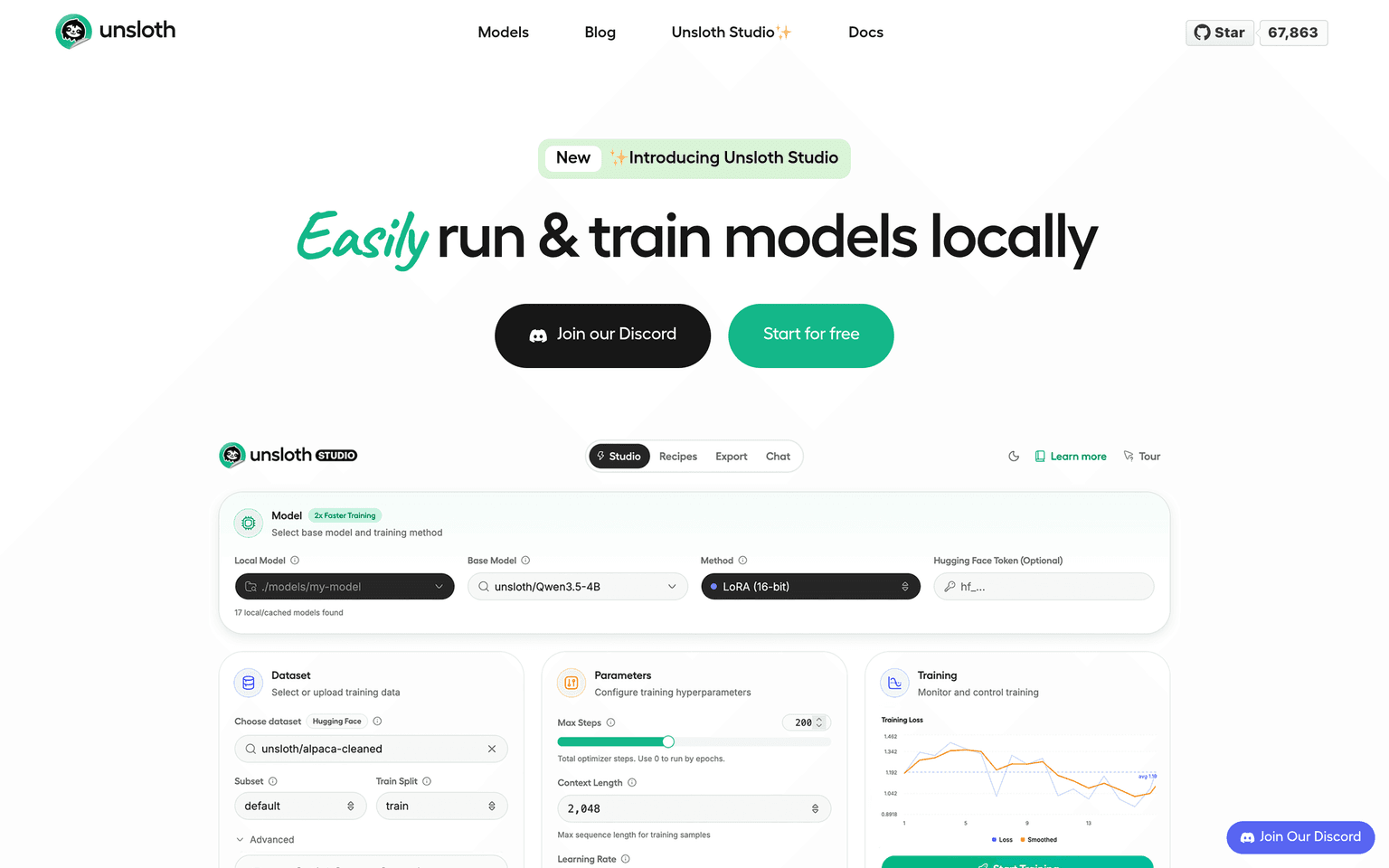
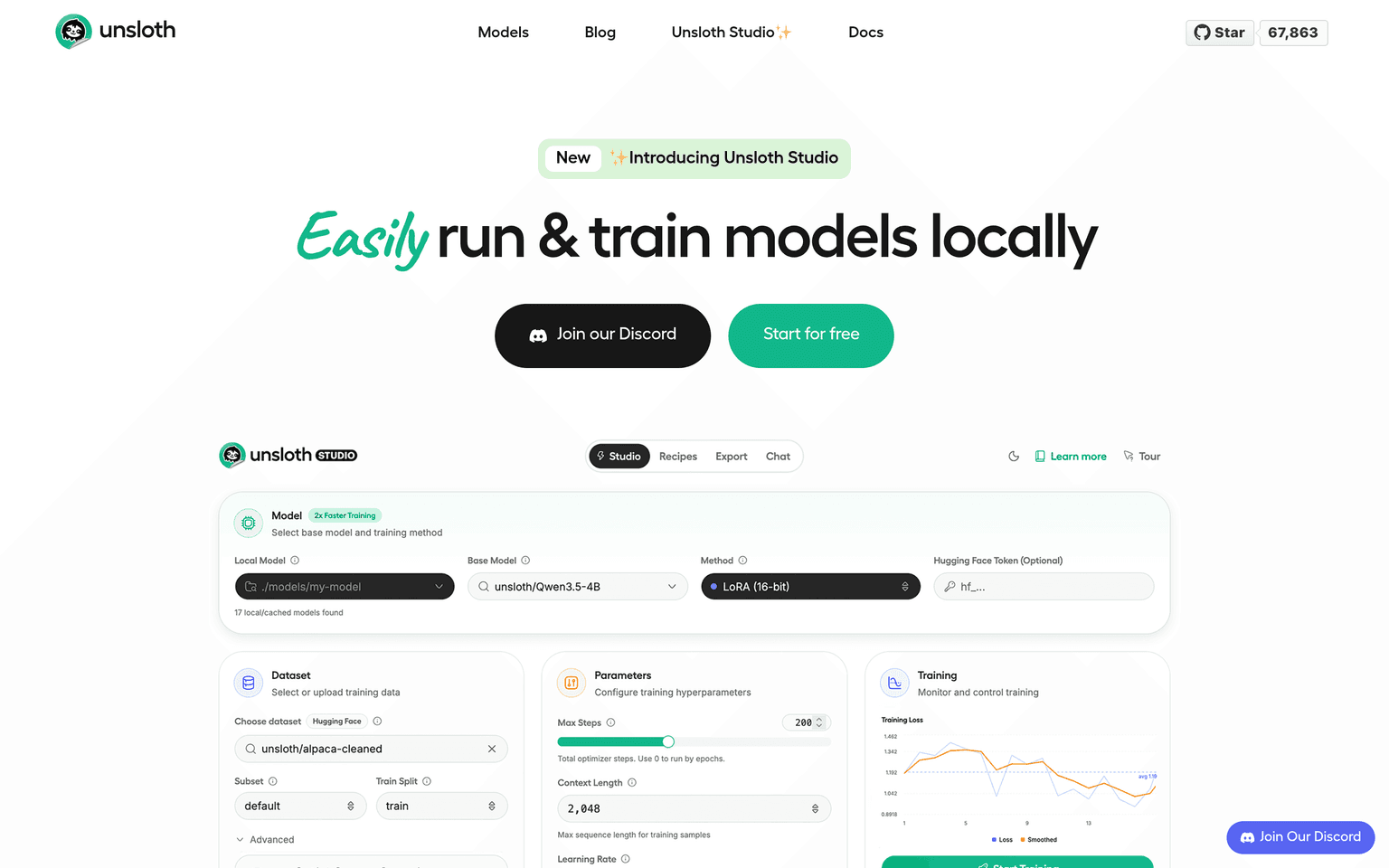
It is built for ML engineers, researchers, and hobbyists who want a custom model without a custom infrastructure budget. You install the Python package (or start from the maintained free Colab and Kaggle notebooks), load a model with LoRA or QLoRA adapters, train on your dataset, and export the result as safetensors or GGUF for llama.cpp, vLLM, or Ollama. Unsloth Studio extends this to a no-code app that runs fully offline on Mac and Windows.
Key Features
- Fine-tuning that runs roughly 2x faster with dramatically less VRAM than standard FlashAttention-2 pipelines, on a single GPU in the free tier
- Support for 500+ models spanning text, vision, audio, and embeddings, with LoRA, QLoRA, and FP8 training
- Export to safetensors or GGUF for direct use with llama.cpp, vLLM, and Ollama
- Unsloth Studio: an offline desktop app for Mac and Windows with no-code training, dataset creation from PDFs/CSVs/JSON, and an OpenAI-compatible API
- Widely used dynamic GGUF quantizations published on Hugging Face for running new open models locally
- Pro and Enterprise tiers adding multi-GPU and multi-node training with larger speedups
Ideal Use Case
A developer or small team that needs a domain-tuned open model — a support bot on company docs, a classifier, a local coding model — and wants to train it on one consumer or workstation GPU instead of renting a cluster. Unsloth's notebooks make the first fine-tune a copy-paste job, and the GGUF export path means the result runs locally in Ollama the same day.
How Unsloth differentiates
Unsloth is one of the most adopted fine-tuning projects in open source: the main GitHub repository has passed 40,000 stars, its quantized model uploads see over 10 million downloads a month on Hugging Face, and the company behind it went through Y Combinator and the GitHub Accelerator with backing from Microsoft's M12 fund. That community scale means new model families are usually supported within days of release.
FAQ
What is Unsloth? Unsloth is an open-source framework that fine-tunes large language models faster and with less GPU memory than standard training pipelines.
Is Unsloth free? The core framework is free and open source. Pro and Enterprise tiers with multi-GPU and multi-node training are paid via contact with sales.
What hardware do I need? Most fine-tunes run on a single NVIDIA GPU; the free Colab and Kaggle notebooks work on free-tier GPUs for smaller models.
What models does Unsloth support? 500+ models, including Llama, Gemma, Qwen, Mistral, and vision, audio, and embedding models, with GGUF and safetensors export.
tl;dr
Unsloth is the open-source standard for fast, memory-efficient LLM fine-tuning — 40k+ GitHub stars, 500+ supported models, and export straight to llama.cpp, vLLM, or Ollama.
Related
Looking for more options? Browse the AI Infrastructure directory or read our best AI infrastructure tools listicle. Unsloth is also tracked on Crunchbase.
Why Use Unsloth
User Reviews
Similar Tools