Encord
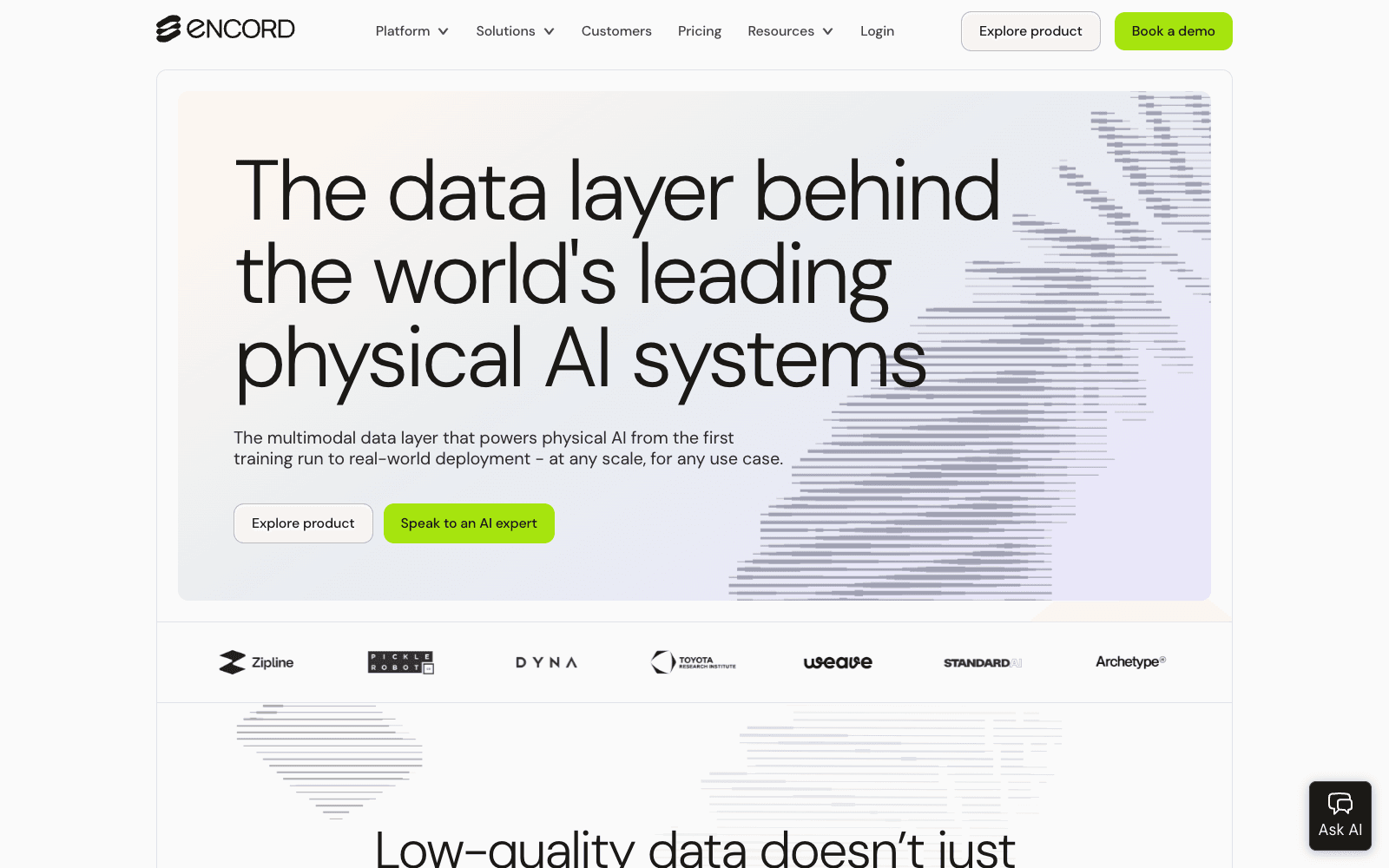
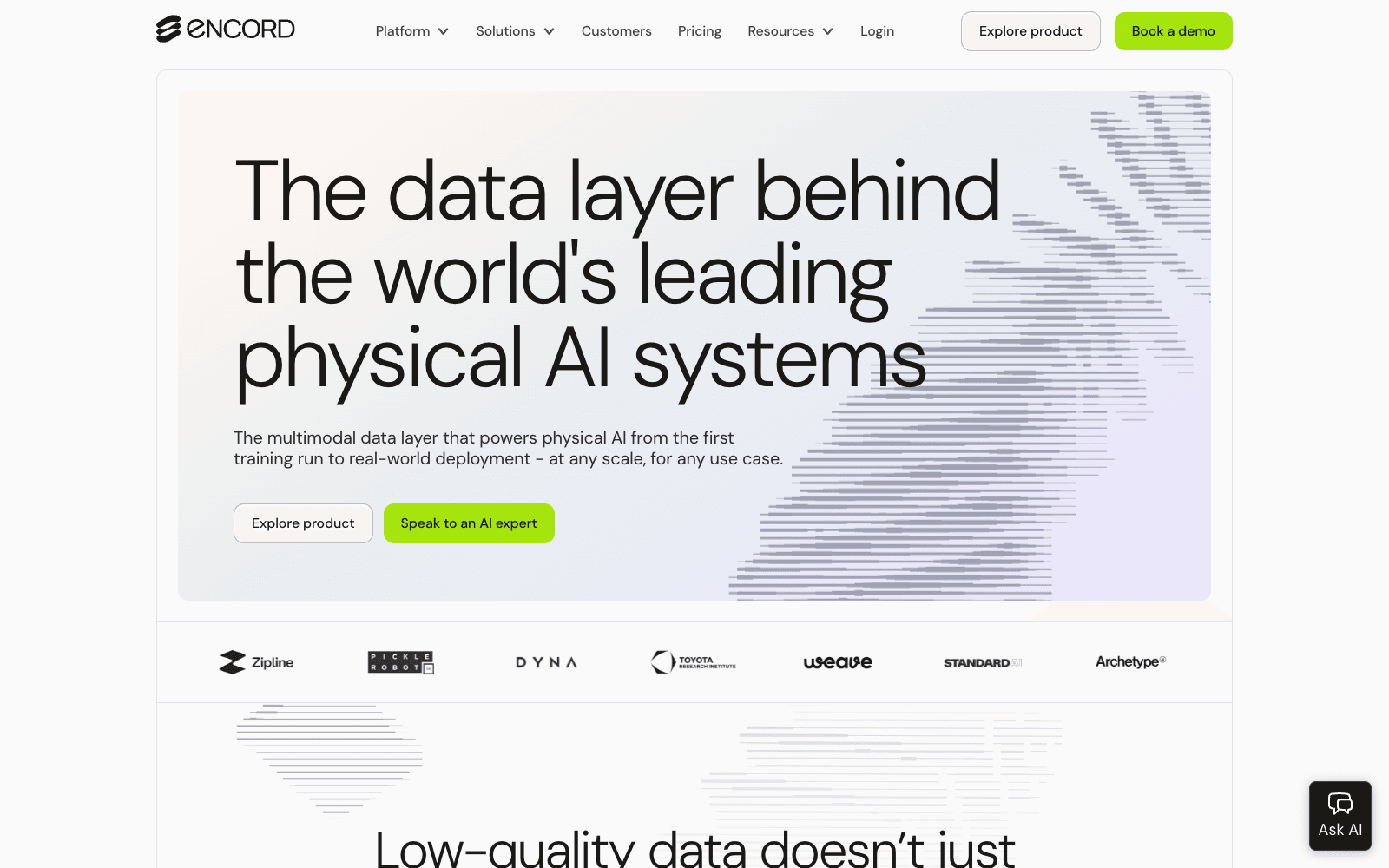
Encord is a data development platform that helps vision and physical-AI teams curate, label, and evaluate multimodal training data.
Overview
Encord
Encord is a data development platform built for computer vision and physical AI teams. Encord lets engineers curate, annotate, and evaluate large image, video, and sensor datasets in one place, then trace exactly which data trained or broke a model. Founded in 2020 and launched through Y Combinator in 2021, Encord targets the messy middle of multimodal AI: finding the right frames to label, managing petabyte-scale storage, and aligning labels to specific model requirements. It is used across robotics, autonomous vehicles, healthcare imaging, and generative video, where annotation quality and dataset traceability decide whether a model ships or stalls.
Production credibility: Founded 2020 in London by Eric Landau (particle-physics research at Stanford) and Ulrik Stig Hansen (MSc Computer Science, Imperial College London; prior emerging-markets derivatives at J.P. Morgan); launched via Y Combinator in spring 2021. Raised approximately $110M total: a $60M Series C in February 2026 led by Wellington Management (with Y Combinator, CRV, Next47, Crane Venture Partners, plus new investors Bright Pixel and Isomer Capital), following a $30M Series B led by Next47 in 2024 and a $4.5M seed. Named customers include Woven by Toyota, Skydio, Synthesia, Philips, and Cedars-Sinai. Managed data volume grew from roughly 1 petabyte to over 5 petabytes in the year to early 2026, and the company has cited revenue from physical-AI customers growing about tenfold.
Key Features
- Data curation that surfaces the most relevant frames and edge cases to label from raw cloud storage
- Multimodal annotation for images, video, DICOM medical imaging, point clouds, audio, and text
- Model-assisted labeling and automated label suggestions to cut manual annotation time
- Quality workflows with review stages, inter-annotator agreement, and consensus scoring
- Dataset indexing and traceability across distributed storage to link data back to model behavior
- Model evaluation that compares performance across identical datasets and flags accuracy regressions
- Python SDK and API for integrating labeling and curation into existing ML pipelines
- SOC 2 and HIPAA-aligned controls for healthcare, government, and regulated deployments
Ideal Use Case
A robotics or autonomous-vehicle team ingests petabytes of camera and sensor footage, uses Encord to find and label the rare scenarios that matter, then evaluates model versions against the same curated set to catch regressions before deployment.
How Encord differentiates
Against Scale AI, Encord is a self-serve software platform teams operate themselves rather than a managed labeling service, giving in-house ML teams direct control over data and workflows. Against Labelbox and SuperAnnotate, Encord leans harder into multimodal and physical-AI data (video, DICOM, point clouds) and ties curation, annotation, and model evaluation into a single traceable loop instead of treating annotation as a standalone step. The trade-off is that Encord expects technical users and an ML workflow already in place; teams wanting fully outsourced human labor still pair it with a managed vendor or internal labelers.
FAQ
Q: What is Encord used for? A: Encord is used to curate, annotate, and evaluate image, video, and sensor datasets for training and testing computer-vision and physical-AI models, with built-in traceability from data to model performance.
Q: Who founded Encord? A: Encord was founded in 2020 by Eric Landau and Ulrik Stig Hansen, who came from physics and quantitative-finance backgrounds, and launched the company through Y Combinator in 2021.
Q: How much has Encord raised? A: Encord has raised approximately $110 million, including a $60 million Series C in February 2026 led by Wellington Management and a $30 million Series B led by Next47.
Q: Encord vs Scale AI: what is the difference? A: Scale AI is primarily a managed data-labeling service that supplies human labor, while Encord is a software platform your own team operates to curate, label, and evaluate data directly. Encord suits in-house ML teams that want control; Scale suits teams outsourcing the labeling work itself.
Q: Does Encord support video and medical imaging? A: Yes. Encord handles images, native video, DICOM and NIfTI medical imaging, point clouds, audio, and text, and offers HIPAA-aligned controls for healthcare data.
tl;dr
Encord is a data development platform for computer-vision and physical-AI teams, covering data curation, multimodal annotation, and model evaluation in one traceable workflow. Backed by ~$110M from Wellington Management, Next47, CRV, and Y Combinator, it serves customers like Woven by Toyota, Skydio, and Synthesia. Best for technical ML teams that want to run their own data pipeline.
Related
Looking for more options? Browse the AI/ML Models directory or read our best AI models listicle. Encord is also tracked on Crunchbase.
Why Use Encord
User Reviews
Similar Tools