Hugging Face
The open-source ML hub — 2M+ models, 500k+ datasets, Spaces, Inference Endpoints, and the Transformers library.
Acquired Hugging Face
Acquired · September 2026
Hugging Face became the public square of open machine learning — roughly 3 million models, 1 million applications and 500,000 datasets used by some 18 million developers, plus the Transformers library much of the field builds on. On September 3, 2026, Nvidia confirmed a $12.93 billion agreement to acquire it: the largest company Nvidia has ever bought and nearly double its $6.9 billion Mellanox purchase. Co-founder Clement Delangue and the founding team are staying, the brand and leadership continue, and Nvidia has committed to keeping the platform open. Regulatory clearance is still pending.
Acquired by NVIDIA.
Last known pricing: Free Hub access, open models and datasets, and CPU Spaces; PRO $9/month; GPU Spaces and Inference Endpoints billed hourly; Enterprise Hub priced per seat.
Is Hugging Face shut down?
No — Hugging Face is still operating. Its acquisition by NVIDIA was announced on September 3, 2026, and the product continues to ship. We list it in the ToolDirectory.AI graveyard's acquired-but-operating section and watch for post-acquisition changes.
What to use instead

Claude
Anthropic flagship chat with strong reasoning, long context, and projects.
Freemium
4.93
383

Anthropic
AI safety company building Claude and pioneering Constitutional AI — $61B valuation.
Freemium
4.93
495

Thinking Machines Lab
Frontier AI lab founded by ex-OpenAI CTO Mira Murati. $2B seed at $12B valuation, in talks for $50-60B. Building useful and safe AI.
Freemium
4.93
462
Overview
Hugging Face is the open-source hub for AI models, datasets, and apps
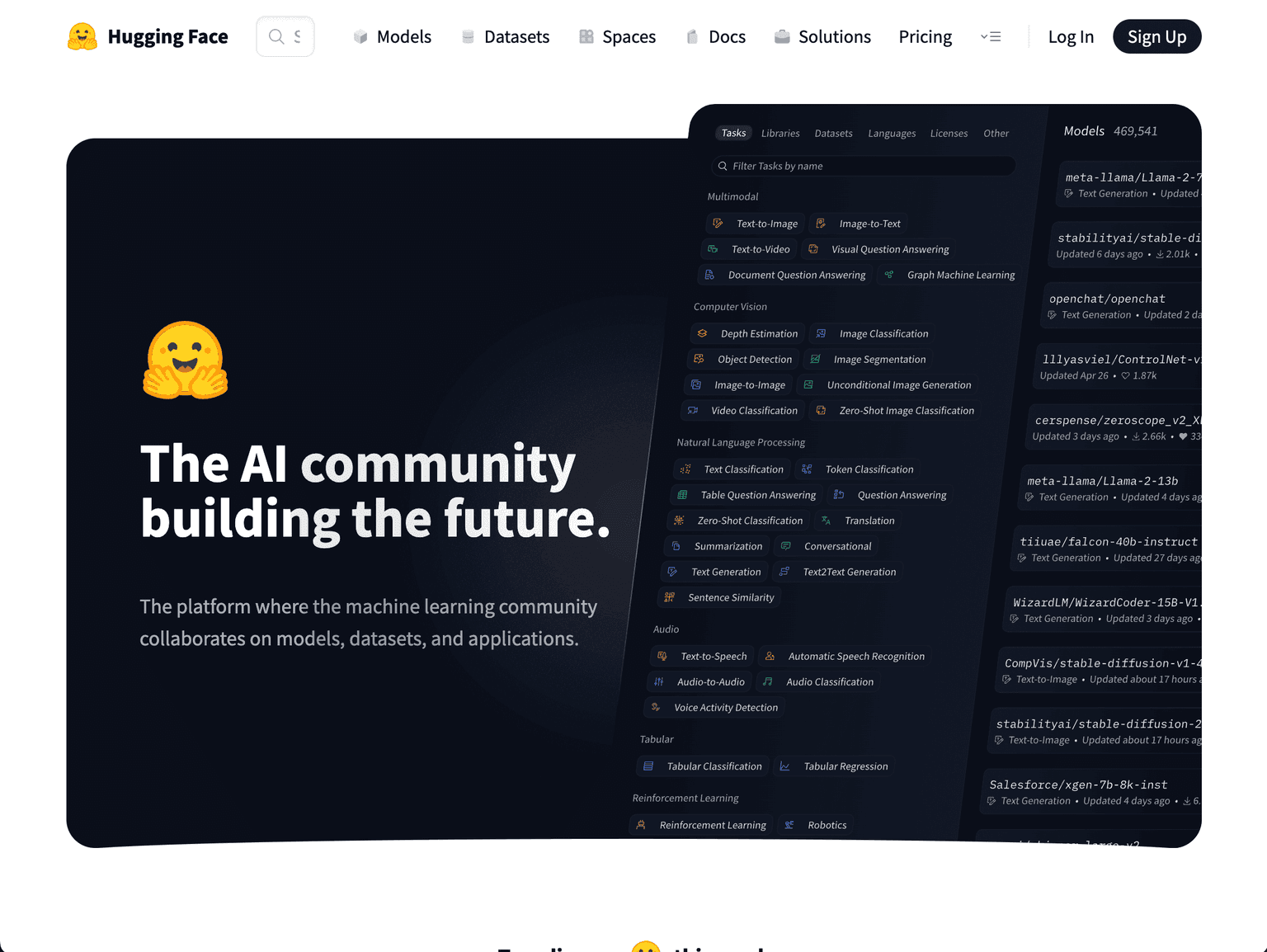
Hugging Face is the largest collaborative platform for machine learning — often called "GitHub for ML." As of 2026, the Hugging Face Hub hosts more than 2 million models, 500,000+ datasets, and about 1 million Spaces (interactive demo apps). It's home to the open-source Transformers and Datasets libraries and the Open LLM Leaderboard, the standard reference for ranking open models. Anthropic, Meta, Google, AWS, Microsoft, Intel, and tens of thousands of other organizations publish their work here.
Acquisition note (September 2026): On September 3, 2026, Nvidia confirmed an agreement to acquire Hugging Face for $12.93 billion — the largest acquisition in Nvidia’s history, more than double the $6.9 billion it paid for Mellanox in 2019. CEO Jensen Huang said Hugging Face “will remain an open platform for the entire AI ecosystem,” with developers keeping their choice of models, frameworks, cloud providers and compute. Co-founder Clement Delangue and the founding team are staying on, and the brand and leadership structure continue. The deal is pending regulatory clearance in multiple jurisdictions and neither company has given a closing date; Hugging Face operates normally in the meantime.
Key Products (2026)
- Hub — public registry for models, datasets, and Spaces. Free for open-source content; private repos available on paid tiers.
- Spaces — host interactive ML demos with Gradio, Streamlit, Docker, or Static. CPU is free; GPU instances start at $0.40/hr.
- Inference Endpoints — production-grade dedicated AI servers, autoscaling, 24/7 uptime. Priced per GPU/hour.
- Inference Providers — pay-per-token routing across major hosted-model providers from a single Hugging Face API.
- Transformers — the de-facto Python library for loading, fine-tuning, and running state-of-the-art models.
- Datasets — companion library for streaming and processing ML datasets at scale.
- smolagents — Hugging Face's lightweight agent framework. Model-agnostic; works with Transformers, OpenAI/Anthropic APIs, LiteLLM, or local Ollama.
- Open LLM Leaderboard — independent benchmark rankings for open base models across academic evaluations.
Pricing (April 2026)
- Free — full Hub access, public repos, free CPU Spaces, community Inference API.
- PRO — $9/user/mo. Higher rate limits, ZeroGPU access, private model serving credits, PRO badge.
- Team — $20/user/mo. Adds SSO, audit log, analytics, and team-level controls.
- Enterprise Hub — custom. Elevated storage and bandwidth, managed billing, dedicated support, regional/private deployments.
- Spaces GPU — $0.40–$23.50/hr by GPU type (T4 → 8×L40S).
- Inference Endpoints — $0.03–$80/hr depending on hardware tier.
- Hub Storage — per-TB storage pricing with volume discounts beyond included quotas.
Best For
- ML researchers and engineers — fastest path to current open-source models, fine-tuning recipes, and reproducible benchmarks.
- Startups and indie devs — host model demos as Spaces with a free or low-cost GPU; ship public projects without infra setup.
- Enterprise ML teams — Inference Endpoints provide SLA-backed serving without operating GPU clusters.
- Educators and students — vast free dataset catalog, free CPU Spaces, and tutorials for every major library.
Hugging Face vs. Replicate vs. Modal vs. Together AI
- Hugging Face — broadest model + dataset catalog; strongest community signal; full open-source library stack.
- Replicate — simpler "model as REST API" experience; smaller catalog, smoother first-time UX.
- Modal — general-purpose serverless GPU; not ML-specific, but flexible for custom training/inference workloads.
- Together AI — focused on hosted-model inference at low per-token prices; less of a community hub.
FAQ
Is Hugging Face free? Yes. Public Hub access, all open-source models/datasets, free CPU Spaces, and the community Inference API are free. PRO ($9/mo) lifts rate limits and adds private serving credits.
What is Spaces? Interactive demo hosting. You push a Gradio/Streamlit/Docker app to a Space and Hugging Face hosts it on CPU (free) or GPU (paid by the hour).
What's the difference between Inference API and Inference Endpoints? The free Inference API is shared, rate-limited, and meant for prototyping. Inference Endpoints are dedicated, autoscaling production servers — pay per GPU-hour with guaranteed availability.
Can I host private models? Yes. PRO, Team, and Enterprise tiers support private repositories. Enterprise adds advanced governance, audit logs, and elevated storage limits.
What is smolagents? A lightweight, model-agnostic agent framework from Hugging Face. It plugs into Transformers, OpenAI/Anthropic APIs (via LiteLLM), or local Ollama — and ships with its own leaderboard for agent capability.
Who owns Hugging Face? Nvidia — a $12.93 billion agreement to acquire Hugging Face was confirmed on September 3, 2026, the largest acquisition in Nvidia’s history. The deal is pending regulatory clearance in multiple jurisdictions with no closing date announced. Hugging Face keeps its brand, leadership and founding team, and continues to operate as an open platform.
Related
Looking for more options? Browse the AI/ML Models directory or read our best AI models listicle. Hugging Face has a Wikipedia entry and is tracked on Crunchbase.
Why Use Hugging Face
FAQ
Editorial Review
Our take on Hugging Face.

Still the center of gravity for open-source ML—2M+ models, a unified Inference Providers API across 15+ backends, and now a $299 robot. The hub keeps getting more useful, but model quality still varies wildly and vetting is on you.
What works
- Inference Providers API gives one interface to 15+ backends at pass-through pricing
- Massive catalog (2M+ models, 500K+ datasets) with a genuinely usable free tier
- Transformers library remains well-maintained and standard in PyTorch workflows
What doesn't
- Model quality and maintenance vary wildly; vetting burden is entirely on you
- Discoverability across 2M models is cluttered; finding the right one takes trial and error
Hugging Face remains the default answer to "where do I find a model," and the catalog numbers back it up: 2M+ models, 500K+ datasets, over 1M Spaces. The more interesting 2026 story is Inference Providers—a single OpenAI-compatible API that routes to 15+ third-party backends (Groq, Together AI, Fireworks, Cerebras, Replicate, and others) at pass-through pricing, meaning you pay the underlying provider's published rate with no markup. That quietly solves the "which inference partner" question that used to send you off-platform the moment you wanted to actually run something. Dedicated Inference Endpoints start at $0.033/hour for the smallest hardware. None of this makes model selection easier, though: quality across those 2M models still varies wildly, plenty are abandoned experiments, and you'll spend real time evaluating before something works for your use case.
Pricing stayed sane. PRO is still $9/month with bundled inference credits and ZeroGPU access; a new Team plan runs $20/user/month for org-level features, and Enterprise starts around $50/user/month for SSO and audit logs. The free tier is genuinely usable—100 GB of private repo storage, community ZeroGPU, and a token amount of monthly inference credit. The Transformers library remains well-maintained and integrates cleanly with standard PyTorch workflows, and Spaces is still the lowest-friction way to put a demo in front of someone.
The wildcard is robotics. After acquiring Pollen Robotics, Hugging Face shipped Reachy Mini, a $299 open-source desktop robot—3,000 units moved by CES in January 2026, an ASUS/NVIDIA partnership followed in March, and by June it was running fully local conversational AI. Whether that becomes a business or stays a lovable side quest, it signals where the company thinks open-source AI goes next: embodied, local, hackable. For the core use case—rapid prototyping, pretrained models without rebuilding from scratch, publishing results—Hugging Face is foundational infrastructure. It's still not a substitute for knowing what you're doing.