Llama
Meta's open-weight AI family — Llama 4 with native multimodality and 10M-token context.
Overview
Llama: Build on Your Own Terms
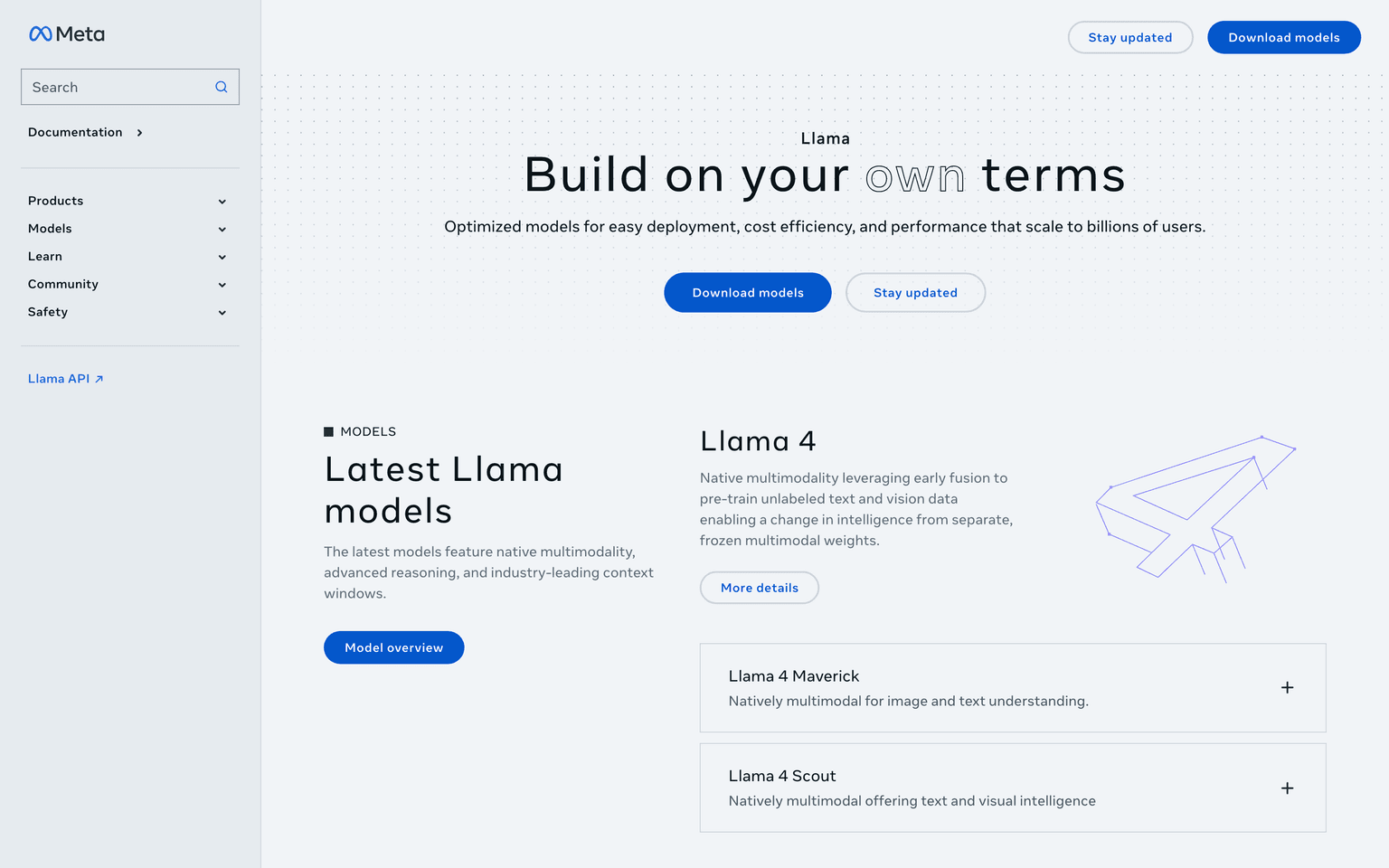
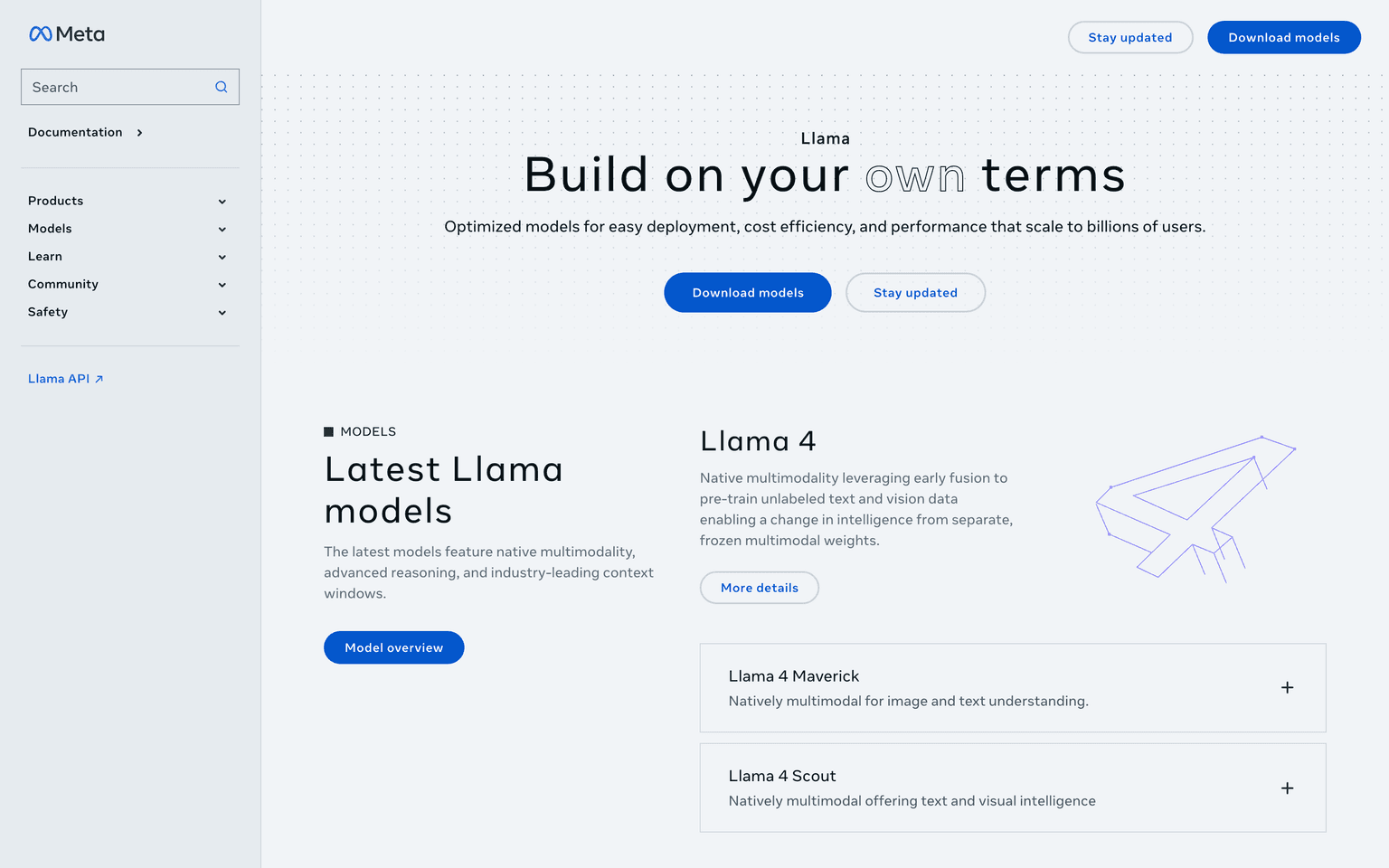
Llama is Meta's family of open-weight large language models — the most-downloaded open AI models in the world, optimized for easy deployment, cost efficiency, and performance that scales to billions of users. The current generation, Llama 4, introduces native multimodality with early-fusion training across unlabeled text and vision data, enabling a step-change in cross-modal intelligence over the previous siloed approach.
The Llama 4 family includes Maverick (10M-token context window, multimodal text + image, optimized for memory, personalization, and multi-modal applications) and Scout (10M context, single H100 GPU efficiency, optimized for long document analysis). Llama 3.3 (70B) delivers 405B-class performance and quality at a fraction of the cost, while Llama 3.1 and 3.2 remain widely deployed for fine-tuning, distillation, and on-device inference.
Key Features:
- Open-weight models you can fine-tune, distill, and deploy anywhere
- Llama 4 Maverick: native multimodal, 10M-token context
- Llama 4 Scout: native multimodal, single-H100 efficient, 10M context
- Llama 3.3 (70B): 405B-class quality at lower cost
- Llama 3.1 and 3.2 still widely deployed
- Native multimodality via early fusion (text + vision)
- Industry-leading context windows
- Llama API for hosted access
- Active developer community and ecosystem
- Used in production by leading AI companies
Ideal Use Case:
Llama is ideal for any team that wants frontier-quality AI without vendor lock-in — whether that means fine-tuning for a specific domain, distilling into an on-device model, or running open-weight inference on private infrastructure for compliance, latency, or cost reasons.
Why Use Llama:
- Open weights — fine-tune, distill, deploy anywhere
- Frontier-class quality at much lower cost
- Native multimodality in Llama 4
- 10M-token context for long-form work
- Massive ecosystem of fine-tunes, tooling, and integrations
FAQ
What is the latest Llama model? Llama 4, in two flavors: Maverick (10M context, optimized for multi-modal applications) and Scout (10M context, single-H100 efficient).
Are Llama models free? Yes — open weights under Meta's Llama license. You only pay for the compute you run them on (or use the Llama API).
Can I fine-tune Llama? Yes — that is one of the core reasons Meta releases the weights.
What's special about Llama 4? Native multimodality via early fusion of text and vision data during pre-training, plus 10M-token context windows.
Can I use Llama on a single GPU? Llama 4 Scout is optimized for single H100 efficiency.
FAQ
What is Llama and what can it do? Llama is Meta's open-weight AI family that includes Llama 4, which offers native multimodality and supports a 10M-token context window. This means you can work with both text and images, and process very large documents or conversations in a single request.
Who should use Llama? Llama is designed for developers, researchers, and organizations that want to build AI applications with a capable, open-weight model. It's particularly suited for teams that need flexibility and want to work with a model from Meta's established AI family.
How much does Llama cost? Llama operates on a paid pricing model. Visit the Llama pricing page for current plans and to inquire about costs tailored to your specific use case.
How does Llama compare to other AI models? Llama competes with alternatives like Claude and other AI models in the market. Your choice depends on factors like your specific use case, integration needs, and preference for open-weight versus closed models.
FAQ
What is Llama and what can it do? Llama is Meta's open-weight AI family that includes Llama 4, which offers native multimodality and supports a 10M-token context window. This means you can work with both text and images, and process very large documents or conversations in a single request.
Who should use Llama? Llama is designed for developers, researchers, and organizations that want to build AI applications with a capable, open-weight model. It's particularly suited for teams that need flexibility and want to work with a model from Meta's established AI family.
How much does Llama cost? Llama operates on a paid pricing model. Visit the Llama pricing page for current plans and to inquire about costs tailored to your specific use case.
How does Llama compare to other AI models? Llama competes with alternatives like Claude and other AI models in the market. Your choice depends on factors like your specific use case, integration needs, and preference for open-weight versus closed models.
tl;dr:
Llama is Meta's open-weight LLM family. Llama 4 brings native multimodality and 10M-token context across Maverick and Scout. Open weights, frontier quality, deploy anywhere.
Related
Looking for more options? Browse the AI/ML Models directory or read our best AI models listicle. Llama has a Wikipedia entry and is tracked on Crunchbase.
Why Use Llama
FAQ
Editorial Review
Our take on Llama.

Meta's open-weight flagship, reset by Llama 5 in April 2026 - 600B parameters and a 5M-token context. Still the serious on-premise option, though Muse Spark shows Meta is no longer exclusively open.
What works
- Llama 5 ships a 5M-token context, the largest of any publicly available model
- Native multimodality across the family, not bolted on afterwards
- Open weights allow on-premise deployment where data cannot leave the estate
What doesn't
- Pricing opacity ("inquire") typical of enterprise lock-in
- Constrained deployment model vs. truly open alternatives
Llama 5 landed on 8 April 2026 and reset the family: 600 billion parameters and a 5-million-token context window, the largest in any publicly available model, with benchmark results Meta puts alongside the frontier closed models. Llama 4 Scout and Maverick remain in service below it - native multimodality, 10M-token context on Scout - while Behemoth, the 2-trillion-parameter tier, was quietly shelved rather than cancelled after mid-training routing and attention problems. The strategic wrinkle worth noting is Muse Spark, Meta's first proprietary model since the Superintelligence Labs reorganisation: the open-weight commitment is no longer the whole story. But here's the friction: pricing is opaque ("inquire"), which usually means enterprise-only negotiation. That defeats half the point of open-weight models—you want to know what you're buying. Deployment-wise, Llama remains an inference play; you're running it on your own infra or through a provider's API, not downloading weights and doing whatever you want on your laptop without somebody's thumb on the scale. For teams already in Meta's ecosystem or with serious budget to spend on inference, Llama 4's capabilities are solid. The multimodal story works. But if you're comparing to Claude or looking for genuinely unconstrained open models, the paid-only, inquire-to-price framing feels like it's testing how much you'll tolerate before you shop elsewhere. The community loves it, but that's often academia and enthusiasts running evals, not production teams paying bills.
User Reviews
Similar Tools