Foam
AI-native observability that auto-instruments your codebase and root-causes production breakages.
Overview
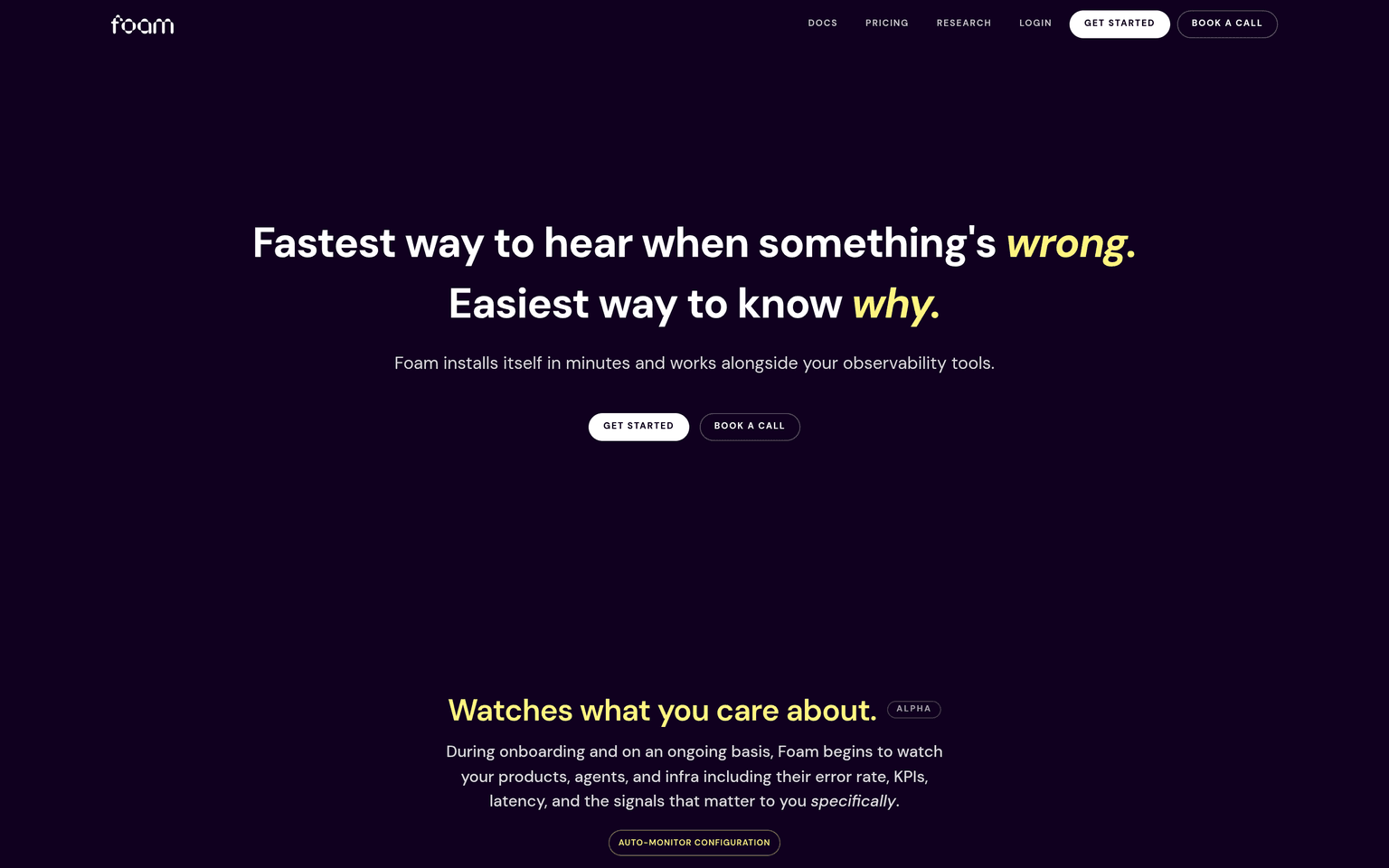
Foam: observability that instruments itself and tells you what actually broke
Foam rethinks the observability workflow from the AI side: instead of engineers hand-wiring instrumentation, dashboards, and alert rules, Foam connects to your GitHub repository, automatically instruments the codebase, and configures monitoring, alerts, and dashboards on its own. Setup takes roughly 15 to 30 minutes, after which Foam watches production continuously.
When something breaks, Foam doesn't just page you — it investigates. Its AI clusters and triages issues, identifies the root cause, and notifies the engineer responsible with an explanation rather than a wall of raw alerts. One customer put it bluntly: "Forty alerts a day and none of them meant anything. Now Foam tells us what actually matters." It runs alongside existing tools like Datadog and Sentry, so adopting it doesn't mean a migration.
Key Features
- Automatic instrumentation via GitHub integration — Foam wires up your codebase in 15–30 minutes without manual SDK work
- Auto-configured monitoring: alerts, dashboards, and clustering are generated for you rather than built by hand
- AI investigation that identifies root cause and routes findings to the responsible engineer
- Conversational debugging — ask Foam questions about production behavior and get answers in seconds
- Coexists with your stack, running alongside Datadog, Sentry, and other observability tools
- Flat credits pricing: $2,000/month for 250 investigations with unlimited seats and no per-host, per-metric, or per-span fees
Ideal Use Case
Foam suits engineering teams running distributed systems, agents, or fast-moving infrastructure who are drowning in alert noise or spending days validating changes in production. Because pricing is per-investigation rather than per-host or per-seat, it fits teams whose telemetry volume would make traditional observability billing painful — and its auto-instrumentation makes it viable for teams that never built a proper observability practice in the first place.
How Foam differentiates
Foam (built by Garage Tech, Inc.) raised a $10M seed round from Khosla Ventures, Max Levchin, The House Fund, and South Park Commons, and its site lists users at Perplexity, Together AI, Orb, Braintrust, and Stream. The wedge is the billing model as much as the AI: unlimited seats, no host/metric/span/event fees, and a flat rate per investigation — a direct contrast with usage-metered incumbents.
FAQ
How long does setup take? About 15–30 minutes: connect GitHub, and Foam instruments the codebase and configures monitoring automatically.
Does Foam replace Datadog or Sentry? It can run alongside them. Teams typically start with Foam as the investigation layer and keep existing tools during evaluation.
How is Foam priced? A credits-based plan at $2,000/month including 250 investigations, unlimited seats, and no per-host or per-event fees; data retention is billed at a pass-through rate.
Who uses Foam? Its site names teams at Perplexity, Together AI, Orb, Braintrust, and Stream among its users.
tl;dr
Foam is AI-native observability: it auto-instruments your codebase, filters the alert noise, and delivers root-cause analysis, priced flat per investigation instead of per host.
Related
Looking for more options? Browse the Developer Tools directory or read our best AI coding tools listicle. Foam is also tracked on Crunchbase.
Why Use Foam
User Reviews
Similar Tools