Vercel AI SDK
Universal TypeScript SDK from Vercel for building AI apps and agents with multi-model support.
Overview
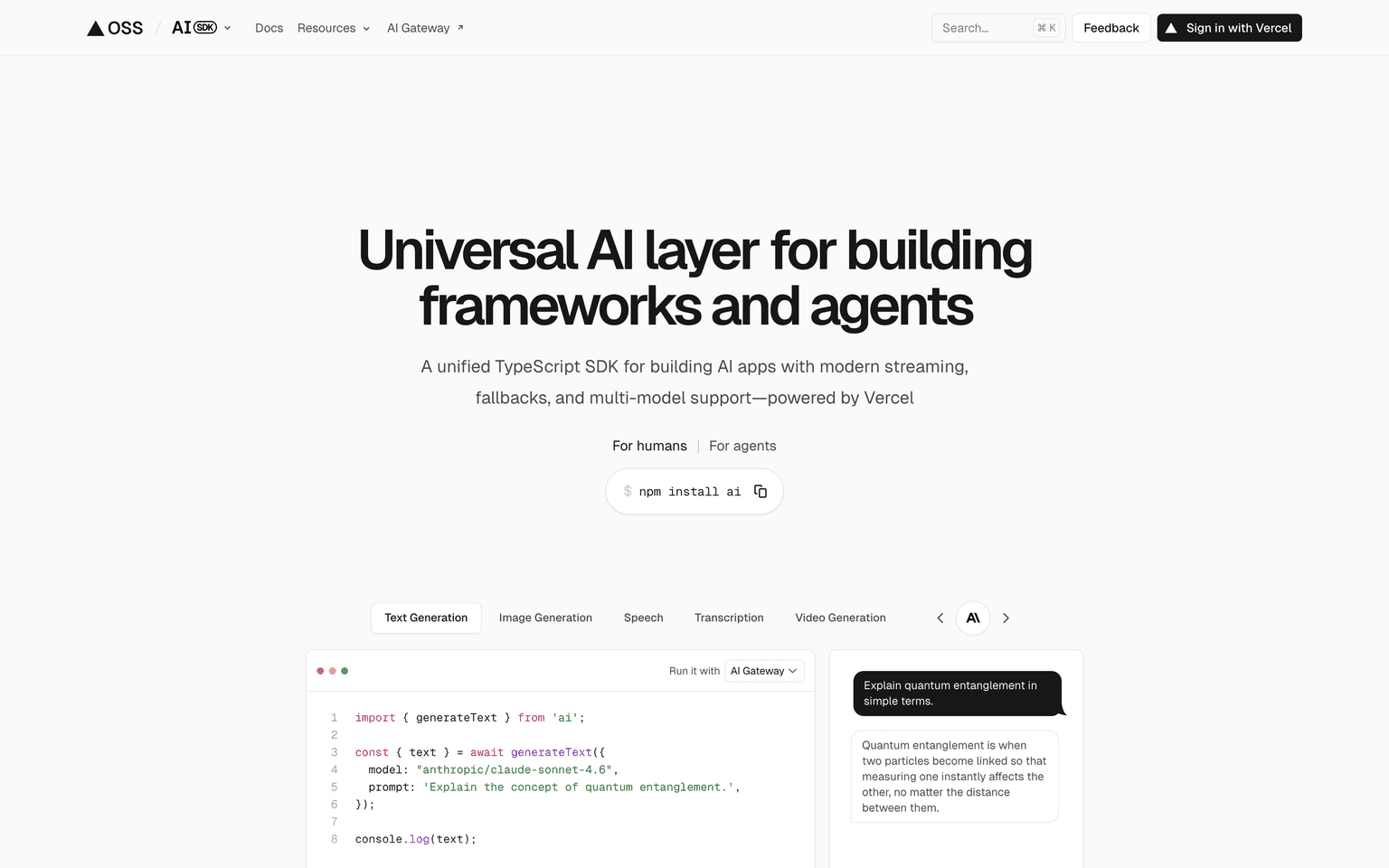
AI SDK: The Universal AI Layer for Frameworks and Agents
The AI SDK is a unified TypeScript SDK from Vercel for building AI apps with modern streaming, automatic fallbacks, and multi-model support. It is the open-source AI toolkit of choice for the JavaScript/TypeScript ecosystem — 12.3M weekly downloads, 23.9k GitHub stars, 623+ contributors, and support for 100+ models across every major provider.
Switch providers with one line of code, get streaming that just works, and ship AI apps and agents in React, Next.js, Vue, Svelte, Node.js, and beyond. Pair it with Vercel AI Gateway to add model routing, fallbacks, and observability to production deployments without touching your code.
Key Features:
- Universal TypeScript SDK with multi-provider support
- Switch models with one line of code
- Real-time streaming for text, image, speech, transcription, and video
- Framework-agnostic: React, Next.js, Vue, Svelte, Node.js, more
- 100+ models supported across every major provider
- Built-in fallbacks for production resilience
- AI Gateway for model routing, caching, and observability
- 12.3M weekly downloads, 23.9k GitHub stars
- Open source — from the creators of Next.js
- "For humans" and "For agents" code paths
Ideal Use Case:
The AI SDK is ideal for any team building AI apps or agents in TypeScript or JavaScript. Especially strong for Next.js apps, agentic workflows that need streaming, and teams that want provider flexibility without rewriting their code.
Why Use AI SDK:
- The most-downloaded AI SDK in the JS ecosystem
- Switch providers with one line — no lock-in
- Streaming, fallbacks, and multi-modal built in
- From the Vercel team behind Next.js
- Open source — fully free
FAQ
Is the AI SDK free? Yes — fully open source. AI Gateway has its own pricing for managed routing.
Which languages? TypeScript and JavaScript. Works with React, Next.js, Vue, Svelte, Node.js, and more.
Which models? 100+ across Anthropic, OpenAI, Google, xAI, DeepSeek, Mistral, and many more.
Do I need Next.js to use it? No — the SDK is framework-agnostic.
FAQ
What does Vercel AI SDK help developers build? Vercel AI SDK is a TypeScript framework for building AI-powered applications and agents with support for multiple AI models. It provides the infrastructure developers need to integrate AI capabilities into their projects.
Who should use Vercel AI SDK? Developers building AI applications benefit most from Vercel AI SDK, especially those working with TypeScript who want a universal SDK that works across different AI models without vendor lock-in.
How much does Vercel AI SDK cost? Vercel AI SDK is completely free and open source, so there are no licensing fees or subscription costs to use it in your projects.
How does Vercel AI SDK compare to alternatives like Grok or Browser Use? Vercel AI SDK focuses on being a multi-model TypeScript SDK for building AI apps and agents, while alternatives like Grok and Browser Use may specialize in different aspects of AI development. The right choice depends on your specific needs and tech stack preferences.
FAQ
What does Vercel AI SDK help developers build? Vercel AI SDK is a TypeScript framework for building AI-powered applications and agents with support for multiple AI models. It provides the infrastructure developers need to integrate AI capabilities into their projects.
Who should use Vercel AI SDK? Developers building AI applications benefit most from Vercel AI SDK, especially those working with TypeScript who want a universal SDK that works across different AI models without vendor lock-in.
How much does Vercel AI SDK cost? Vercel AI SDK is completely free and open source, so there are no licensing fees or subscription costs to use it in your projects.
How does Vercel AI SDK compare to alternatives like Grok or Browser Use? Vercel AI SDK focuses on being a multi-model TypeScript SDK for building AI apps and agents, while alternatives like Grok and Browser Use may specialize in different aspects of AI development. The right choice depends on your specific needs and tech stack preferences.
tl;dr:
The AI SDK is Vercel's universal TypeScript SDK for building AI apps and agents — multi-provider, multi-modal, streaming, with fallbacks. 12.3M weekly downloads, fully open source.
Related
Looking for more options? Browse the AI Infrastructure directory or read our best AI infrastructure tools listicle. Vercel AI SDK is also tracked on Crunchbase.
Why Use Vercel AI SDK
FAQ
Editorial Review
Our take on Vercel AI SDK.

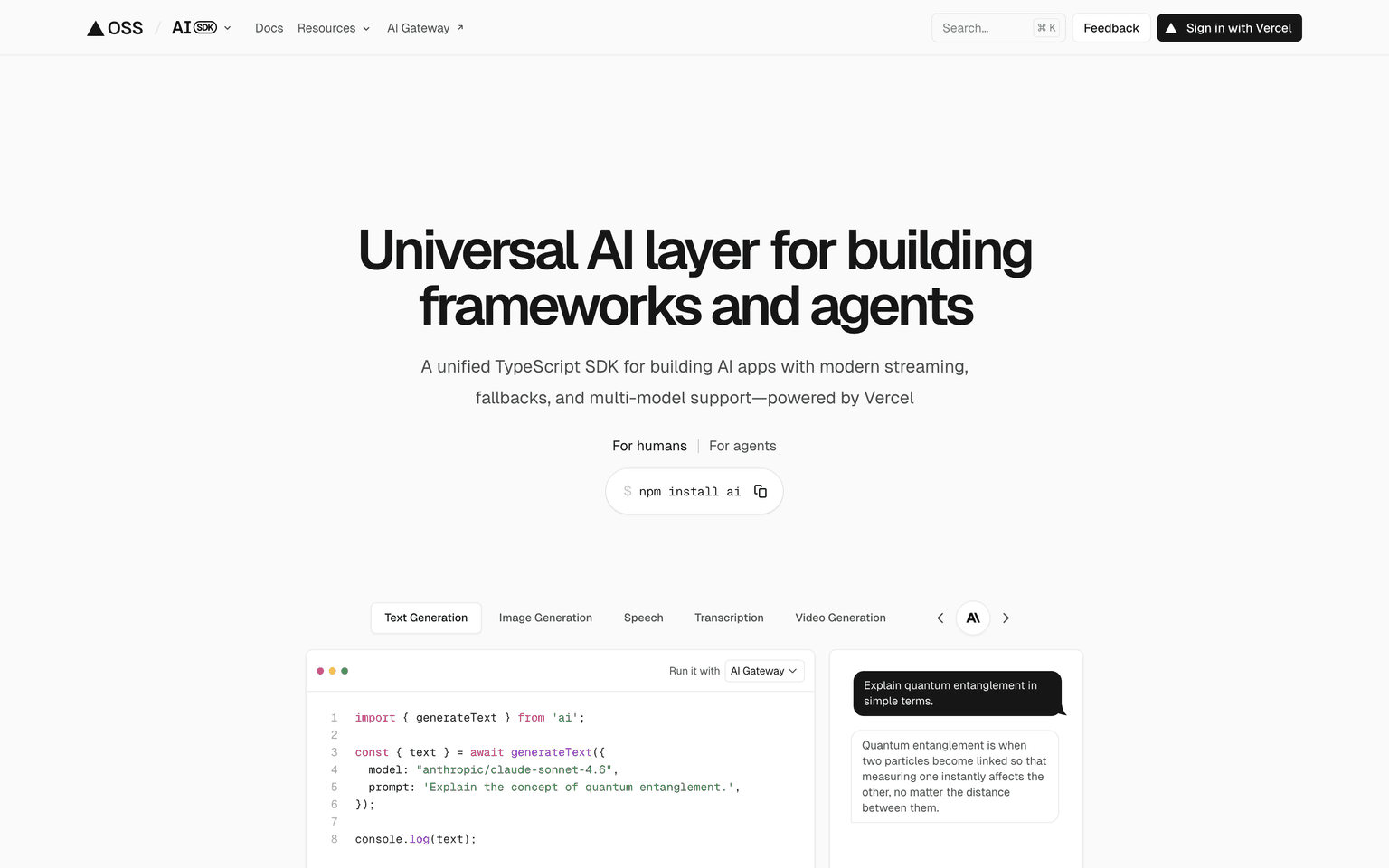
Two major releases in a year turned a chat-streaming toolkit into a production agent framework. AI SDK 7 adds durable agents, tool approvals, and telemetry overhauls -- still free, still open source, still the default choice for TypeScript teams.
What works
- Open source and provider-agnostic; the same code runs against multiple model providers with no vendor lock-in
- Agent primitives are production-grade now: durable WorkflowAgent execution, tool approvals, and per-tool timeout budgets shipped in AI SDK 7
- Native TypeScript with typed tool context; slots straight into Node/Next.js projects
What doesn't
- Two major versions in about a year (6 in late 2025, 7 in June 2026) means recurring migration work for production apps
- Newest surfaces -- realtime voice, video generation -- are experimental and still shifting
Vercel's AI SDK has grown up fast. What was a lean streaming-and-function-calling library is now, as of AI SDK 7 (June 2026), a full agent framework for TypeScript. AI SDK 6 introduced the Agent abstraction -- define a model, instructions, and tools once, reuse it everywhere -- plus a production-ready ToolLoopAgent, first-class MCP support, and human-in-the-loop tool approvals. AI SDK 7 went further: WorkflowAgent ties into Vercel's Workflow SDK so a crashed process no longer loses agent state, telemetry got a ground-up rework, and you can now set timeout budgets per step, per chunk, and per tool. It even ships a harness layer that puts Claude Code, Codex, and other agent CLIs behind the same interface as the rest of the SDK.
What hasn't changed is the character of the thing. It's still open source, still provider-agnostic -- you're not betting the farm on one model API -- and it still assumes you're a developer who owns the stack. There's no visual builder and no hand-holding; the SDK gives you well-shaped primitives and expects you to compose them. For teams already living in TypeScript and Next.js, that's exactly the right trade, and the craft shows in details like typed tool context and structured output streaming.
The rough edge now is velocity rather than gaps. Two major versions in roughly a year means real migration work if you built on v5 or v6, and the newest surfaces -- realtime voice and video generation are still flagged experimental -- will keep shifting under you. Budget for keeping up. But as free infrastructure for shipping AI features and agents, this is the strongest it has ever been.
User Reviews
Similar Tools