Leading AI Tools in Healthcare (2026)









Best AI Tools in Healthcare for 2026
If you're researching the leading AI tools in healthcare in 2026, the category looks nothing like it did three years ago. The headline-grabbing pilots of 2022–2023 are mostly behind us; what's left is a smaller, more credible set of products with real FDA clearances, signed enterprise contracts, and outcomes data that holds up to peer review. Several of the names that defined the early conversation — Babylon Health, Olive AI, IBM Watson Health — have shut down, been sold for parts, or quietly retreated from the category.
This guide covers the eight AI tools that actually move the needle in healthcare today: Abridge, Aidoc, Viz.ai, Hippocratic AI, Tempus, Recursion, Isomorphic Labs, and Notable. Each is rated on what it ships in production today, what regulatory clearance it carries, and what the honest 2026 limitations are.
This is an editorial market overview, not medical advice. Always consult a qualified healthcare professional for clinical decisions.
How We Evaluated These Tools
The eight healthcare AI tools below were evaluated on five criteria, in priority order — recognizing that healthcare AI is YMYL (your-money-or-your-life) content where vendor claims warrant a higher evidentiary bar than other software categories:
- Real production deployments at named US health systems — not vendor case studies, but verified live deployments at health systems disclosed by name with size of deployment
- FDA clearance status (where applicable) — diagnostic and triage tools must operate under appropriate FDA 510(k) or De Novo clearance for the specific indication; ambient documentation tools don't require it
- Peer-reviewed outcomes data — independent clinical validation in published medical literature, not just vendor whitepapers
- Regulatory and reimbursement posture — Medicare NTAP / new technology add-on payments, MDR / EU CE marking, payer contracts that signal real economic validation
- 2026 currency — the company is still operating, funded, and shipping; we explicitly excluded shut-down companies (Babylon, Olive AI) and acquired-and-quiet ones (IBM Watson Health → Merative)
We did not include AI features bolted onto non-AI-first hospital IT (Epic's AI features, Cerner / Oracle Health AI, Microsoft Dragon Copilot inside the broader Microsoft Health stack) — those are bundled add-ons that solve different procurement problems. For the broader operations and analytics layers underneath these tools, see our Best AI Tools for Data Visualization and Analytics and Best AI Tools for Operations.
The Five Categories of Healthcare AI Worth Tracking
Most teams researching "AI in healthcare" are solving one of five distinct problems. Mixing them is the most common mistake — drug discovery and clinical documentation share almost nothing besides the word "AI."
- Ambient clinical documentation: AI scribes that listen to the patient visit and draft the note. Leaders: Abridge, Heidi, Suki, Microsoft Dragon Copilot.
- Diagnostic imaging: AI that reads X-rays, CT, MRI, and pathology slides to flag findings or triage urgency. Leaders: Aidoc, Viz.ai, Qure.ai, Paige.
- Drug discovery: AI for molecule design, target identification, and clinical-trial optimization. Leaders: Recursion, Isomorphic Labs, Atomwise, Insilico.
- Patient-facing AI agents: AI that interacts with patients directly for triage, follow-up, or chronic-care check-ins. Leader: Hippocratic AI.
- Healthcare operations: AI for scheduling, intake, prior auth, revenue cycle, and back-office work. Leaders: Notable, AKASA, Innovaccer.
The right tool depends entirely on which of these is your problem. A drug-discovery platform doesn't help your radiology department, and an ambient scribe doesn't reduce your prior-auth burden.
Quick Comparison: Leading Healthcare AI Tools
| Tool | Best for |
|---|---|
| Abridge | Ambient clinical scribe. Best for hospital systems and ambulatory practices reducing physician documentation burden. Most-deployed scribe in US hospitals as of 2026. |
| Aidoc | Diagnostic imaging triage. Best for radiology departments needing real-time flagging of critical findings. Holds the most FDA clearances in the category. |
| Viz.ai | Stroke and time-critical imaging. Best for stroke centers, large-vessel occlusion detection, and care coordination across the stroke chain. |
| Hippocratic AI | Patient-facing AI agents. Best for low-acuity high-volume patient outreach (chronic-care check-ins, post-discharge follow-up). |
| Tempus | Precision medicine platform. Best for oncology workflows where genomic + clinical data inform treatment decisions. |
| Recursion | Phenomic drug discovery. Best for pharma R&D partners running biology-first discovery at scale. |
| Isomorphic Labs | Structural biology drug discovery. Best for partners building on AlphaFold-class structure prediction. |
| Notable | Healthcare operations AI agents. Best for large provider organizations automating intake, scheduling, prior auth. |
Ambient Clinical Documentation: The Category That Hit Escape Velocity
Ambient AI scribes are the single most-deployed healthcare AI category in 2026. The pitch is simple: an AI listens to the patient visit and drafts the clinical note in real time, returning hours per day to physicians who currently spend 1–2 hours nightly on "pajama-time" documentation. Major US health systems have signed deals; the value prop is well-understood; the procurement question has shifted from "does this work?" to "which vendor and at what price?"
1. Abridge — The Most-Deployed Ambient Scribe
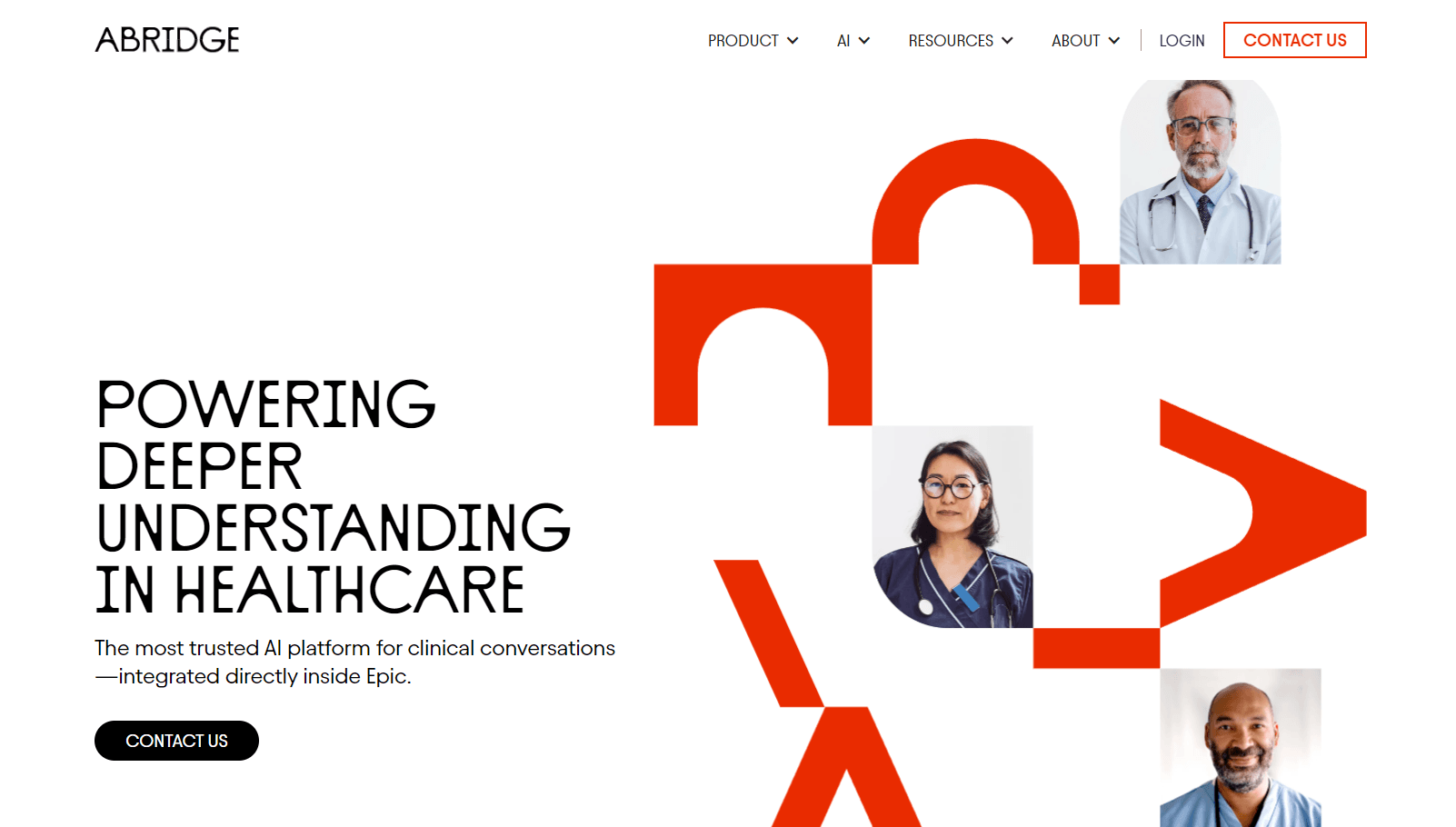
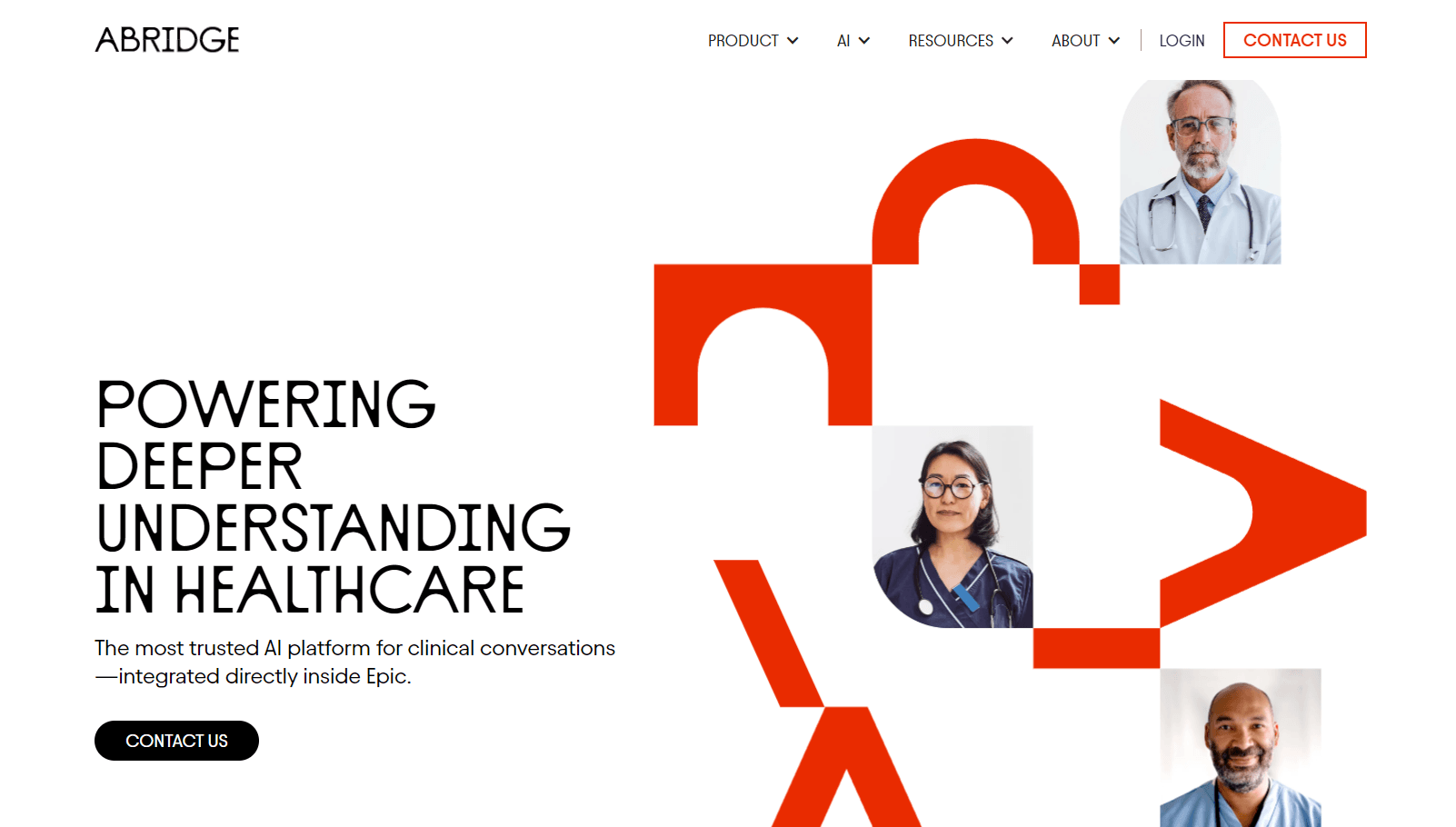
Abridge reached commercial dominance in the ambient-scribe category in 2024–2025 and entered 2026 with the largest US health-system footprint of any AI medical scribe. The product listens to patient encounters, generates structured clinical documentation in real time (with citations back to the audio), and integrates directly into Epic and other EHRs. Outcomes data published with academic partners shows measurable reductions in physician documentation time and burnout scores.
Production credibility: $300M Series E at a $2.75B valuation in early 2025 led by Elad Gil, Lightspeed, Khosla, USV, and CVS Health Ventures; total funding $462M+; deployed at Kaiser Permanente, UPMC, Sutter Health, Christus Health, Mayo Clinic Health System, and 100+ other US hospitals; native Epic integration via Epic's Workshop partner program.
What it wins at: large health systems, Epic-integrated workflows, and procurement-friendly references; physician-facing UX that's been tuned through real production deployments rather than demos.
Where it falls down: priced for enterprise deployment — small practices typically can't justify the implementation cost. Microsoft Dragon Copilot (formerly Nuance DAX) competes hard for the same accounts in Microsoft-aligned health systems.
Diagnostic Imaging: AI That Sits Inside Radiology Workflows
Diagnostic imaging AI is the most regulated, most clinically-validated lane in healthcare AI. The leaders here have FDA clearances, peer-reviewed validation studies, and integration into the PACS/RIS systems radiologists already use. "AI reads the scan" is no longer the product — "AI flags the urgent finding so the right scan gets to the right radiologist first" is.
2. Aidoc — The Imaging Triage Leader
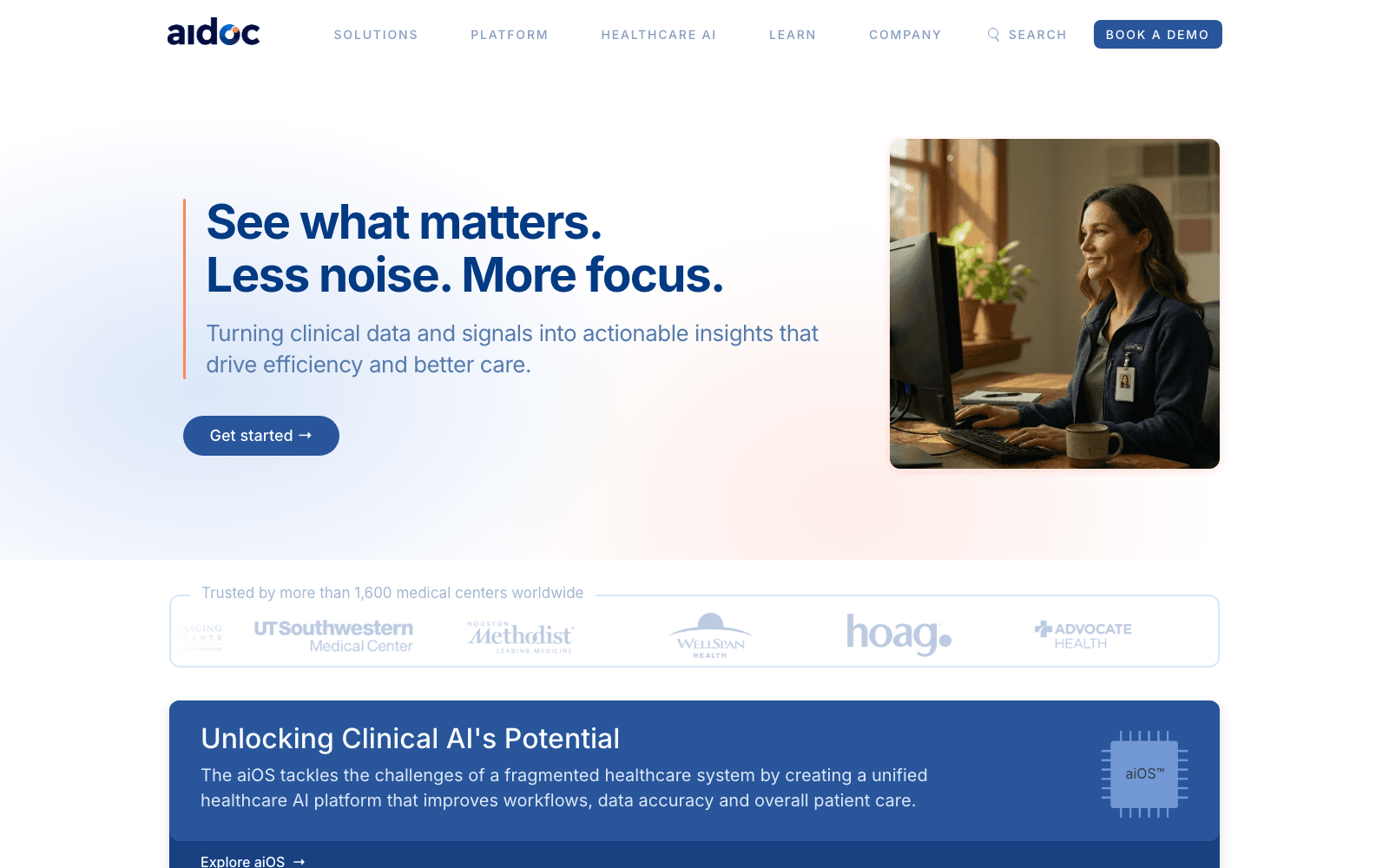
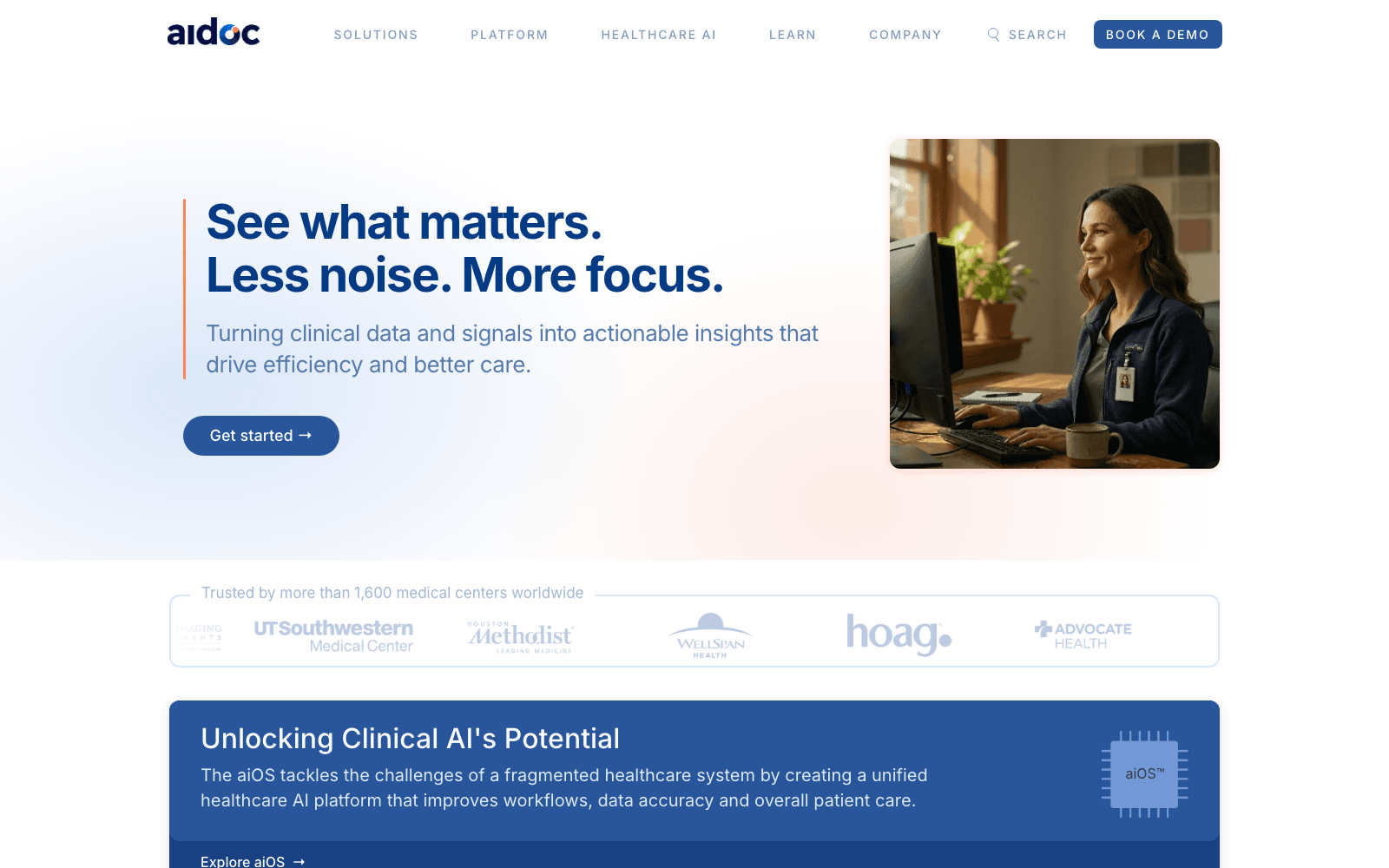
Aidoc holds the most FDA clearances of any radiology AI vendor and runs as a triage layer across the worklist — flagging suspected strokes, pulmonary embolisms, intracranial hemorrhages, and other time-critical findings so they're surfaced for the radiologist first. The 2024–2025 expansion into a broader "care coordination" platform across multiple specialties strengthened the enterprise pitch.
Production credibility: raised $250M+ across funding rounds (most recently a $110M Series D in 2024) led by General Catalyst, Square Peg, and TCV; 17+ FDA-cleared algorithms (the most of any radiology AI vendor); deployed at >900 hospitals globally including Yale New Haven, Cedars-Sinai, NYU Langone, Banner Health, and Sheba Medical Center.
What it wins at: large radiology departments, time-critical findings where minutes matter, and workflows where the AI is a triage layer rather than a replacement for the radiologist.
Where it falls down: AI triage tools carry a real false-positive cost — a radiologist still reads every flagged scan, and "alert fatigue" is a real risk if thresholds aren't tuned. Implementation requires meaningful integration work with the existing PACS.
3. Viz.ai — The Stroke and Care-Coordination Specialist
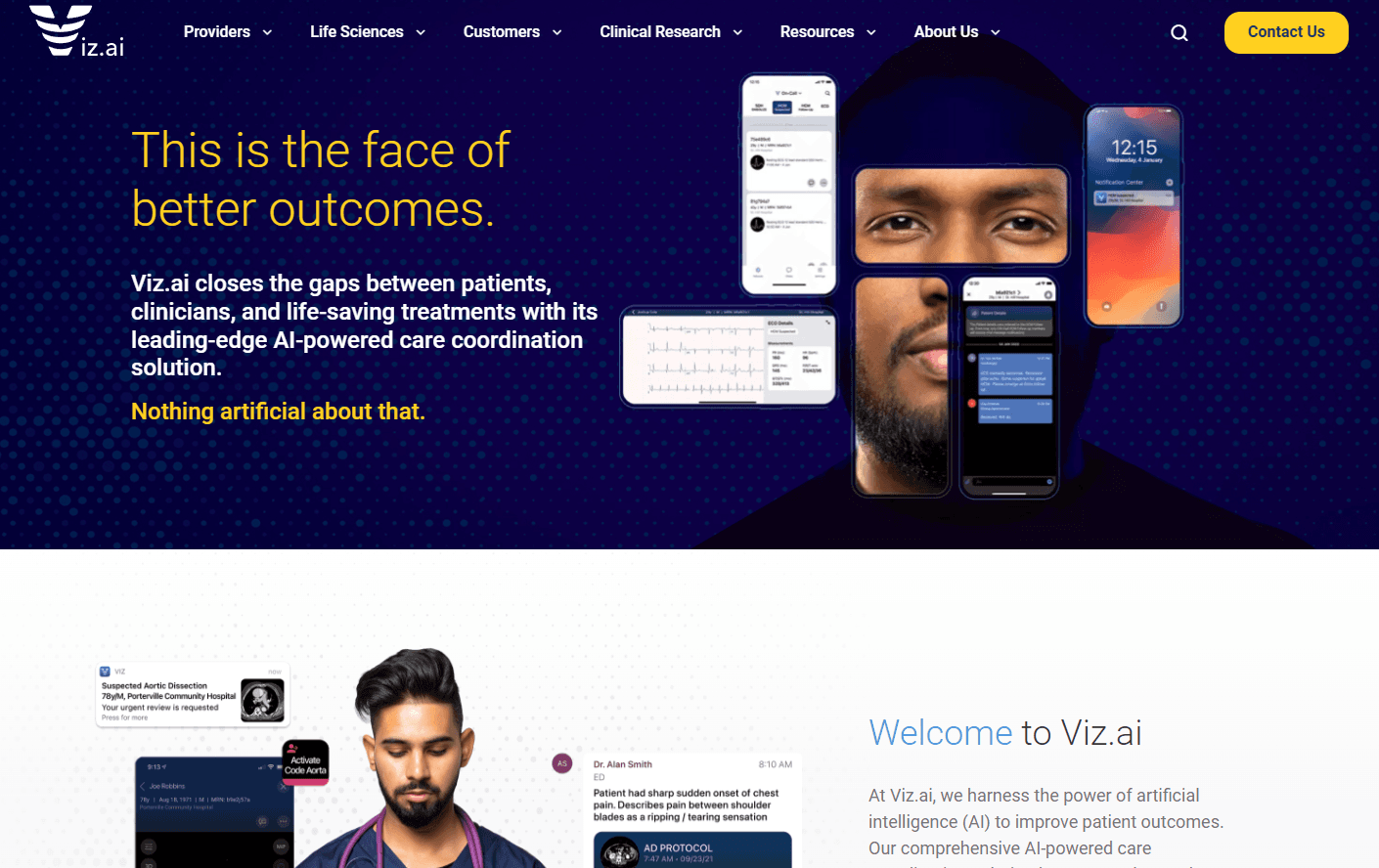
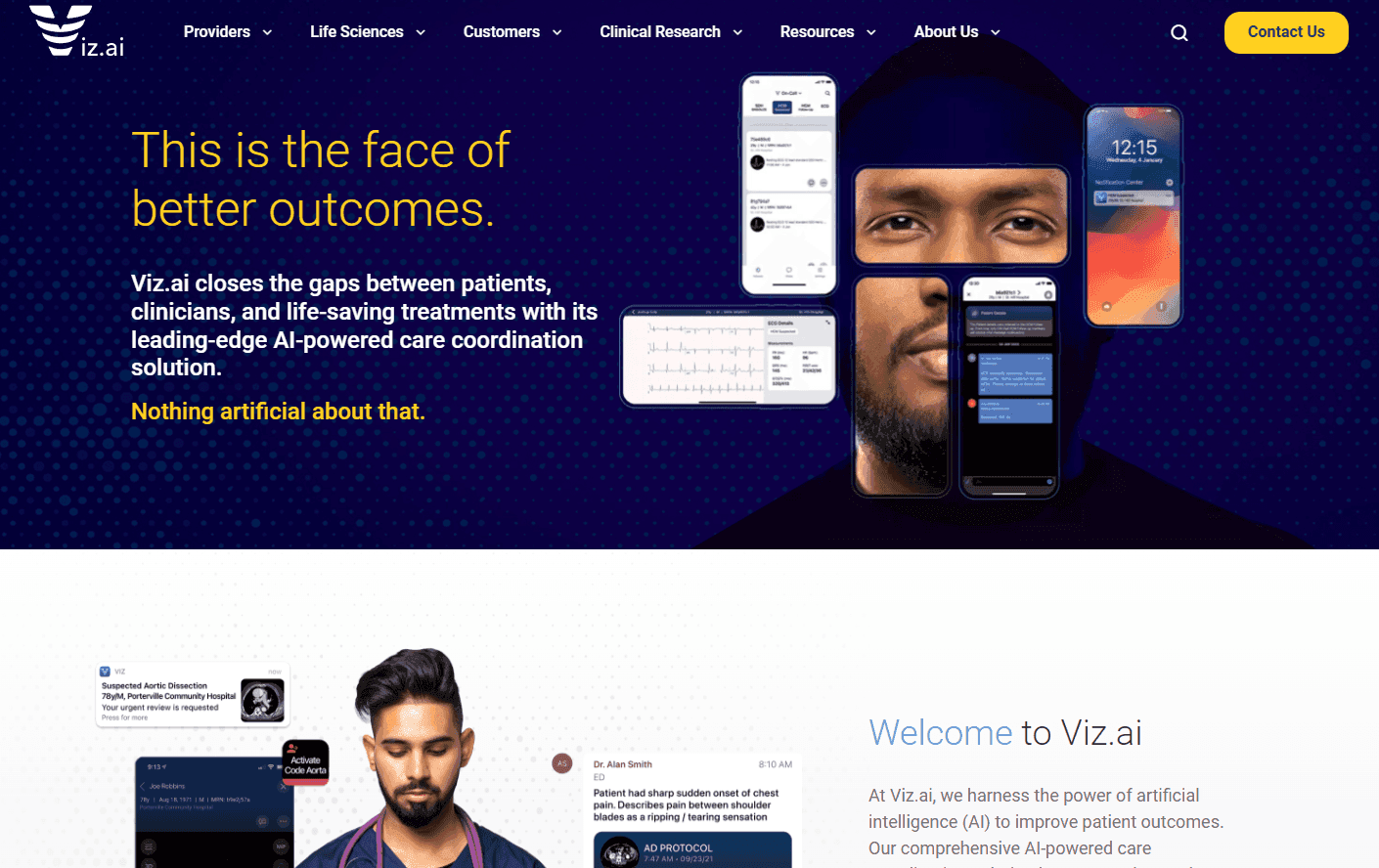
Viz.ai built the leading product for AI-assisted stroke care — large-vessel occlusion detection on CT angiogram, paired with a coordination platform that pages the right specialist on the stroke chain in real time. The 2025 expansion into pulmonary embolism, aortic syndromes, and cardiology workflows broadened it from a single-condition tool to a multi-condition care-coordination layer.
Production credibility: raised $250M+ at $1.2B+ valuation (2022 Series E led by Tiger Global); the Viz LVO algorithm became the first AI ever granted Medicare NTAP reimbursement in 2020 ($1,040 per qualifying use), the breakthrough payer-validation moment for the entire category; multiple FDA-cleared algorithms across stroke, PE, and aortic indications; deployed at >1,800 US hospitals.
What it wins at: stroke centers and comprehensive stroke programs, time-from-CT-to-thrombectomy reductions that translate to real outcomes, and care-team coordination beyond just the imaging read.
Where it falls down: narrower focus than Aidoc — for general radiology triage across many findings, Aidoc is the broader pick. Implementation cost is real and best justified at high stroke volumes.
Patient-Facing AI: The Safety-Constrained Lane
Patient-facing AI is the highest-stakes lane in healthcare AI and the slowest to commercialize for good reasons. The bar isn't just "does the AI give a useful answer?" — it's "does the AI never give a dangerous answer when it doesn't know." Most general-purpose chatbots fail this test catastrophically.
4. Hippocratic AI — Safety-First Patient Outreach
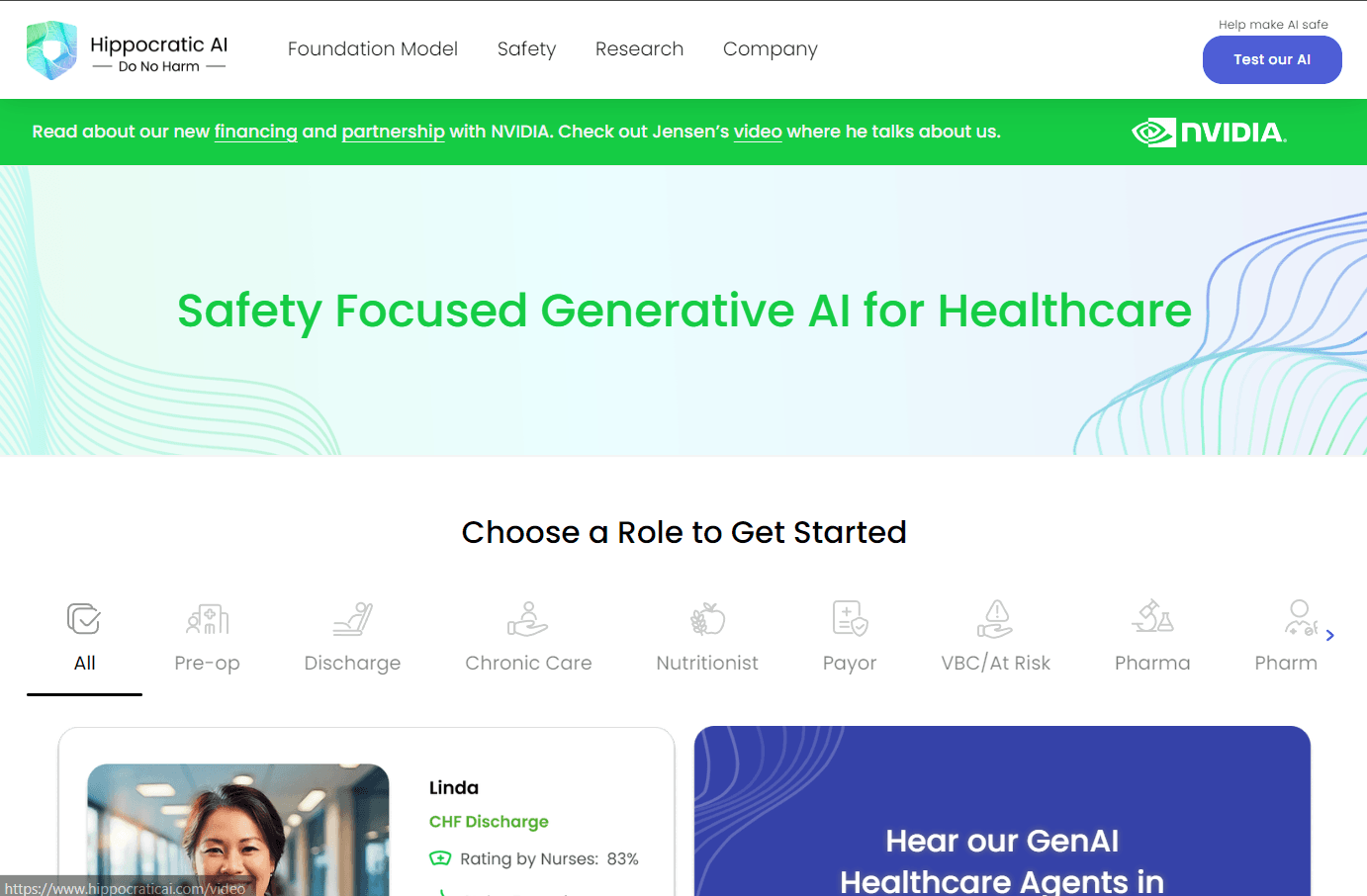
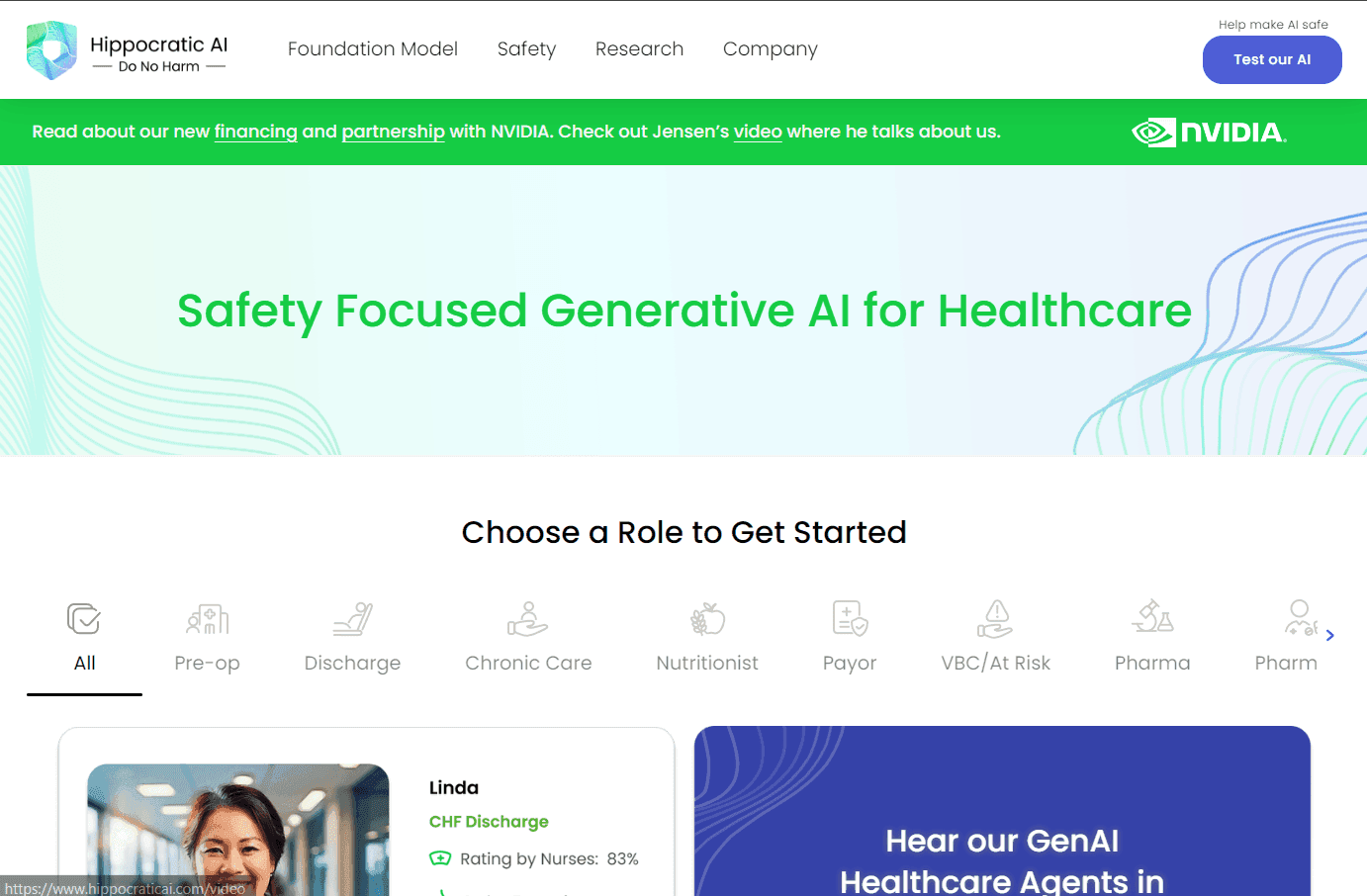
Hippocratic AI raised meaningful funding ($500M+ across rounds through 2024–2025) on the thesis that low-acuity, high-volume patient outreach is the right wedge for clinical-grade safety-focused AI. The product handles chronic-care check-ins, post-discharge follow-up, and pre-procedure prep calls — work that's important enough to need to happen but doesn't require physician judgment, with safety guardrails designed for the ways general-purpose models fail.
Production credibility: $278M Series B at a $1.64B valuation in early 2025 led by Andreessen Horowitz, with Premji Invest, General Catalyst, Kleiner Perkins, and others; total raised $278M+; the product's safety architecture is supervised by a panel of >1,000 licensed clinicians who score outputs against clinical safety benchmarks; deployments include Cone Health, WellSpan, Mass General Brigham, and major payer partnerships for chronic-care outreach.
What it wins at: payer and provider deployments where outbound patient outreach is gated by call-center capacity, post-discharge programs, and chronic-condition management at scale.
Where it falls down: explicitly not for diagnosis or anything requiring clinical judgment. The category remains young and the regulatory landscape for patient-facing AI is still being shaped.
Precision Medicine and Drug Discovery: The Long-Cycle Bets
The drug-discovery and precision-medicine lanes operate on multi-year timelines. The companies below are placing real bets — clinical-stage molecules, public-market scrutiny, and pharma partnerships — but the outcomes that justify the AI claims are years out.
5. Tempus — Precision Medicine at Production Scale
Tempus operates one of the largest molecular and clinical datasets in oncology and runs an AI platform for treatment decision support, clinical trial matching, and pharma partnerships. Public since 2024 ($TEM), with mature commercial products in oncology and growing presence in cardiology and neurology.
Production credibility: went public on NASDAQ ($TEM) in June 2024 at ~$8B valuation; pre-IPO raised $1.3B+ across rounds; deployed across 65%+ of US NCI-designated cancer centers per company disclosures; pharma research partnerships with AstraZeneca, GSK, Pfizer, and Bayer; 250+ pharma research collaborations to date.
What it wins at: oncology workflows where genomic + clinical data inform treatment decisions, clinical trial matching, and pharma partnerships looking for real-world evidence at scale.
Where it falls down: the broader "AI for healthcare" pitch on top of the precision-medicine core is still maturing as a product. As a public company in a regulated industry, expect quarterly volatility around the AI-vs-services revenue mix.
6. Recursion — Phenomic Drug Discovery
Recursion ($RXRX) runs one of the largest phenomic-imaging datasets in pharma — automated cell-imaging at industrial scale, paired with ML to surface molecule-target relationships. Multiple clinical-stage assets and pharma partnerships make it the most clinically advanced public AI-drug-discovery company.
Production credibility: public on NASDAQ ($RXRX) since 2021; merged with Exscientia in September 2024 to form the largest publicly-traded AI drug discovery company by combined market cap; the combined entity has >10 clinical-stage programs in the pipeline; pharma partnerships with Bayer, Roche/Genentech, and Sanofi; partnership with NVIDIA on the BioHive supercluster announced in 2023.
What it wins at: large-scale biology-first discovery where the AI consumes phenomic data, partnerships with traditional pharma, and a public-company governance and disclosure regime.
Where it falls down: drug discovery timelines mean AI claims won't be definitively validated for years; investors and partners are betting on the platform, not on shipped drugs. Public-market exposure adds noise.
7. Isomorphic Labs — DeepMind's AlphaFold Spinout
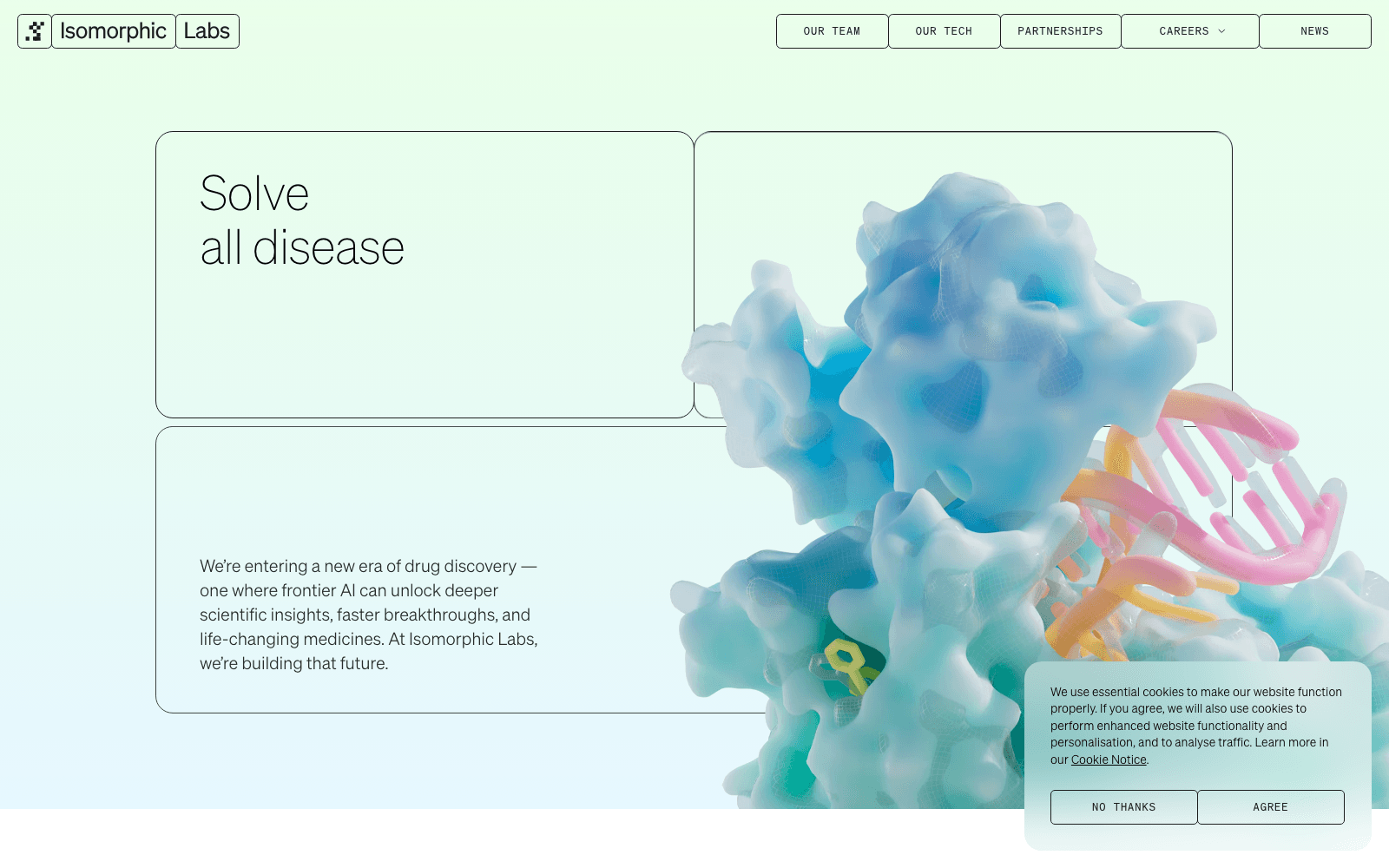
Isomorphic Labs is Alphabet's drug-discovery spinout from DeepMind, built on the AlphaFold lineage and partnerships with Eli Lilly and Novartis. The bet is that protein-structure prediction at AlphaFold's quality changes the economics of structural-biology-first discovery.
Production credibility: Alphabet/DeepMind subsidiary spun out in 2021; AlphaFold 3 published in Nature in May 2024 with the broadened multi-molecule prediction capability; pharma partnerships announced in January 2024 with Eli Lilly ($45M+ upfront, $1.7B+ in milestones) and Novartis ($37.5M+ upfront, $1.2B+ in milestones); operates with the credibility of an Alphabet-funded lab without short-term revenue pressure.
What it wins at: structural biology workflows, pharma partnerships where AlphaFold-class structure prediction is the input to design, and the credibility of an Alphabet-backed lab.
Where it falls down: still early in commercial validation — the partnerships are real, but shipped clinical assets are not yet here. Information asymmetry is high; this is harder to evaluate from the outside than a public company like Recursion.
Healthcare Operations: The Quiet Compounding Bet
8. Notable — AI Agents for the Back Office
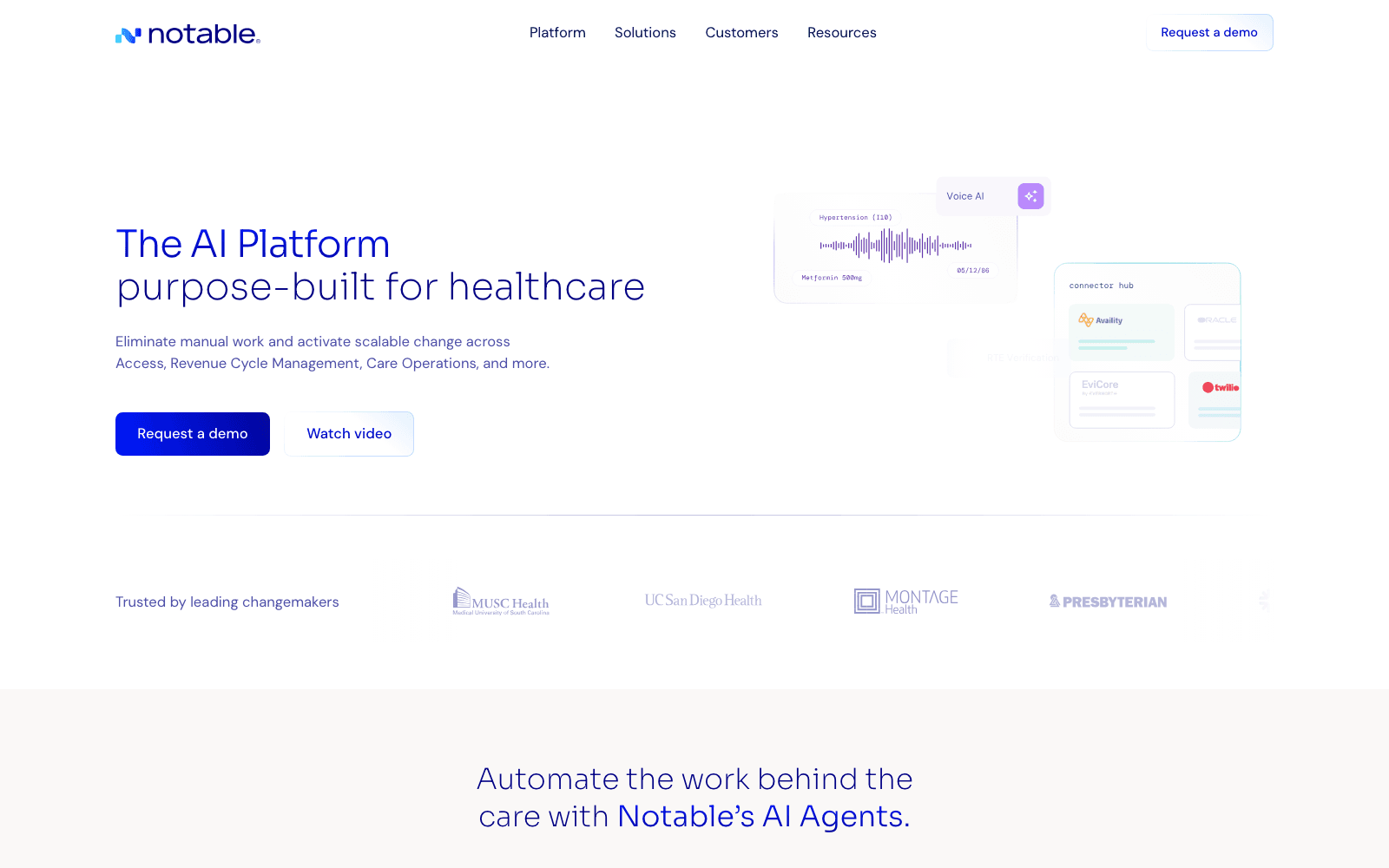
Notable targets the unglamorous operational work that consumes a meaningful percentage of every health system's payroll: patient intake, scheduling, prior authorization, eligibility verification, and other workflows where the AI agent talks to the patient or the payer instead of a staff member doing it manually. The 2025 push into AI agents (rather than just RPA-with-an-LLM) is the right architectural call for the category.
Production credibility: raised $135M+ across rounds led by Greylock, ICONIQ, F-Prime, and Maverick; deployed at Intermountain Health, North Kansas City Hospital, MercyOne, OSF HealthCare, and other large provider organizations; processes >2M patient interactions per month per company disclosures; SOC 2 Type II + HIPAA-compliant architecture purpose-built for healthcare operations workflows.
What it wins at: large provider organizations with meaningful back-office headcount, prior-auth workloads where each automated approval has a measurable cost-per-touch impact, and patient-intake automation that smooths the front door.
Where it falls down: ROI requires real volume — small practices won't move the needle on a Notable deployment. Healthcare ops AI is a quiet category with less obvious clinical credibility than imaging or scribes; getting CFO buy-in is faster than CMO buy-in.
How to Pick a Healthcare AI Tool
Match the tool to the actual operational problem:
- Physician documentation burden: Abridge (or Heidi / Suki / Microsoft Dragon Copilot)
- Radiology triage at scale: Aidoc
- Stroke care or time-critical imaging: Viz.ai
- Patient outreach at volume: Hippocratic AI (low-acuity only)
- Oncology precision medicine: Tempus
- AI drug discovery, public-market: Recursion
- AI drug discovery, structural biology: Isomorphic Labs
- Back-office automation: Notable
For most US health systems, the highest-ROI starting point in 2026 is ambient clinical documentation (Abridge or its peers) — the value prop is well-validated, the procurement cycle is short, and physician satisfaction wins on the same projects that move the financial needle. Diagnostic imaging and patient-facing AI are credible second moves; drug discovery is a different category for a different audience (pharma R&D, not provider IT).
Adjacent Reading
- Best AI Tools for Data Visualization and Analytics (2026) — analytics and BI layer underneath healthcare AI
- Enhancing Efficiency: AI Tools for Operations — broader business operations AI context
- Best AI Tools for Real Estate (2026) — vertical-industry companion guide
- Best AI Tools for Finance and Accounting (2026) — vertical-industry companion guide
- Top 5 AI Legal Tools Transforming the Industry — adjacent regulated-industry vertical
Frequently Asked Questions
Are AI tools in healthcare FDA-approved? It depends on the tool. Diagnostic imaging tools like Aidoc and Viz.ai operate under FDA 510(k) clearances for specific indications — they're regulated as medical devices. Ambient clinical scribes (Abridge, Heidi, Suki) generally don't require FDA clearance because they're documentation tools, not diagnostic devices. Drug-discovery platforms aren't FDA-regulated themselves; the molecules they help discover go through the standard drug-approval process. Always check the specific clearance status for the indication you care about.
Is AI safe to use in clinical settings? In the lanes where it's been clinically validated and properly integrated, yes — and the outcomes data is increasingly strong. The risk profile is highest for patient-facing AI making clinical recommendations and lowest for back-office operations and ambient documentation. Health systems generally adopt the lower-risk categories first and add the higher-risk ones with more guardrails.
Will AI replace doctors? Not the doctors. AI is reliably automating the work around the doctor — documentation, image triage, intake, prior auth — and that's where the productivity gains are. The clinical judgment, relationship, and accountability layers remain human. Specialties most affected by automation (radiology, pathology) are the ones where AI extends rather than replaces the specialist's reach.
What happened to IBM Watson Health? IBM sold the Watson Health assets to Francisco Partners in 2022, where they became Merative. The original "AI doctor" framing didn't deliver, but the underlying products (clinical and life-sciences data tools) continue to operate. The lesson, broadly: generic LLMs without clinical workflow integration didn't change healthcare; specialized products that integrate into existing systems are the ones moving the category forward.
What happened to Babylon Health? Babylon went public via SPAC in 2021, struggled commercially, and entered insolvency in 2023. The UK NHS contract was transferred to other providers. Babylon's failure didn't doom patient-facing AI as a category, but it did teach the survivors (Hippocratic AI being the most visible) that safety-first design and disciplined wedge selection matter more than viral demos.
Are these tools available outside the US? Most have international presence to varying degrees. Aidoc and Viz.ai are deployed across Europe, Asia, and Latin America. Abridge is primarily US-focused as of 2026. Hippocratic AI's footprint is mostly US payer/provider deployments. Always check regional regulatory clearance — FDA clearance doesn't transfer to MDR (Europe), TGA (Australia), or PMDA (Japan).
How do health systems actually evaluate these tools? A serious pilot in a single specialty or department, six to twelve months long, with pre-defined outcome metrics (documentation time saved, time-to-treatment improvements, cost-per-touch reductions). The vendor demos are uniformly impressive; the differentiation shows up in integration quality, change management, and how the tool performs on the long tail of cases the demo didn't show.
What's the typical pricing for healthcare AI tools in 2026? Wide range. Ambient scribes (Abridge, Suki) typically run $200–500 per physician per month at the enterprise tier, with bulk discounts for large health-system deployments. Diagnostic imaging tools (Aidoc, Viz.ai) are commonly priced per-scan or per-deployment-site at six-figure annual contracts; Viz.ai's NTAP reimbursement offsets a meaningful portion of stroke-pathway costs. Hippocratic AI prices per-call or per-outcome. Tempus, Recursion, and Isomorphic Labs operate via pharma research contracts measured in $millions–$tens-of-millions per partnership. Notable is custom-priced for enterprise deployments.
Final Thoughts
Healthcare AI in 2026 is finally past the cycle of hype demos and into the harder work of disciplined deployment. The leaders in each category are no longer the loudest companies — they're the ones with FDA clearances, signed enterprise contracts, peer-reviewed outcomes data, and the operational discipline to make a 50,000-physician health system actually adopt their tool.
For health systems still planning their first AI deployment, ambient clinical documentation is the most credible 2026 starting point: well-validated, procurement-friendly, and aligned with physician satisfaction in a way that few other categories are. For pharma R&D, drug-discovery platforms are a longer-cycle bet that requires real clinical evidence to fully justify the AI claims. For everyone else, the right move is to pick one category, run a serious pilot, and let outcomes data — not vendor pitches — drive the next move.
Categories these tools span
More collections you may also like


Sign up for our newsletter
Receive weekly updates so you can stay up-to-date with the world of AI
Sign up for our newsletter
Receive weekly updates so you can stay up-to-date with the world of AI
The AI tools directory for discovering, exploring, and comparing the most innovative AI tools in the industry