Best AI Tools for Real Estate (2026)










Best AI Tools for Real Estate in 2026
If you're researching the best AI tools for real estate in 2026, the category serves three different audiences with different products: residential agents and brokers (lead generation, valuation, marketing), commercial brokers and investors (property intelligence, deal sourcing, market data), and listing-side workflows (virtual staging, listing copy, photo enhancement). The leaders in each lane have matured significantly since 2024 — HouseCanary's AVMs are now standard in residential valuation; Reonomy and Cherre dominate commercial data; Haystacks AI and Leadflow have reshaped how investors source deals and evaluate markets.
This guide covers the six AI tools that move the needle in real estate workflows in 2026: HouseCanary, Reonomy, Cherre, Haystacks AI, Leadflow, and Dreamhouse AI. Each is rated on the lane it serves, what it ships in production, and where the honest 2026 limitations are.
The Three Lanes of Real Estate AI in 2026
- Valuation and data: AI-powered AVMs (automated valuation models), property intelligence, market analytics. Leaders: HouseCanary (residential), Reonomy (commercial), Cherre (data integration).
- Lead generation and predictive marketing: identify likely sellers, score leads, target marketing. Leaders: Leadflow, Haystacks AI.
- Listing-side and visual: virtual staging, listing copy, photo enhancement. Leader: Dreamhouse AI.
Most serious agents and brokers in 2026 use one tool from each of the first two lanes (data + leads); listing-side tools are situational depending on whether you're handling staging in-house.
Quick Comparison
| Tool | Best for |
|---|---|
| HouseCanary | Residential valuation. Best for residential agents, appraisers, and lenders needing AVMs and forecasting. |
| Reonomy | Commercial property intelligence. Best for commercial brokers and investors sourcing deals and contacting owners. |
| Cherre | Real estate data integration. Best for institutional investors and large brokerages unifying data across multiple sources. |
| Haystacks AI | Investment market intelligence. Best for residential and small-multifamily investors evaluating markets and properties. |
| Leadflow | Lead generation for investors. Best for fix-and-flip and wholesale investors needing high-volume motivated-seller leads. |
| Dreamhouse AI | Virtual staging and visualization. Best for listing agents staging properties without physical furniture. |
Valuation and Data
This is the foundational lane. Every credible real estate workflow needs reliable property data and valuation; the leaders below differ on whether they target residential, commercial, or institutional use cases.
1. HouseCanary — Residential Valuation and Forecasting
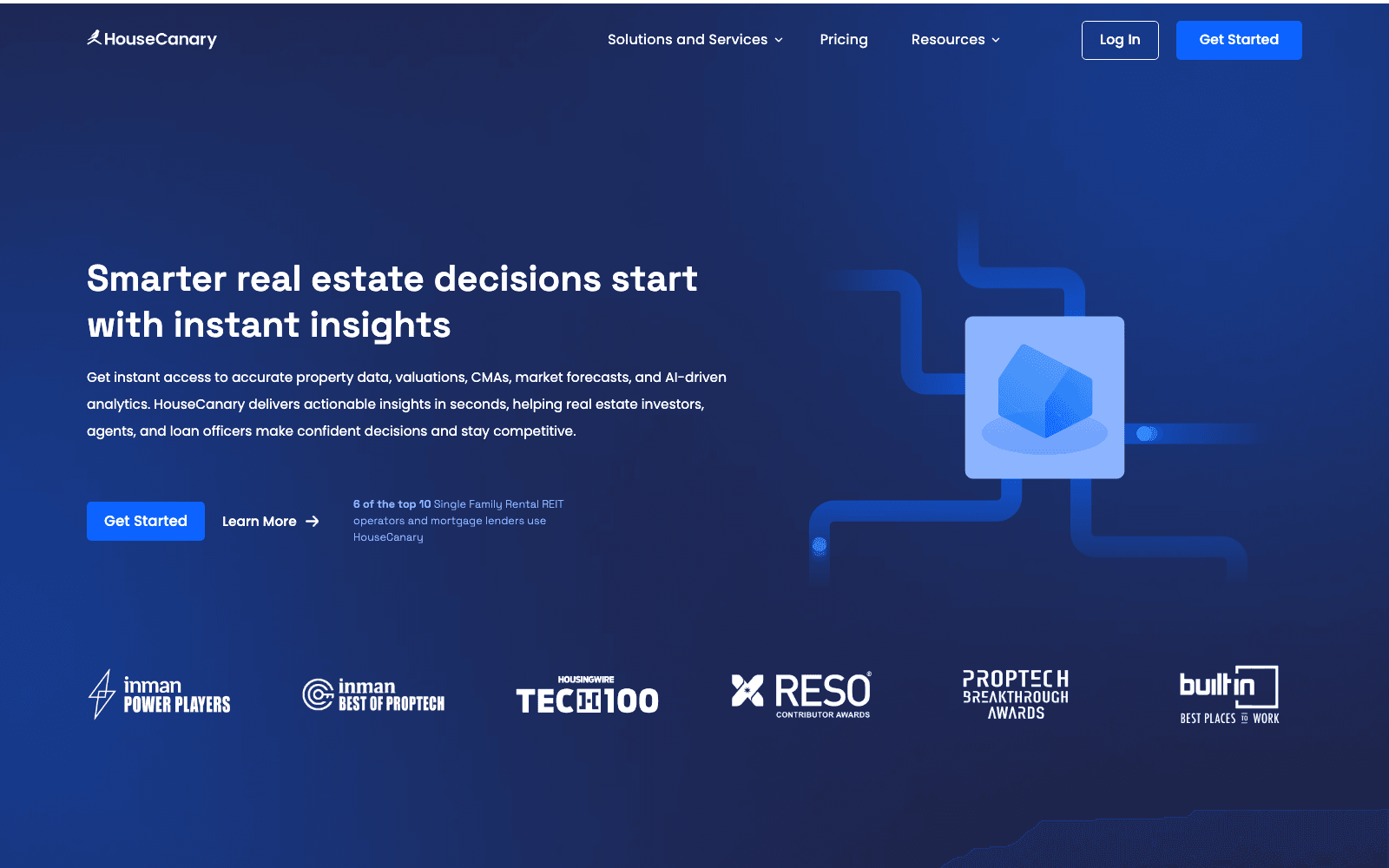
HouseCanary is the leading AI-powered residential AVM provider, used by lenders, appraisers, and agents who need accurate property valuations at scale. The product extends beyond simple AVMs into market forecasting, ComeHome (consumer-facing valuations), and analytics for portfolio-level decision-making.
What it wins at: AVM accuracy on residential properties, market forecasting tools that hold up under stress-testing, and integration with lender and brokerage workflows that institutional users need.
Where it falls down: priced for institutional and brokerage tiers; individual agents at smaller brokerages typically can't justify it. Coverage and accuracy vary by metro market — verify in your specific area before relying on it.
2. Reonomy — Commercial Property Intelligence
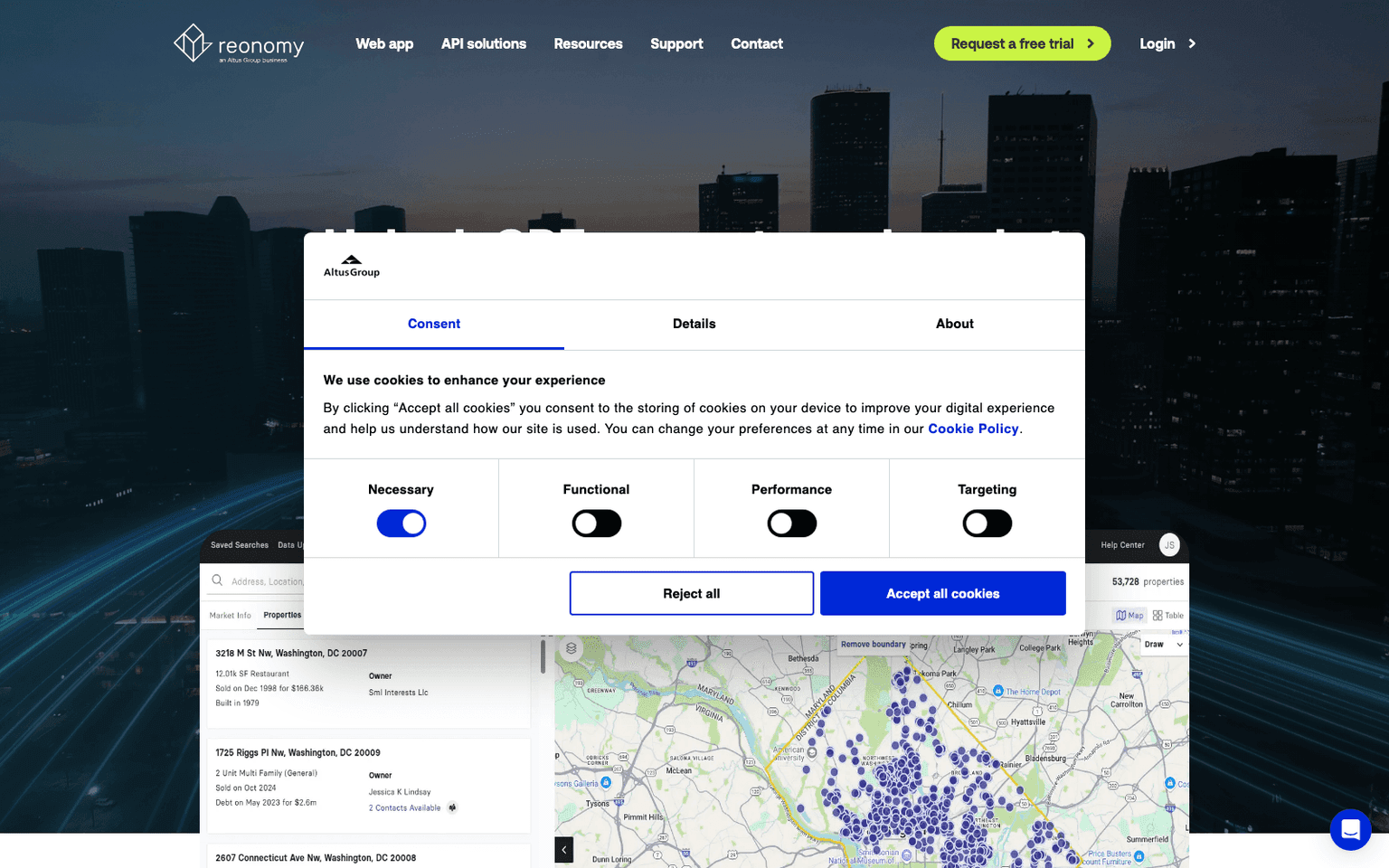
Reonomy is the leading commercial real estate property intelligence platform. Owner contacts, debt information, tenant data, transaction history, and the AI-powered prospecting workflows commercial brokers use to source deals and identify off-market opportunities.
What it wins at: commercial property data depth, owner-contact information that's hard to source elsewhere, and the most-used commercial prospecting workflow in the category.
Where it falls down: commercial-only — useless for residential workflows. Subscription pricing is for serious commercial brokerages, not casual users.
3. Cherre — Real Estate Data Integration Platform
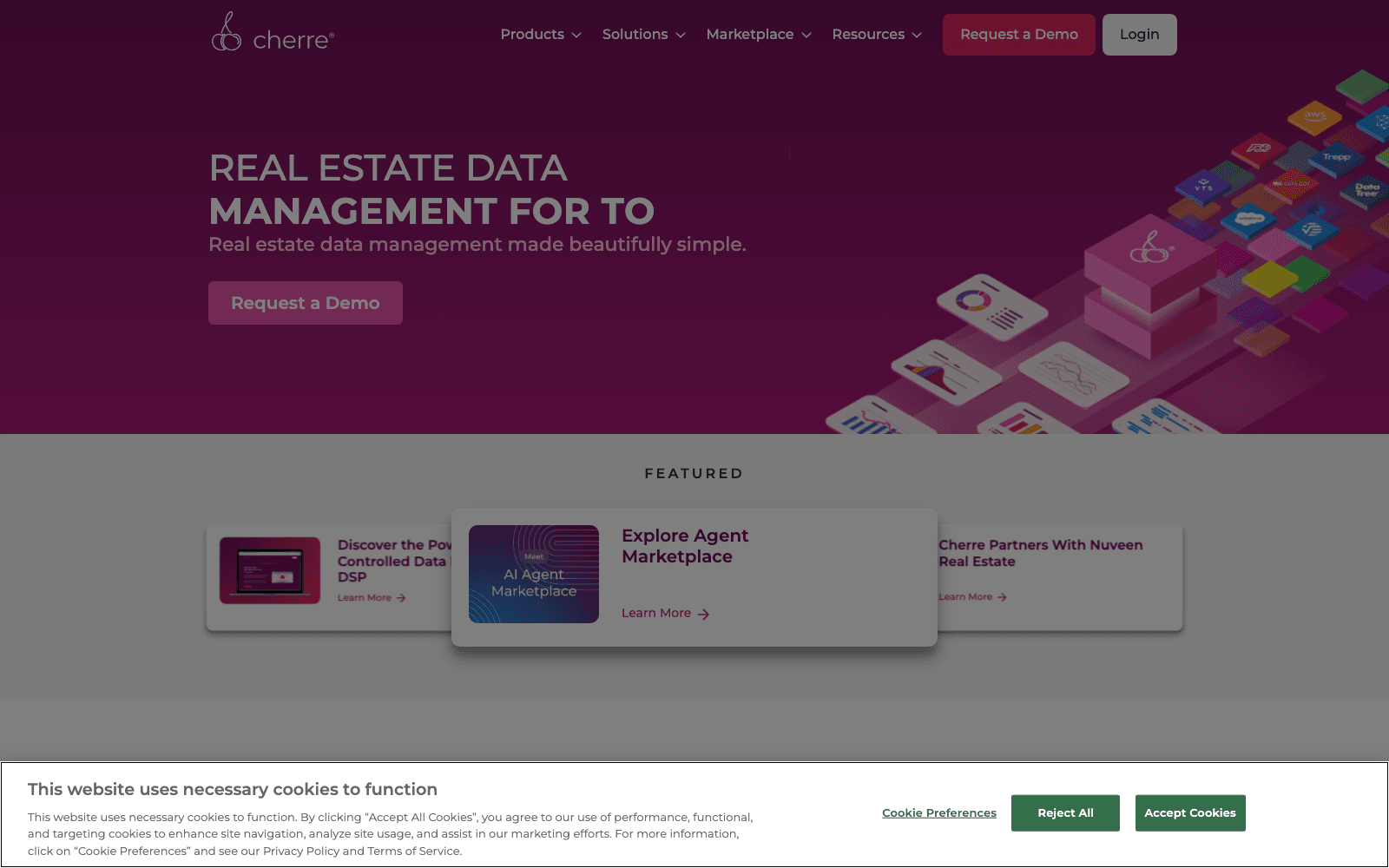
Cherre sits one tier up from HouseCanary and Reonomy — instead of being a single data product, it's the integration platform that unifies third-party, internal, and public real estate datasets for institutional users. Used by REITs, large brokerages, and investment funds to centralize their data infrastructure.
What it wins at: institutional and enterprise scale, multi-source data unification, and API-first workflows for engineering teams building proprietary real estate tools internally.
Where it falls down: enterprise-only — wrong tool for individual agents or small brokerages. Implementation is multi-month rather than days.
Lead Generation and Predictive Marketing
This is the lane most individual agents care about — finding sellers and buyers before competitors do. The leaders below take different angles: Haystacks evaluates markets and individual properties for investors; Leadflow generates investor-focused motivated-seller leads.
4. Haystacks AI — Market Intelligence for Investors

Haystacks AI targets the investor side specifically — AI-driven market intelligence for residential and small-multifamily investing decisions. Market scoring, property-level analysis, deal evaluation. For investors comparing markets or evaluating individual properties, the AI compresses what would otherwise be hours of manual analysis.
What it wins at: investor-facing workflows, market and submarket scoring, and the comparative analysis (Market A vs Market B) that drives capital allocation decisions.
Where it falls down: investor-focused — less useful for traditional buyer/seller agents. Not a replacement for property-level due diligence by a human.
5. Leadflow — Investor Lead Generation

Leadflow identifies motivated-seller properties (distressed, off-market, equity-rich) for fix-and-flip investors and wholesalers. Different audience, different workflow, different definition of "good lead."
What it wins at: fix-and-flip and wholesale investor workflows, motivated-seller lead volume, and the data tooling investors use to source off-market deals.
Where it falls down: investor-focused — wrong tool for retail buyer/seller agents. Lead quality varies by market and lead-volume tier.
Listing-Side and Visual
6. Dreamhouse AI — Virtual Staging in Seconds

Dreamhouse AI handles the virtual staging problem — empty rooms photograph poorly and lower buyer interest, but physical staging costs thousands per listing. Dreamhouse generates AI virtual staging in seconds: same room, same photo, but with AI-generated furniture and decor at multiple style options. Used heavily by listing agents, REI investors flipping vacant properties, and short-term rental hosts marketing units.
What it wins at: fast virtual staging at low cost per image, multiple style options per room, and accessibility to non-designer agents.
Where it falls down: disclosure rules vary by state — many MLS systems require labeling AI-staged photos as such. Quality is high but careful inspection sometimes reveals AI artifacts; not yet a full replacement for high-end physical staging on luxury properties.
How to Build Your 2026 Real Estate AI Stack
Match the tool to your role:
- Residential agent: HouseCanary for accurate AVMs (or your MLS's built-in AVM if budget is tight) + Dreamhouse AI for staging + Leadflow if you do investor work on the side
- Commercial broker: Reonomy as the foundation, with Cherre if your brokerage is at institutional scale
- Real estate investor (residential / small multifamily): Haystacks AI for market analysis + Leadflow for motivated-seller leads + HouseCanary for valuation
- Institutional / REIT analyst: Cherre as the data platform + Reonomy / HouseCanary for vertical-specific use cases
For most individual agents, the practical 2026 stack is one predictive-marketing tool + one valuation tool + one visual tool, totaling around $300–600/month. Investors typically run 2–3 data tools at higher cost because the deal-sourcing edge pays back fast.
For adjacent reading, see our Best AI Tools for Marketing & SEO (real estate agents are heavy marketing-tool buyers), Top 7 AI Tools for Social Media Management for the listing-promotion side, and Best AI Customer Support Tools for AI assistants handling inbound buyer inquiries.
Frequently Asked Questions
Are AI valuations (AVMs) accurate enough to replace appraisals? Not for transactions that legally require an appraisal (most mortgages). AVMs are accurate enough for ranging — within 5–10% of appraised value on standard properties in well-tracked markets — but lenders, buyers, and sellers who need legal-grade valuations still require human appraisal. Use AVMs for pricing decisions, market analysis, and CMAs; use appraisals for transactions that require them.
Will AI replace real estate agents? Not the agents; replacing the volume of repetitive search and screening work. Most teams find AI tools shift agents toward higher-value activities (negotiation, relationships, complex transactions) and away from cold calling and farming. The buyer-and-seller representation work, with the trust and judgment it requires, remains stubbornly human.
Are virtual staging photos legal in MLS listings? Legal but with disclosure requirements that vary by state and MLS. Most MLS systems now require labeling AI-staged or AI-edited photos as such. Failure to disclose has been the basis for lawsuits and license complaints. When in doubt, label it.
Is using AI for cold-calling sellers ethical? The regulation here is moving fast. AI voice agents calling homeowners are subject to TCPA, state-level robocall laws, and increasingly specific AI disclosure requirements. Some states require explicit AI-disclosure on the call itself. Treat AI cold-calling like robocalling — if you're not 100% sure it's compliant, get legal review.
What's the difference between a predictive lead and a marketing list? A marketing list is everyone in a ZIP code (broad). A predictive lead is the subset of those people the AI thinks are most likely to sell in the next 6–12 months (narrow, scored). Predictive leads cost more per name but waste less marketing spend on people who won't move for years.
Are these tools available outside the US? Most are US-focused as of 2026. HouseCanary, Reonomy, Cherre, and Leadflow are US-only or US-primary. Haystacks AI and Dreamhouse AI work internationally. Outside the US, regional alternatives have stronger local data; verify your specific market before subscribing.
Can AI write listing descriptions? Yes, and the quality is now indistinguishable from human-written when edited for property-specific detail. ChatGPT and Claude do this well; dedicated listing-copy tools exist but the differentiation over a general-purpose LLM is small. Most agents in 2026 use a general-purpose AI plus a property-specific human-edit pass.
Final Thoughts
The AI-for-real-estate category in 2026 has matured into specific operational tooling rather than the "AI will revolutionize real estate" framing of 2022. The leaders work in production at real brokerages and investment firms; the differentiation is on data depth, workflow integration, and which audience cut they serve.
If you're an individual agent or broker not yet using any of these tools, HouseCanary for accurate valuations plus a free-tier of Dreamhouse AI for staging is a credible starting point that pays back in the first deal it influences. Investors should start with Haystacks AI for the analytics layer and add Leadflow only if motivated-seller volume is the bottleneck.
Categories these tools span
More collections you may also like


Sign up for our newsletter
Receive weekly updates so you can stay up-to-date with the world of AI
Sign up for our newsletter
Receive weekly updates so you can stay up-to-date with the world of AI
The AI tools directory for discovering, exploring, and comparing the most innovative AI tools in the industry