Factory Droid
Agent-native software development platform with autonomous Droids that handle the full SDLC — coding, incidents, docs, missions over multi-day horizons.
Overview
Factory Droid: Autonomous AI Software Engineers
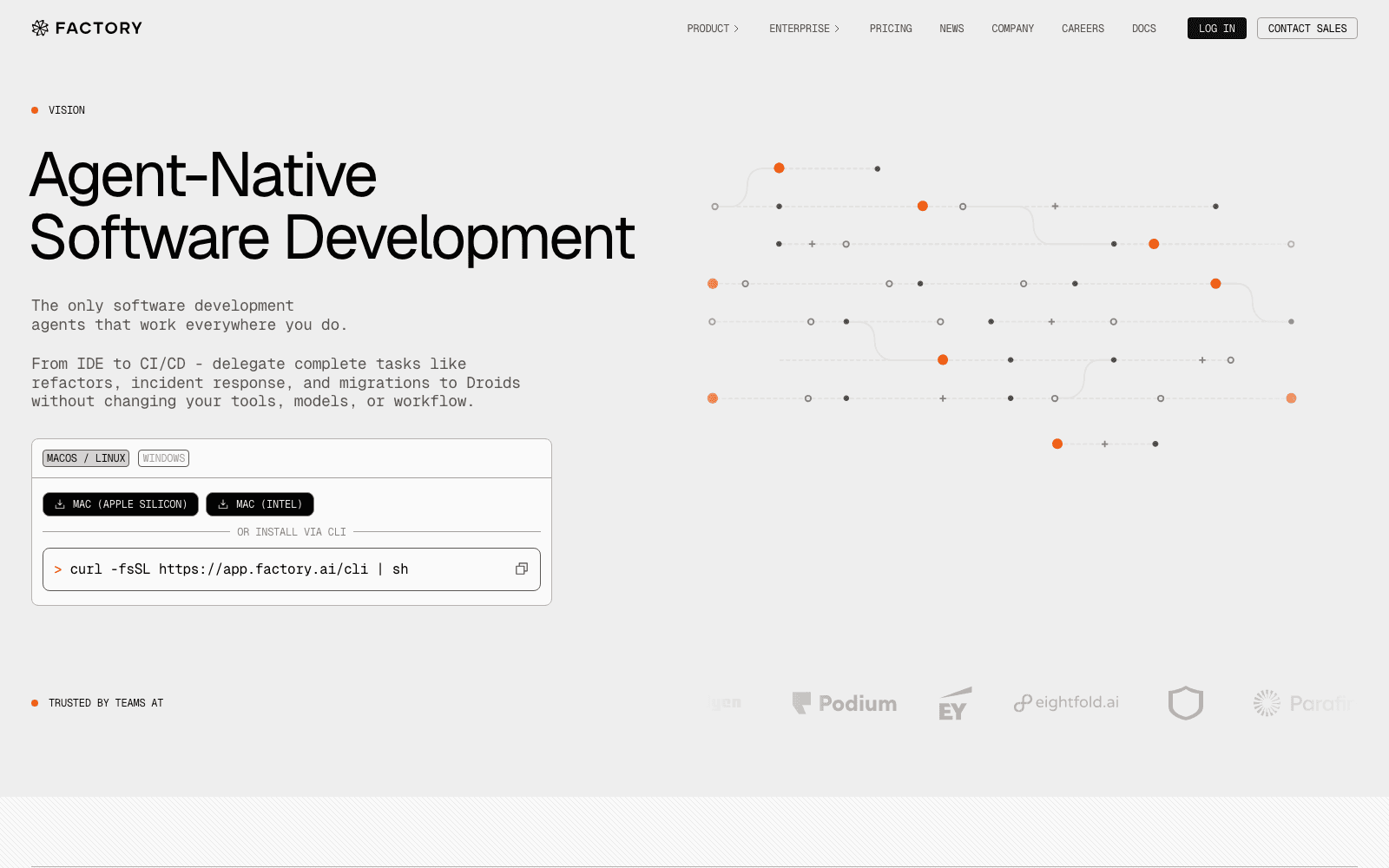
Factory builds Droids — autonomous AI software engineers that handle the full software development lifecycle without human steering at every step. Droids write code from scratch, resolve production incidents, write and update documentation, and now pursue Missions over multi-day horizons that require sustained reasoning.
Sequoia-backed and used by enterprise engineering teams to offload high-volume work that doesn't need a senior engineer, freeing humans for the design and review work that does.
Key Features
- Droids — autonomous agents specialized for code, incidents, or docs
- Missions — multi-day autonomous work, with the agent self-correcting as it learns
- Agent-native dev platform — Droids interact with code, infra, and tools as first-class peers
- Used in production for SWE work at Sequoia portfolio companies and enterprise teams
- Web and CLI interfaces for monitoring and steering Droids
Ideal Use Case
Engineering teams with backlog volume — recurring bug triage, doc upkeep, dependency upgrades, incident response — who want autonomous agents handling the routine work while senior engineers focus on architecture and review.
Why Use Factory Droid
Most "AI engineer" products are glorified pair-programmers. Factory's bet is that real autonomy — Droids that work overnight and deliver merge-ready PRs in the morning — is qualitatively different and worth productizing. The Missions feature operationalizes that.
FAQ
What does Factory Droid do? Factory Droid is an agent-native software development platform where autonomous Droids handle the full software development lifecycle—from coding and incident management to documentation and multi-day projects—without requiring constant human oversight.
Who should use Factory Droid? Factory Droid is built for development teams and organizations looking to automate end-to-end development workflows and let AI agents independently manage complex, ongoing technical missions across days.
How much does Factory Droid cost? Factory Droid operates on a paid pricing model. Visit the Factory Droid pricing page for current plans and details on how to get started.
How does Factory Droid compare to other AI development tools? Unlike GitHub Copilot, Cursor, and v0—which focus on code completion and UI generation—Factory Droid emphasizes fully autonomous agents that manage entire development cycles, incident response, and documentation as independent actors over extended timeframes.
tl;dr
Autonomous AI software engineer fleet. Multi-day Missions, role-specialized Droids, agent-native platform. Sequoia-backed.
Related
Looking for more options? Browse the Developer Tools directory or read our best AI coding tools listicle. Factory Droid is also tracked on Crunchbase.
Why Use Factory Droid
Editorial Review
Our take on Factory Droid.

Autonomous development agents that run missions over days—ambitious scope, but still finding its footing.
What works
- Multi-day task horizons push beyond single-request tools
- Full SDLC coverage (code, docs, incidents) in one system
- Used daily at Nvidia, Adobe, EY and Adyen; $150M Series C at $1.5B in April 2026
What doesn't
- Opaque pricing and enterprise-only positioning limits reach
- Unproven long-term autonomy—agent behavior at scale unclear
Factory Droid positions itself as something bigger than code completion: it frames agents as active participants in your SDLC, capable of handling coding, incident response, documentation, and multi-day tasks without constant human steering. That's genuinely different from the Copilot-to-Cursor continuum, which mostly augments your typing.
The architecture feels serious—agents working across a full development lifecycle rather than one-off prompts. If you're running complex, repeating workflows or trying to offload entire classes of toil (like docs-from-code or incident triage), the multi-day-horizon framing matters. You're not babysitting it every keystroke.
The catch: pricing requires you to inquire, which usually signals custom/enterprise pricing or fresh-enough product that they haven't settled on a tier structure. No transparency there limits how easy it is to experiment. You also can't tell from the facts alone whether "autonomous" means truly hands-off or just longer context windows—that gap between marketing and lived experience is where a lot of agent tools stumble. The community has faith, but this isn't a proven daily driver for most shops yet.
User Reviews
Similar Tools