Best AI Search Engines (2026)












Best AI Search Engines in 2026
AI search engines are now the default way millions of people get answers, and the best AI search engine for most people is Perplexity.ai, a conversational answer engine that responds in plain language and shows live citations under every claim. This guide ranks eleven AI search engines across general answers, academic research, developer work, and the mainstream assistants most people now search inside, so you can pick the right one for the question you have.
An AI search engine reads the live web, synthesizes what it finds, and returns a direct written answer with sources, instead of handing you a ranked list of blue links. That shift, from "ten links" to "one cited answer," separates an AI search engine (or answer engine) from a traditional one. Below: how we evaluated them, the three lanes, a quick comparison, and a tool-by-tool breakdown.
Updated August 2, 2026. Added the two mainstream assistants — ChatGPT and Gemini — that now handle the majority of search-shaped questions, and re-verified every pick as active.
How We Evaluated These AI Search Engines
We weighted five criteria, because "best" depends on the job.
- Answer accuracy and citations (30%): Does it get the answer right, and can you click through to verify it? Citations are non-negotiable for an answer engine.
- Source quality and freshness (25%): Does it pull from credible, current sources, or recycle stale, low-authority pages?
- Speed and user experience (20%): How fast is the answer, and how clean is the follow-up experience?
- Privacy and ads (15%): Does it track you or inject ads, or stay clean and private?
- Price and value (10%): What do you get free, and is the paid tier worth it?
The Three Lanes of AI Search in 2026
The category is too broad for one list, so we split it three ways.
- General AI answer engines: Everyday questions answered conversationally with citations. The lane most people mean by "AI search."
- Research and academic search: Tools that search peer-reviewed papers and surface scientific evidence, not blog posts.
- Developer and neural search: Answer engines tuned for technical questions, plus search APIs other AI apps are built on.
- The mainstream default: The general assistants — ChatGPT and Gemini — that now answer search-shaped questions for most people, whether or not they think of it as search.
What changed in 2026 is that answer-style results went mainstream. Google's AI Overviews and AI Mode, ChatGPT Search, and Gemini now put a synthesized answer above the link list, raising the bar on citation quality and source freshness. The flip side: some standalone answer engines got squeezed, and one former developer favorite, Phind, shut down in early 2026 as a direct result.
Quick Comparison
- Perplexity.ai — Best overall. Fast, conversational answers with live citations for almost any question.
- You.com — Best for choosing your own model. Multiple LLMs and modes, now leaning enterprise and API.
- Andi Search — Best free and ad-free pick. Clean conversational answers with no tracking.
- Kagi — Best privacy-first paid search. Ad-free, subscription-funded, with AI features layered on top.
- Genspark — Best for agentic research pages. Multiple agents build a structured "Sparkpage" per query.
- Elicit — Best for systematic literature review. Runs structured workflows across academic papers.
- Consensus App — Best for "what does the science say?" Surfaces evidence from peer-reviewed studies.
- scite — Best for citation context. Shows whether papers support or contradict a claim.
- Exa — Best search API for builders. Neural, embeddings-based search that powers other AI apps.
- ChatGPT — Where most people already search. Built-in web search inside the assistant they use anyway.
- Gemini — Best if you live in Google's stack. Search-grounded answers wired into the products you already have open.
General AI Answer Engines
1. Perplexity.ai — Best overall AI search engine
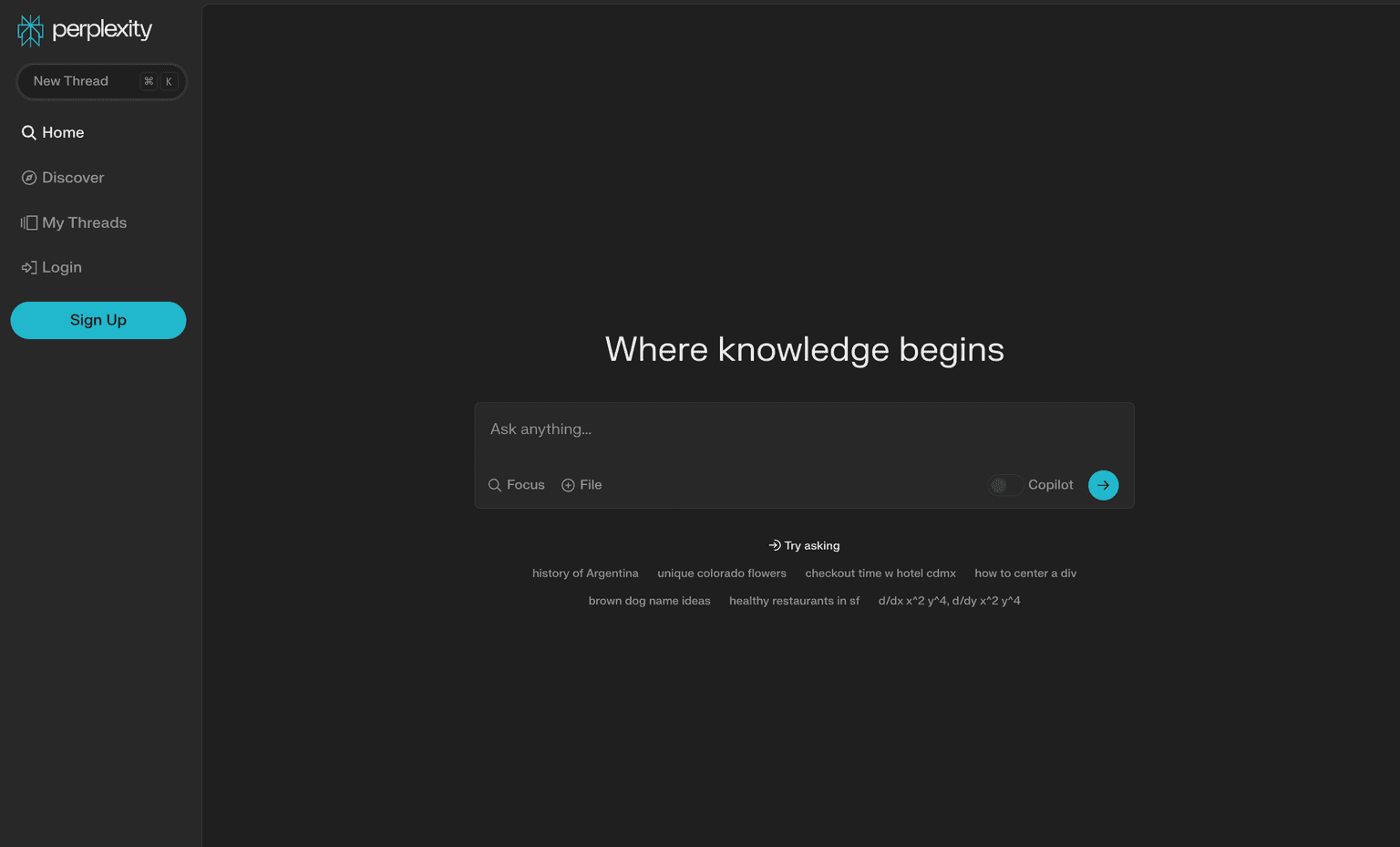
Perplexity.ai is the answer engine we reach for first. Ask in plain language and it returns a concise written answer with numbered citations, then lets you keep asking follow-ups in the same thread, every claim tied to a link you can check.
It stretches beyond quick facts: a built-in research mode reads across many sources, and Perplexity now ships a free AI browser, Comet (see our Best AI Browsers guide).
Production credibility: One of the highest-profile venture-backed answer engines, valued at roughly $20 billion-plus in early-2026 financing and used by millions each month.
What it wins at: Conversational answers with clickable citations; fast follow-up threads; a strong free tier.
Where it falls down: It can still misread a source, so verify anything load-bearing; the best research features need Pro.
2. You.com — AI search with model choice and an enterprise tilt
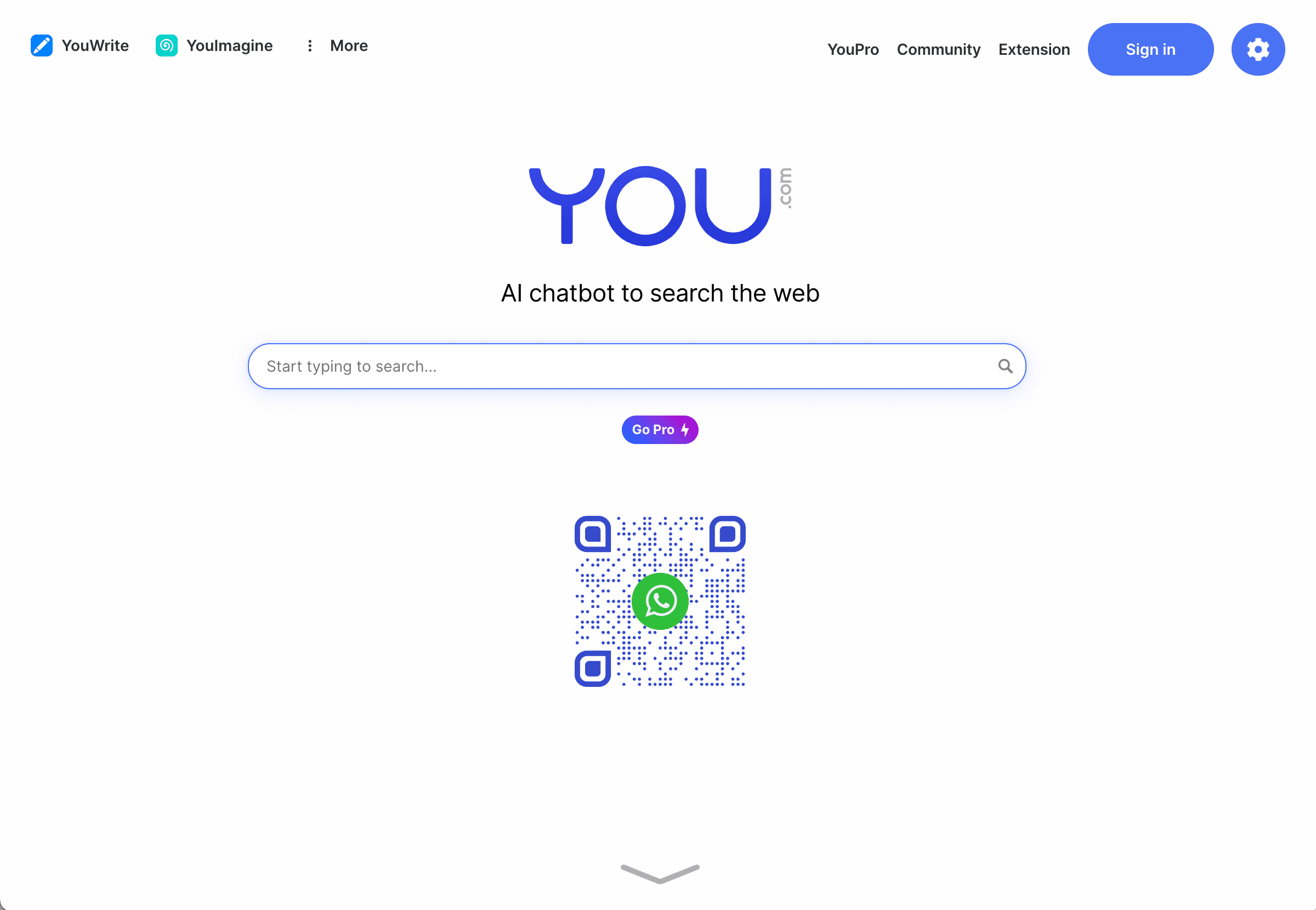
You.com lets you pick the model and mode behind your answer rather than locking you to one: switch among multiple large language models, run a research mode for longer questions, or use a quick mode for fast facts, all with citations attached.
Over the past year You.com leaned hard into enterprise and developer infrastructure: the same engine now ships as an API that companies build on, with options like zero data retention for private team searches, flexing from consumer answer engine to app infrastructure in one product.
Production credibility: Raised a $100M Series C at a $1.5 billion valuation in late 2025 and reports over a billion queries a month through its API.
What it wins at: Model and mode flexibility; a developer-friendly API; privacy options for business use.
Where it falls down: The consumer experience now plays second fiddle to the enterprise pitch; the modes add a small learning curve.
3. Andi Search — Ad-free conversational answers, free
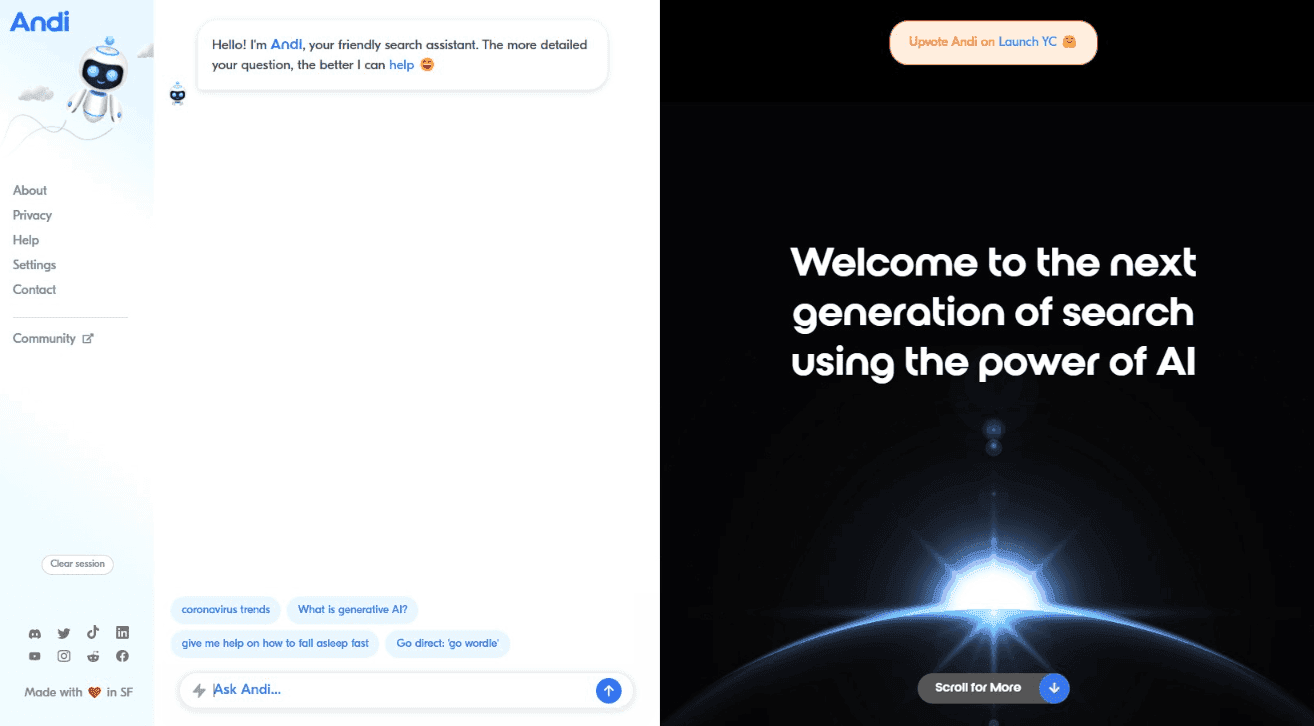
Andi Search answers like a friend texting you back: a direct, conversational reply instead of a wall of links, in a clean interface with visual cards. It combines generative AI with live data and semantic search, and it is free.
The draw is what it leaves out. Andi runs no ads and does not track users, store searches, or profile you, a private everyday answer engine and a solid no-clutter alternative to Perplexity.
Production credibility: An independent, ad-free answer engine named a top free AI search engine by mainstream tech press.
What it wins at: Genuinely free; no ads; a privacy-first stance with clean, conversational answers.
Where it falls down: A smaller feature set than the venture-backed leaders; fewer deep-research tools.
4. Kagi — Premium, ad-free search with AI on top
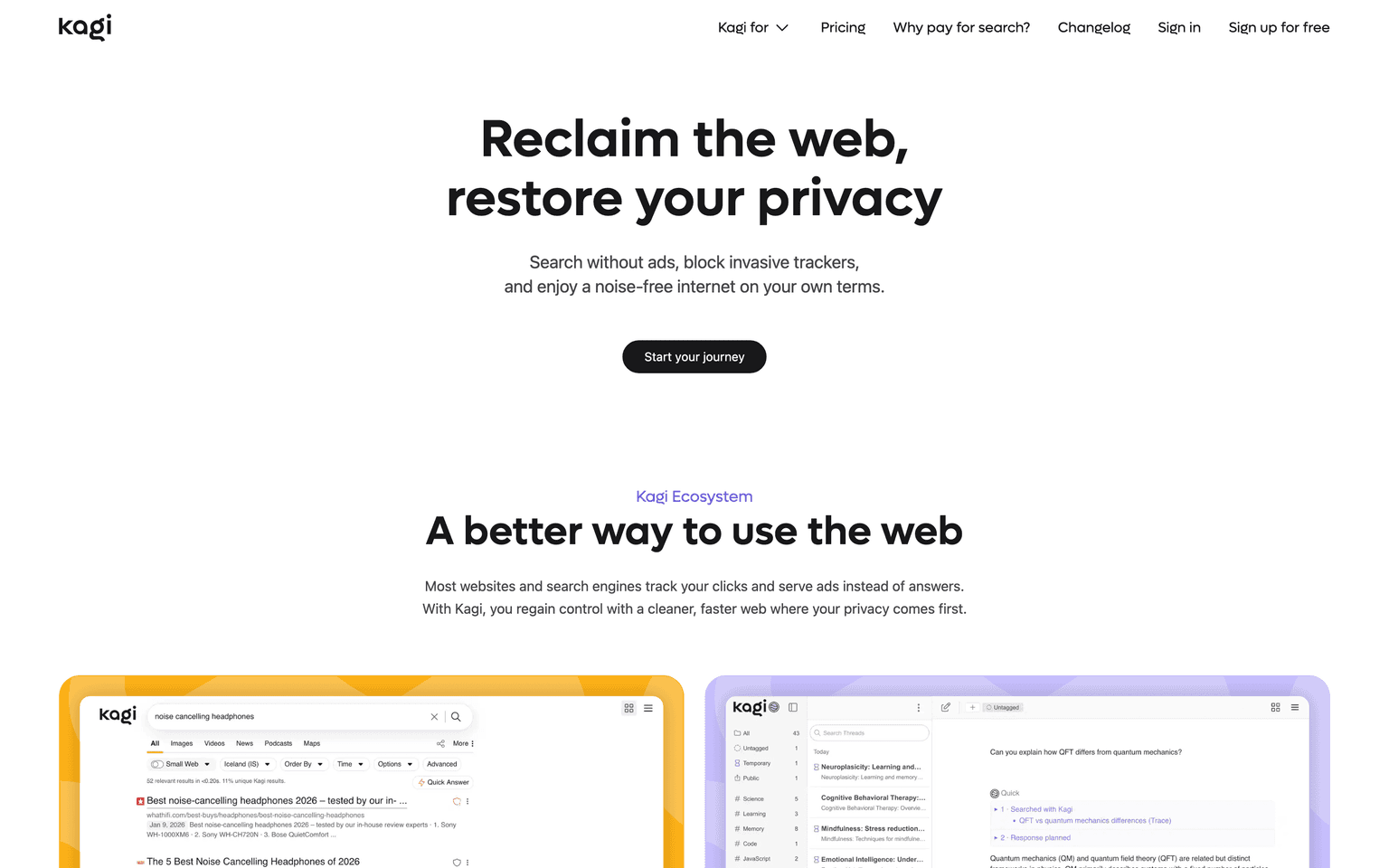
Kagi sells the opposite of ad-funded search: you pay a subscription, and in return get no ads, no tracking, and results you can customize by raising or lowering domains you trust. A quick answer mode and an assistant sit on top of that clean foundation.
Because the model is subscriptions, the incentives line up with you instead of advertisers, and plans start around $5 a month. It is the privacy-first engine for people who search all day and resent ads and tracking.
Production credibility: A subscription-funded, ad-free search engine supported entirely by paying members, not advertising.
What it wins at: No ads or tracking; deep result customization; AI layered onto strong traditional search.
Where it falls down: It costs money, and the cheapest tier caps monthly searches.
5. Genspark — Agentic search that builds Sparkpages
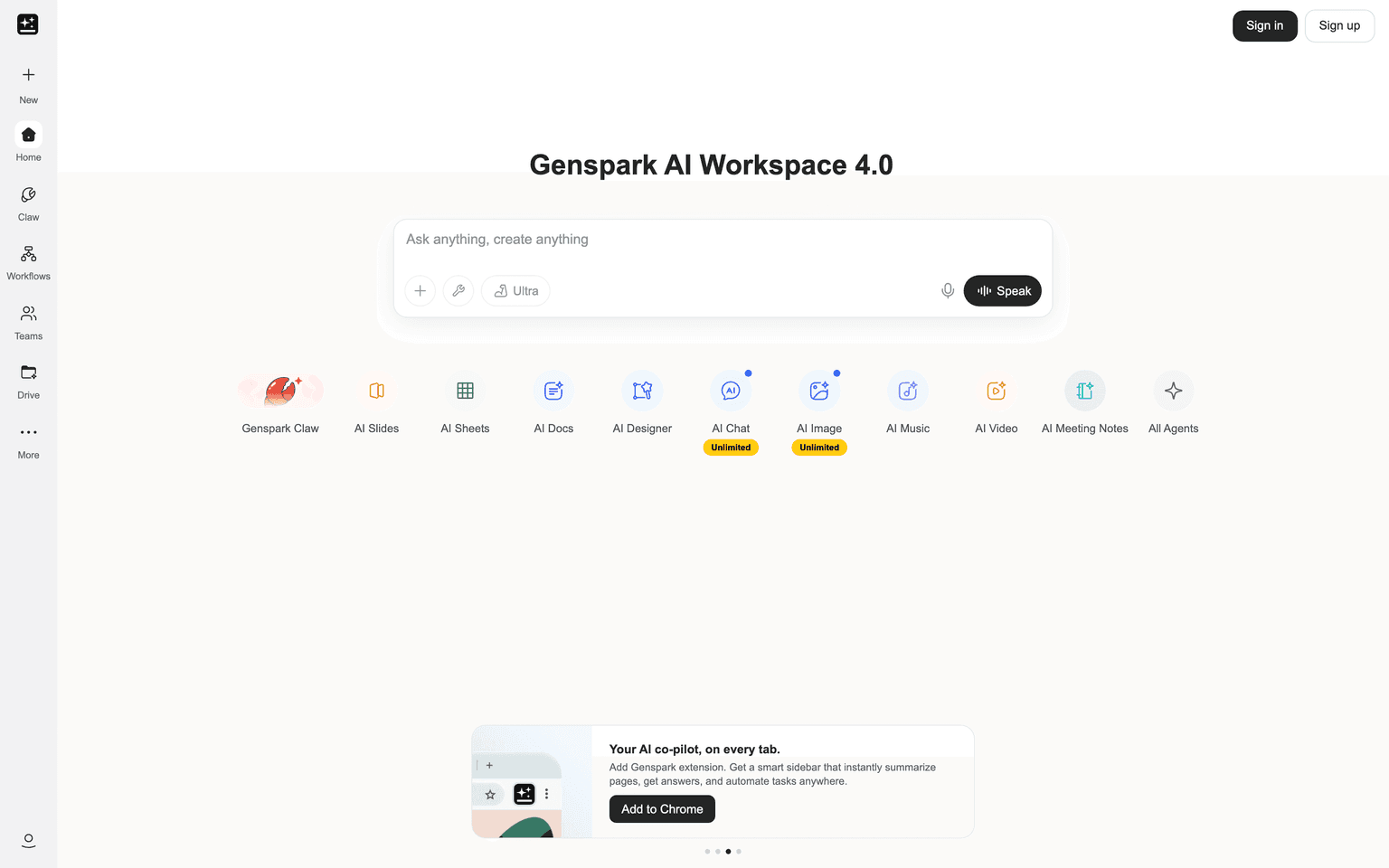
Genspark takes a different shape from a chat box. Ask something broad and it dispatches several AI agents to research the topic in parallel, then assembles the findings into a "Sparkpage," a structured, shareable summary with citations, ideal for wide questions that would otherwise mean fifteen open tabs.
Over the past year Genspark expanded from search into a broader agentic workspace, so search is now one capability inside a larger product. It shines on research-style queries but is heavier than you want for a quick fact.
Production credibility: Raised a large round at a roughly $1.25 billion valuation in late 2025 while expanding from search into agentic workflows.
What it wins at: Parallel multi-agent research; structured, shareable Sparkpages; broad topic coverage.
Where it falls down: Overkill for simple questions; its center of gravity has shifted toward general agents.
Research and Academic Search
6. Elicit — AI research assistant over academic papers
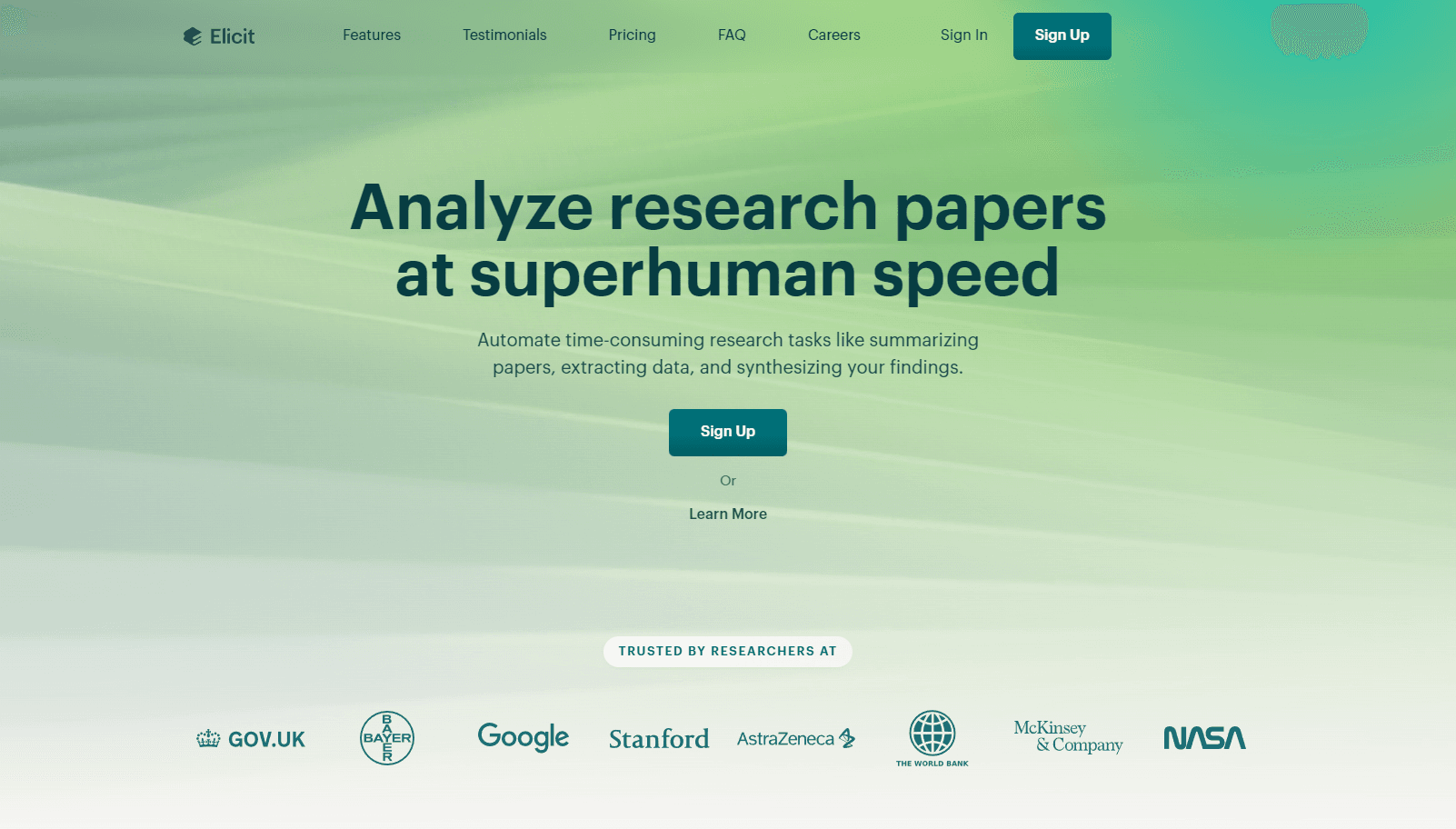
Elicit is built for real literature work. Instead of the open web, it searches a very large corpus of academic papers and clinical trials, producing summaries, extracted data, and cited reports in seconds rather than afternoons.
The workflow is the standout. Elicit can screen abstracts, pull data points out of many papers at once, and organize them into a table. If your "search" is a systematic review, this is the lane leader.
Production credibility: A venture-backed research assistant (roughly $31M raised) that searches well over 100 million academic papers and clinical trials.
What it wins at: Systematic literature review; structured data extraction; outputs built for academic rigor.
Where it falls down: Not for everyday web questions; serious use lives behind paid plans.
7. Consensus App — Evidence from peer-reviewed studies
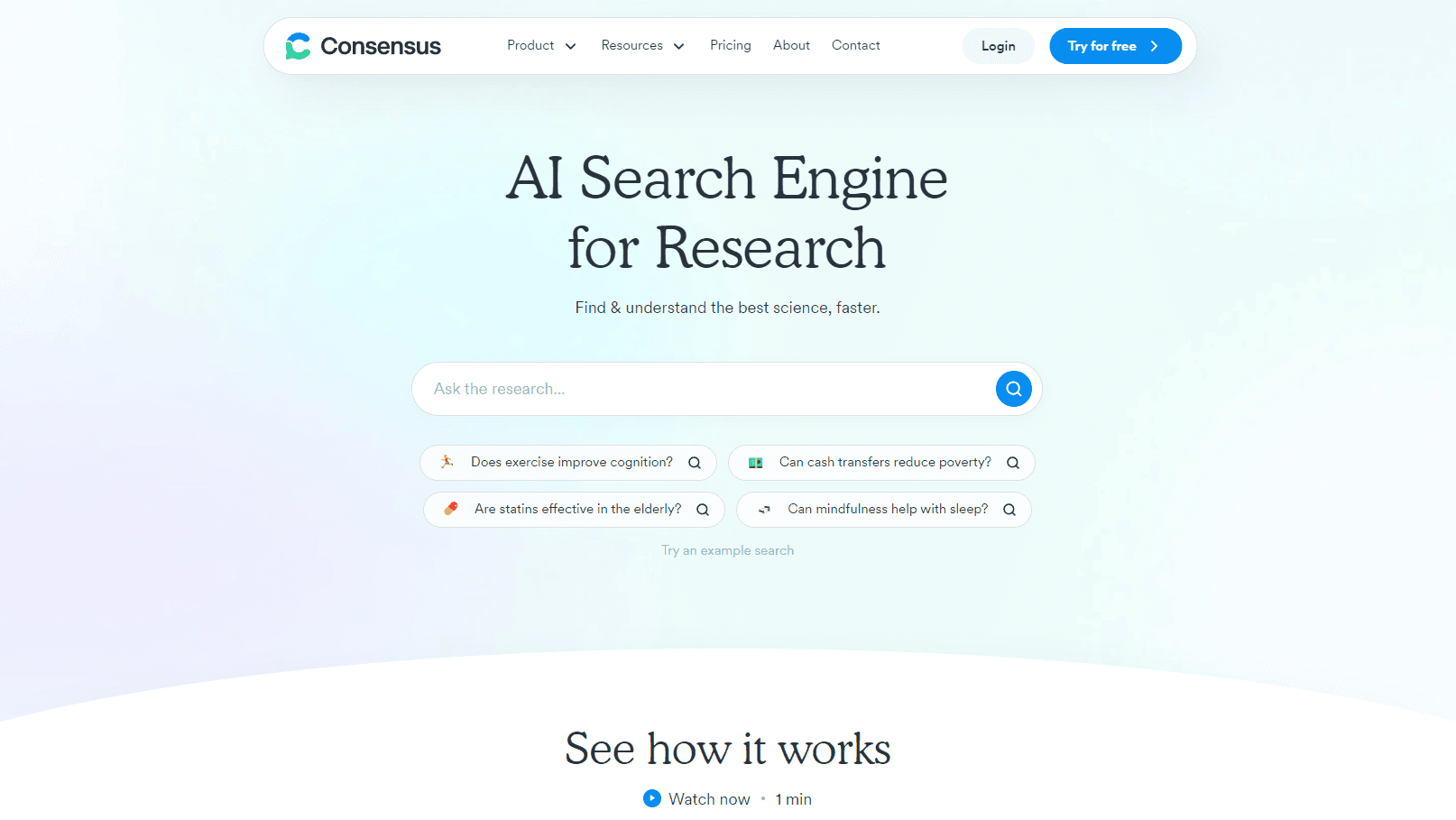
Consensus App answers a specific kind of question: "what does the research actually say about this?" Ask a yes-or-no or cause-and-effect question, and it searches a large database of peer-reviewed papers and synthesizes the findings with each claim tied back to its source.
Its signature feature is a meter showing how much the body of research agrees, so you can tell a settled finding from a contested one at a glance. For health and science questions, it beats general web search.
Production credibility: Searches a corpus of over 200 million peer-reviewed papers; backed by a recent venture funding round.
What it wins at: Fast read on scientific consensus; answers grounded only in peer-reviewed studies; an agreement meter.
Where it falls down: Narrow by design (research questions, not general search); the strongest analysis features are paid.
8. scite — Smart Citations that show context
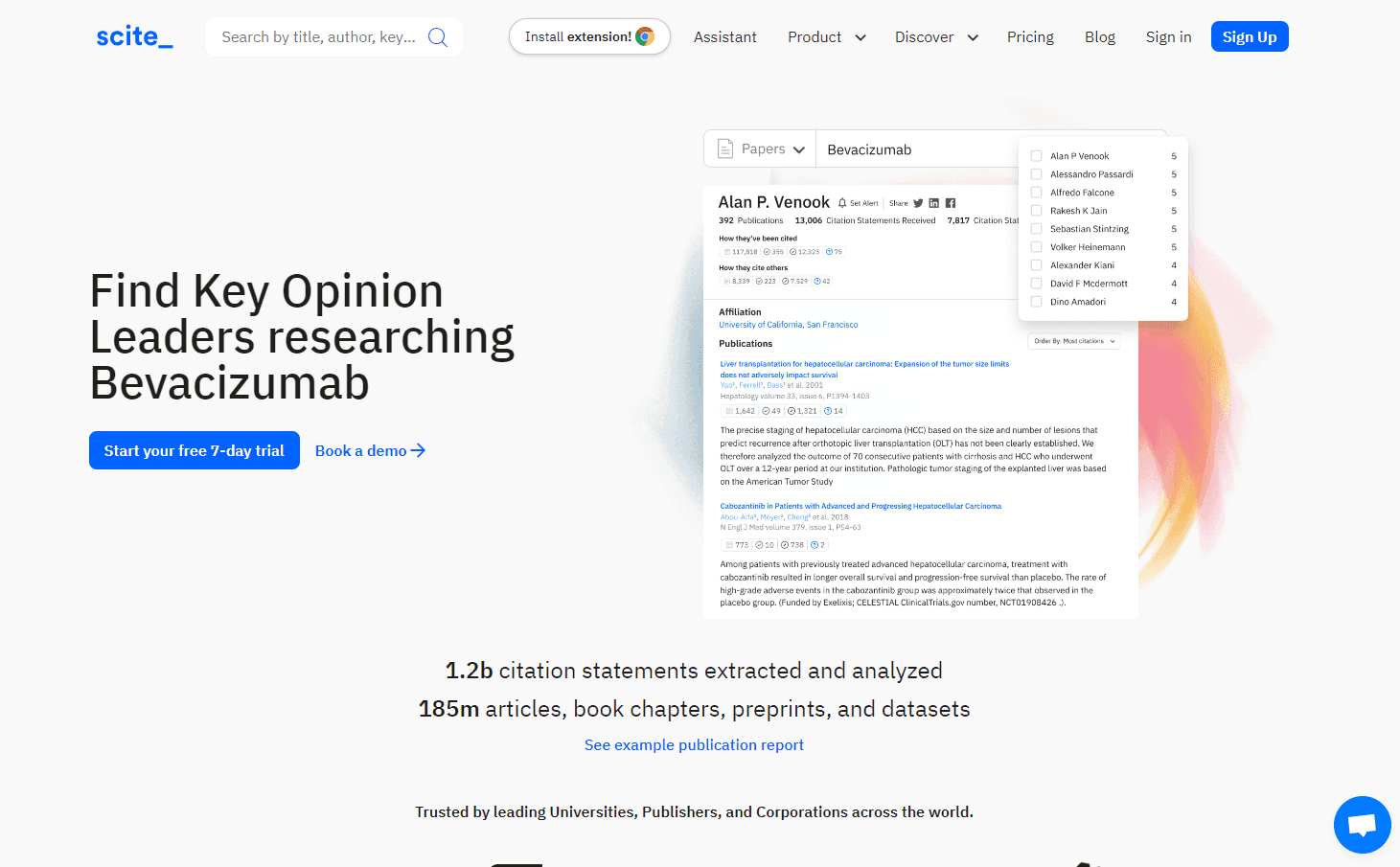
scite tackles a problem raw citation counts hide: not all citations are endorsements. Its Smart Citations show the exact sentence where one paper cites another and classify whether it supports, contradicts, or merely mentions the finding.
That context is gold for judging reliability: you can see whether a headline finding has been replicated or quietly disputed. It pairs naturally with Elicit and Consensus, find evidence there, then pressure-test it here.
Production credibility: Analyzes over a billion citation statements from more than 180 million articles; used by millions of researchers and students.
What it wins at: Citation context (supporting versus contradicting); pressure-testing reliability; deep coverage of the literature.
Where it falls down: Specialized for academics; less useful if you are not evaluating scholarly claims.
Developer and Neural Search
This lane thinned out in 2026. Phind, the standalone answer engine built for developers, shut down in January 2026 — as foundation models like ChatGPT, Claude, and Gemini absorbed technical Q&A, a dedicated developer search engine lost its moat. For everyday coding questions, those models plus Perplexity.ai now handle it. What still pays off is search built for other AI apps to consume, and that is where Exa leads.
9. Exa — Neural search API for AI apps
Exa is less a website you visit and more the search layer other AI products are built on. Instead of matching keywords, it uses neural embeddings to find pages by meaning, well suited to feeding clean results into an AI agent or app.
Exa's API returns high-quality results and content for a query, and it has become a common building block inside coding assistants and research agents. End users rarely touch it directly, but the AI tools they use do.
Production credibility: Raised a $250M round at a roughly $2.2 billion valuation in 2026; counts thousands of companies, including Cursor and HubSpot, as customers.
What it wins at: Meaning-based (neural) web search; a clean API for builders; results tuned for AI agents.
Where it falls down: It is developer infrastructure, not a consumer answer engine; using it means writing code.
The Mainstream Default
The honest complication in any 2026 AI search list: most AI search does not happen in an AI search engine. It happens inside a general assistant that has web access, because that is the tab people already have open. Both of the following are worse than Perplexity at citation discipline and better than everything else at being already installed.
10. ChatGPT — Where most AI search actually happens
ChatGPT answers search-shaped questions with live web results and links, inside the assistant hundreds of millions of people already use for other work. That distribution, not answer quality, is what makes it the most-used AI search product in the world.
Production credibility: ChatGPT is the most widely adopted consumer AI product ever released, and its search capability is available on the free tier as well as paid plans. Our own referral data shows ChatGPT sending more traffic to this directory than every other AI assistant combined.
What it wins at: Zero switching cost, conversational follow-up, and the ability to move straight from a search result into drafting, analysis, or code without changing tools.
Where it falls down: Citation discipline is looser than a dedicated answer engine — sources appear, but the link-to-claim mapping is less rigorous than Perplexity's, and it is easier to end up with a confident answer whose provenance you have not checked.
11. Gemini — Search grounded in Google's index
Gemini answers with grounding in Google's own index and sits inside the products a lot of people work in all day — Search, Workspace, Android, and Chrome. For anyone already in that stack, it is the lowest-friction answer engine available.
Production credibility: Gemini is Google's flagship model line, distributed through Search's AI Mode and AI Overviews as well as the standalone app, which makes it the answer engine with the widest reach of any product on this list.
What it wins at: Freshness and breadth of index, multimodal input, and integration with documents and mail you already have.
Where it falls down: The experience varies by surface — the answer you get in Search, in the Gemini app, and inside Workspace are not the same product — and it is the least neutral option here, since the grounding and the ad business share an index.
How to Choose an AI Search Engine
- Everyday answers: Perplexity.ai for cited, conversational answers; Andi Search if you want it free and ad-free.
- Academic research: Elicit for systematic reviews, Consensus App for scientific consensus, scite for citation context.
- Developer and technical work: Phind is gone, so use Perplexity.ai or a foundation model with web search, and Exa when building search into an app.
- Privacy-first: Kagi for ad-free, no-tracking search all day; Andi Search for a free, no-tracking option.
- On a budget: Andi Search is free and Perplexity.ai has a capable free tier; built-in answers in ChatGPT Search, Gemini, and Google AI Mode cost nothing extra.
- Agentic research pages: Genspark builds a structured Sparkpage from several angles at once.
Adjacent Reading
Comparing the models behind these tools? Our Best LLMs guide breaks down the underlying language models, while Top Conversational AI Platforms covers the chat assistants many of these answer engines build on. And because AI search and AI browsing are converging fast, our Best AI Browsers guide is the natural next read.
Frequently Asked Questions
What is an AI search engine? An AI search engine reads the live web, synthesizes what it finds, and returns a direct written answer with citations, instead of a ranked list of links to read yourself. It is often called an answer engine because the output is an answer, not a results page.
What is the best AI search engine in 2026? For most people it is Perplexity.ai, because it pairs fast, conversational answers with clickable citations on nearly any question. For academic work, Elicit and Consensus are stronger; for an app, Exa is the pick.
Is Perplexity better than Google? For getting a direct, cited answer, many people now prefer Perplexity because it synthesizes sources and shows its citations instead of leaving you to open links. Google is still better for navigational searches, local results, and shopping, and its own AI Overviews now add answer-style results.
Are there free AI search engines? Yes. Andi Search is free and ad-free, and Perplexity offers a capable free tier. Built-in answer features in ChatGPT Search, Google AI Mode, and Gemini also cost nothing extra.
What is the best AI search engine for academic research? Elicit is best for systematic literature reviews and structured data extraction, Consensus is best for reading what peer-reviewed studies conclude, and scite is best for seeing whether other papers support or contradict a finding. Many researchers use all three together.
What is the best AI search engine for developers? Phind was the leading developer-focused answer engine, but it shut down in January 2026. Today, developers get the best results from Perplexity.ai or a foundation model with web search, and from Exa's neural search API when building search into their own apps.
Do AI search engines show their sources? The good ones do. Perplexity, You.com, Andi, Consensus, and Elicit all attach citations so you can verify each claim. Treat any answer engine that hides its sources with caution.
Final Thoughts
If you read only one line: start with Perplexity.ai. It is the best all-around AI search engine in 2026, fast, conversational, and honest about its sources, with a free tier that replaces a lot of ordinary web searching.
From there, choose by the question. For scientific work, lean on Elicit, Consensus App, and scite. For building AI search into your own product, Exa is the developer-grade option; for ad-free, privacy-first daily searching, Kagi and Andi Search are worth your attention. The category moved fast this year, but a cited answer you can verify is the standard that lasts.
Compare tools in this collection
Categories these tools span
More collections you may also like


Sign up for our newsletter
Receive weekly updates so you can stay up-to-date with the world of AI
Sign up for our newsletter
Receive weekly updates so you can stay up-to-date with the world of AI
The AI tools directory for discovering, exploring, and comparing the most innovative AI tools in the industry