Sesame
Voice-first AI companion — natural conversational voice and lightweight all-day eyewear.
Overview
Sesame: Bringing the Computer to Life
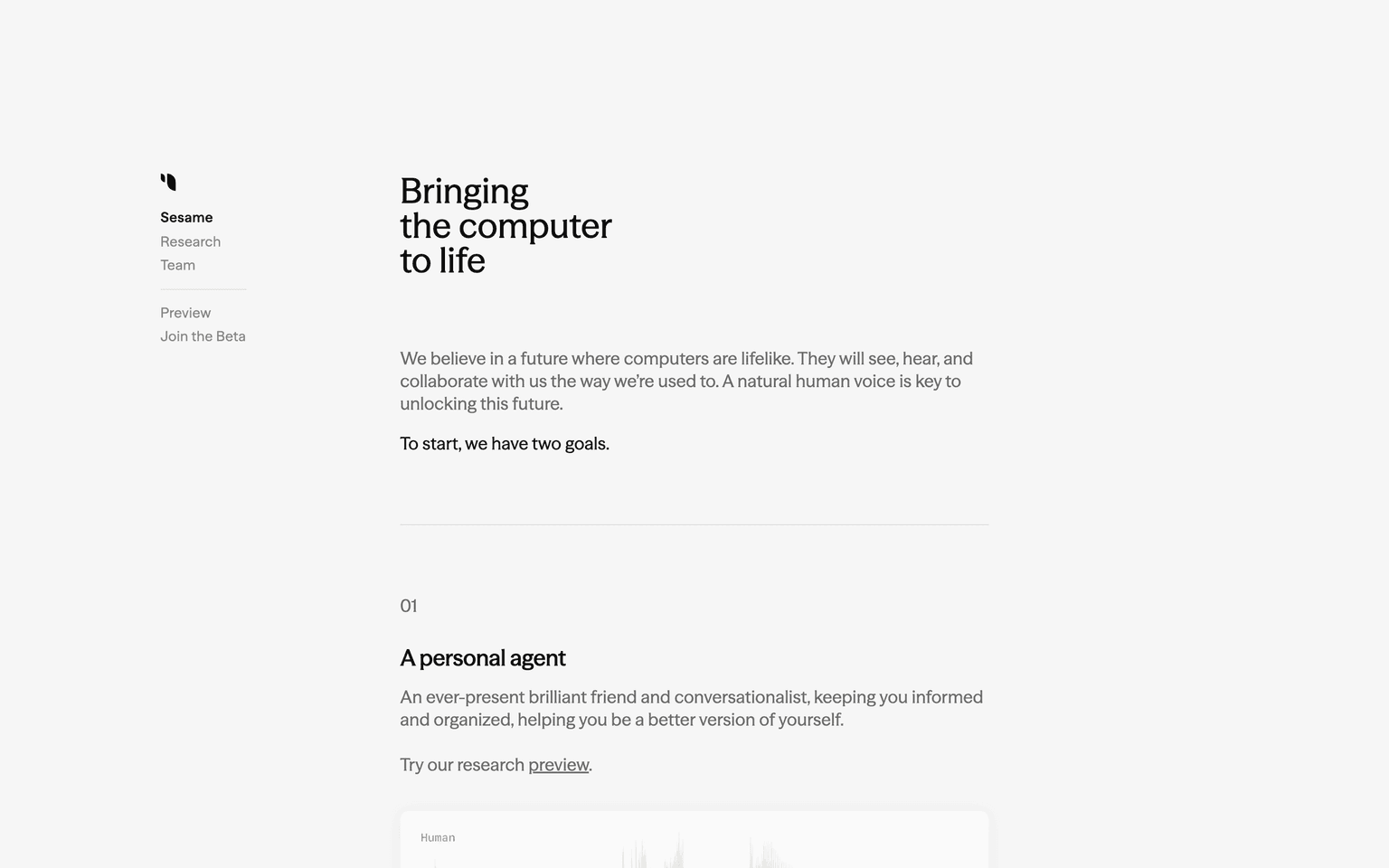
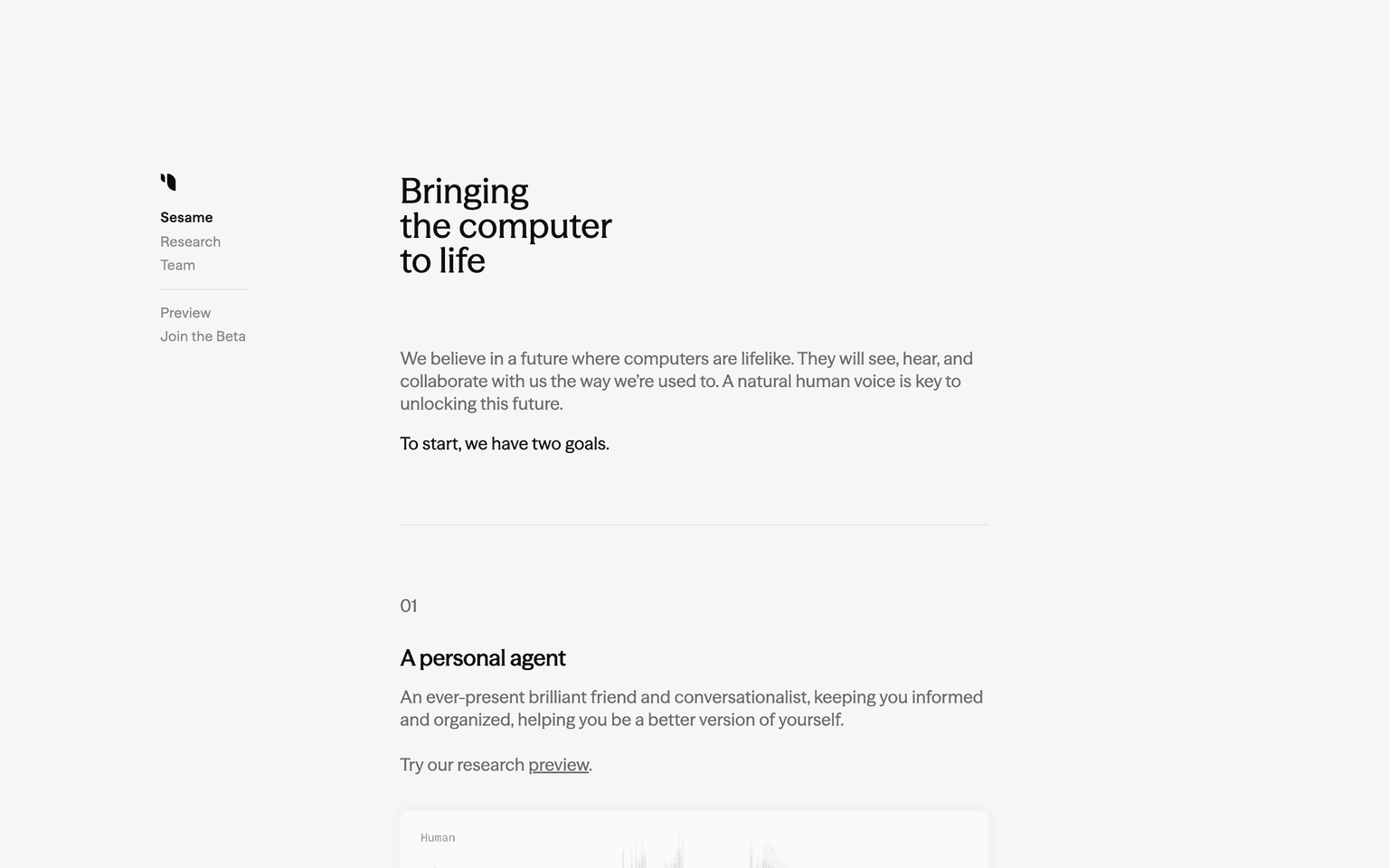
Sesame is building a future where computers are lifelike — they will see, hear, and collaborate with us the way we are used to with each other. The team's thesis is that natural human voice is the key to unlocking that future, and they are designing a new kind of computer around it.
The company has two starting goals. First, a personal agent — an ever-present brilliant friend and conversationalist that keeps you informed and organized, helping you be a better version of yourself. Sesame's research preview ("Crossing the uncanny valley of conversational voice") is the first public proof point. Second, lightweight eyewear designed to be worn all day, giving you high-quality audio and convenient access to your AI companion who can observe the world alongside you.
Key Features:
- Conversational voice that crosses the uncanny valley
- Personal agent for daily life — informed, organized, supportive
- Lightweight all-day eyewear (in development)
- Research preview available to try
- Beta program for early access
- Interdisciplinary product and research team
- Voice-first by design
Ideal Use Case:
Sesame is ideal for early adopters and AI enthusiasts who want to experience the next generation of voice-first AI companions. Especially relevant for people thinking about ambient computing, AI hardware, and the post-screen interface.
Why Use Sesame:
- Industry-leading conversational voice
- Voice-first design philosophy
- Hardware + software stack vision
- Backed by an interdisciplinary research-first team
- Research preview available now
FAQ
Can I try Sesame today? Yes — through the research preview on their site.
What is the eyewear? Lightweight, all-day eyewear designed to give your Sesame companion audio and a view of your world.
Is Sesame open to beta testers? Yes — Join the Beta on sesame.com.
What does "crossing the uncanny valley" mean? Sesame's research focuses on conversational voice that feels genuinely human, not robotic.
tl;dr:
Sesame is bringing the computer to life with voice-first AI — a personal agent that crosses the uncanny valley, plus lightweight all-day eyewear in development. Research preview live.
Related
Looking for more options? Browse the AI Audio Creation directory or read our best AI audio tools listicle. Sesame is also tracked on Crunchbase.
Why Use Sesame
FAQ
Editorial Review
Our take on Sesame.

Sesame is a voice-first AI companion built for lightweight eyewear, emphasizing natural conversation over text interfaces.
What works
- Natural conversational voice focus, not synthetic-sounding
- Free research preview lowers barrier to exploration
- Strong community rating (4.93) from early testers
What doesn't
- Research preview status; production readiness uncertain
- Hardware pairing details sparse; unclear integration depth
Sesame positions itself as a voice-first AI companion designed for always-on eyewear hardware. The pitch is straightforward: skip the phone screen, talk to your glasses. As of 2026, that's a real category emerging (Meta Orion, Brilliant Labs), though the actual hardware-software pairing here is still in research preview, so treat it as exploratory. The natural conversational voice is the core claim—no stilted synthetic speech—which matters for a device you'd wear all day.
The free research preview model means you're not paying to try it, but you're also not buying a finished product. The alternatives (ElevenLabs for voice synthesis, Cartesia for low-latency models, Deepgram for speech-to-text) are more established, so Sesame's real differentiation hinges on how well the voice naturalness holds up in continuous conversation and how tight the eyewear integration actually is.
If you're building a voice-first wearable or researching conversational AI for always-on use, worth a look. If you need production-grade voice AI for a backend service, the alternatives have more battle-tested infrastructure. The hardware story—"lightweight"—is vague enough that real-world weight, latency, and battery impact remain unknowns.
User Reviews
Similar Tools