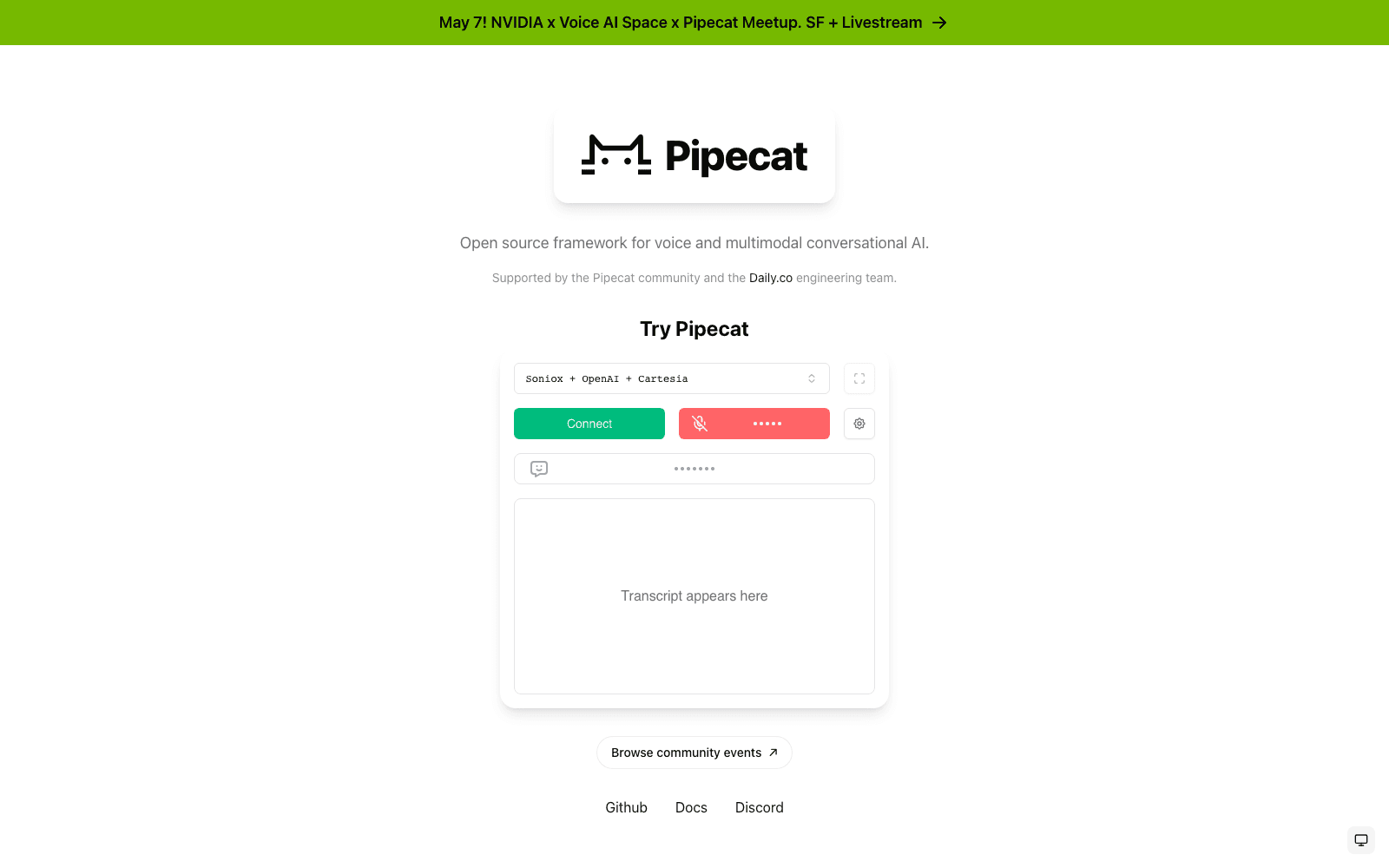
Pipecat
Open-source Python framework for real-time voice and multimodal conversational agents — by Daily, the WebRTC infrastructure leader. Most-used voice agent OSS.

Overview
Pipecat: Open-Source Voice Agent Framework
Pipecat is an open-source Python framework for building real-time voice and multimodal conversational AI agents — created by Daily, the company that's been providing real-time video and audio communication infrastructure since 2016. Pipecat has become the most-used framework for production voice agents, with Pipecat Flows extending it into structured flow-control patterns for complex agent behavior.
Used widely across the AI ecosystem (NVIDIA, Modal, AssemblyAI all ship Pipecat integrations), and the de-facto OSS choice for teams that want to own their voice agent stack rather than buy into a managed platform.
Status note (October 2026): On October 29, 2026, Deepgram announced it is acquiring Daily, the company that created Pipecat. Pipecat itself is not part of the sale: it moves to an independent Pipecat Foundation run by a steering committee that includes Deepgram's competitors, and it stays open source under the BSD-2 license.
Key Features
- Open-source Python framework with composable pipeline pattern
- Pipecat Flows — structured flow control for complex voice agent behavior
- Native integrations with all major STT, LLM, TTS providers
- Daily WebRTC infrastructure underneath (battle-tested at scale)
- Active community + extensive documentation
Ideal Use Case
Developers building voice agents who want OSS code-level control rather than a managed platform — particularly teams with custom requirements or stringent privacy/compliance needs.
Why Use Pipecat
LiveKit Agents and Pipecat are the two leading voice agent frameworks. Pipecat's edge: deeper Python ergonomics, broader provider integrations, and the simplicity of the pipeline pattern. Strong fit for teams already using Daily's WebRTC.
FAQ
Who owns Pipecat after the Deepgram–Daily deal? No single company. When Deepgram announced its acquisition of Daily on October 29, 2026, Pipecat was moved to an independent Pipecat Foundation, and it remains open source under the BSD-2 license.
Q: Is Pipecat fully open source? A: Yes — MIT-licensed Python framework. You can self-host completely.
Q: How does Pipecat compare to LiveKit Agents? A: Both are voice agent frameworks. Pipecat is Python-first with the pipeline pattern; LiveKit has Python + Node.js with broader infrastructure positioning.
Q: Who maintains Pipecat? A: The Daily team plus an active community. Daily is the WebRTC infrastructure company that's been in real-time A/V since 2016.
tl;dr
The leading open-source voice agent framework. Python pipelines, Pipecat Flows for control, MIT-licensed. By Daily.
Related
Looking for more options? Browse the Developer Tools directory or read our best AI coding tools listicle. Pipecat is also tracked on Crunchbase.
Why Use Pipecat
User Reviews
Similar Tools