Neurometric
Inference orchestration that routes each AI task to the right-sized model, with caching and failover.
Overview
Neurometric: stop paying frontier prices for routine AI work
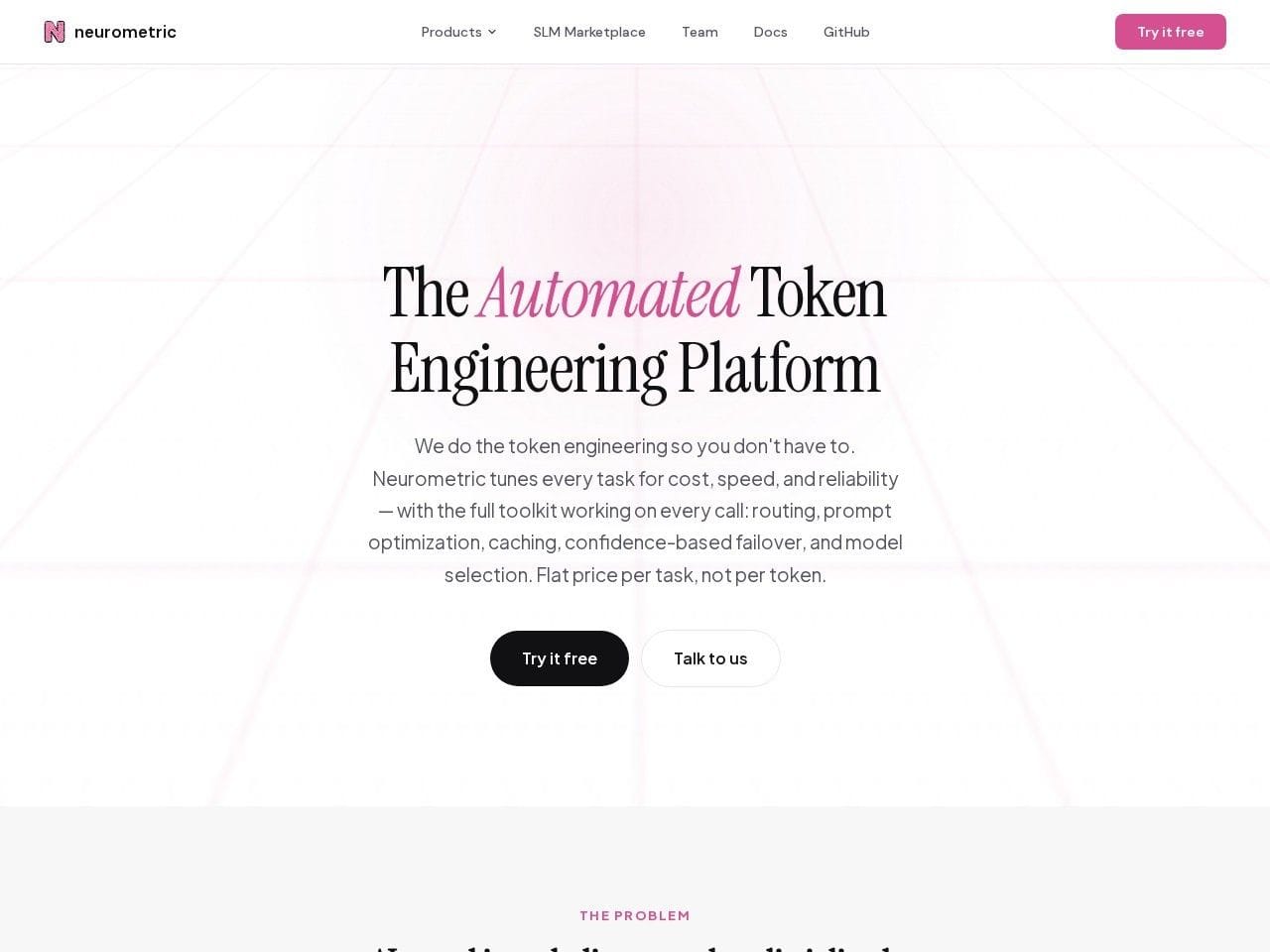
Agentic workflows fire thousands of model calls, and most of them are simple — yet many teams send every call to the same frontier model by default. Neurometric calls its answer "token engineering": the platform evaluates every individual model call in real time and routes each task to the most cost-effective model that meets the required accuracy, speed, and quality threshold, reserving frontier tokens for the work that actually needs them.
Routing is one piece of a broader inference-orchestration layer. Neurometric combines model routing, prompt optimization, caching, and confidence-based failover in a single continuously updated system, and when no existing model fits a task well, its Auto-SLM Creator generates a purpose-built small language model. A Task Endpoint Manager handles routing and analytics, and an SLM Marketplace offers pre-trained task-specific models.
Key Features
- Real-time model routing that scores each call and sends it to the cheapest model meeting the quality bar
- Prompt optimization and caching to cut redundant tokens before they are spent
- Confidence-based failover, escalating to stronger models when a response falls below threshold
- Auto-SLM Creator that builds custom small language models when no off-the-shelf option fits
- Task Endpoint Manager with routing analytics, plus an SLM Marketplace of pre-trained models
- Usage-based pricing for custom SLMs plus a platform fee for the management endpoint
Ideal Use Case
Neurometric fits teams running agentic AI in production whose inference bill is climbing faster than usage — high-volume pipelines full of classification, extraction, and routing calls where a right-sized model preserves accuracy at a fraction of frontier cost, with failover as the safety net.
How Neurometric differentiates
Simple routers pick between two or three named models; Neurometric operates a full optimization loop — route, optimize, cache, fail over, and mint a custom SLM when needed. The company raised a $4M pre-seed in June 2026 from Betaworks, Everywhere Ventures, ex/ante, Encoded, and angels including Jason Calacanis and HubSpot CTO Dharmesh Shah. One reported customer result: a core workflow dropped from $40,000 per year to $250 per month while accuracy rose from 70% to 96%. Founder and CEO Rob May is a repeat AI founder and investor.
FAQ
How is Neurometric different from a basic LLM router? It evaluates every call against accuracy, speed, and cost thresholds, and adds prompt optimization, caching, failover, and automatic creation of custom small language models — not just endpoint switching.
Will routing to smaller models hurt quality? The system only downgrades a call when the target model meets the defined quality threshold, and confidence-based failover escalates borderline cases to stronger models.
What does it cost? Pricing is usage-based for custom SLMs plus a platform fee for the management endpoint; specific rates are quoted through sales.
Who is behind Neurometric? CEO Rob May and a team of AI and systems engineers, backed by a $4M pre-seed from Betaworks, Everywhere Ventures, and angels including Jason Calacanis and Dharmesh Shah.
tl;dr
Neurometric is an inference-orchestration layer that routes each AI task to the right-sized model — with prompt optimization, caching, failover, and auto-generated SLMs — to cut inference spend without cutting quality.
Why Use Neurometric
User Reviews
Similar Tools