Inception Labs
Inception Labs builds Mercury — diffusion-based LLMs from Stanford spinout. Novel architecture vs autoregressive transformers; 10x faster inference. Khosla
Overview
Inception Labs
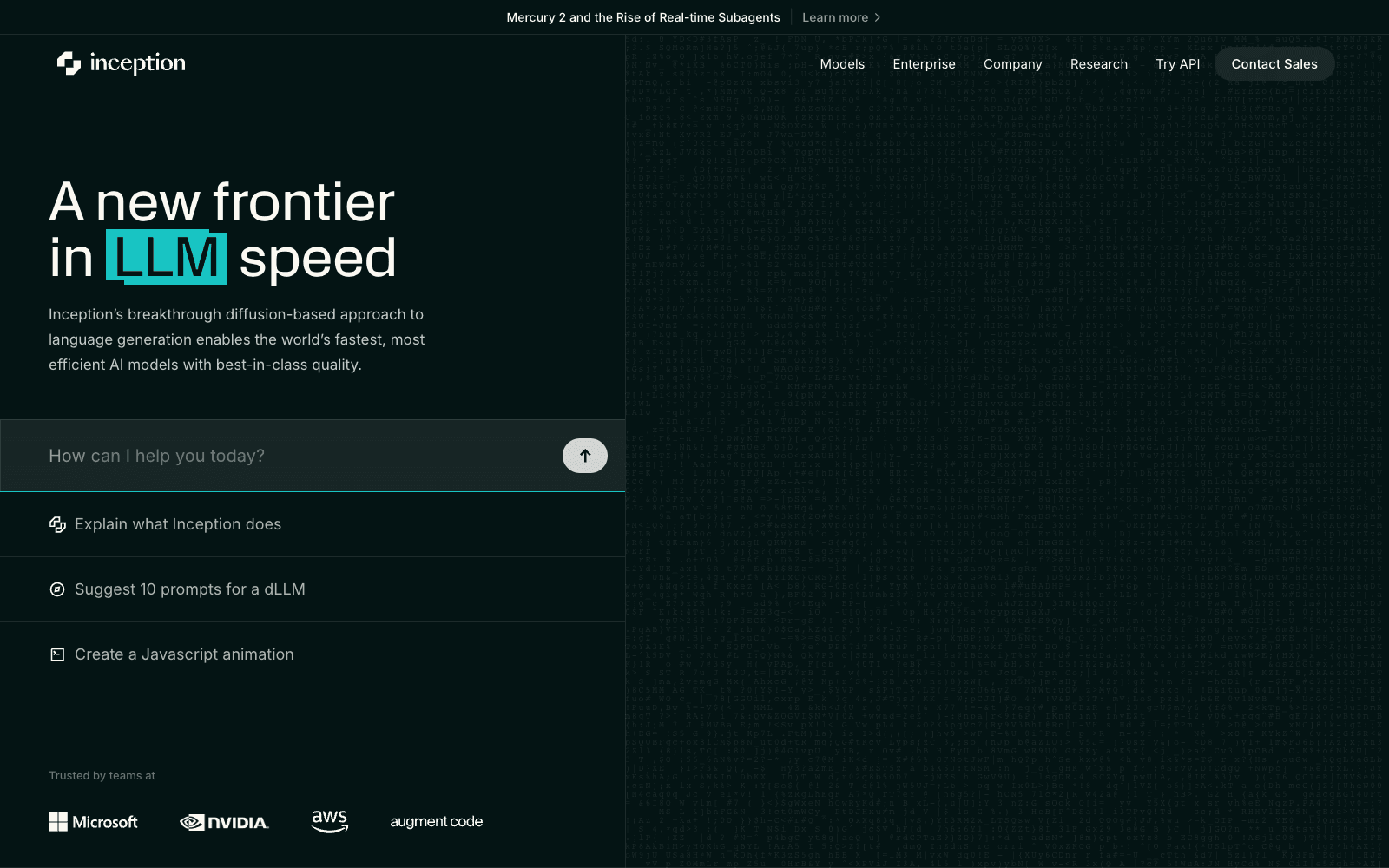
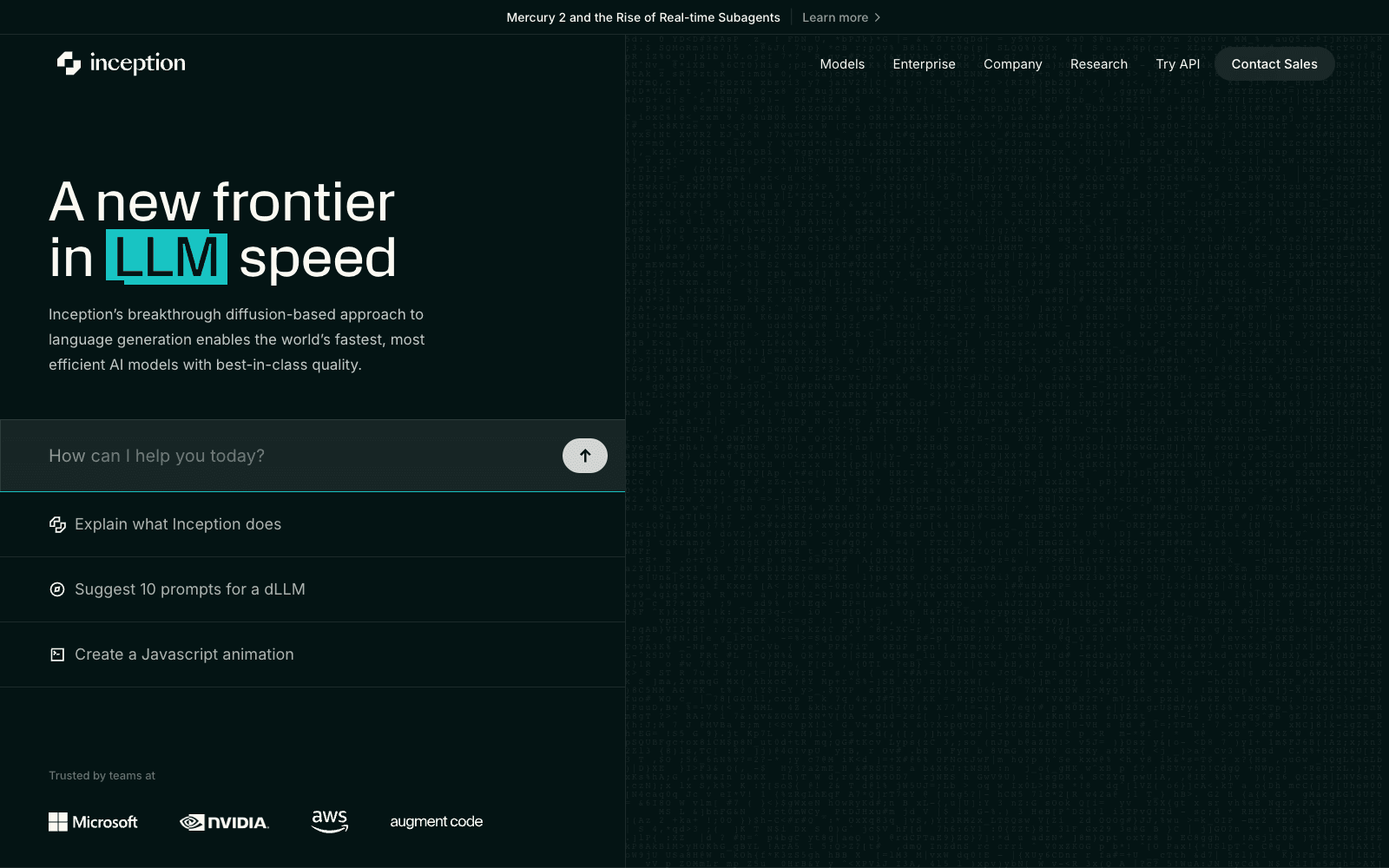
Inception Labs is the Stanford-spinout AI lab building Mercury — diffusion-based large language models with a fundamentally different architecture than autoregressive transformers. Inception Labs' diffusion approach generates tokens in parallel rather than sequentially, delivering reportedly 10× faster inference at comparable quality. Inception Labs was founded by Stefano Ermon (Stanford CS faculty) and represents one of the most credible non-transformer bets in AI.
Production credibility: Founded 2024 by Stefano Ermon (Stanford CS faculty, ex-Director of CS Theory at Stanford); Stanford spinout; $20M+ seed round led by Khosla Ventures with participation from Mayfield and M12. Mercury LLM available as API; reportedly 10× faster inference than equivalent autoregressive models. Stefano Ermon is a leading academic in diffusion-model theory.
Key Features
- Mercury — diffusion-based large language model architecture (vs autoregressive transformers)
- Parallel token generation produces ~10× faster inference at comparable quality
- Founded 2024 by Stefano Ermon (Stanford CS faculty, diffusion-model theorist)
- Approximately $20M+ seed; Khosla Ventures lead with Mayfield and M12 participation
- API access available with competitive pricing vs OpenAI / Anthropic
- Stanford spinout with strong academic research lineage
- Targets latency-sensitive applications where autoregressive models hit speed ceilings
Ideal Use Case
Latency-sensitive production AI applications — code completion, real-time agents, voice AI — where the autoregressive token-by-token decode of GPT/Claude is the bottleneck. Also AI researchers exploring non-transformer architectures.
How Inception Labs differentiates
Every major frontier model (GPT, Claude, Gemini, Llama) uses autoregressive transformer architecture, which generates text token-by-token in sequence. Inception Labs' Mercury uses diffusion — the same family of techniques that powers Stable Diffusion and Midjourney for images — to generate language tokens in parallel. The architectural difference matters when inference latency is the binding constraint. For coding tools, voice agents, and real-time interfaces where every millisecond of decode latency matters, Mercury's 10× speed advantage compounds into a fundamentally different product experience.
FAQ
Q: What is Inception Labs? A: Inception Labs is a Stanford-spinout AI lab building Mercury — diffusion-based large language models that generate tokens in parallel rather than sequentially, achieving ~10× faster inference.
Q: Who founded Inception Labs? A: Stefano Ermon, Stanford CS faculty and a leading academic in diffusion-model theory, founded Inception Labs in 2024.
Q: How much has Inception Labs raised? A: Approximately $20M+ seed round led by Khosla Ventures with participation from Mayfield and M12.
Q: Inception Labs vs OpenAI / Anthropic? A: OpenAI and Anthropic use autoregressive transformers (sequential token generation). Inception Labs' Mercury uses diffusion architecture (parallel token generation). Reportedly 10× faster inference at comparable quality — particularly meaningful for latency-sensitive applications.
Q: Is Mercury open-source? A: Mercury is available via API as a commercial product. Research papers are published; weights are not open-sourced.
tl;dr
Inception Labs builds Mercury — diffusion-based LLMs (vs autoregressive transformers) from a Stanford spinout. ~10× faster inference. Founded by Stanford CS faculty Stefano Ermon, a diffusion-model theorist. $20M+ seed (Khosla lead). The most credible non-transformer architecture bet in AI.
Related
Looking for more options? Browse the AI/ML Models directory or read our best AI models listicle. Inception Labs is also tracked on Crunchbase.
Why Use Inception Labs
User Reviews
Similar Tools