Cognee
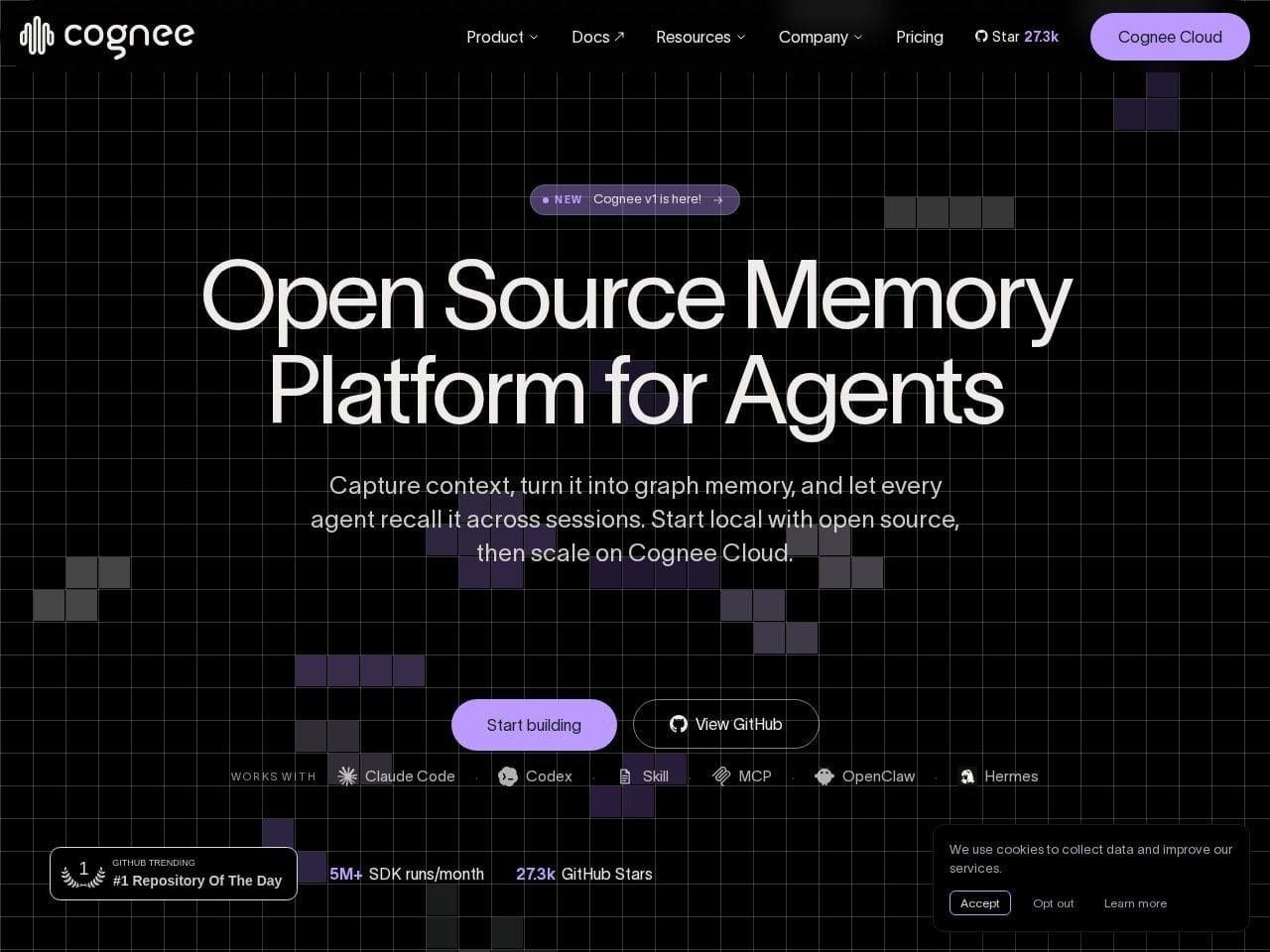
Open-source memory engine that turns your data into knowledge graphs AI agents recall across sessions.
Overview
Cognee: give AI agents a memory that outlives the session
Most LLM applications forget everything the moment a conversation ends, forcing developers to stuff context windows with raw files on every run. Cognee takes a different approach: it ingests your notes, documents, chat history, warehouse tables, and API data, then organizes that material into a knowledge graph paired with vector embeddings. Agents query this graph memory to recall facts, entities, and relationships across sessions instead of re-reading everything from scratch.
The project is open source and local-first — you can run the Python package on your own machine and keep data where it lives. A hosted platform adds managed pipelines, workspaces, and connectors for teams that do not want to operate the infrastructure themselves, with first-party support for Claude Code, Cursor, LangGraph, and other agent frameworks via MCP.
Key Features
- Pipelines that extract entities and relationships from documents, chats, warehouses, and APIs and load them into combined graph and vector memory
- Custom ontologies and data models, so the graph reflects your domain rather than generic triples
- MCP integration that lets compatible coding agents such as Claude Code and Cursor read and write memory directly
- Multi-agent recall across sessions — memory is shared infrastructure, not a per-conversation cache
- Local-first open-source package plus a hosted platform with workspaces and managed connectors
- Free hosted tier (1M tokens, unlimited users); Standard plan priced at $2.50 per 1M tokens processed
Ideal Use Case
Cognee fits engineering teams building agents that need durable, structured recall: support copilots that remember account history, coding agents that retain architectural context between tasks, or research assistants working over large private corpora. If plain vector search keeps returning fragments without relationships, graph memory is the upgrade path.
How Cognee differentiates
Where flat vector stores return isolated chunks, Cognee returns connected context — entities plus the relationships between them. The open-source repository has passed 27,000 GitHub stars with more than 5M SDK runs per month, and the company is backed by Pebblebed, Vermillion Cliffs Ventures, 42CAP, Combination VC, and Angel Invest. Named users include Bayer, Knowunity, SlideSpeak, and the University of Wyoming.
FAQ
Is Cognee open source? Yes. The core engine is an open-source Python package you can run locally; the hosted platform is optional.
How is Cognee different from a vector database? Cognee builds a knowledge graph on top of embeddings, so queries can traverse relationships between entities instead of relying on similarity alone.
Does Cognee work with Claude Code or Cursor? Yes. Cognee ships an MCP server, so MCP-compatible agents can store and retrieve memory without custom glue code.
What does the hosted platform cost? There is a free tier with 1M tokens and one workspace; the Standard plan is usage-based at $2.50 per 1M tokens processed, with enterprise plans available.
tl;dr
Cognee is an open-source memory engine that turns your data into a queryable knowledge graph, giving AI agents durable recall across sessions — free to run locally, usage-priced in the cloud.
Related
Looking for more options? Browse the AI Infrastructure directory or read our best AI infrastructure tools listicle. Cognee is also tracked on Crunchbase.
Why Use Cognee
User Reviews
Similar Tools