Zed
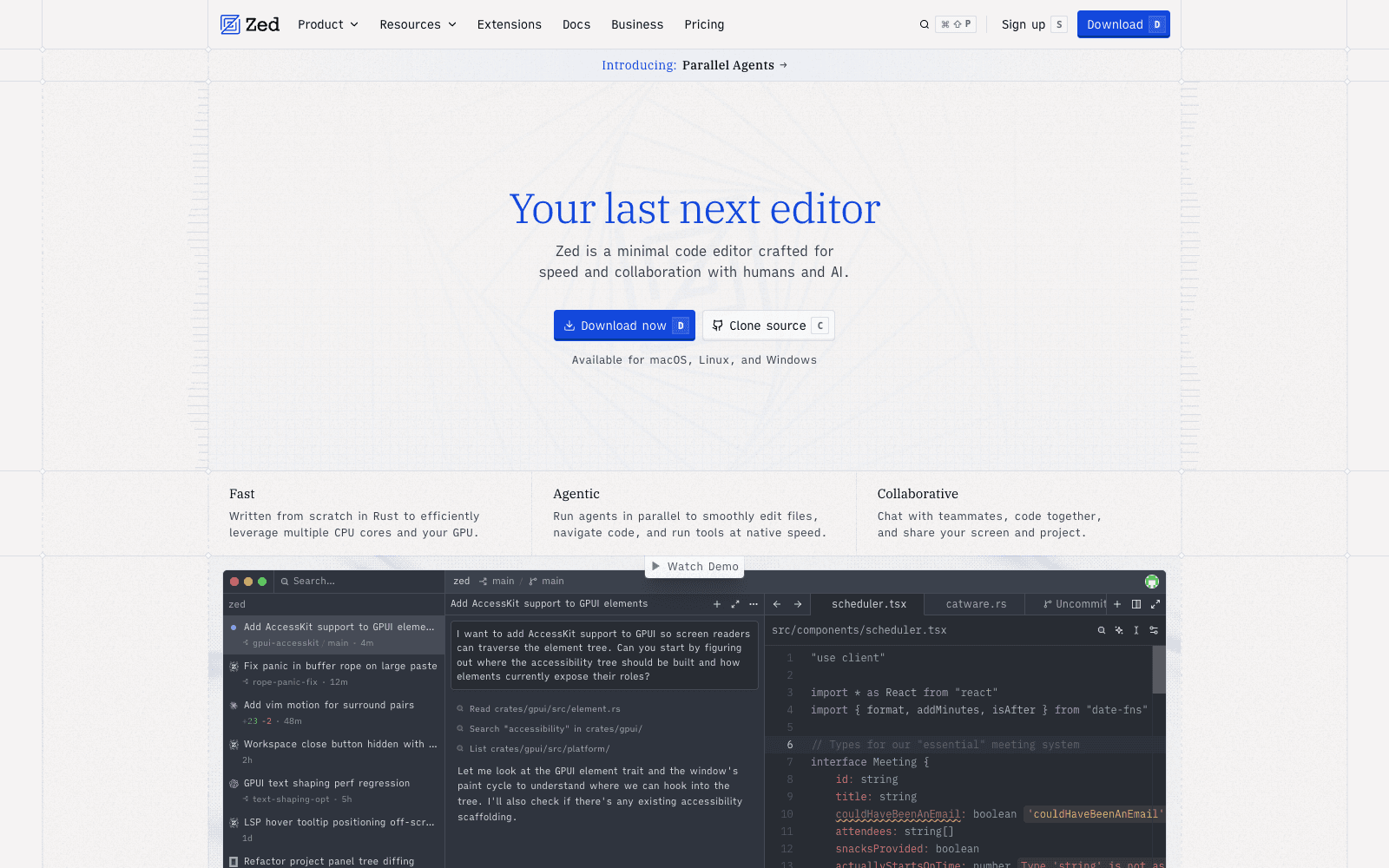
Zed is an open-source, GPU-accelerated code editor written in Rust with native AI agents and real-time multiplayer collaboration.
Overview
Zed
Zed is an open-source code editor written in Rust by the team that built Atom and Tree-sitter at GitHub. Zed renders its entire interface on the GPU through a custom framework called GPUI, which is why Zed feels faster than Electron-based editors: independent tests show roughly a 0.6-second cold start and about 222 MB of idle memory, versus multi-gigabyte footprints elsewhere. Beyond speed, Zed is built for agentic coding, running AI agents through an open Agent Client Protocol so models from Anthropic, OpenAI, and others work natively. It also keeps the real-time multiplayer editing the founders pioneered with Atom's Teletype.
Production credibility: Founded in 2019 by Nathan Sobo, Antonio Scandurra, and Max Brunsfeld, the team that led Atom at GitHub and created Tree-sitter (the incremental parser now used by Neovim, Helix, and GitHub code search). Zed has raised about $44.5M total, including a $32M Series B led by Sequoia Capital in August 2025; earlier investors include Redpoint Ventures, Root Ventures, and Matchstick Ventures, plus angels Dylan Field (Figma) and Tom Preston-Werner (GitHub). Zed open-sourced its GPUI rendering framework and authored the Agent Client Protocol, an open standard for connecting AI agents to editors.
Key Features
- Written from scratch in Rust with a custom GPU-rendered UI framework (GPUI) instead of Electron.
- Independent benchmarks report a ~0.6s cold start and ~222 MB idle RAM, well below Electron-based editors.
- Founded in 2019 by Nathan Sobo, Antonio Scandurra, and Max Brunsfeld, the creators of Atom and Tree-sitter.
- Raised ~$44.5M total, including a $32M Series B led by Sequoia Capital (Aug 2025).
- Authored the Agent Client Protocol (ACP), an open standard so any AI agent can plug into the editor.
- Runs native AI agent threads in parallel, bounded by your API rate limits rather than editor architecture.
- Real-time multiplayer editing and channels, descended from the team's work on Atom's Teletype.
- Free and open-source under the GPL; works with multiple model providers (Anthropic, OpenAI, and others).
Ideal Use Case
Use Zed when you want a fast, keyboard-driven editor for daily coding, pair programming over the network, or directing AI agents yourself rather than handing the entire task to a chat box.
How Zed differentiates
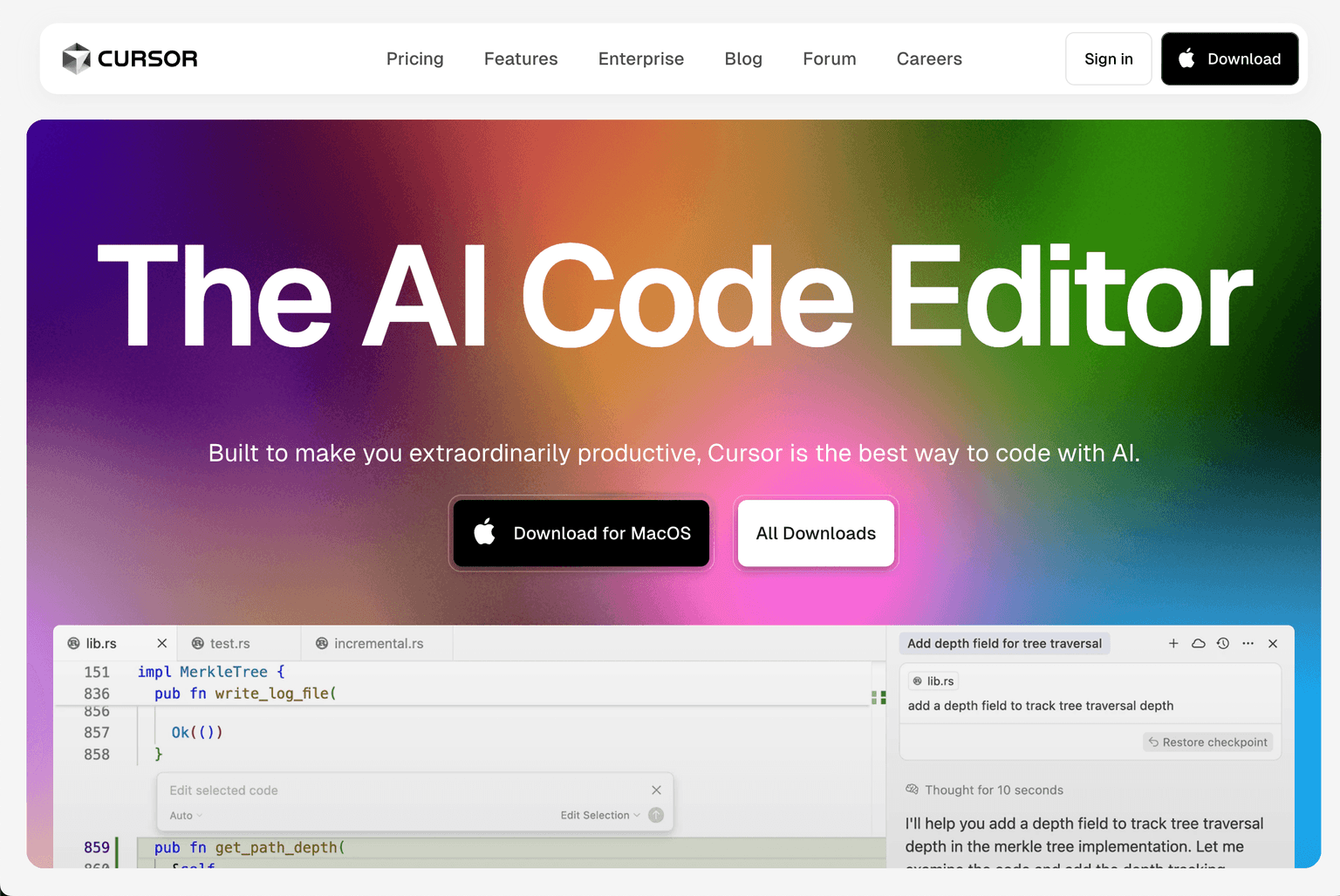
Versus VS Code, Zed is dramatically lighter and faster because it avoids Electron, but its extension ecosystem is far smaller and younger. Versus Cursor, Zed expects you to direct AI agents and prizes raw editor speed, while Cursor (a VS Code fork) leans into AI doing more of the code generation. Versus Neovim, Zed offers a modern GUI, built-in collaboration, and agent support without heavy configuration, though Vim users give up some muscle memory and depth. The trade-off is maturity: Zed reached 1.0 only recently, so some languages and plugins still lag the incumbents.
FAQ
Q: Is Zed free? A: Yes. Zed is open-source under the GPL and free to use. Paid plans cover hosted collaboration features and managed AI usage, but the editor itself is free.
Q: Zed vs Cursor: which should I pick? A: Zed is a from-scratch Rust editor focused on speed and on letting developers steer AI agents directly, and it can run multiple agents in parallel. Cursor is a VS Code fork that automates more of the code generation. Pick Zed for raw speed and control; pick Cursor if you want AI to do more of the heavy lifting inside a familiar VS Code layout.
Q: Who founded Zed? A: Nathan Sobo, Antonio Scandurra, and Max Brunsfeld, the team that built Atom at GitHub and created Tree-sitter. The company was founded in 2019.
Q: How much has Zed raised? A: About $44.5M total, including a $32M Series B led by Sequoia Capital in August 2025, with participation from Redpoint, Root Ventures, and angels including Dylan Field and Tom Preston-Werner.
Q: Does Zed work on Windows? A: Zed launched on macOS and Linux first; a Windows build has been in progress and rolling out. Check the current download page for the latest platform status.
tl;dr
Zed is an open-source, GPU-accelerated code editor written in Rust by the creators of Atom and Tree-sitter. It pairs benchmark-leading startup speed and low memory use with native, parallel AI agents via the open Agent Client Protocol. Backed by a $32M Sequoia-led Series B (~$44.5M total).
Related
Looking for more options? Browse the Developer Tools directory or read our best AI coding tools listicle. Zed is also tracked on Crunchbase.
Why Use Zed
Editorial Review
Our take on Zed.

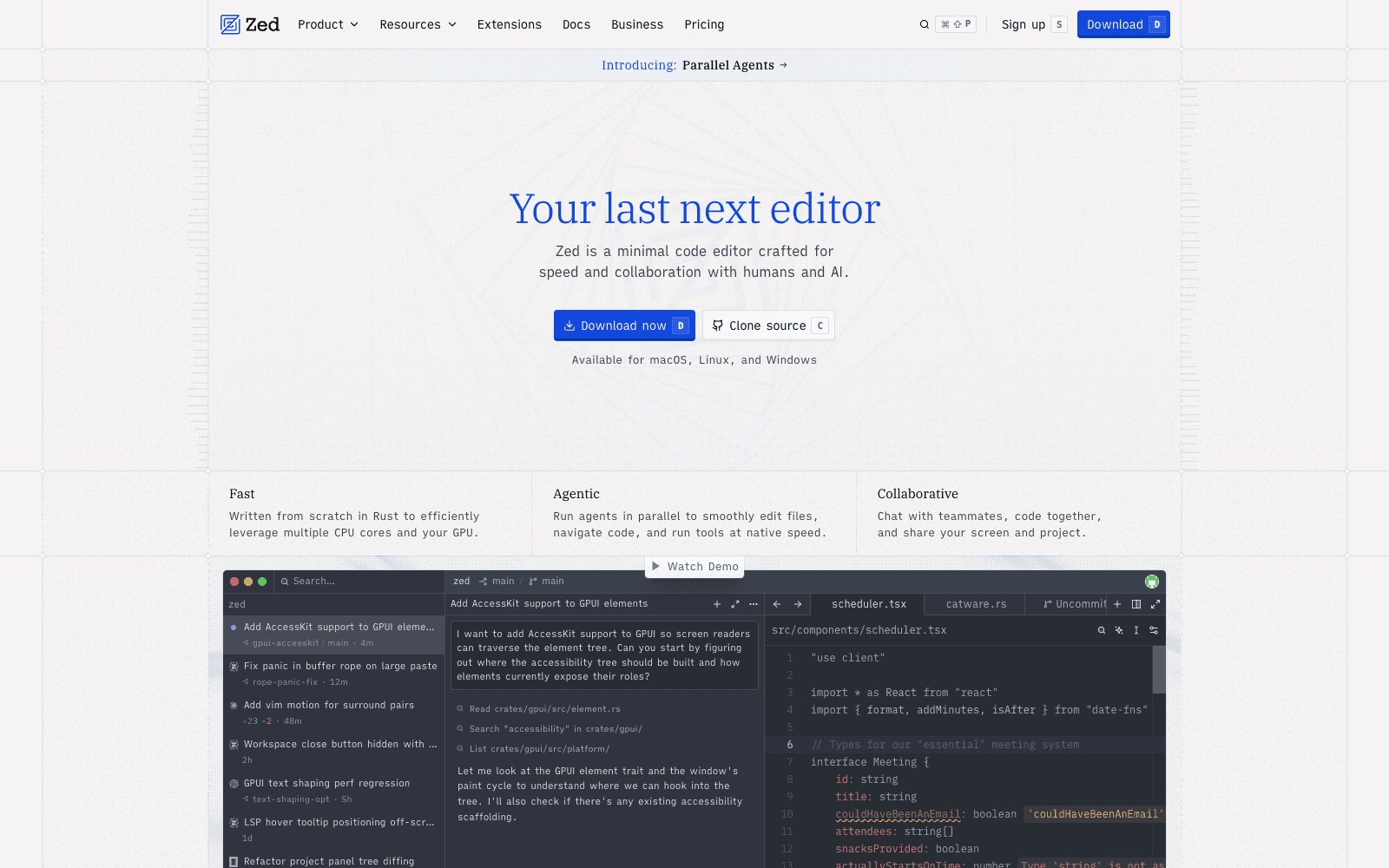
A Rust-built editor that is genuinely fast, now on macOS, Linux and Windows, with agentic AI wired in rather than bolted on. Open source, native Git, real debugging. The strongest argument yet for leaving a heavier editor behind.
What works
- Rust and GPU rendering deliver latency the alternatives do not match
- Model-agnostic AI over ACP and MCP, not one locked-in assistant
- Open source, with native Git, DAP debugging and Vim bindings
What doesn't
- Extension ecosystem is still thinner than the established editors
- Agentic features move fast, so workflows shift between releases
Zed's founding claim is speed, and it earns it structurally rather than through tuning — written in Rust, using multiple cores and GPU acceleration for rendering. The result is an editor where input latency is not something you think about.
What has changed the calculation recently is that the AI story is coherent. Agentic editing runs multiple threads across projects at once, edit prediction uses Zed's own open-weight Zeta2 model, and the inline assistant transforms selections in place. Crucially it is model-agnostic: Claude and other agents connect over ACP and MCP, so you are not tied to one vendor's assistant.
The editor fundamentals hold up independently of the AI. Native Git covers staging, committing, diffs, push and pull; multibuffers let you edit excerpts from across a codebase in one surface; Vim bindings are first class, including text objects and marks; debugging runs on the Debug Adapter Protocol. Remote development keeps the UI local while code executes elsewhere. Extension breadth still trails the older editors, which remains the main reason people bounce.
User Reviews
Similar Tools