Cognition Labs
AI-driven software engineering solutions
Overview
Revolutionizing Software Development with Cognition Labs' AI Engineer, Devin
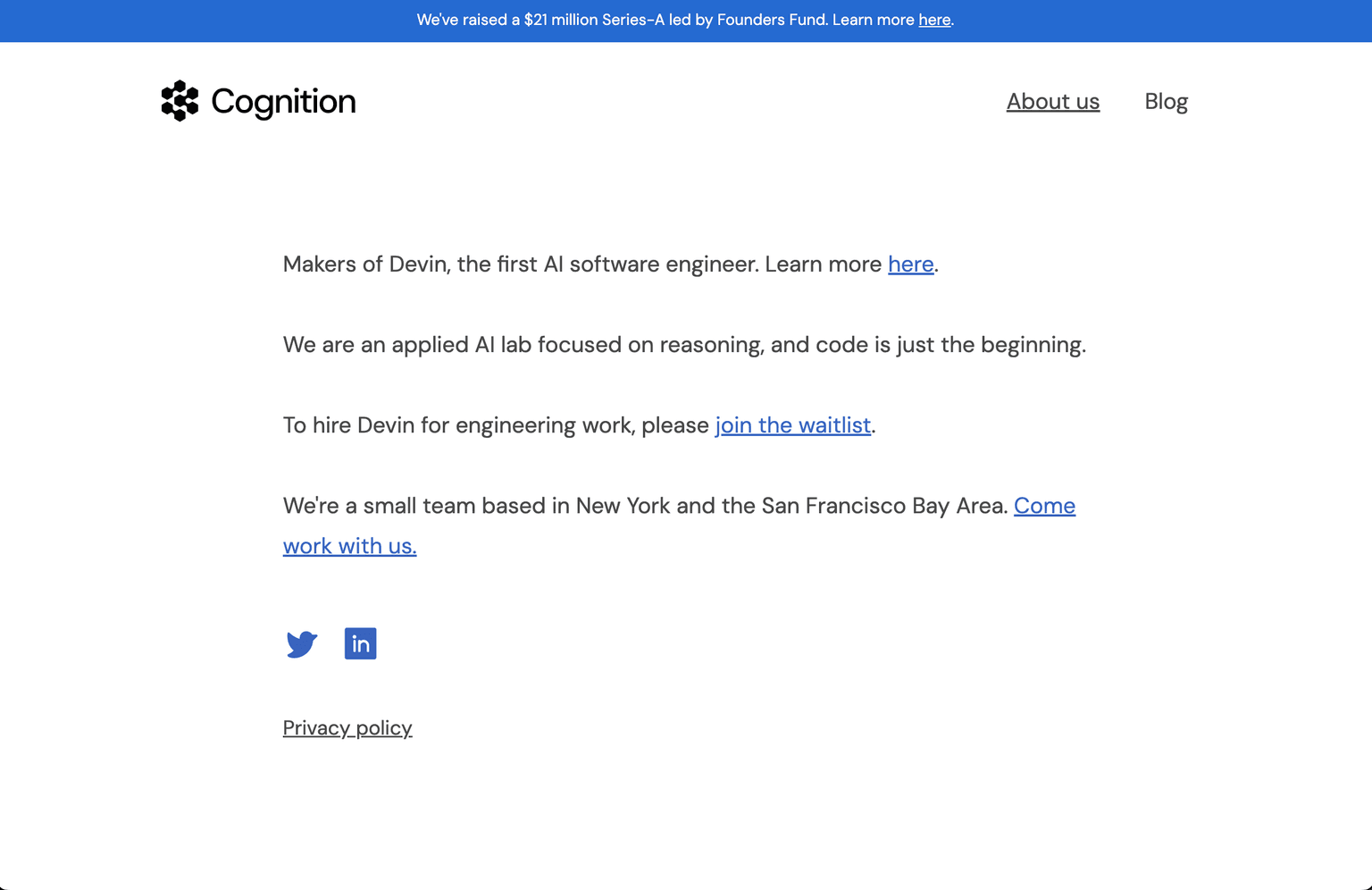
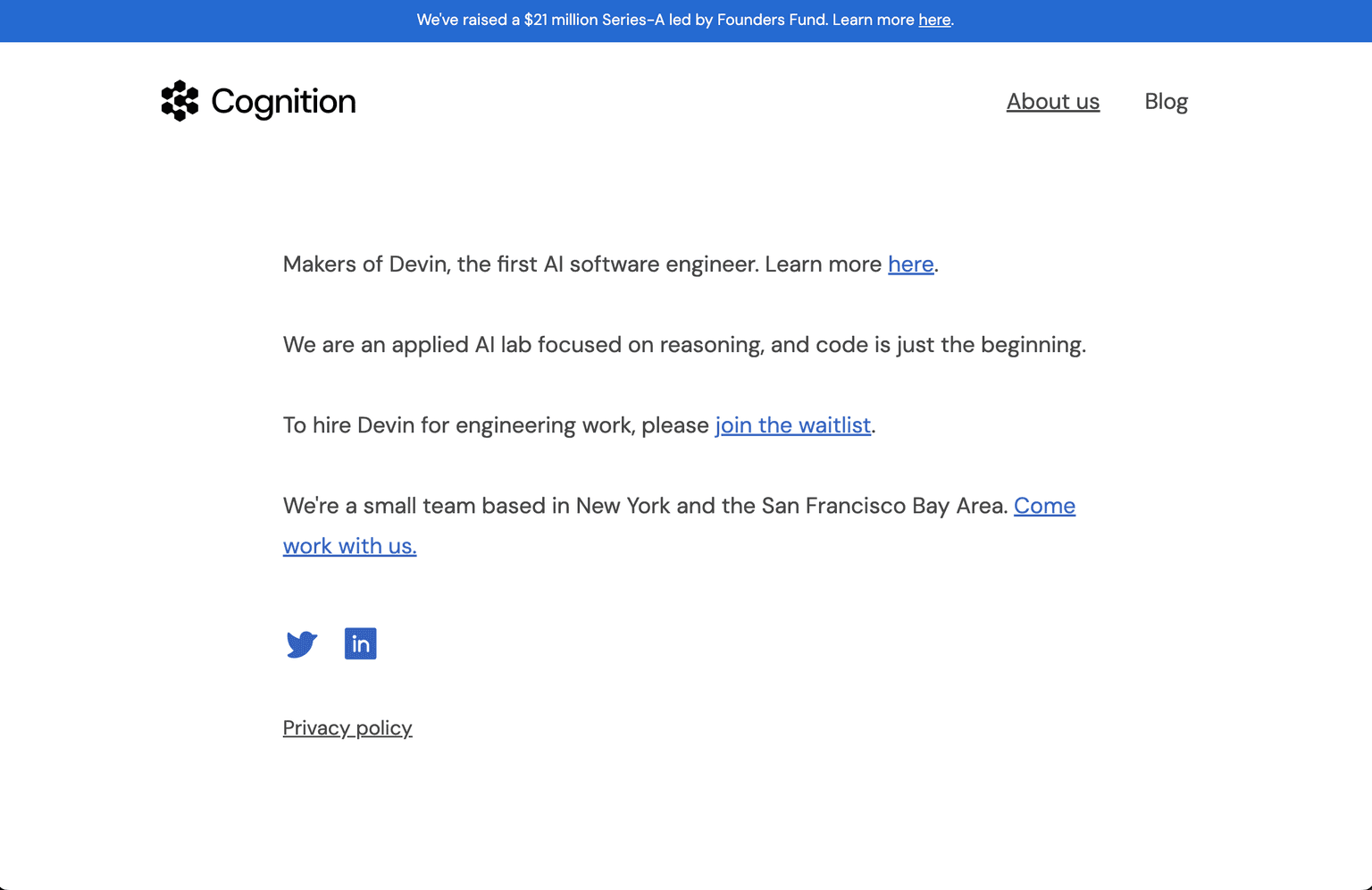
Cognition Labs stands at the forefront of the AI revolution, introducing Devin - the first AI software engineer designed to redefine the landscape of coding and software development. As an applied AI lab with a focus on reasoning, Cognition Labs is pioneering the integration of AI in the realm of software engineering, offering innovative solutions that promise to enhance efficiency, creativity, and problem-solving capabilities in the tech industry.
Key Features:
- AI Software Engineering: Harness the power of AI for complex coding tasks.
- Advanced Reasoning Capabilities: AI that understands and applies logical reasoning in development.
- Efficiency and Speed: Accelerate development cycles with AI-driven insights and automation.
- Scalable Solutions: Tailored AI applications that grow with your project needs.
Ideal Use Case:
Cognition Labs is ideal for tech companies, startups, and individual developers seeking to leverage AI's potential to optimize software development processes, from conceptualization to deployment. Devin, the AI software engineer, is particularly suited for projects requiring innovative solutions, rapid development, and high-quality code.
Why use Cognition Labs:
- Innovate Faster: Reduce development time with AI-powered coding assistance.
- Enhance Quality: Improve code quality with AI-driven analysis and optimization.
- Stay Ahead: Gain a competitive edge by incorporating the latest AI technologies in software development.
- Access Expertise: Benefit from the knowledge and experience of a leading AI lab.
FAQ
What does Cognition Labs do? Cognition Labs provides AI-driven software engineering solutions designed to help developers build and ship code more efficiently. The platform leverages artificial intelligence to assist with various aspects of the software development workflow.
Who should use Cognition Labs? Cognition Labs is built for software developers and engineering teams looking to integrate AI assistance into their development process. It's suited for individuals and organizations that want to streamline their coding workflows.
How much does Cognition Labs cost? Cognition Labs operates on a paid pricing model. Visit the Cognition Labs pricing page for current plans and detailed pricing information.
How does Cognition Labs compare to similar tools? Cognition Labs competes in the AI-assisted development space alongside tools like GitHub Copilot, Cursor, and v0. Each tool offers different approaches to AI-driven coding assistance, so comparing features directly on their respective sites can help you find the best fit for your workflow.
tl;dr:
Cognition Labs introduces Devin, an AI software engineer, marking a significant milestone in the evolution of software development. By integrating AI into the coding process, Cognition Labs offers a powerful tool for developers and companies aiming to enhance efficiency, innovation, and quality in their projects.
Related
Looking for more options? Browse the Developer Tools directory or read our best AI coding tools listicle. Cognition Labs has a Wikipedia entry and is tracked on Crunchbase.
Why Use Cognition Labs
Editorial Review
Our take on Cognition Labs.

The Devin maker is no longer the underdog: over $1B raised in May 2026 at a valuation reported around $25–26B, roughly $492M ARR, and Windsurf's product, brand and team folded in.
What works
- Genuine autonomous-agent model, not an autocomplete layer bolted onto an editor
- Revenue scaled roughly thirteen-fold year over year, to about $492M ARR by May 2026
- Windsurf acquisition added an enterprise IDE business, 350+ customers and the SWE-1.6 model
What doesn't
- Autonomous execution demands review discipline and scoped credentials to be safe
- Early independent evaluations of Devin's unattended completion rate were unflattering
Cognition builds Devin, the autonomous software agent that takes a ticket and works it rather than autocompleting alongside you. That framing was easy to dismiss in 2024, when early evaluations put Devin's independent task-completion rate in the mid-teens and the gap between demo and production looked enormous. The financial picture since then is not the picture of a struggling entrant.
Revenue went from roughly $37 million in May 2025 to about $492 million in May 2026 — a thirteen-fold move inside a calendar year — and in May 2026 the company raised more than $1 billion at a valuation reported between $25 and $26 billion. Devin alone had scaled from about $1 million ARR in September 2024 to $73 million by June 2025.
The step-change was structural. In July 2025 Cognition acquired Windsurf's IP, product, brand and remaining engineering team, after Google hired away Windsurf's CEO and several senior engineers in a $2.4 billion licensing arrangement and an OpenAI acquisition bid collapsed. That brought roughly $82 million in ARR, more than 350 enterprise customers and the SWE-1.6 model — converting Cognition from a single-product developer subscription into a company with an enterprise IDE business attached.
The honest evaluation question is no longer traction, it is autonomy. Devin is sold on doing work unattended, and unattended work needs review discipline, scoped credentials and a rollback plan. Judge it on how much of a real ticket it closes without intervention on your codebase — not on whether it out-autocompletes Copilot or Cursor, which is a different product category.
User Reviews
Similar Tools