CodeRabbit
AI-powered code review — cut review time and bugs in half, instantly.
Overview
CodeRabbit: Cut Code Review Time and Bugs in Half
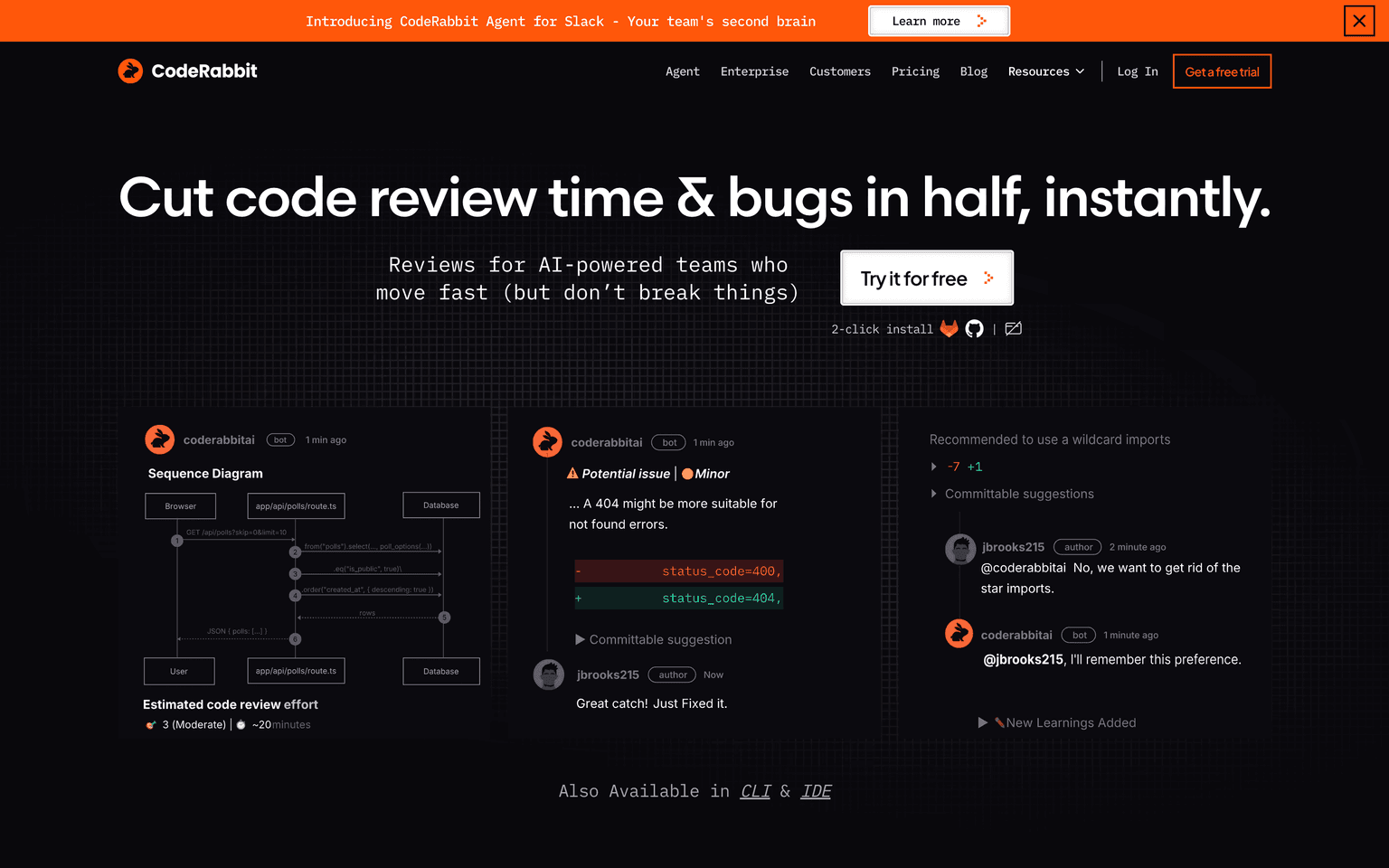
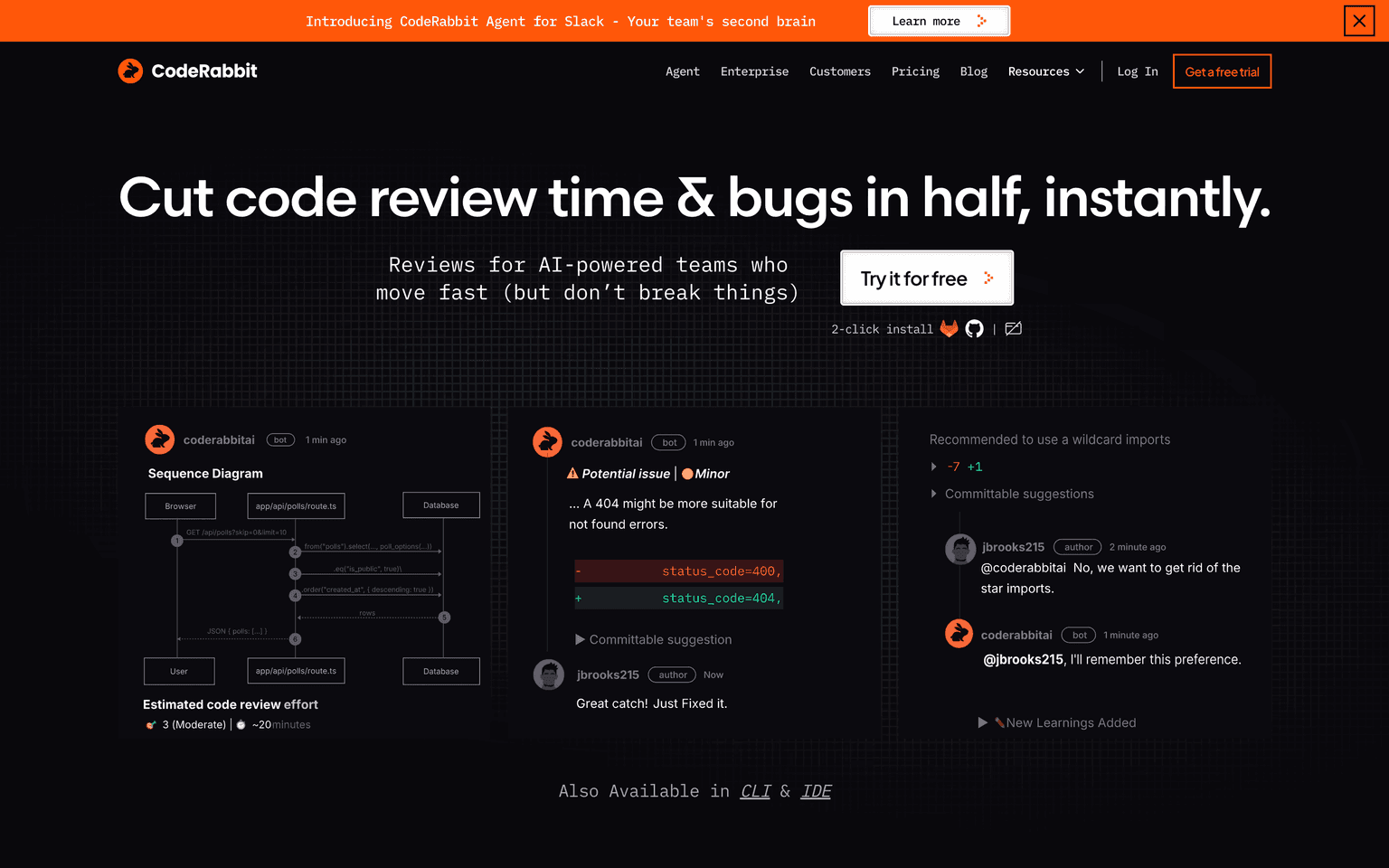
CodeRabbit is the AI-powered code review platform built for teams that move fast but don't want to break things. Install in one click on GitHub or GitLab and get committable suggestions, sequence diagrams, security and quality flags, and impact estimates on every PR. Available in CLI and IDE for shift-left review before code even hits PR.
In 2026, CodeRabbit shipped CodeRabbit Agent for Slack — your team's "second brain" that surfaces engineering context directly in Slack. The platform is one of the fastest-growing AI code review tools globally, used by AI-powered teams across solo engineers, startups, and enterprise.
Key Features:
- AI-powered code review on every PR
- Committable suggestions and inline review comments
- Sequence diagrams and architectural context
- Security, quality, and complexity flags
- Code review effort estimation
- GitHub and GitLab integration (1-click install)
- CLI and IDE support for shift-left review
- CodeRabbit Agent for Slack (new)
- Free tier; paid for advanced features
- Enterprise-ready with SSO and audit logs
Ideal Use Case:
CodeRabbit is ideal for engineering teams of any size that want to reduce review burden and catch issues earlier. Especially strong for fast-moving teams where reviewer bandwidth is the bottleneck and for organizations enforcing consistent review standards across many repos.
Why Use CodeRabbit:
- Cut PR review time and bugs in half
- 1-click install on GitHub or GitLab
- Committable suggestions, not just comments
- CLI and IDE shift-left review
- New: CodeRabbit Agent for Slack
FAQ
Where does CodeRabbit run? GitHub, GitLab, CLI, and IDE. Is there a free tier? Yes — free for individuals; paid for teams and enterprise. What's CodeRabbit Agent for Slack? A new product surfacing engineering context directly in Slack. Does CodeRabbit replace human review? No — it accelerates human review and catches obvious issues automatically.
FAQ
What does CodeRabbit do? CodeRabbit is an AI-powered code review tool that automatically analyzes code changes to identify bugs and issues. It's designed to cut both review time and the number of bugs that slip through, helping development teams move faster.
Who should use CodeRabbit? CodeRabbit is built for software development teams that want to automate their code review process and catch problems earlier. It works particularly well for teams looking to speed up their review cycles without sacrificing code quality.
How much does CodeRabbit cost? CodeRabbit offers a freemium pricing model, with a free tier available to try and paid options for additional features. Visit the CodeRabbit pricing page for current plans and details on what each tier includes.
How does CodeRabbit compare to similar tools? While tools like GitHub Copilot, Cursor, and v0 focus on code generation and assistance, CodeRabbit specializes specifically in automated code review. If your priority is catching bugs and speeding up the review process rather than writing code, CodeRabbit offers a more targeted solution.
FAQ
What does CodeRabbit do? CodeRabbit is an AI-powered code review tool that automatically analyzes code changes to identify bugs and issues. It's designed to cut both review time and the number of bugs that slip through, helping development teams move faster.
Who should use CodeRabbit? CodeRabbit is built for software development teams that want to automate their code review process and catch problems earlier. It works particularly well for teams looking to speed up their review cycles without sacrificing code quality.
How much does CodeRabbit cost? CodeRabbit offers a freemium pricing model, with a free tier available to try and paid options for additional features. Visit the CodeRabbit pricing page for current plans and details on what each tier includes.
How does CodeRabbit compare to similar tools? While tools like GitHub Copilot, Cursor, and v0 focus on code generation and assistance, CodeRabbit specializes specifically in automated code review. If your priority is catching bugs and speeding up the review process rather than writing code, CodeRabbit offers a more targeted solution.
tl;dr:
CodeRabbit is the AI-powered code review platform — committable suggestions, sequence diagrams, security flags. 1-click install on GitHub or GitLab. CLI, IDE, and now Slack.
Related
Looking for more options? Browse the Developer Tools directory or read our best AI coding tools listicle. CodeRabbit is also tracked on Crunchbase.
Why Use CodeRabbit
FAQ
Editorial Review
Our take on CodeRabbit.

Focused code-review automation that does one thing; whether it saves you time depends on your review process and how much you trust AI suggestions.
What works
- Freemium entry means low friction to test it
- Processed 13M+ pull requests across 2M+ repositories for 8,000+ paying customers
- Narrow scope: just code review, easy to understand what you're getting
What doesn't
- AI review suggestions still need human verification; not a replacement
- Suggestions still need human verification; it will not catch design-level flaws
CodeRabbit is a narrowly scoped tool: it automates code review feedback using AI. The pitch is familiar—faster reviews, fewer bugs—but the real question is whether it actually fits into your workflow.
The freemium model is sensible for trying it out. You can kick the tires without commitment. That said, AI code review is inherently probabilistic. It'll catch some real issues and some false positives; you'll still need humans reading the output, especially on security-critical or complex logic. Don't expect it to replace thoughtful code review—think of it as a first pass that flags style, common mistakes, and maybe some deeper patterns if you're lucky.
If you're drowning in review volume or you've got junior devs on the team, automation that surfaces obvious issues before human eyes touch the PR might be worth the time investment to evaluate. If your reviews are already tight and focused, or if your team prefers pairing and async discussion, this is less obviously a win. The metric that matters: does it reduce meaningful review friction, or just add another tool to your stack?
User Reviews
Similar Tools