Galileo
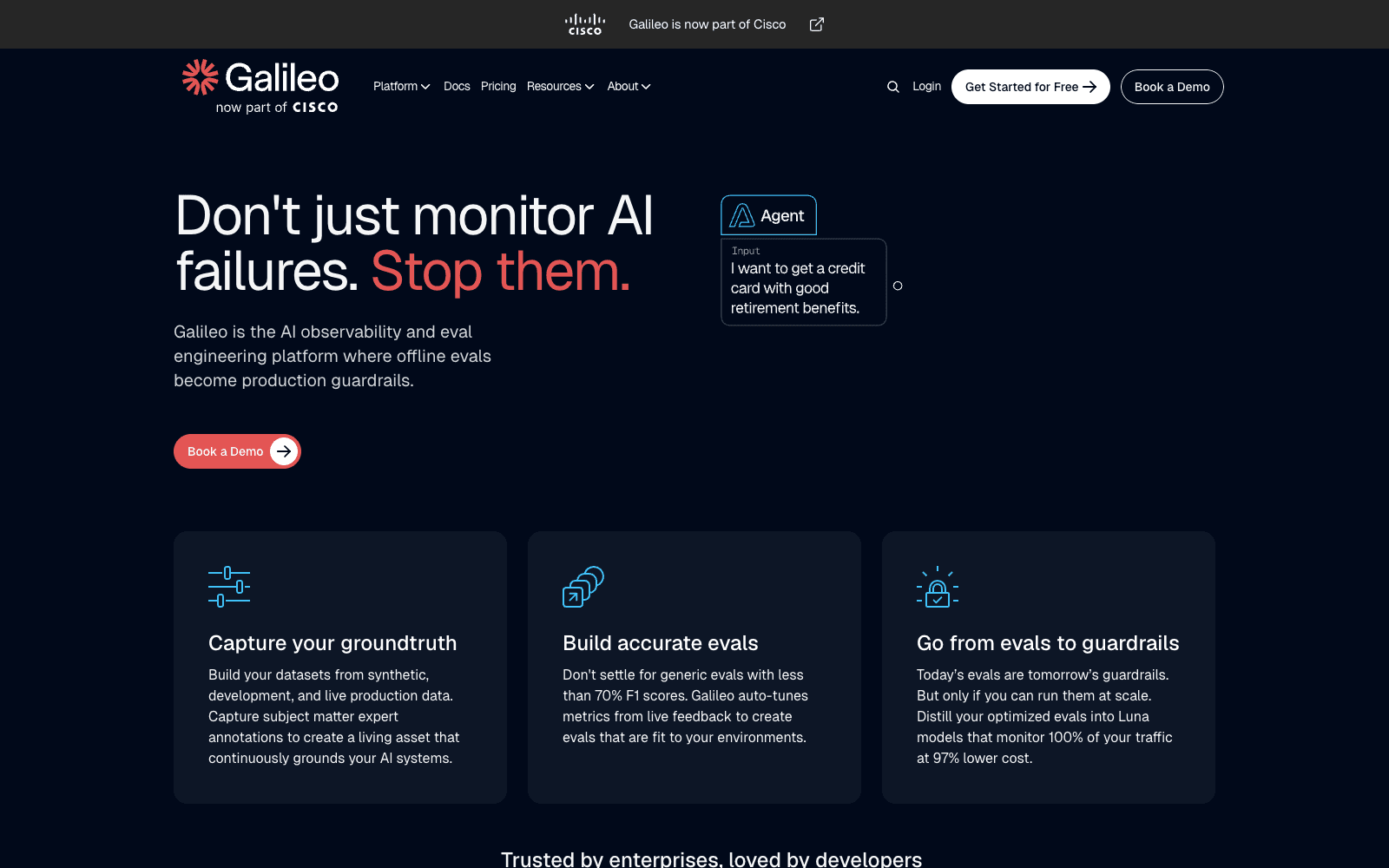
Galileo is an LLM evaluation and observability platform that tests, monitors, and guardrails GenAI applications and agents at enterprise scale.
Acquired Galileo
Acquired · April 2026
Still operating. Cisco announced its intent to acquire Galileo, the AI evaluation and observability platform, on April 9, 2026; the deal completed on May 22, 2026 and terms were undisclosed. Galileo joined Splunk, which markets the technology as Splunk Agent Observability, but galileo.ai still sells Galileo under its own name with a free tier.
Acquired by Cisco.
Last known pricing: Free $0/month (5,000 traces); Pro from $100/month billed yearly (50,000 traces); Enterprise by quote (galileo.ai/pricing, September 2026).
Is Galileo shut down?
No — Galileo is still operating. Its acquisition by Cisco was announced on April 9, 2026, and the product continues to ship. We list it in the ToolDirectory.AI graveyard's acquired-but-operating section and watch for post-acquisition changes.
What to use instead

Cyera
AI-native data security platform for discovery, classification, and protection. Sequoia/Accel-backed unicorn; Forbes AI 50 2026.
Freemium
4.92
503

Elicit
AI research automation and data analysis
Paid - Inquire
4.92
420

Mira Network
Decentralized verification network for AI outputs — consensus-based hallucination reduction.
Freemium
4.82
297
Overview
Galileo
Galileo is an LLM evaluation and observability platform for testing, monitoring, and guardrailing generative AI applications and agents. (Not to be confused with the text-to-UI design tool of a similar name, Galileo here is the evaluation and AI reliability platform at galileo.ai.) The platform captures traces from your GenAI app, scores them with research-backed metrics powered by its Luna evaluation models, and turns those offline evals into real-time production guardrails. Founded in 2021 by engineers from Google AI, Google Brain, Apple Siri, and Uber, Galileo focuses on agent reliability: catching hallucinations, tool-call errors, and quality regressions across multi-step AI systems before users see them.
Production credibility: Founded in 2021 by Vikram Chatterji (CEO), Atindriyo Sanyal, and Yash Sheth, with backgrounds at Google AI, Google Brain, Apple Siri, and Uber AI. Galileo has raised approximately $68M total, headlined by a $45M Series B in October 2024 led by Scale Venture Partners, with Premji Invest, Databricks Ventures, ServiceNow Ventures, Amex Ventures, Citi Ventures, and Battery Ventures participating. Customers include HP, Twilio, Reddit, and Comcast. The platform is built on Galileo's Luna and Luna-2 small language models for fast, low-cost evaluation, and in 2025 the company launched a free agent reliability tier combining observability, evaluation, and guardrails for multi-agent systems.
Acquisition note (April 2026): Cisco announced its intent to acquire Galileo on April 9, 2026 and completed the deal on May 22, 2026, on undisclosed terms. The team and technology joined Splunk, where it is marketed as Splunk Agent Observability, while galileo.ai continues to sell Galileo directly.
Key Features
- Trace capture and observability for GenAI apps and multi-agent systems
- Research-backed evaluation metrics for hallucination, correctness, and quality
- Luna and Luna-2 evaluation models for fast, low-cost scoring at scale
- Offline evals and experiments to compare prompts, models, and agent versions
- Real-time guardrails that block hallucinations and unsafe outputs in production
- Agentic evaluations purpose-built for tool calls and multi-step agent traces
- Production monitoring with alerting on quality and reliability regressions
- Python and TypeScript SDKs plus enterprise deployment options
Ideal Use Case
AI engineering teams use Galileo to evaluate prompts and agents offline, monitor GenAI applications in production, and apply real-time guardrails that block hallucinations and unsafe outputs before they reach users.
How Galileo differentiates
Against Arize, which grew from ML observability for tabular and embedding models, Galileo is built first for LLM and agent evaluation with its own Luna evaluation models so scoring runs cheaply at scale. Compared with Weights & Biases, an experiment-tracking suite for model training, Galileo focuses on the production evaluation and monitoring of GenAI apps rather than the training loop. Versus Braintrust and LangSmith, Galileo pushes research-backed metrics and guardrails for multi-agent systems; the trade-off is that its enterprise depth can be more than a small team prototyping a single prompt needs.
FAQ
Who owns Galileo? Galileo is owned by Cisco, which completed the acquisition on May 22, 2026 and placed it within Splunk. Splunk markets it as Splunk Agent Observability, but Galileo is still sold under its own name at galileo.ai.
Q: What does Galileo do? A: Galileo is an LLM evaluation and observability platform. It captures GenAI traces, scores them with research-backed metrics powered by its Luna models, and converts offline evaluations into real-time production guardrails for apps and agents. (This is the evaluation platform at galileo.ai, not the text-to-UI design tool with a similar name.)
Q: Who founded Galileo? A: Galileo was founded in 2021 by Vikram Chatterji (CEO), Atindriyo Sanyal, and Yash Sheth, engineers who previously worked at Google AI, Google Brain, Apple Siri, and Uber.
Q: How much funding has Galileo raised? A: Galileo has raised about $68M total, including a $45M Series B in October 2024 led by Scale Venture Partners, with Premji Invest, Databricks Ventures, ServiceNow Ventures, and others participating.
Q: Galileo vs Arize: what's the difference? A: Arize started as ML observability for tabular and embedding models and added LLM features. Galileo was built first for LLM and agent evaluation, using its own Luna evaluation models to score outputs cheaply at scale and apply guardrails, making it a fit for teams focused on GenAI quality and agent reliability.
Q: Is this Galileo the same as the AI design tool? A: No. This Galileo (galileo.ai) is an LLM evaluation and observability platform for GenAI quality and agent reliability. The text-to-UI design tool (usegalileo.ai) is a separate company that shares a similar name.
tl;dr
Galileo is an LLM evaluation and observability platform that tests, monitors, and guardrails GenAI apps and agents using its Luna evaluation models. Founded in 2021 by ex-Google/Apple engineers, it has raised about $68M (a $45M Series B led by Scale Venture Partners) and counts HP, Twilio, Reddit, and Comcast as customers. (This is the eval platform, not the same-named design tool.)
Related
Looking for more options? Browse the Developer Tools directory or read our best AI coding tools listicle. Galileo is also tracked on Crunchbase.
Why Use Galileo