Apache TVM
Open-source ML compiler framework for diverse hardware.
Overview
Apache TVM: Optimizing Machine Learning Models for Various Hardware
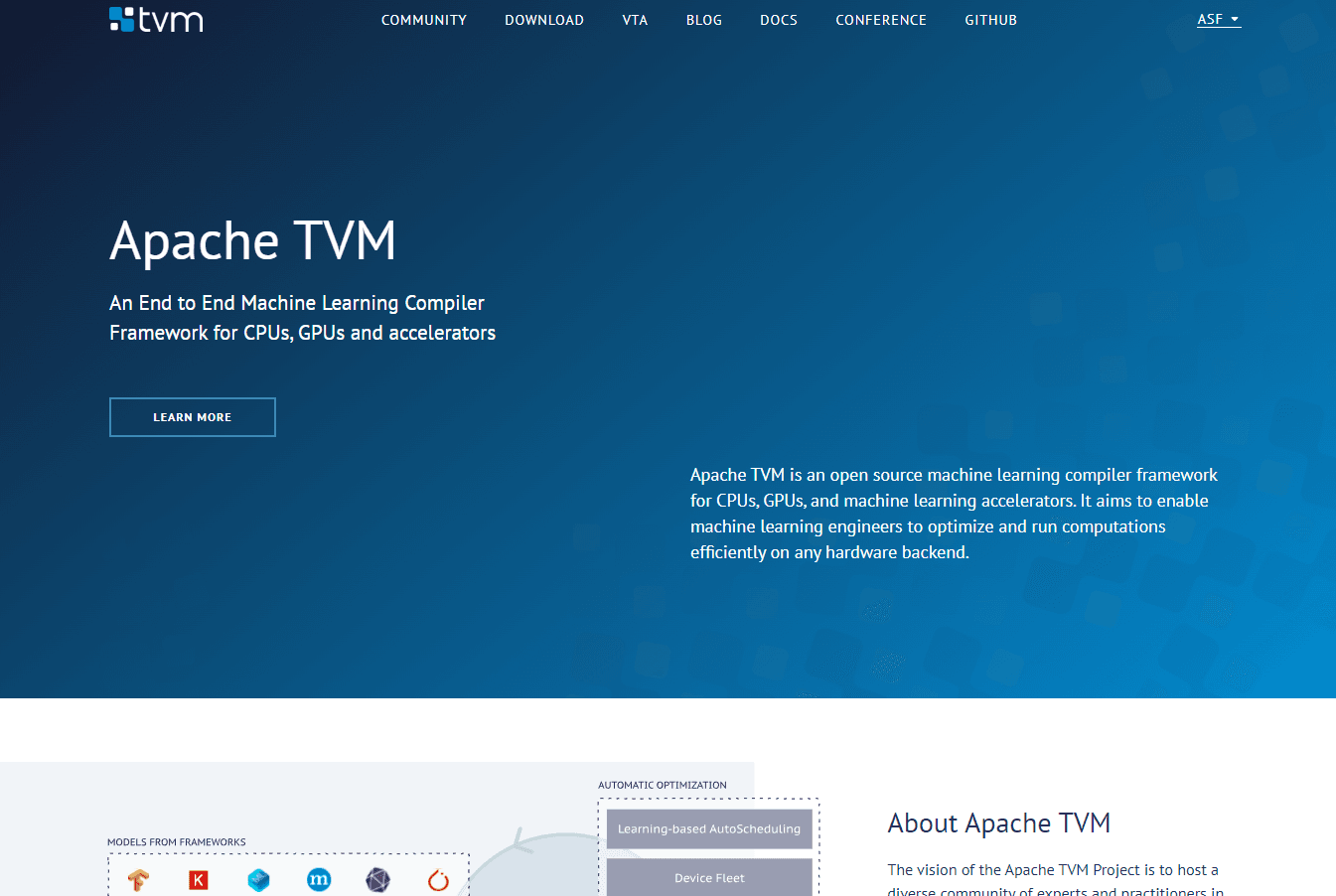
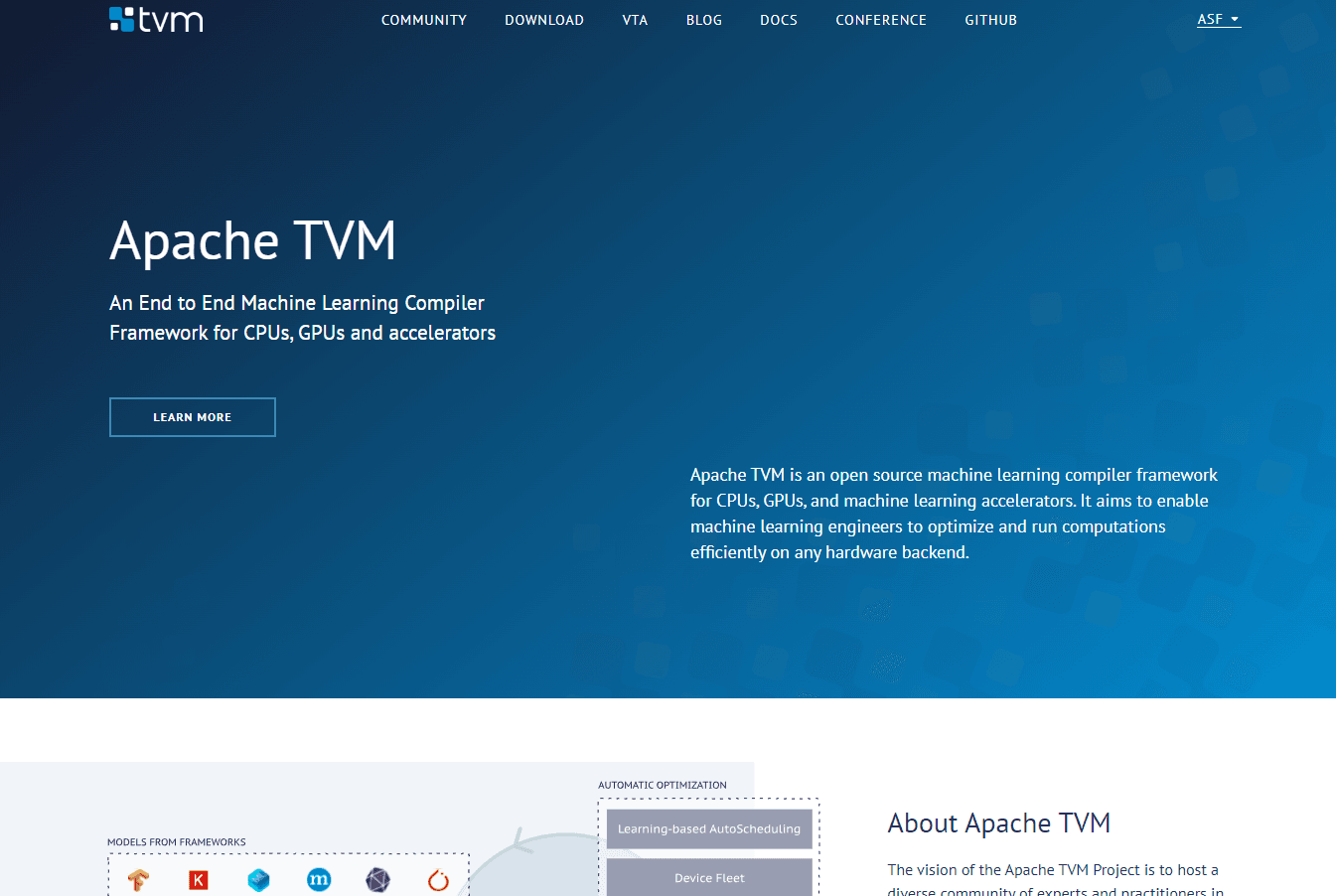
Apache TVM is a renowned open-source machine learning compiler framework designed to cater to CPUs, GPUs, and machine learning accelerators. Its primary objective is to empower machine learning engineers with the tools to optimize and efficiently execute computations on any hardware backend.
Key Features:
- Performance: Enhances ML workloads on existing hardware through compilation and minimal runtimes.
- Run Everywhere: Supports CPUs, GPUs, browsers, microcontrollers, FPGAs, and more. It can automatically generate and optimize tensor operators on multiple backends.
- Flexibility: Whether you need block sparsity, quantization, random forests, memory planning, MISRA-C compatibility, or Python prototyping, TVM's design caters to all these needs.
- Ease of Use: Seamlessly compile deep learning models from Keras, MXNet, PyTorch, Tensorflow, CoreML, DarkNet, and more. Start with Python and then transition to C++, Rust, or Java for production stacks.
Ideal Use Case:
Developers and machine learning engineers seeking an efficient and versatile compiler framework will find Apache TVM invaluable. It's especially beneficial for those looking to optimize ML models across various hardware platforms.
Why use Apache TVM:
- Comprehensive support for diverse hardware, from CPUs to FPGAs.
- Automatic tensor operator generation and optimization.
- Extensive flexibility catering to various ML needs.
- Easy integration with popular deep learning frameworks.
FAQ
What is Apache TVM used for? Apache TVM is an open-source ML compiler framework designed to optimize and deploy machine learning models across a wide variety of hardware platforms. It helps developers compile ML models efficiently for different devices and accelerators.
Who should use Apache TVM? Apache TVM is built for developers and ML engineers who need to deploy machine learning models on diverse hardware targets, from CPUs and GPUs to specialized accelerators and edge devices. It's particularly useful for teams optimizing model performance across multiple platforms.
What is the pricing structure for Apache TVM? Apache TVM is an open-source project, so there are no licensing costs to use the framework itself. For enterprise support or consulting services, visit the Apache TVM website to inquire about available options.
How does Apache TVM compare to other development tools? While tools like GitHub Copilot, Cursor, and v0 focus on code generation and AI-assisted development, Apache TVM is specifically built as an ML compiler framework. It addresses a different use case—optimizing and compiling machine learning models for production deployment across heterogeneous hardware rather than general code assistance.
tl;dr:
Apache TVM is a powerful open-source ML compiler framework, designed to optimize and run ML models efficiently across a wide range of hardware. With its flexibility and ease of use, it stands out as a go-to solution for ML optimization.
Related
Looking for more options? Browse the Developer Tools directory or read our best AI coding tools listicle. Apache TVM is also tracked on Crunchbase.
Why Use Apache TVM
Editorial Review
Our take on Apache TVM.

Apache TVM is an open-source ML compiler that optimizes neural networks across CPUs, GPUs, and specialized accelerators.
What works
- Compiles to diverse hardware—mobile, edge, accelerators, TPUs
- Active open-source community with proven production deployments
- Fine-grained control over compute scheduling and memory layout
What doesn't
- Steep learning curve; requires compiler and hardware knowledge
- Tuning and debugging can be time-consuming and brittle
Apache TVM handles the hard problem of taking a trained model and making it run fast on whatever hardware you actually have. It's a compiler framework built by researchers and production teams at scale, designed to bridge the gap between high-level ML frameworks (PyTorch, TensorFlow) and the metal—whether that's ARM, x86, GPUs, or custom silicon. You write or import a model; TVM figures out how to schedule computation efficiently for your target device.
The appeal is real if you're shipping ML to constrained environments or need to squeeze performance out of diverse hardware. But TVM has a learning curve; it's not a click-button tool. You need to understand compilation, scheduling primitives, and your hardware's memory and compute hierarchy. It's strongest for teams with ML systems expertise and specific performance targets, less so for quick prototyping.
The main trade-off: flexibility and performance gains come with complexity. Setup, tuning, and debugging can be time-intensive. If your use case is "deploy to one popular GPU on cloud VMs," you might not need TVM's overhead. But if you're targeting heterogeneous hardware or mobile, or if model size and latency matter urgently, it's a tool worth learning.
User Reviews
Similar Tools