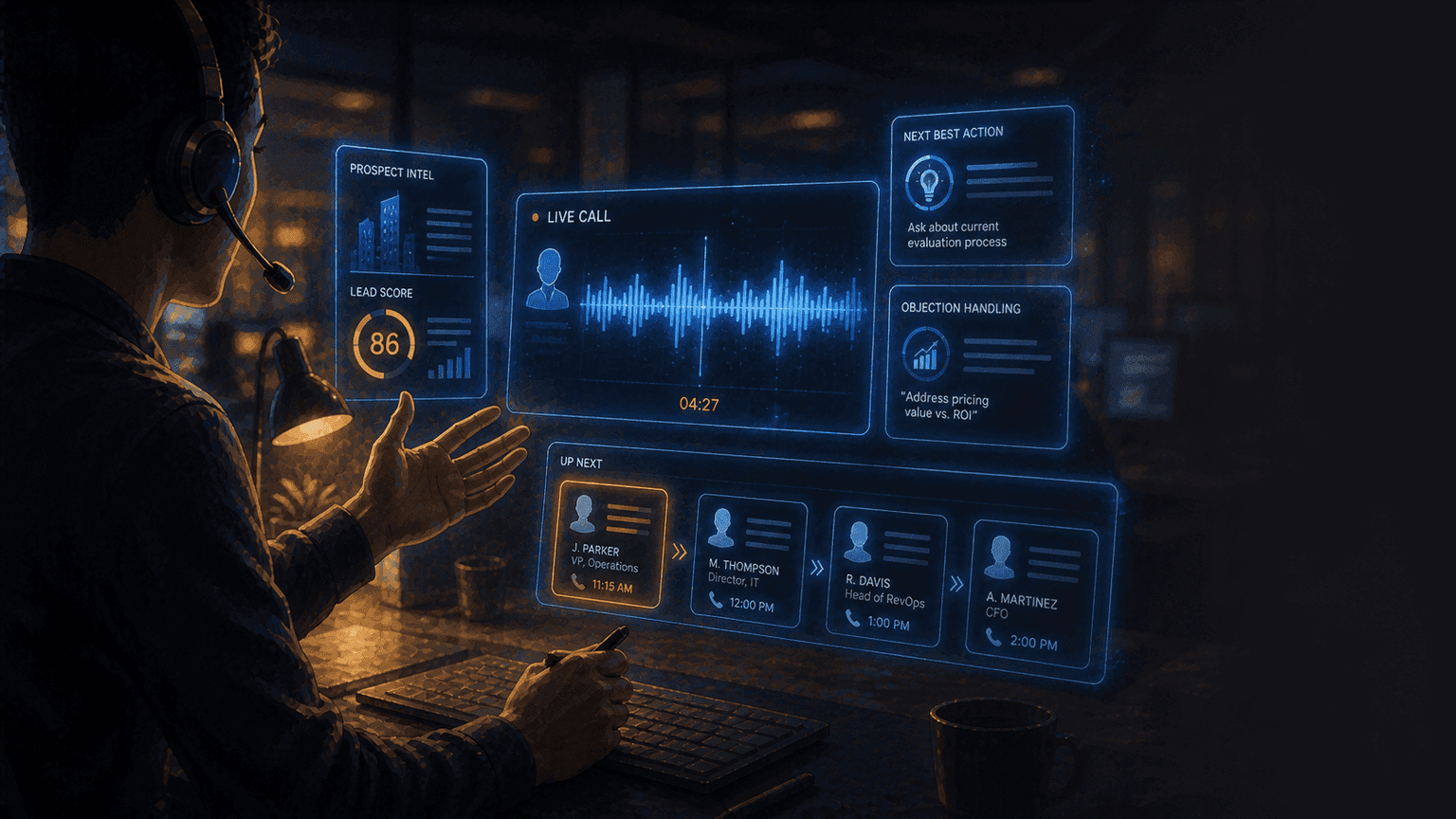
Docket.io
4.8Paid215
Side-by-side comparison of Docket.io and SalesAPE.ai — pricing, features, and use cases. Reviewed by our editorial team in Oct 2026.

Docket.io and SalesAPE.ai address different stages of the sales pipeline and buyer journey. Docket wins for teams struggling to engage website visitors in real time, converting high-intent buyers during active research sessions.
It uniquely positions itself as a conversational qualification engine on your website, powered by a Sales Knowledge Lake™ that unifies GTM data and delivers 95% accuracy with 2.7% hallucination rates.
Built for mid-market and enterprise teams with complex products requiring technical depth, Docket handles product demonstrations, objection resolution, and discovery conversations directly in the browser.
In contrast, SalesAPE.ai targets the inbound email, SMS, chat, and WhatsApp channels—engaging leads immediately after they request contact but before sales reps wake up the next morning.
SalesAPE's APE AI engine trains itself on your business, website, and sales process, then continuously self-improves based on conversation outcomes. It excels at rapid lead qualification and appointment booking across multiple communication channels, claimed to deliver 40% more conversions.
The choice hinges on where your conversion bottleneck lives: if 98% of your website visitors leave without real conversations, Docket solves that. If inbound leads reply late because your SDRs sleep, SalesAPE solves that.
Docket customers report 30% more qualified pipeline from the same traffic, 15% pipeline uplift, and 12% higher win rates. SalesAPE users report claims of 40% conversion increases and appointment booking rates that spike after implementing sub-60-second response times.
Docket deploys in under three days to two weeks; SalesAPE takes four to five weeks because it crawls your website, analyzes product inventory, and refines FAQs during setup. Neither is a comprehensive sales platform—Docket requires traffic to work, SalesAPE requires inbound leads to qualify. For traffic-heavy SaaS companies with technical buyers, Docket; for inbound-rich SMBs with fast-moving sales cycles, SalesAPE.
Website visitor engagement & product demos
Docket engages every visitor with voice, chat, and visual product explanations, delivering 95% accuracy answers from a centralized Sales Knowledge Lake. Over 30% of conversations exceed one minute with an average of 3+ minutes of engagement, capturing pricing, onboarding, and security discussions that were previously lost.
Rapid inbound channel response (email, SMS, WhatsApp)
SalesAPE deploys across email, SMS, chat, and WhatsApp simultaneously, responding in seconds and achieving sub-60-second reply rates. SalesAPE's self-improving APE AI engine continuously optimizes based on conversation outcomes; four to five weeks of setup ensures it knows your business better than you do.
Enterprise security & governance
Docket holds SOC 2 Type II, ISO 27001, and GDPR certifications with guardrails on approved knowledge—nothing goes live without brand alignment. SalesAPE does not disclose comparable compliance tier details; reviews cite frustration with customer support and demo scheduling friction.
4 use cases scored. Docket.io wins 2, SalesAPE.ai wins 0.
Neither tool publishes a starting price.
Neither tool offers a free tier or trial.
Docket.io averages 4.8 / 5 vs 4.6 / 5 on the other side.
Docket.io has 143 ratings vs 102 on the other.
Where each tool earns its rating — and where it falls short.
Every spec on one page. Live-pulled from each tool's detail page.
Quick answers to the questions readers ask before picking between these two.
Docket deploys in under two to three weeks with white-glove onboarding that connects your data sources overnight and validates answers before production. SalesAPE takes four to five weeks because it crawls your website, analyzes product details, reviews your sales process, and refines FAQs to ensure the agent matches your brand voice and business knowledge.
Yes. Docket engages website visitors and routes qualified conversations to sales reps; SalesAPE picks up when those reps (or new inbound emails) arrive, qualifying and booking calls across email, SMS, and chat. Teams with high website traffic and high inbound email volume could use Docket for onsite conversion and SalesAPE for channel-based follow-up.
Docket claims 95% accuracy with 2.7% hallucination rates, powered by a governed Sales Knowledge Lake™ that answers only from approved knowledge sources. If Docket does not know an answer, it explicitly offers to connect the visitor with a human—no improvisation on pricing, security, or compliance. SalesAPE does not disclose comparable accuracy metrics publicly.
Docket uses traffic-based pricing and starts at the Growth tier for up to 20,000 monthly visitors. SalesAPE pricing is custom and not publicly disclosed; you must book a demo to get a quote. Neither platform publishes transparent per-seat or per-conversation pricing, making direct cost comparison difficult without sales calls.
Docket holds SOC 2 Type II, ISO 27001, and GDPR certifications with enterprise-grade security controls including encrypted data in transit and at rest, complete audit trails, and role-based access controls. SalesAPE does not prominently disclose comparable compliance certifications in public materials.
Both integrate with major CRMs. Docket syncs with Salesforce, HubSpot, Marketo, and 100+ GTM tools, transferring full conversation, pain points, qualification answers, and company context directly into your CRM. SalesAPE integrates with HubSpot, Salesforce, and Zoho, syncing leads, appointments, and conversation logs in real time.
Docket's traffic-based model may not fit early-stage startups with minimal monthly visitors, as you will pay for minimal engagement. SalesAPE requires existing inbound lead generation; if you do not have leads coming in, qualification tools will not help. Both are designed for scale. Evaluate your lead-generation playbook first, then layer these tools once you have traffic or inbound volume to qualify.
Choose Docket.io if your primary conversion bottleneck is on your website. You have traffic but lose high-intent buyers because your team cannot answer technical questions in real time, your forms create friction, and your chatbot defaults to requesting email addresses.
Docket wins for product-heavy B2B companies (SaaS, software, platforms, complex services), enterprises with multi-product portfolios, and marketing teams that want to measure success not by form fills (MQLs) but by Agent Qualified Leads (AQLs) that have already self-qualified through real conversation.
Deployment weeks and traffic-based pricing work well for companies receiving 20,000+ monthly website visitors with deal velocity to justify the annual commitment. Choose SalesAPE.ai if your bottleneck is inbound channel speed and qualification depth.
You get plenty of email, chat, and SMS inquiries but your SDRs reply the next morning while competitors close the deal, or you manually spend hours vetting tire-kickers instead of focusing high-value reps on closing.
SalesAPE fits mid-market and SMB teams (20–100 staff) that already have lead generation running but need sub-60-second response automation and intelligent filtering. Four-to-five week setup is worth the investment if you're replacing SDRs or scaling inbound without hiring.
Custom pricing and lack of transparency require demo engagement, but the self-improving APE AI engine and multichannel engagement across email, SMS, and WhatsApp make it valuable for service businesses, e-commerce, B2C, and SaaS companies that prize response speed.
For enterprises needing both website engagement and inbound channel automation, identify your most painful bottleneck first, then layer the second tool later.
More sales & revops head-to-heads.
 vs
vs vs
vs
 vs
vs vs
vs vsvs
vsvsReceive weekly updates so you can stay up-to-date with the world of AI
Receive weekly updates so you can stay up-to-date with the world of AI
The AI tools directory for discovering, exploring, and comparing the most innovative AI tools in the industry