Best AI Genogram Makers (2026)




Best AI Genogram Makers in 2026
A genogram is more than a family tree. Where a family tree records who is related to whom, a genogram adds a standardized clinical layer — medical history, emotional relationships, and behavioral patterns across generations — that therapists, doctors, social workers, and genealogists rely on. The best AI genogram makers now turn a plain-language description, a photo of a hand-drawn chart, or a GEDCOM file into a correctly notated genogram in seconds, instead of hours of manual symbol placement.
This guide compares the four genogram tools our editors rate most highly in 2026, from a standards-based clinical tool to a long-running desktop program and a free chat-to-diagram generator. Each has a clear best-fit, so the right pick depends on whether you value clinical accuracy, team collaboration, offline depth, or speed.
How We Evaluated These Tools
We ranked each tool against five weighted criteria, in priority order:
- Notation accuracy — does the output follow the standard genogram symbol set (the McGoldrick convention) for relationships, medical categories, and emotional bonds? This is what separates a genogram from a generic diagram.
- AI generation quality — how well does the tool turn a text description, image, or GEDCOM import into a usable chart with minimal cleanup?
- Privacy and compliance — for clinical use, does it offer encryption and HIPAA-ready handling? Family and medical data is sensitive.
- Export and collaboration — PNG, PDF, SVG, GEDCOM export, and whether teams can work on the same chart.
- Pricing transparency and 2026 currency — clear plans, a real free path where possible, and active maintenance.
The Three Lanes of Genogram Software in 2026
- Specialized AI genogram tools — built around clinical notation first, with AI generation on top. Best for accuracy. (GenogramAI)
- Diagramming platforms with genogram support — general visual-collaboration tools that draw genograms well and shine for teams. (Creately)
- Desktop and free generators — mature offline software for deep reporting (GenoPro), and free chat-based tools for quick drafts (MyMap.AI).
Quick Comparison
- GenogramAI — Best overall for clinical accuracy. AI generation from text, images, or GEDCOM on the McGoldrick standard; HIPAA-ready Clinical mode. Free tier, then $12–$29/mo.
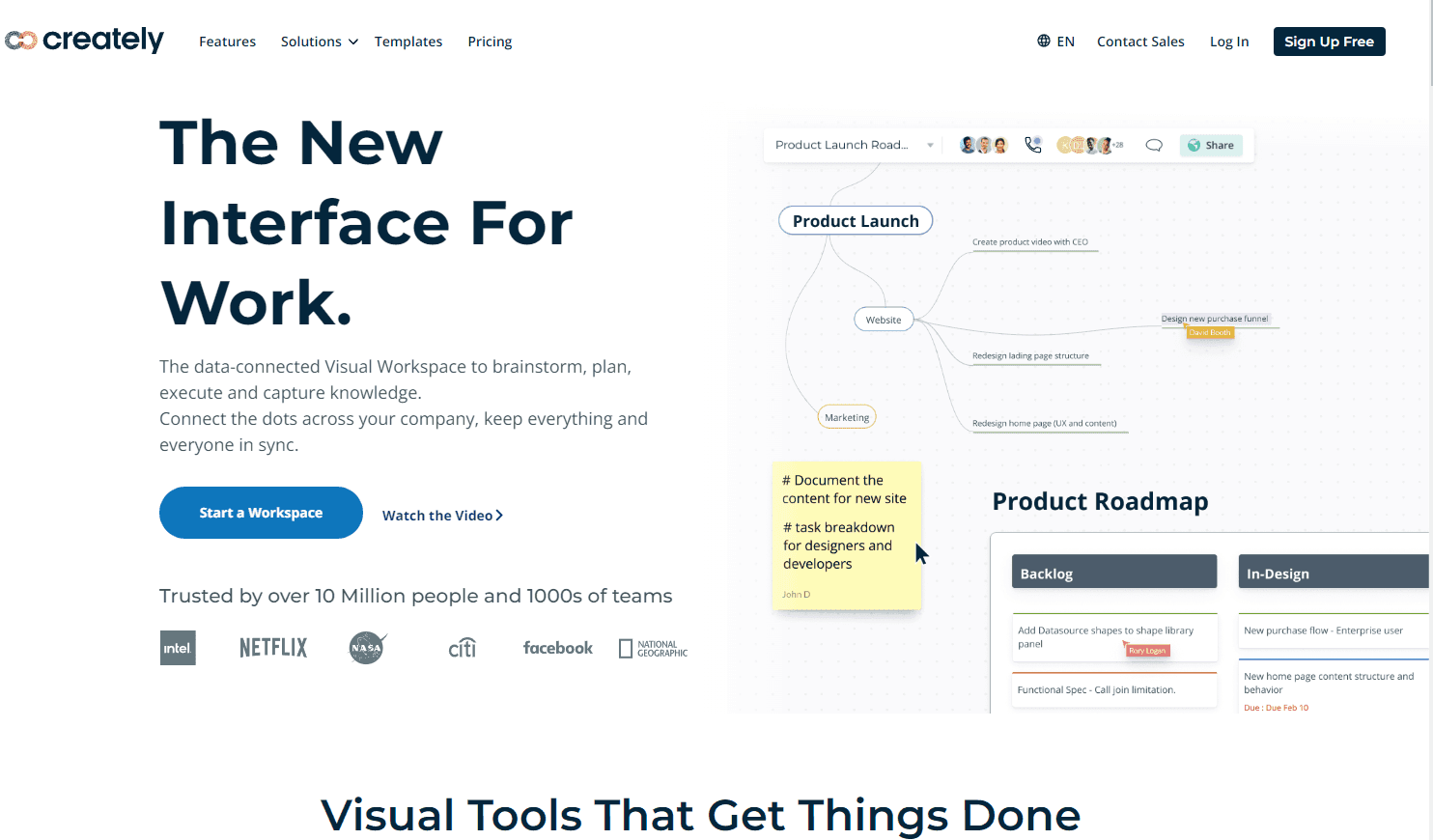
- Creately — Best for teams. AI text-to-genogram inside a full visual-collaboration workspace, with a standards-based clinical symbol library following McGoldrick notation, templates, real-time collaboration, and structured data. Free plan with paid tiers.
- GenoPro — Best for offline depth. Long-running Windows desktop program (since 1998) with medical tagging, GEDCOM, and detailed HTML/PDF/SVG reports. 14-day trial, then perpetual license.
- MyMap.AI — Best free quick drafts. Chat-based generator that builds a genogram from a sentence, no signup required. Free to start; Pro from $20/mo.
Specialized AI Genogram Tools
1. GenogramAI — Best overall for clinical accuracy
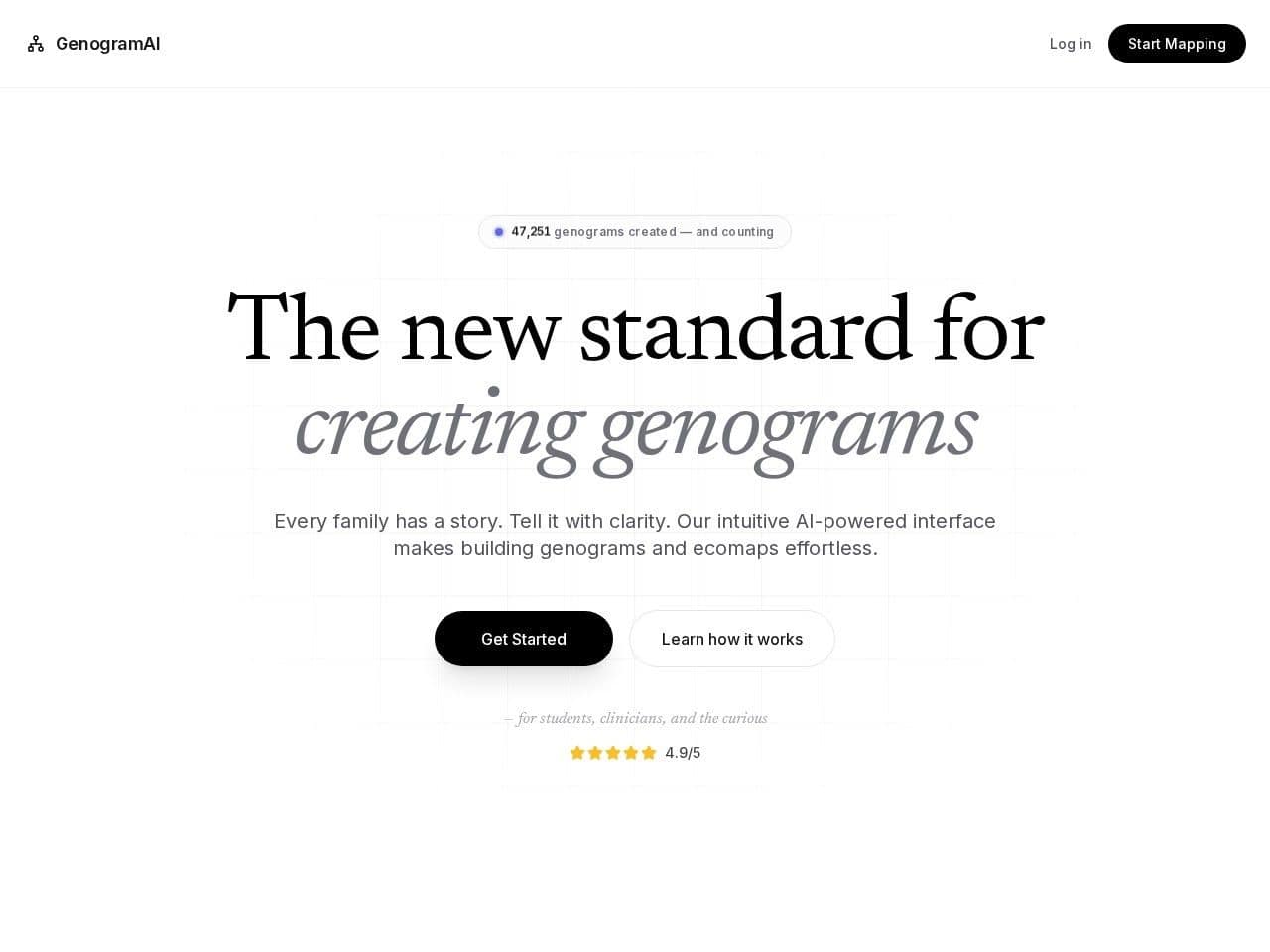
GenogramAI is the only tool in this list built around genogram notation first and AI second. You describe a family in plain language, upload a photo of a hand-drawn chart, or import a GEDCOM file, and it produces a correctly notated genogram on an infinite vector canvas — using the standard clinical symbol set rather than approximating it.
Production credibility: GenogramAI is built on the McGoldrick genogram standard, covering 58 relationship types, 21 medical categories, and 12 cultural-heritage patterns. Its Clinical tier adds AES-256-GCM zero-knowledge encryption and HIPAA-ready data handling, with a Mac and Windows desktop app that runs fully offline for confidential case work.
What it wins at: clinical notation accuracy, AI generation from multiple inputs, and privacy features that matter for real patient or client data.
Where it falls down: it is a focused genogram and ecomap tool, not a general whiteboard — and the free tier caps you at two projects.
Diagramming Platforms With Genogram Support
2. Creately — Best for teams
Creately is a visual-collaboration and diagramming platform that handles genograms as one of many chart types. For teams — clinics, faculty, or research groups mapping families together — its real-time collaboration, template library, and structured data make it the most practical shared workspace of the group. Its AI can turn a text prompt into a first-draft genogram you refine on the canvas.
Production credibility: Creately is a mature, widely deployed diagramming platform used across enterprises and education for flowcharts, org charts, mind maps, and family diagrams, with a built-in library of standard clinical genogram symbols and notation, plus export options, in a single collaborative workspace.
What it wins at: team collaboration, breadth of diagram types, standards-based genogram symbols, and templates that get you started fast.
Where it falls down: genograms are one chart type among many here rather than the whole product, so you do not get the fully offline desktop mode a dedicated genogram app builds in. Creately does maintain HIPAA compliance alongside SOC 2 and ISO 27001, but the Business Associate Agreement that clinical work requires is an enterprise arrangement rather than something included on the free or entry tiers.
Desktop and Free Generators
3. GenoPro — Best for offline depth
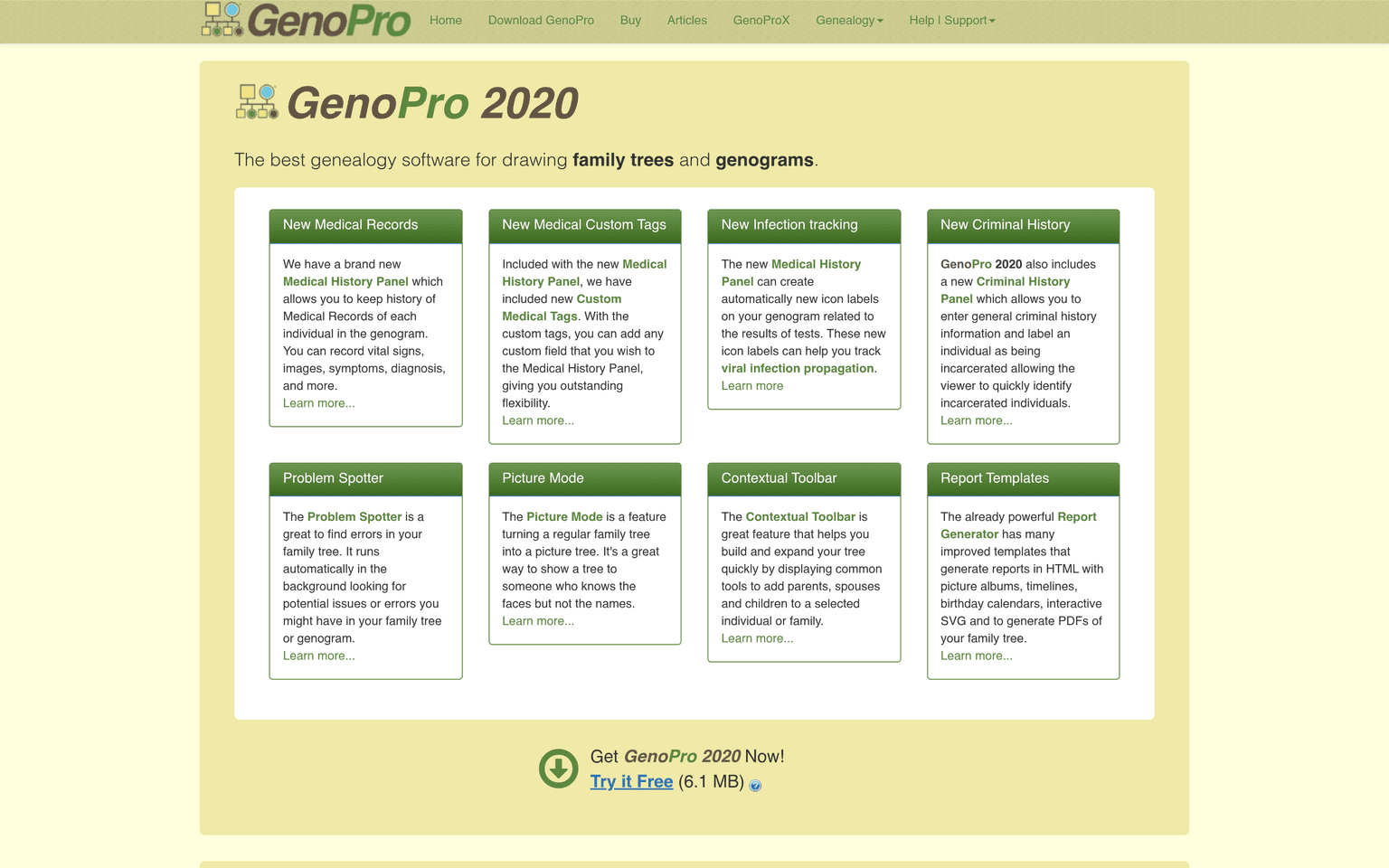
GenoPro is the veteran of the category — a desktop genogram and genealogy program first released in 1998. It scales to thousands of individuals per project, attaches medical records and custom tags to each person, and generates shareable reports in HTML, PDF, and interactive SVG. For genealogists and counselors who want an offline, one-time-purchase tool with deep reporting, it remains a reference point.
Production credibility: created in 1998 by Daniel Morin at the University of Waterloo, GenoPro has more than two decades of releases (GenoPro 2020 desktop, plus the newer GenoProX cloud edition), a Medical Records Panel, Problem Spotter error detection, and GEDCOM interoperability. A perpetual license means you buy once and keep using it.
What it wins at: offline operation, report depth, and permanence — no subscription required for the desktop app.
Where it falls down: the mature desktop app is Windows-only with a steeper learning curve, and it lacks the AI drafting of newer tools (GenoProX narrows that gap).
4. MyMap.AI — Best free quick drafts
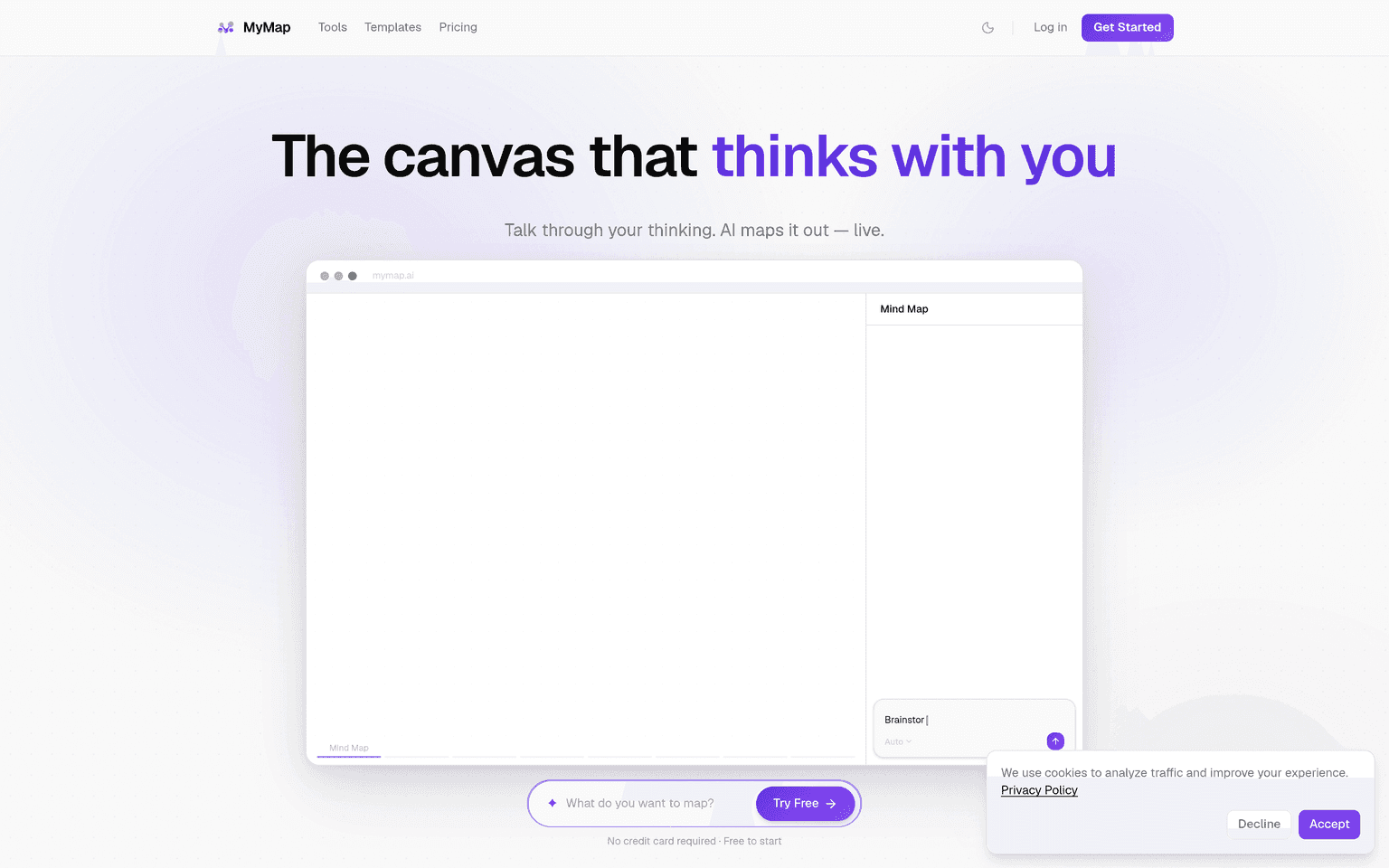
MyMap.AI is a chat-based AI diagram generator that also makes genograms, family trees, mind maps, and flowcharts. Describe the family and relationships in a sentence and it drafts a genogram you refine by chatting — adding people, adjusting layout, and exporting to PNG, JPG, or PDF. There is no signup required to start, which makes it the easiest on-ramp for students and first-time users.
Production credibility: MyMap.AI is a general-purpose AI mapping tool with dedicated genogram, family-tree, and mind-map generators. Free accounts get a monthly allowance of AI messages with no signup; Pro and Team Pro plans add higher limits and collaboration.
What it wins at: speed, a genuine free path, and approachability for non-specialists.
Where it falls down: it trades clinical precision for simplicity — it is not built around the full McGoldrick symbol set, so it is better for coursework and quick drafts than HIPAA-grade clinical work.
How to Choose
- Clinicians and social workers handling real client data: start with GenogramAI for notation accuracy and HIPAA-ready privacy.
- Teams mapping families together (clinics, faculty, research): Creately for collaboration and templates.
- Genealogists and academics who want offline depth and detailed reports: GenoPro.
- Students and first-timers who need a fast, free genogram: MyMap.AI.
A common combination: draft quickly in MyMap.AI, then build the final version in Creately when a team works on it together, or in GenogramAI when the file needs HIPAA-ready handling.
Adjacent Reading
Genograms sit at the intersection of clinical work, education, and wellbeing. If you are mapping families for care or study, see our guides to the leading AI tools in healthcare, the top AI tools every student should use, and the best AI tools for holistic wellness and mental health.
Frequently Asked Questions
What is the difference between a genogram and a family tree? A family tree records who is related to whom. A genogram adds a standardized clinical layer — medical history, emotional relationships, and behavioral patterns across generations — using a specific symbol set. Genograms are used in therapy, medicine, and social work, not just genealogy.
What is the best AI genogram maker in 2026? For clinical accuracy, GenogramAI is our top pick because it is built on the McGoldrick standard with AI generation and HIPAA-ready privacy. For team collaboration, Creately is the strongest choice; for offline depth, GenoPro; and for a fast free draft, MyMap.AI.
Can I make a genogram from a text description? Yes. GenogramAI and MyMap.AI both generate a genogram from a plain-language description, and GenogramAI can also import from an image or a GEDCOM file. You then refine the chart on the canvas.
Is there a free genogram maker? Yes. MyMap.AI lets you create a genogram free with no signup, GenogramAI has a free tier for two projects, and Creately offers a free plan. GenoPro provides a 14-day free trial before its perpetual-license purchase.
Are AI genogram makers HIPAA-compliant? GenogramAI's Clinical tier is HIPAA-ready, with zero-knowledge encryption and an offline desktop mode. General diagramming and free tools are fine for coursework and drafts, but clinicians handling protected health information should use a tool with explicit compliance features.
Which genogram tool is best for teams? Creately, because it is a real-time collaborative workspace with templates, structured data, and export options, so multiple people can build and review the same family diagram together.
Final Thoughts
The genogram category has split into clear lanes. If accuracy and privacy matter — the case for most clinicians — start with GenogramAI. If you are working as a team, Creately is the most practical shared canvas. And if you just need a quick, free draft, MyMap.AI turns a sentence into a chart in seconds. Match the tool to the job and you will spend less time drawing symbols and more time reading the story the genogram tells.
Categories these tools span
More collections you may also like


Sign up for our newsletter
Receive weekly updates so you can stay up-to-date with the world of AI
Sign up for our newsletter
Receive weekly updates so you can stay up-to-date with the world of AI
The AI tools directory for discovering, exploring, and comparing the most innovative AI tools in the industry