Virtue AI
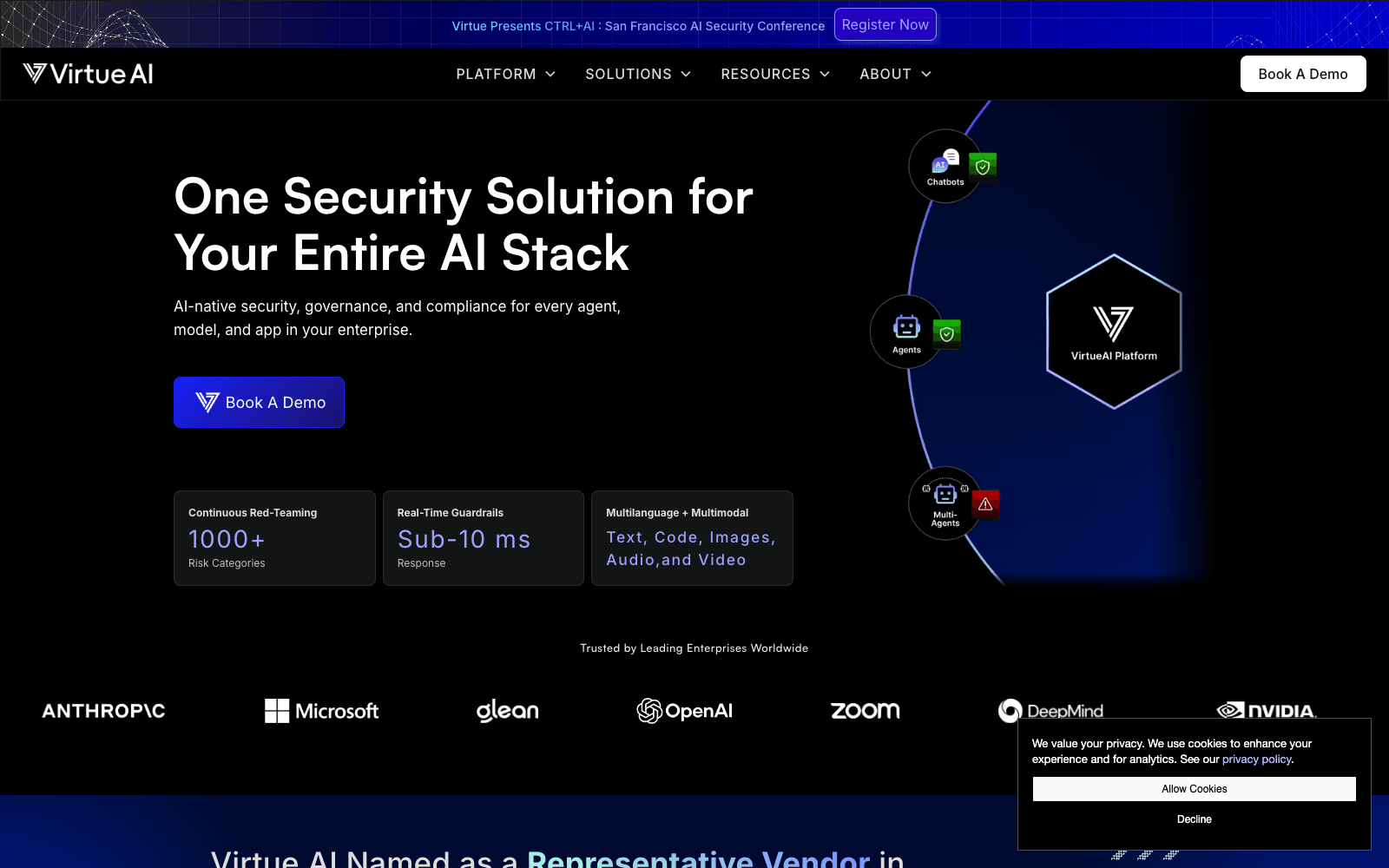
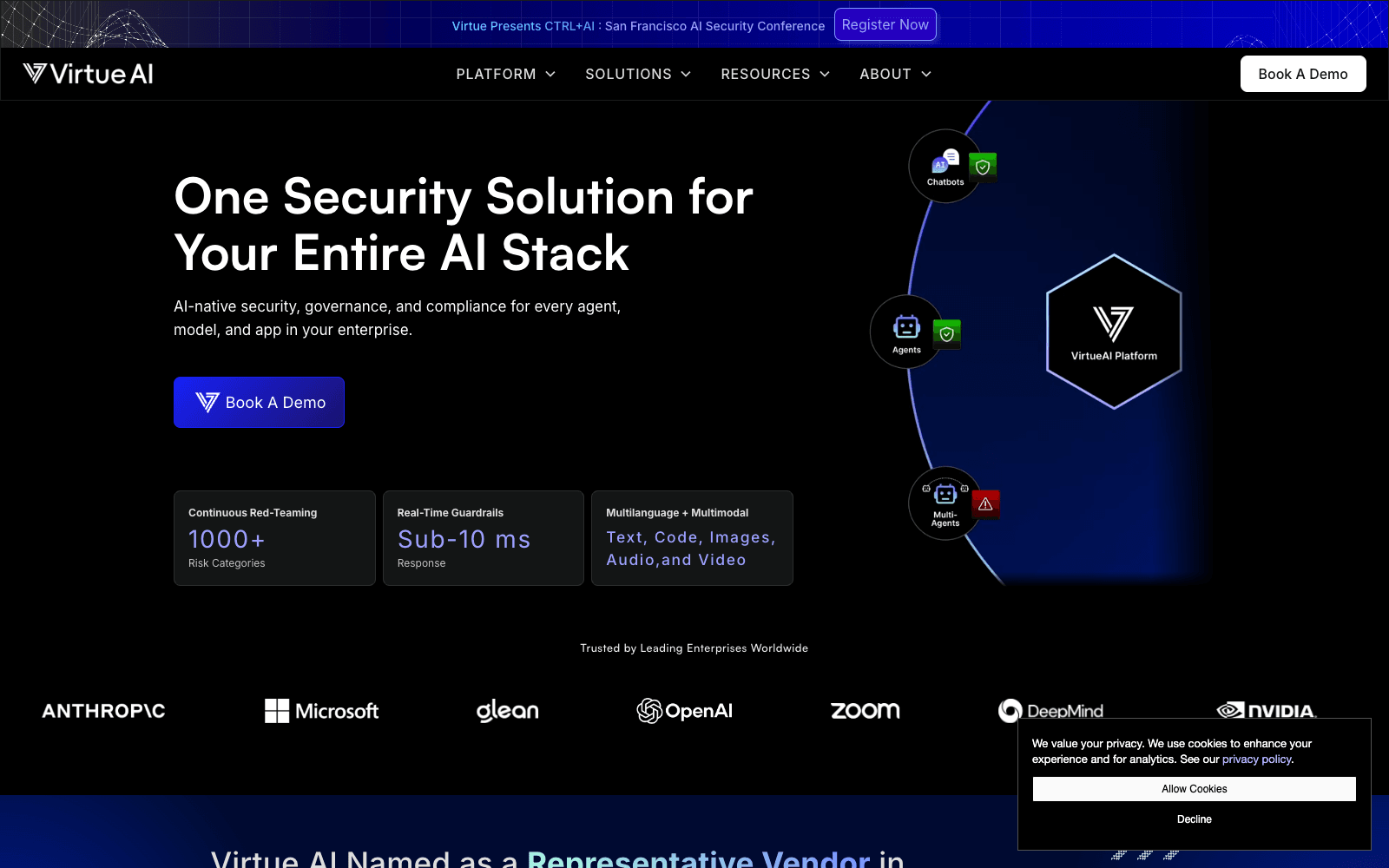
Virtue AI is an AI-native security and compliance platform that red-teams and guards enterprise LLMs, apps, and AI agents.
Acquired Virtue AI
Acquired · August 2026
Virtue AI, the startup building runtime protection and automated red-teaming for AI models, apps and agents, was acquired by Fortinet in a deal announced on August 17, 2026. Terms were not disclosed; Fortinet called the price immaterial. Virtue AI had raised $30 million in 2025. Its technology is being folded into Fortinet's Security for AI portfolio, and virtueai.com now redirects to Fortinet's FortiAIGate product page.
Acquired by Fortinet.
Is Virtue AI shut down?
Effectively, yes. Virtue AI was acquired by Fortinet and the standalone product was sunset on August 17, 2026. Its record is preserved in the ToolDirectory.AI graveyard, our hand-reviewed registry of AI tools that shut down or were acquired.
What to use instead

Cyera
AI-native data security platform for discovery, classification, and protection. Sequoia/Accel-backed unicorn; Forbes AI 50 2026.
Freemium
4.92
503

Mira Network
Decentralized verification network for AI outputs — consensus-based hallucination reduction.
Freemium
4.82
297
Featured

Dataloop
Comprehensive data management engine for AI, specializing in image and video annotation
Freemium
4.77
240
Overview
Virtue AI
Virtue AI is an AI-native security and compliance platform that red-teams and guards enterprise LLMs, applications, and AI agents. Virtue AI pairs VirtueRed, an automated red-teaming engine that probes 1,000+ risk categories, with VirtueGuard, a real-time filter that screens text, code, images, audio, and video in 100+ languages at sub-10ms latency. The company was founded in 2024 by academics who spent decades on AI safety, and it targets teams shipping generative AI who need guardrails without crippling response times. Virtue AI sells to frontier labs and regulated enterprises that have to prove their models behave before and after deployment, not just trust a vendor benchmark.
Production credibility: Founded 2024 by Bo Li (UChicago/UIUC professor, now CEO), Dawn Song (UC Berkeley), Sanmi Koyejo (Stanford), and Carlos Guestrin (Stanford) — a team citing 80+ combined years in AI safety research. Raised $30M across seed and Series A (announced April 2025), co-led by Lightspeed Venture Partners and Walden Catalyst Ventures, with Prosperity7 (Saudi Aramco), Factory, Osage University Partners, plus angels Lip-Bu Tan, Amarjit Gill, and Stanford's Chris Ré; later databases list cumulative funding near $60M. Named customers include several frontier labs, Uber (content-safety guardrails for GenAI apps) and Glean. VirtueGuard models are marketed as up to 30x faster with up to 50% better performance than incumbent guardrails, and VirtueGuard is available in Google Cloud's Vertex AI for in-VPC deployment.
Acquisition note (August 2026): Fortinet acquired Virtue AI in a deal announced on August 17, 2026, for undisclosed terms. Virtue AI's runtime protection and AI validation technology is being combined with FortiAIGate and FortiGuard Labs threat intelligence, and virtueai.com now redirects to Fortinet's FortiAIGate page.
Key Features
- VirtueRed: automated, continuous red-teaming spanning 1,000+ risk categories with 100+ proprietary attack algorithms
- VirtueGuard: real-time guardrails across text, code, image, audio, and video at sub-10ms latency
- Coverage in 100+ languages for multilingual content moderation and safety
- AgentSuite: pre-deployment testing plus runtime action enforcement at prompt, tool/MCP, and network levels
- Policy-to-control mapping that translates regulations and internal policy into enforceable guardrails
- In-VPC deployment via Google Cloud Vertex AI so prompts and data stay in the customer's environment
- Risk reporting that scores models and agents before and after they ship
Ideal Use Case
An enterprise launching a customer-facing GenAI agent uses VirtueRed to surface jailbreaks and policy violations pre-launch, then runs VirtueGuard inline to block unsafe inputs and outputs at runtime.
How Virtue AI differentiates
Virtue AI competes with WitnessAI and Lakera on runtime LLM defense, but leans harder on the research-grade red-teaming side (1,000+ risk categories, 100+ algorithms) than most guardrail-only vendors. Its multimodal coverage — audio, video, and code, not just text — is broader than many rivals that focus on text prompts. Against horizontal governance suites like OneTrust, Virtue AI is narrower: it secures model behavior rather than cataloging org-wide privacy and compliance obligations. The trade-off is that buyers wanting GRC paperwork and data-mapping still need a separate governance tool. As a 2024-founded startup, its track record is shorter than incumbent security platforms.
FAQ
Who owns Virtue AI? Fortinet acquired Virtue AI in August 2026. The standalone Virtue AI site now redirects to Fortinet's FortiAIGate product, which is where its AI security technology now lives.
Q: What does Virtue AI do? A: It provides AI-native security for LLMs and agents through VirtueRed (automated red-teaming across 1,000+ risk categories) and VirtueGuard (real-time multimodal guardrails for text, code, images, audio, and video).
Q: Who founded Virtue AI? A: It was founded in 2024 by AI-safety researchers Bo Li (CEO), Dawn Song, Sanmi Koyejo, and Carlos Guestrin, from UC Berkeley, Stanford, and UChicago/UIUC.
Q: How much has Virtue AI raised? A: Virtue AI announced $30M in seed and Series A funding in April 2025, co-led by Lightspeed Venture Partners and Walden Catalyst Ventures; later databases list cumulative funding near $60M.
Q: Who are Virtue AI's customers? A: Reported customers include several frontier AI labs along with Uber and Glean, which use Virtue AI for content-safety guardrails on their generative AI features.
Q: Virtue AI vs WitnessAI: what's the difference? A: Both secure enterprise LLM use, but Virtue AI emphasizes deep automated red-teaming and multimodal guardrails for models and agents, while WitnessAI focuses on network-level visibility and policy control over how employees use AI apps.
tl;dr
Virtue AI is an AI-native security platform that red-teams and guards enterprise LLMs and agents. Founded in 2024 by Berkeley/Stanford/UIUC AI-safety researchers, it raised $30M (seed + Series A) led by Lightspeed and Walden Catalyst, with customers reported to include frontier labs, Uber, and Glean.
Related
Looking for more options? Browse the Security & Governance directory or read our best AI security tools listicle. Virtue AI is also tracked on Crunchbase.
Why Use Virtue AI