OpenAI Dots
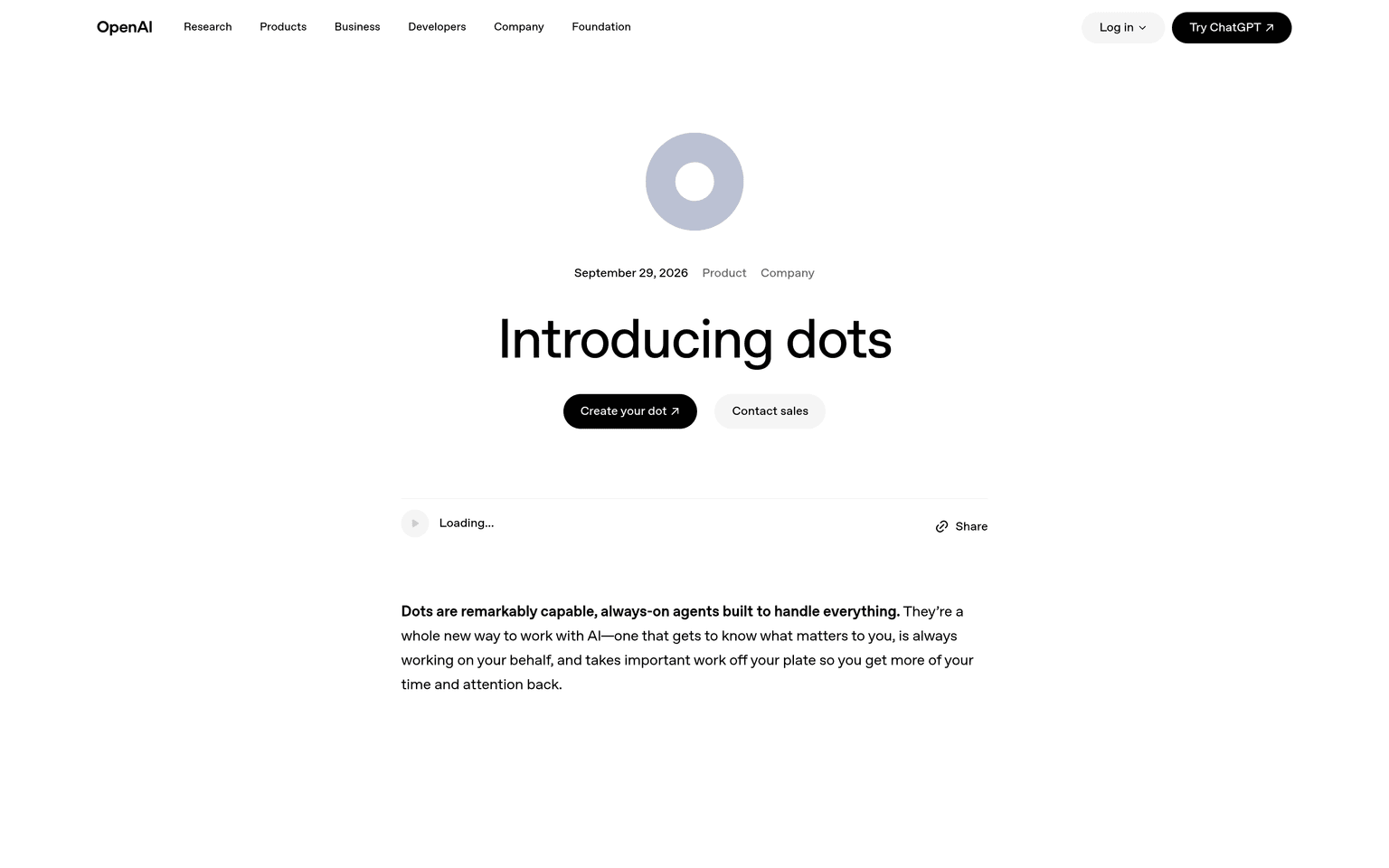
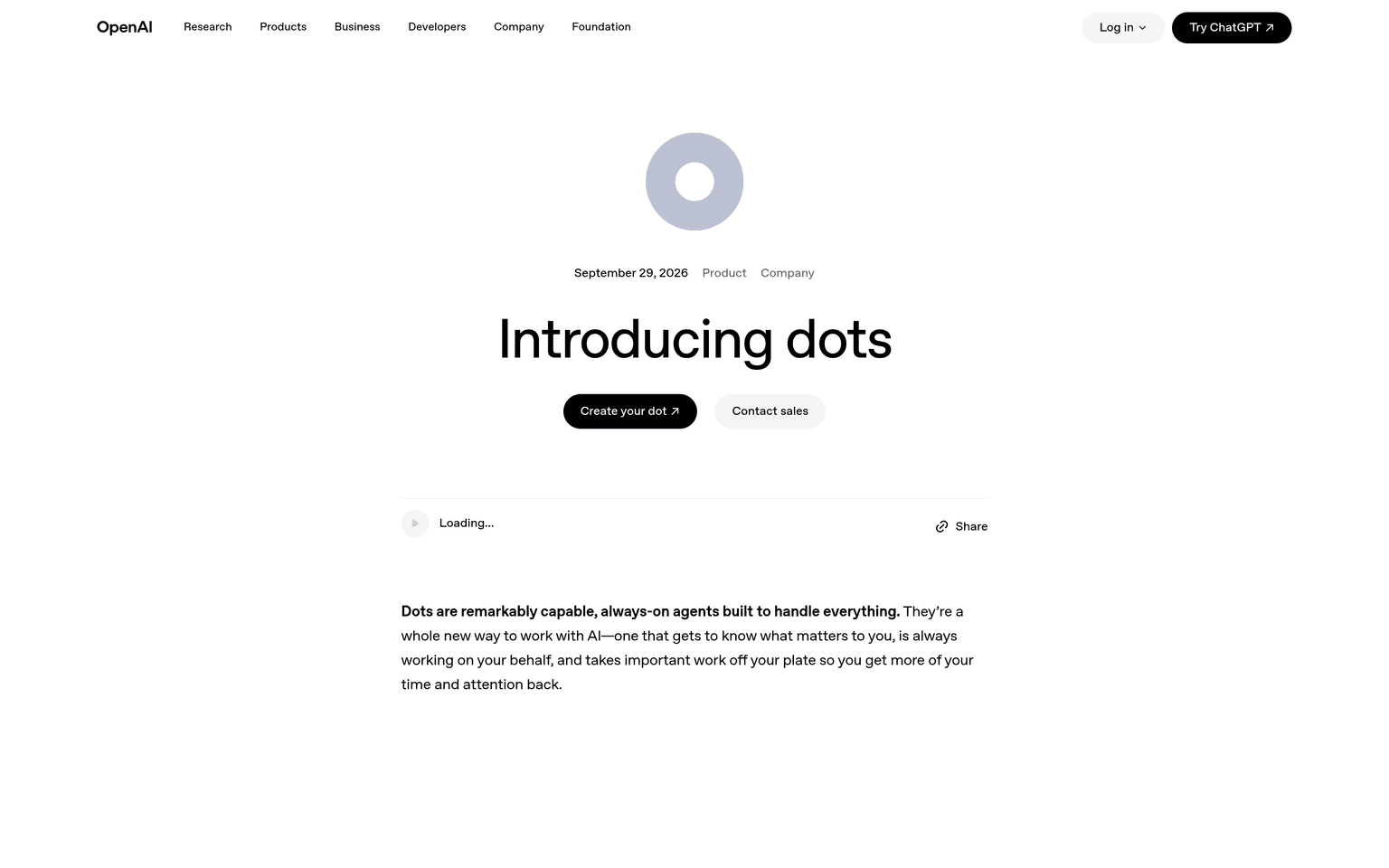
OpenAI Dots are persistent agents inside ChatGPT that keep working between conversations on their own cloud computer.
Overview
OpenAI Dots
OpenAI Dots are persistent agents that keep working on a project after the conversation ends. Dots are not chat sessions: each dot runs on its own cloud computer with a browser, connects to more than 4,000 applications through plugins, and can be reached from ChatGPT, Slack or Microsoft Teams. You set the goal and the boundaries; the dot works out the steps. When idle it runs what OpenAI calls proactive research using read-only tools that cannot send messages, modify content or drive your machine — the design choice that separates a standing agent from a scheduled script.
Production credibility: OpenAI announced dots on 29 September 2026 at DevDay and published the details on its own site. They run on GPT-6 Astra and roll out to Pro, Business Premium and Enterprise plans in eligible markets; Pro access excludes the EEA, Switzerland and the UK, and Enterprise access is a beta an administrator has to switch on. Texting a dot began rolling out to US Pro users on 28 October 2026. OpenAI also previewed specialist dots for organisations with their own identity and access management, and is working with Microsoft to bring them under Agent 365 governance. OpenAI's own caution is worth repeating: dots can still make mistakes, so consequential work needs review.
Key Features
- Persistent agents that continue working between conversations
- A dedicated cloud computer and browser per dot
- Connections to more than 4,000 apps through plugins
- Proactive research while idle, using read-only tools
- Reachable from ChatGPT, Slack and Microsoft Teams
- Sign-in to supported sites with saved passwords, without exposing them to the model
Ideal Use Case
Knowledge work that spans days rather than minutes: a competitive watch that keeps updating, an inbox that gets triaged while you sleep, a research thread that advances on its own. It fits organisations already on a paid ChatGPT plan, and the approval rules make it workable where an unattended agent would otherwise be unacceptable.
How OpenAI Dots differentiates
ChatGPT Agent does a task while you wait. A dot keeps the task. That difference — persistence plus a cloud computer of its own — is what the whole autumn 2026 cohort is competing on, alongside Meta's Muse, xAI's Grok Bot and Anthropic's Claude Duet. OpenAI's edge is distribution and the plugin surface; the constraints are plan-gating, regional exclusions for Pro, and the general caveat that standing agents fail in ways one-shot tasks do not.
FAQ
Q: What are OpenAI Dots? A: Dots are persistent agents in ChatGPT that keep working on a project between conversations. Each runs on its own cloud computer with a browser and can connect to more than 4,000 apps.
Q: Who can use Dots? A: They are available on ChatGPT Pro, Business Premium and Enterprise plans in eligible markets. Pro access excludes the EEA, Switzerland and the UK, and Enterprise access is an admin-enabled beta.
Q: How much do Dots cost? A: There is no separate price. Dots are included with the paid ChatGPT plans that support them.
Q: What can a Dot do without asking? A: Dots start with built-in rules about when to act alone and when to ask. While idle they run proactive research with read-only tools that cannot send messages, change content or control your computer.
Q: Where can I talk to a Dot? A: In ChatGPT, through Slack or Microsoft Teams, and by text message for US Pro users since late October 2026.
tl;dr
OpenAI Dots are persistent ChatGPT agents that keep working between conversations on their own cloud computer, with 4,000-plus app connections and read-only proactive research while idle. Announced 29 September 2026; included with Pro, Business Premium and Enterprise plans in eligible markets.
Why Use OpenAI Dots
User Reviews
Similar Tools