Laminar
Laminar is open-source observability for AI agents: tracing, automatic failure clustering, and evals built from the errors it finds.
Overview
Laminar
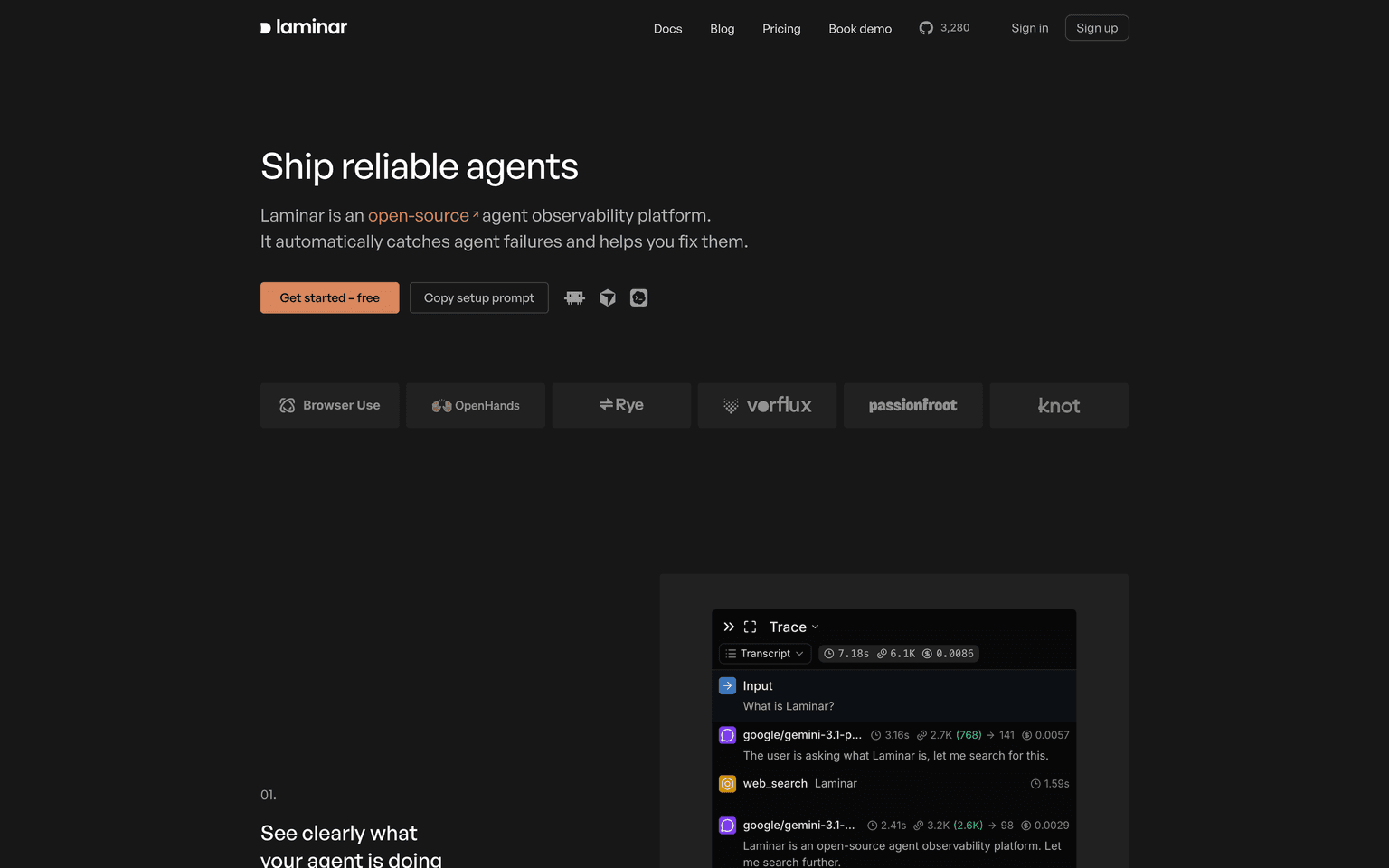
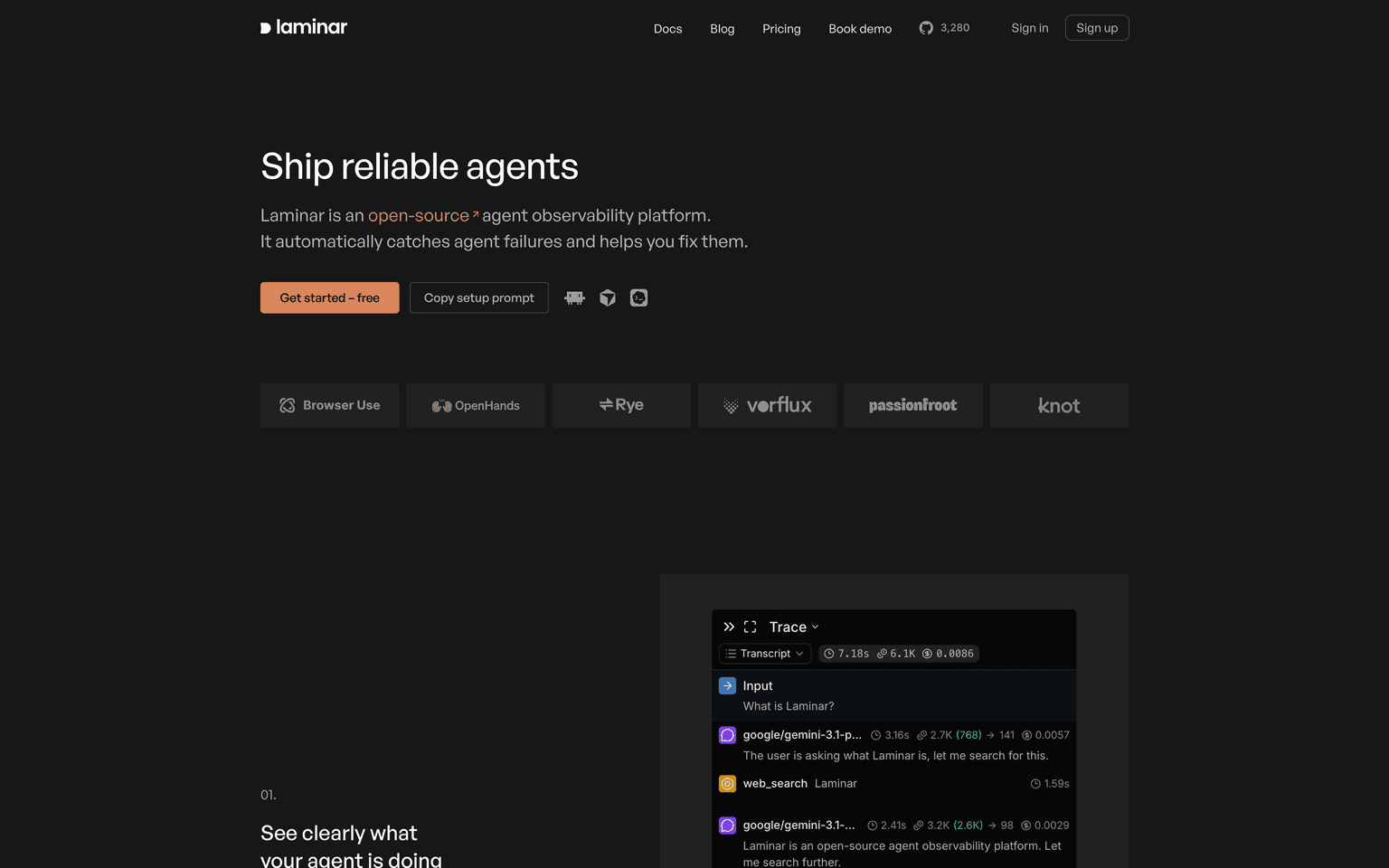
Laminar is open-source observability for AI agents, built around the problem that agent runs fail in ways you did not anticipate. Laminar traces each run — LLM calls, tool calls, sub-agents, tokens and cost — into a readable transcript, then uses what it calls Signals to analyse every run and surface unexpected failure modes, clustering similar failures into distinct patterns so you see the shape of the problem rather than one example. Those clusters convert into evaluation datasets, so the failures you found become the regression tests you run next time.
Production credibility: Laminar is Apache 2.0 licensed and published at github.com/lmnr-ai/lmnr, and it can be self-hosted with Docker or on Kubernetes via Helm charts. The hosted service starts free, and the company documents enterprise requirements including SOC 2 Type II and HIPAA. The site now serves from laminar.sh, with the older lmnr.ai domain redirecting, so both links reach the same product.
Key Features
- Automatic tracing of LLM calls, tool calls, sub-agents, tokens and cost
- Readable transcript view of what an agent actually did
- Signals that cluster unexpected failures into distinct patterns
- Evaluation datasets generated from those failure clusters
- Self-hosting via Docker or Kubernetes with Helm
- Apache 2.0 licence with a free hosted tier
Ideal Use Case
Teams running agents in production who can see that something is going wrong but cannot say what, how often, or whether last week's fix helped. The failure clustering earns its place once run volume is past the point where reading traces by hand works, and the Apache licence suits organisations that need to self-host rather than ship traces to a vendor.
How Laminar differentiates
Langfuse, LangSmith, Braintrust and Helicone all trace and evaluate; the crowded part of the market is the dashboard. Laminar's distinguishing move is going from traces to failure clusters to eval datasets automatically, so the loop from noticing a problem to testing for it is one product rather than three steps of manual work. It is also younger than the incumbents, so the integration surface is narrower — worth checking your framework is covered before committing.
FAQ
Q: What is Laminar? A: Laminar is an open-source observability platform for AI agents. It traces runs, clusters unexpected failures into patterns using Signals, and turns those clusters into evaluation datasets.
Q: Is Laminar open source? A: Yes. Laminar is Apache 2.0 licensed at github.com/lmnr-ai/lmnr, and can be self-hosted with Docker or on Kubernetes with Helm charts.
Q: How much does Laminar cost? A: The hosted service has a free tier to get started, with paid plans above it. Self-hosting the open-source version carries no licence cost.
Q: What are Signals in Laminar? A: Signals analyse every agent run to surface failure modes you did not define in advance, then group similar failures into distinct clusters so you can see patterns rather than single incidents.
Q: How does Laminar differ from Langfuse? A: Both trace and evaluate LLM applications. Laminar's emphasis is the automatic path from traces to clustered failures to eval datasets, closing the loop between finding a problem and testing for it.
tl;dr
Laminar is open-source agent observability: tracing of LLM and tool calls, Signals that cluster unexpected failures into patterns, and eval datasets generated from those clusters. Apache 2.0, self-hostable, with a free hosted tier.
Key Features
Why Use Laminar
User Reviews
Similar Tools