Distributional
Distributional is an enterprise AI testing platform that statistically detects drift and regressions in agents and LLM applications before they hit product
Overview
Distributional
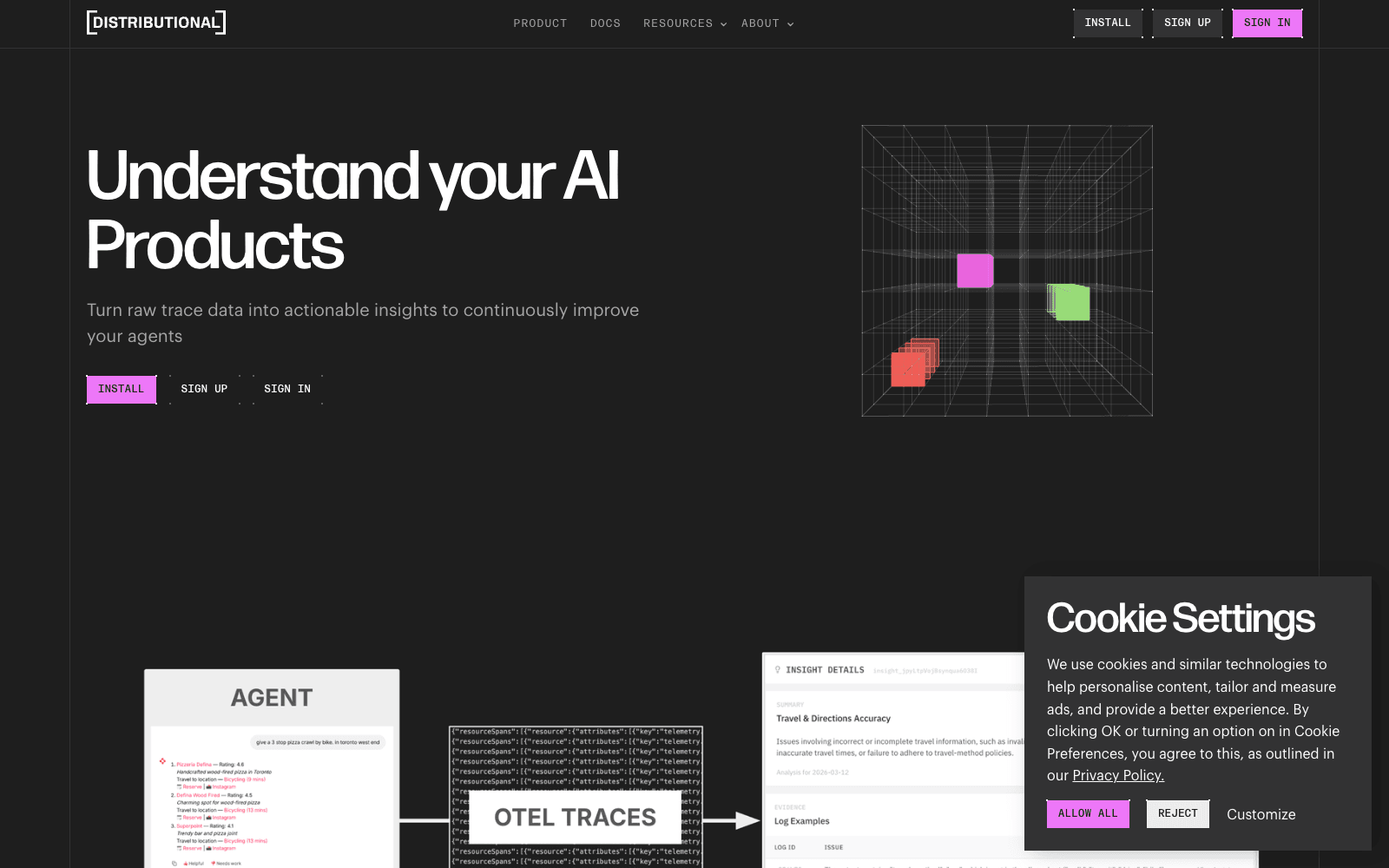
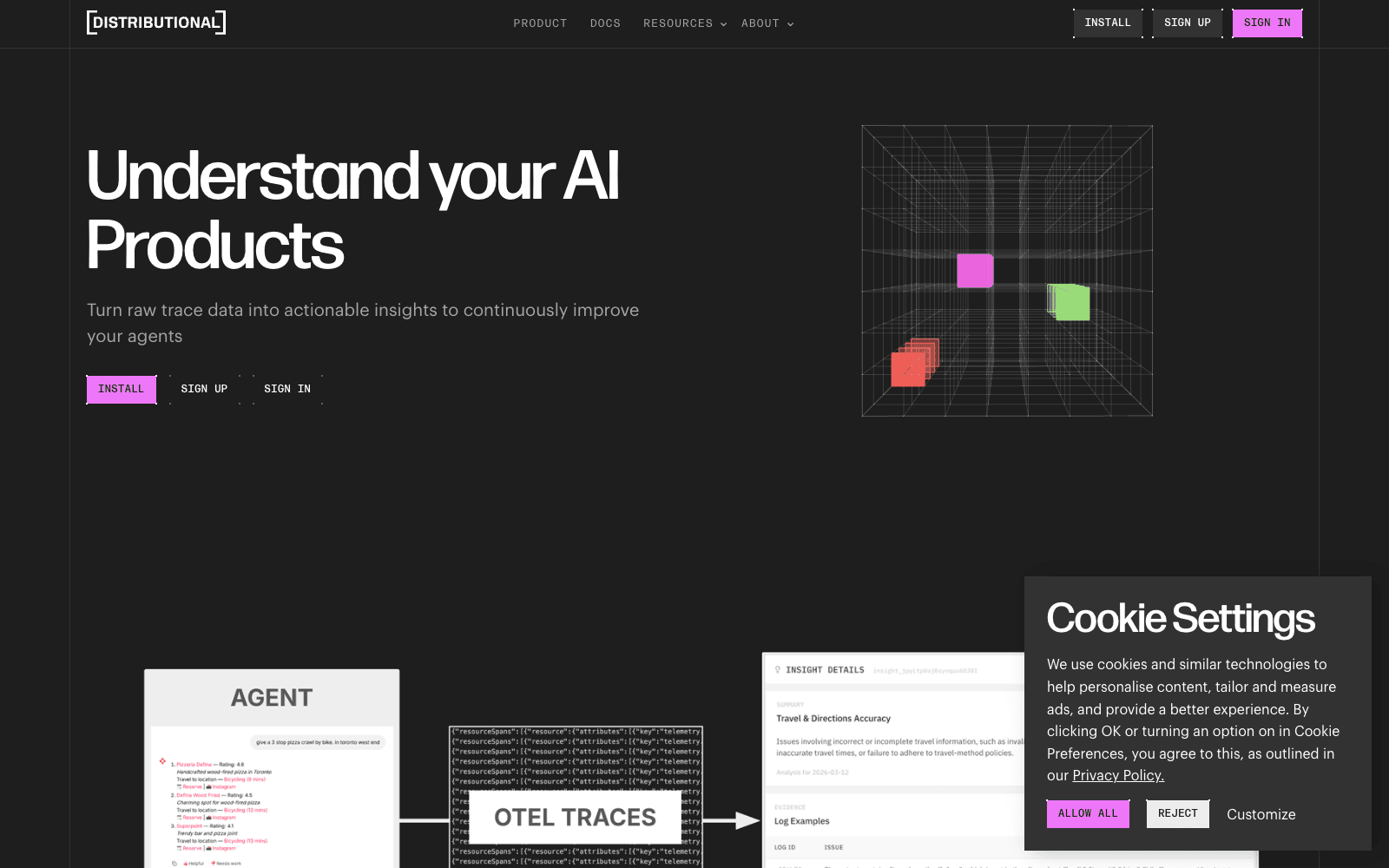
Distributional is an enterprise AI testing platform that detects when AI agents and LLM applications start behaving differently before that drift reaches production. Rather than scoring single outputs, Distributional enriches your production trace data and runs adaptive, statistical analysis across it, clustering, anomaly detection, and change detection, to surface behavioral shifts that aggregate metrics hide. Founded in 2023 by Scott Clark, who previously built and sold SigOpt to Intel, Distributional treats non-deterministic AI as a testing problem: the same prompt can return different answers, so you test the distribution of behavior, not a fixed expected value. The result is continuous, automated regression testing for AI products.
Production credibility: Founded in September 2023 and based in Berkeley, California, by Scott Clark (CEO), former VP/GM of Intel's AI and supercomputing software group and co-founder of SigOpt, the model-optimization company Intel acquired in 2020. Distributional raised a $19M Series A in October 2024 led by Two Sigma Ventures, bringing total funding to approximately $30M in under a year; backers include Andreessen Horowitz, Operator Collective, SV Angel, Oregon Venture Fund, Essence VC, and Alumni Ventures. The founding team draws on AI experience from Bloomberg, Google, Intel, Meta, SigOpt, Slack, Stripe, Uber, and Yelp, and the product launched as an enterprise AI testing platform with adaptive statistical methods.
Key Features
- Enriches raw production trace data to expose hidden behavioral signals in AI logs
- Adaptive, statistical testing of behavior distributions rather than single expected outputs
- Unsupervised analysis including clustering, anomaly detection, and change detection
- Similarity Index for adaptive testing that adjusts as production data evolves
- Continuous regression and drift detection for agents and LLM applications
- Test repositories and dashboards to organize, track, and share results
- Integrations with alerting and database tooling for production workflows
- Purpose-built for non-deterministic generative and agentic systems, not tabular model drift
Ideal Use Case
Enterprise AI and platform teams use Distributional to continuously test agents and LLM applications against their own production behavior, catching regressions and unexpected drift before customers are affected.
How Distributional differentiates
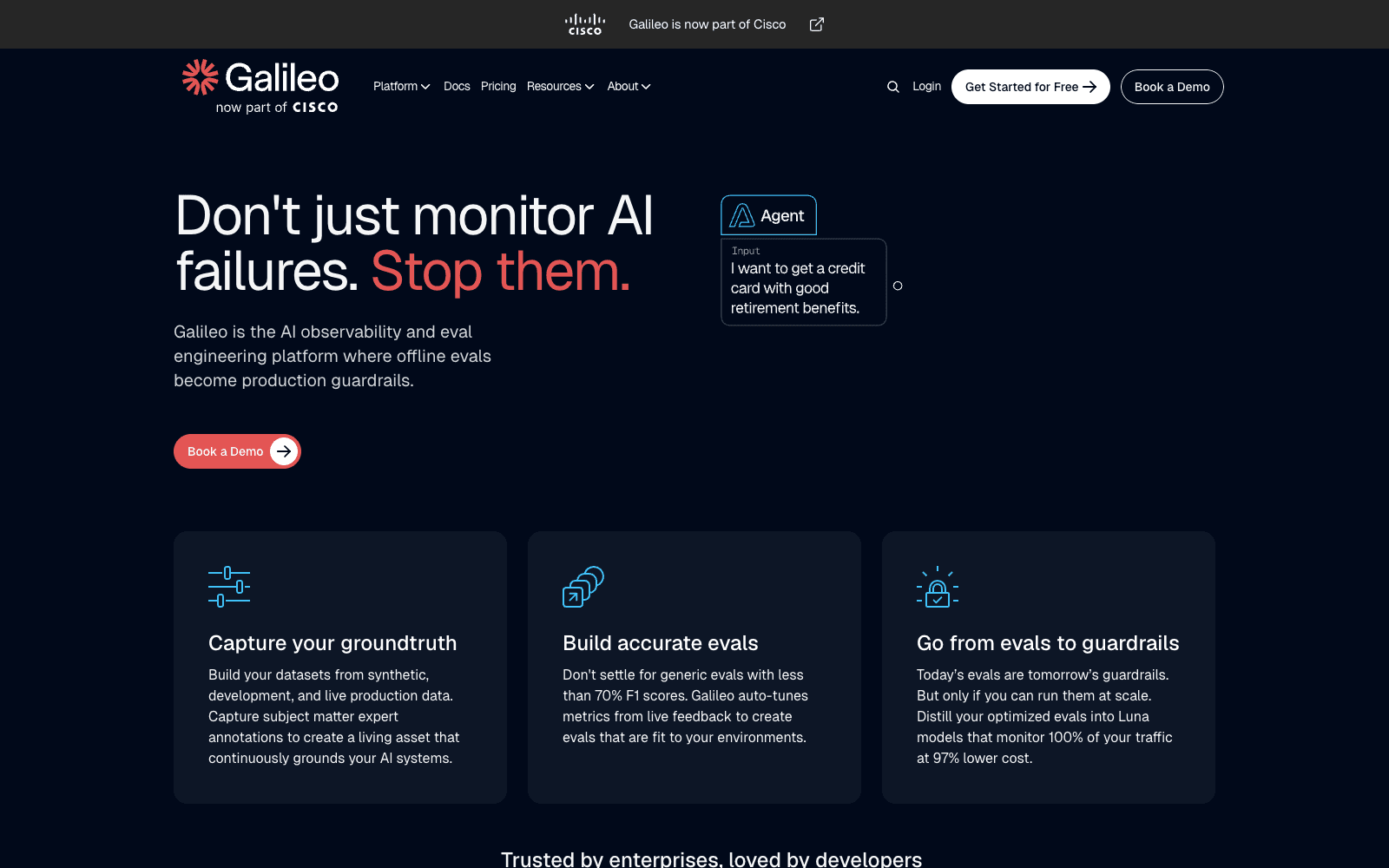
Tools like Galileo, Arize Phoenix, and LangSmith mostly score individual outputs or traces against expected answers or LLM-judge rubrics. Distributional instead tests the statistical distribution of behavior across many production runs, which fits non-deterministic agents where there is no single correct output. Against general ML observability platforms such as Arize and WhyLabs, Distributional is purpose-built for generative and agentic systems rather than tabular model drift. The trade-off: its adaptive, statistics-first approach is aimed at enterprise teams with real production traffic, so very early prototypes may get more value from a lightweight eval tool first.
FAQ
Q: What does Distributional do? A: Distributional is an enterprise AI testing platform. It enriches production trace data and runs adaptive statistical analysis, clustering, anomaly detection, and change detection, to catch when AI agents and LLM apps drift or regress before issues reach users.
Q: Who founded Distributional? A: Distributional was founded in 2023 by Scott Clark, who earlier co-founded SigOpt (acquired by Intel in 2020) and served as a VP/GM in Intel's AI software group. The founding team includes engineers with experience across Bloomberg, Google, Meta, Stripe, and Uber.
Q: How much funding has Distributional raised? A: Distributional has raised about $30M total, including a $19M Series A in October 2024 led by Two Sigma Ventures, with Andreessen Horowitz, Operator Collective, SV Angel, and others participating, all within roughly a year of incorporation.
Q: Distributional vs Galileo: what's the difference? A: Galileo focuses on evaluating and monitoring individual outputs and traces with research-backed metrics and guardrails. Distributional focuses on statistical, distribution-level testing of how an AI system behaves across many production runs, which suits teams worried about subtle drift in non-deterministic agents.
Q: What kinds of AI systems is Distributional built for? A: It is built for non-deterministic generative AI and agentic applications running in production, where the same input can yield different outputs, rather than for traditional tabular ML model monitoring.
tl;dr
Distributional is an enterprise AI testing platform that uses adaptive, statistical analysis of production traces to catch behavioral drift and regressions in agents and LLM apps. Founded by SigOpt's Scott Clark, it has raised about $30M (including a $19M Series A led by Two Sigma Ventures) and targets enterprises running AI in production.
Related
Looking for more options? Browse the Developer Tools directory or read our best AI coding tools listicle. Distributional is also tracked on Crunchbase.
Why Use Distributional
User Reviews
Similar Tools