Charlie Labs
Charlie Labs runs daemons: standing agents that triage issues, update dependencies and keep docs current across GitHub and Linear without prompts.
Overview
Charlie Labs
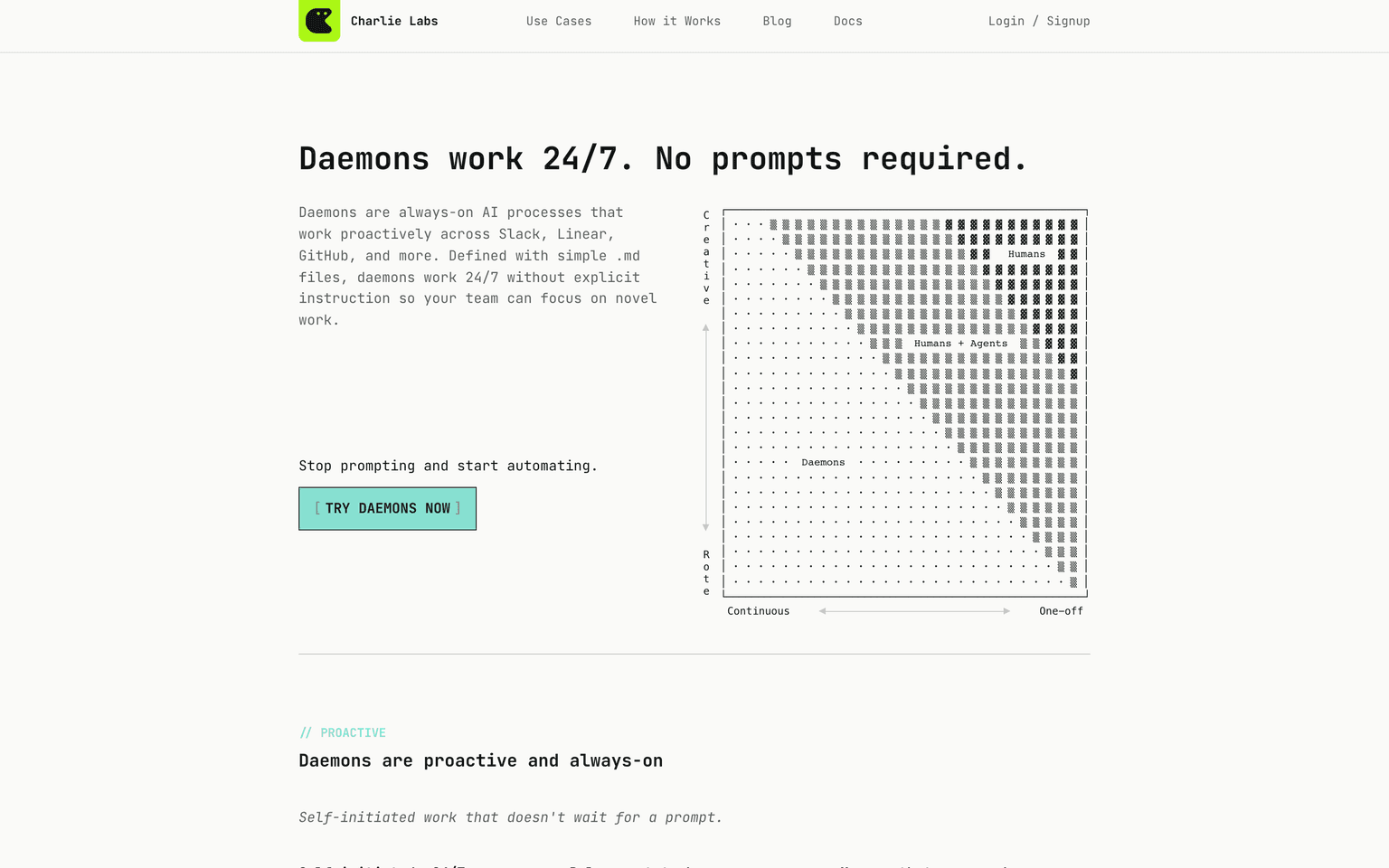
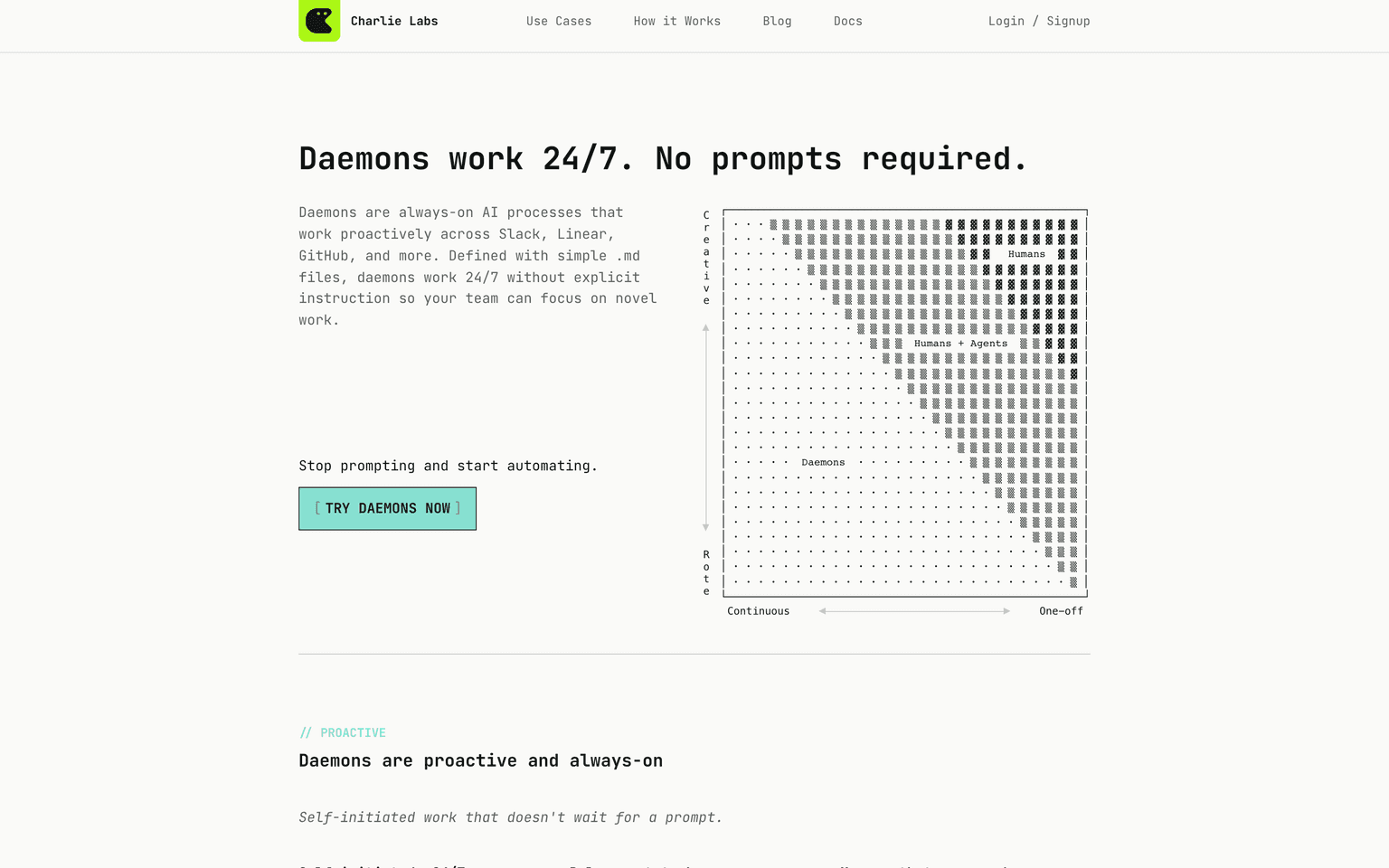
Charlie Labs builds daemons — standing agents that do recurring engineering maintenance without being asked each time. Charlie Labs configures them from Markdown files kept in the repository, and they fire on events such as a pull request opening or an issue being created, plus scheduled sweeps that look for drift. The work they take on is the housekeeping that accumulates: bug triage, dependency updates, documentation that no longer matches the code, and preparing pull requests for review. Output arrives as PRs, updates or escalations in the tools the team already uses.
Production credibility: Charlie Labs publishes its daemons product at charlielabs.ai with a dashboard at dash.charlielabs.ai, maintains a GitHub organisation, and posts as @charliehelps. The product is prompt-free by design: configuration lives in Markdown in your repository, and the triggers are documented as event-based, scheduled, or cross-system. Pricing is not published on the site, so cost comes through signup or a conversation rather than a public plan table.
Key Features
- Daemons that run continuously rather than waiting for a prompt
- Configuration as Markdown files committed to your repository
- Event triggers on pull requests, issues and merges
- Scheduled sweeps that catch drift and missed items
- Cross-system awareness across GitHub and Linear signals
- Output as pull requests, updates or escalations in existing tools
Ideal Use Case
Teams whose backlog is full of maintenance nobody schedules: stale dependencies, untriaged bugs, documentation lagging behind the code, and pull requests waiting on a first pass. It suits repositories already wired to GitHub and Linear, where the daemon can read the same signals a maintainer would.
How Charlie Labs differentiates
Most coding agents are invoked: you open a session, describe a task, and review the result. Charlie's daemons are standing processes with their own triggers, so the unit of work is a policy rather than a prompt. That makes it complementary to Claude Code or Cursor rather than a replacement — those write the feature, the daemons keep the repository tidy around it. The main unknown for buyers is commercial: with no published pricing, cost has to be established directly.
FAQ
Q: What is Charlie Labs? A: Charlie Labs builds daemons: autonomous agents that handle recurring engineering maintenance such as bug triage, dependency updates and documentation upkeep across GitHub and Linear, without being prompted each time.
Q: How are Charlie daemons configured? A: Through Markdown files committed to your repository. The configuration is reviewable and version controlled alongside the code it governs.
Q: What triggers a daemon? A: Repository events such as a pull request opening, an issue being created or code merging, plus scheduled sweeps that check for drift or missed items.
Q: How much does Charlie Labs cost? A: Pricing is not published on the site. Access starts through the dashboard at dash.charlielabs.ai, so cost is established directly with the company.
Q: Does Charlie replace a coding agent like Claude Code? A: No. Charlie is aimed at standing maintenance work rather than interactive feature development, so most teams run it alongside an interactive agent rather than instead of one.
tl;dr
Charlie Labs runs daemons — standing agents configured in Markdown that triage issues, update dependencies and maintain docs across GitHub and Linear on events and schedules, returning pull requests. Pricing is not published.
Why Use Charlie Labs
User Reviews
Similar Tools