World Labs
Fei-Fei Li's spatial-intelligence company. Marble — World Labs' first commercial product — generates persistent, editable 3D worlds from text, photos, video.
Overview
World Labs: Spatial Intelligence (Marble)
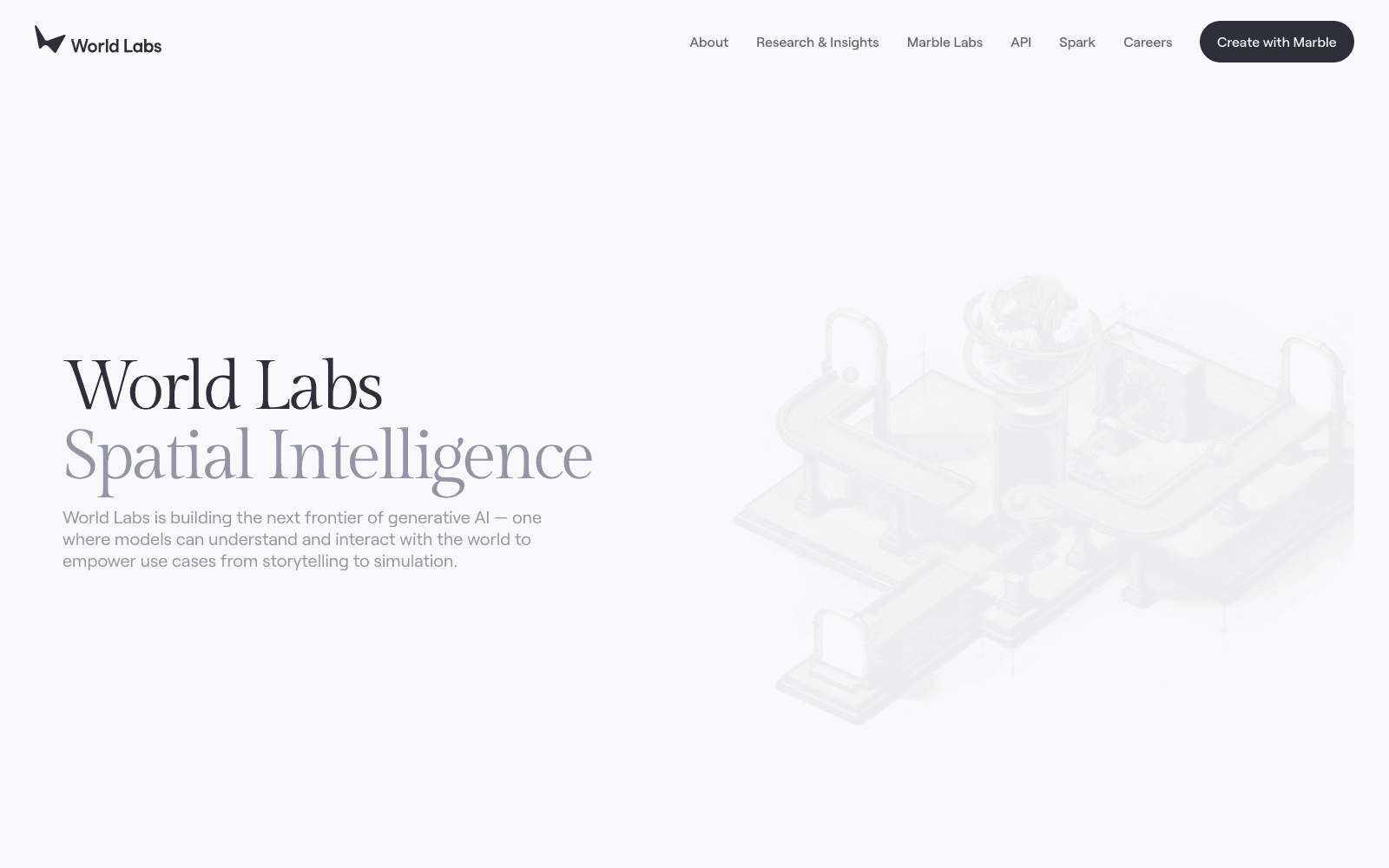
World Labs is the AI company founded by Fei-Fei Li (the "godmother of AI" who created ImageNet) with Justin Johnson, Christoph Lassner, and Ben Mildenhall — the team building world models that develop physics-based understanding of real environments. Marble, World Labs' first commercial product, generates spatially-consistent, high-fidelity, persistent 3D worlds from text prompts, photos, video, 3D layouts, or panoramas.
Marble launched November 2025 with freemium and paid tiers, and represents the most concrete commercial entry yet in the "world models" race that's parallel to (but increasingly distinct from) the LLM frontier.
Key Features
- Marble — generate 3D worlds from text, photos, video, panoramas
- Spatially-consistent, persistent environments you can move through
- Editable and downloadable for use in games, VR, simulations
- Freemium tier with paid plans for higher fidelity and ownership rights
- Founded by Fei-Fei Li and team behind ImageNet, NeRF, NeuralRecon
Ideal Use Case
Game developers prototyping levels, filmmakers visualizing locations, architects exploring spaces, VR/AR creators building immersive experiences, and ML researchers studying spatial intelligence.
Why Use World Labs / Marble
LLMs handle text reasoning; image and video models handle visuals. Marble handles 3D space — the missing modality for embodied AI, robotics simulation, and next-generation creative tools. World Labs's pedigree (Fei-Fei Li + co-creators of NeRF) is the strongest possible signal in this space.
FAQ
What does World Labs create? World Labs is a spatial-intelligence company that builds tools for generating 3D worlds. Its first product, Marble, takes text, photos, or video as input and creates persistent, editable 3D environments from that content.
Who should use World Labs' products? Marble is designed for creators, developers, and designers who need to generate and customize 3D worlds quickly without building from scratch. It works well for game development, architectural visualization, and any project requiring editable 3D environments.
What pricing options does World Labs offer? World Labs uses a freemium model with both free and paid tiers available. Visit the World Labs pricing page for current plans and to see which tier matches your needs.
How does World Labs compare to other AI tools? World Labs focuses specifically on spatial intelligence and 3D world generation, whereas tools like Claude emphasize conversational AI and text. If your project centers on creating interactive, editable 3D spaces from multimedia inputs, Marble offers specialized capabilities built for that purpose.
tl;dr
Fei-Fei Li's spatial-intelligence company. Marble generates 3D worlds from prompts, photos, video. The world models race's most credible entry.
Related
Looking for more options? Browse the AI/ML Models directory or read our best AI models listicle. World Labs is also tracked on Crunchbase.
Why Use World Labs
Editorial Review
Our take on World Labs.

Marble turns sketches and photos into editable 3D worlds, but you're paying for a moonshot that's still finding its footing.
What works
- Generates editable 3D environments, not static images
- Low barrier to entry with free tier
- Genuinely novel spatial-AI approach
What doesn't
- Coherence breaks down on large or complex edits
- Steep learning curve relative to image-gen tools
World Labs is Fei-Fei Li's bet on spatial intelligence—the idea that AI should understand and generate 3D space the way humans navigate it. Marble, their first product, does something genuinely novel: it builds persistent, editable 3D environments from text prompts, photos, or video. The output isn't a static render; it's a world you can walk through, modify, and layer with new elements. For creators working in game design, architecture visualization, or immersive storytelling, that's a meaningful departure from image-gen tools that spit out flat pictures.
The catch is that spatial generation is still brittle. Coherence degrades as you push environments outward or try complex edits. The interface requires learning a new mental model—neither quite 3D modeling software nor image tools. The freemium structure lets you test without friction, though serious use will require paid tiers.
Worth exploring if you're building worlds and don't mind rougher edges. Not ready to replace traditional 3D pipelines, but genuinely useful for rapid iteration and prototyping.
User Reviews
Similar Tools