Moonlake AI
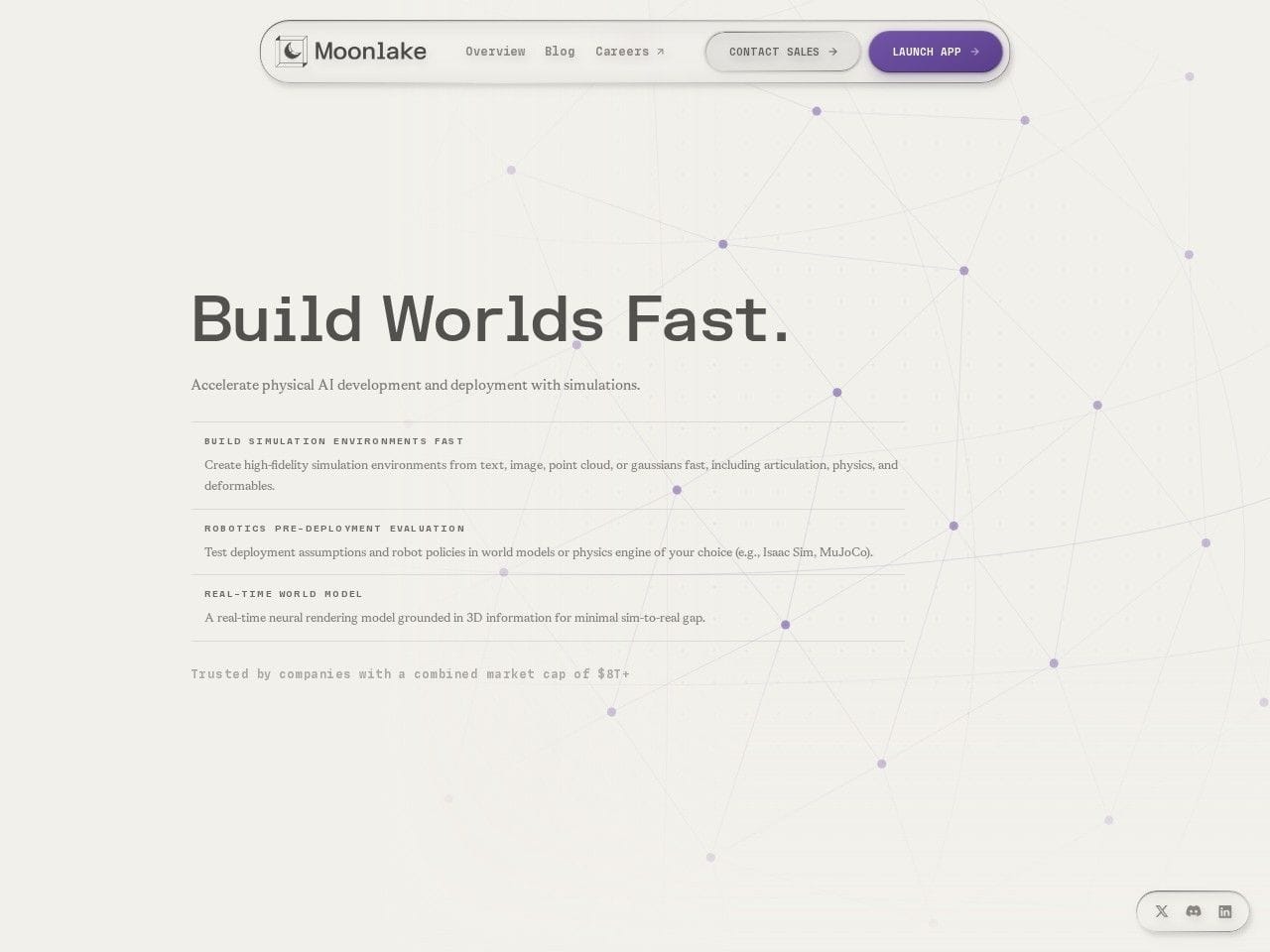
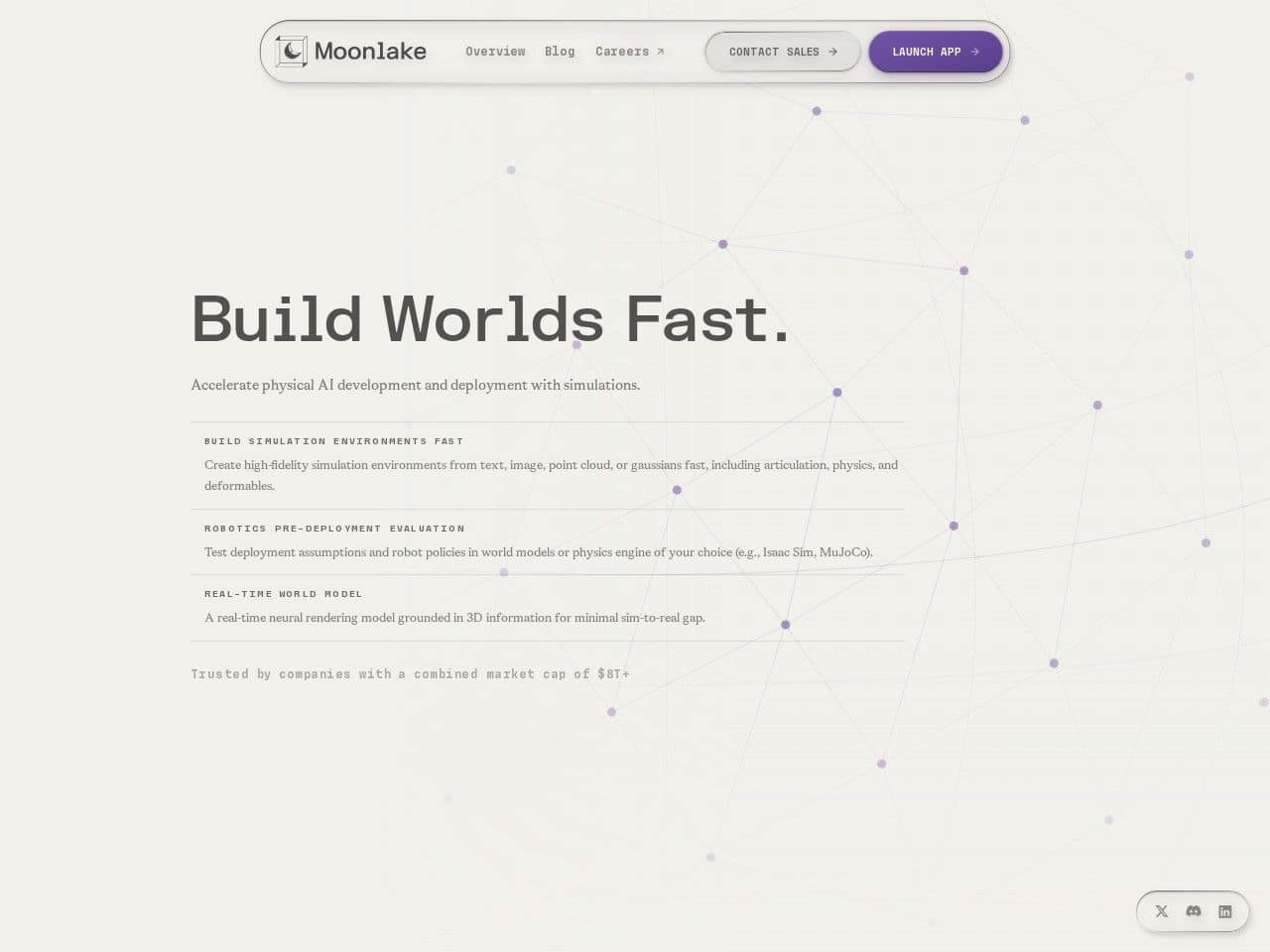
World-model agent that builds physics-validated 3D scenes and articulated assets inside Blender.
Overview
Moonlake AI: A world-model agent that builds physics-validated 3D scenes in Blender
Moonlake AI is a San Francisco research lab focused on world modeling, and its 3D Agent brings computer-use capabilities to 3D content work by operating directly inside Blender. Give it a prompt, an image, a point cloud, CAD data, a scan, or a floor plan, and the agent builds and reconstructs editable scenes with hundreds of objects, models individual assets, and creates articulated objects such as hinged doors, refrigerators, and filing cabinets. Instead of one-shot generation, it works like a technical artist: iterating over long-horizon trajectories, inspecting its own output, and refining until the scene holds up.
What separates Moonlake from generative 3D endpoints is verification. Built-in physics validation loops check geometry, structural validity, articulation, deformation, friction, mass, constraints, and collision, with code-based structural checks and automatic repair. The output is SimReady: scenes and assets prepared for downstream simulation, with cloud integrations for NVIDIA Isaac Sim and MuJoCo so robotics teams can evaluate policies before deployment. Access today runs through a waitlist and contact-sales motion, following an earlier open beta that drew a 10,000-person waitlist.
Key Features
- 3D Agent with computer-use capabilities that acts directly inside Blender while preserving fine-grained editability
- Scene and asset generation from multimodal input: text, images, point clouds, Gaussians, CAD files, scans, and floor plans
- Physics validation loops covering geometry, articulation, friction, mass, constraints, and collision, with automatic repair
- Articulated asset creation (doors, appliances, cabinets) for interactive simulation environments
- SimReady, USD-compatible output with cloud integrations for NVIDIA Isaac Sim and MuJoCo
- Automated cleanup passes: naming, object states, camera framing, material consistency, and export readiness
Ideal Use Case
Moonlake fits robotics and physical-AI teams that need large volumes of physics-valid simulation environments, digital-factory operators turning scans into working digital twins, and game or media teams that want editable 3D worlds assembled at agent speed rather than by hand.
How Moonlake AI differentiates
Moonlake emerged from stealth in October 2025 with a $28M seed round from Threshold Ventures, AIX Ventures, and NVentures (NVIDIA's venture arm), joined by angels including Jeff Dean, Ian Goodfellow, Naval Ravikant, YouTube co-founder Steve Chen, and Vercel's Guillermo Rauch. Founders Fan-Yun Sun (Stanford CS PhD, ex-NVIDIA research) and Sharon Lee (Stanford AI Lab) build around control and verification: the agent validates physics rather than just producing plausible-looking geometry. Its beta waitlist passed 10,000 users, including developers from Microsoft, NVIDIA, Sony, Google, and EA, with coverage in Forbes and DigiTimes.
FAQ
Does Moonlake replace Blender? No. The agent operates inside Blender, so everything it builds stays editable with standard tooling. What inputs does it accept? Text prompts, images, point clouds, Gaussians, CAD files, scans, walkthrough videos, and floor plans. Is the output usable for robotics simulation? Yes. Scenes are physics-validated and SimReady, with integrations for NVIDIA Isaac Sim and MuJoCo. How do I get access? Through the waitlist or contact sales; beta-era subscriptions were press-reported at $15/month, but current pricing is not published on the site.
tl;dr
Moonlake AI's world-model agent builds physics-validated, editable 3D scenes and articulated assets inside Blender — a $28M-backed simulation-content engine for robotics, digital twins, and world building.
Related
Looking for more options? Browse the Engineering & Simulation directory or read our best AI engineering tools listicle. Moonlake AI is also tracked on Crunchbase.
Why Use Moonlake AI
User Reviews
Similar Tools